
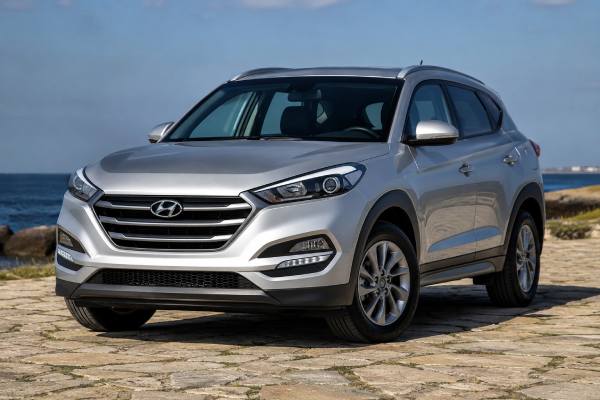
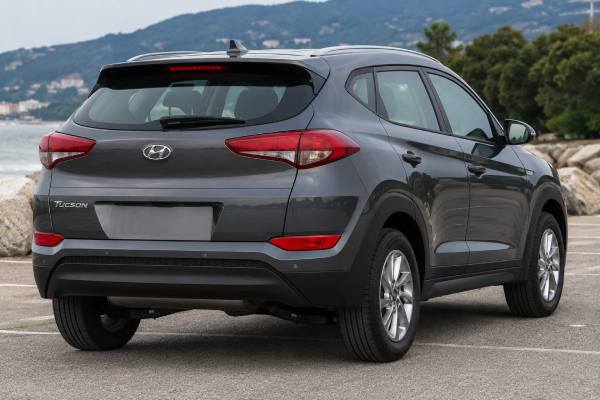
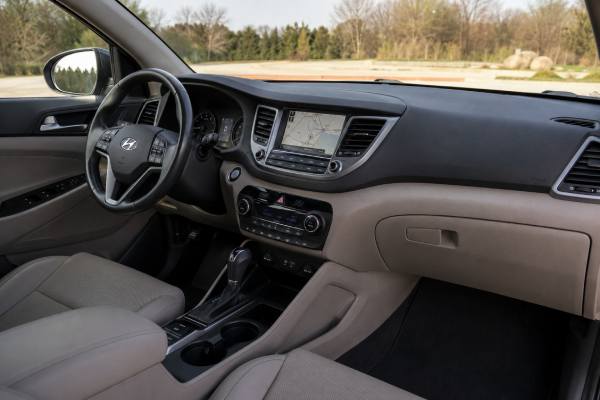
The 2016–2018 Hyundai Tucson AWD with the Nu 2.0 GDI engine is the simpler gasoline version of the TL-generation Tucson. It pairs a naturally aspirated 2.0-liter direct-injection four-cylinder with a conventional 6-speed automatic and active on-demand all-wheel drive. For many used-SUV buyers, that matters more than headline power. This version avoids the 1.6 turbo’s dual-clutch transmission, has useful cabin space, and offers respectable safety scores, but it is not quick and it needs careful oil, recall, and AWD-system checks before purchase.
Final Verdict
The 2016–2018 Hyundai Tucson AWD 2.0 GDI is a good used compact SUV for buyers who want a comfortable, easy-to-drive crossover with winter traction, simple automatic-transmission behavior, and practical cargo space. Its strongest appeal is the combination of a conventional 6-speed automatic, available safety equipment, and manageable running costs. The tradeoff is performance: the 164 hp Nu 2.0 GDI feels modest with AWD, passengers, or hills. Buy one only with clean service records, completed recall work, no oil-consumption symptoms, and proof that the AWD transfer case and rear differential have not been neglected.
| Pros | Cons |
|---|---|
| Conventional 6-speed automatic avoids the 1.6T dual-clutch concerns | 164 hp feels strained with AWD and highway passing |
| Active AWD adds useful snow and wet-road traction | Fuel economy trails many FWD compact SUV rivals |
| 31.0 cu ft cargo area is practical for family use | Direct-injection engine can develop intake-valve carbon deposits |
| Strong IIHS crash-test results for the TL generation | Advanced driver aids were trim-dependent, not universally standard |
| Good parts availability and familiar Hyundai service network | Recall completion and oil-use history need careful verification |
Table of Contents
- Tucson TL AWD 2.0 GDI Overview
- 2016–2018 Tucson 2.0 GDI AWD Specs
- Trims, Safety Ratings and Driver Assistance
- Reliability, Common Issues and Recalls
- Maintenance and Used Buying Guide
- Driving, Performance and Efficiency
- How the Tucson 2.0 AWD Compares
Tucson TL AWD 2.0 GDI Overview
The Tucson TL 2.0 GDI AWD is best understood as the practical, lower-stress version of Hyundai’s 2016–2018 compact SUV. It is not the quickest Tucson of this generation, but it is the version many used buyers prefer because it uses a regular torque-converter automatic instead of the turbo model’s dry dual-clutch gearbox.
The TL-generation Tucson arrived for the 2016 model year with a more polished cabin, a larger cargo area, better crash performance, and a more mature road feel than the previous Tucson. In North America, the 2.0 GDI was the base gasoline engine, usually found in SE trim for 2016–2017 and in SE, SEL, and SEL Plus forms for 2018. All-wheel drive was optional, and this guide focuses on those AWD examples.
The engine is Hyundai’s Nu-family 2.0-liter gasoline direct-injection four-cylinder. It makes 164 hp at 6,200 rpm and 151 lb-ft of torque at 4,000 rpm. That torque peak tells you a lot about how the vehicle drives: it needs revs when loaded, and it does not have the low-rpm shove of the 1.6 turbo. Around town it is smooth enough, but it is more steady than energetic.
The AWD system is not an off-road 4×4 system. It is an active on-demand setup that drives the front wheels most of the time and sends torque rearward when traction or acceleration demands it. It also includes an AWD lock function for low-speed slippery situations. That makes it useful for snow, rain, gravel lanes, and steep driveways, but not for rock crawling or heavy trail work.
For buyers, the key appeal is balance. This Tucson is compact enough to park easily, roomy enough for daily family use, and simple enough that independent shops can service most wear items. The main cautions are typical modern-Hyundai used-car checks: engine oil consumption, recall completion, GDI carbon buildup, AWD fluid service, brake-system recall work, and corrosion in salt-road regions.
2016–2018 Tucson 2.0 GDI AWD Specs
This Tucson uses a naturally aspirated 2.0-liter GDI gasoline engine, a 6-speed automatic transmission, and active on-demand AWD in a five-seat unibody SUV. The most important technical facts are the modest torque output, the conventional automatic, the useful cargo volume, and the official AWD fuel economy of 21 city, 26 highway, and 23 combined mpg US.
| Item | Specification |
|---|---|
| Engine family | Hyundai Nu 2.0 GDI gasoline inline-four |
| Displacement | 1,999 cc / 2.0 L |
| Construction | Aluminum block and aluminum cylinder head |
| Valvetrain | DOHC, 16 valves, dual continuously variable valve timing |
| Fuel system | Gasoline direct injection |
| Induction | Naturally aspirated |
| Bore x stroke | 81 mm x 97 mm |
| Compression ratio | 11.5:1 |
| Power | 164 hp / 122 kW at 6,200 rpm |
| Torque | 205 Nm / 151 lb-ft at 4,000 rpm |
| Fuel type | Regular unleaded gasoline |
| EPA fuel economy, AWD | 11.2 / 9.0 / 10.2 L/100 km city/highway/combined (21 / 26 / 23 mpg US) |
| Item | Specification |
|---|---|
| Transmission | 6-speed automatic with lock-up torque converter |
| Manual shift mode | SHIFTRONIC manual shift control |
| Drive type | Active on-demand all-wheel drive |
| AWD lock | Driver-selectable low-speed lock function |
| Front suspension | MacPherson struts with coil springs and stabilizer bar |
| Rear suspension | Independent multi-link with coil springs and stabilizer bar |
| Steering | Motor-driven rack-and-pinion power steering |
| Brakes | Ventilated front discs, solid rear discs, ABS |
| Common wheel and tire | 17 x 7.0 alloy wheels with 225/60R17 tires |
| Turning circle | 10.6 m / 34.9 ft curb to curb |
| Item | Specification |
|---|---|
| Body style | Five-door compact SUV, five seats |
| Length | 4,475 mm / 176.2 in |
| Width | 1,849 mm / 72.8 in, excluding mirrors |
| Height | 1,646–1,651 mm / 64.8–65.0 in |
| Wheelbase | 2,670 mm / 105.1 in |
| Ground clearance | 163 mm / 6.4 in |
| Curb weight, AWD | About 1,571–1,672 kg / 3,463–3,686 lb, trim dependent |
| Fuel tank | 62.1 L / 16.4 US gal |
| Cargo volume | 878–1,753 L / 31.0–61.9 cu ft |
| Passenger volume | 2,894 L / 102.2 cu ft without panoramic roof |
| Towing capacity | 680 kg / 1,500 lb with trailer brakes |
| Item | Specification or note |
|---|---|
| Engine oil capacity | 4.0 L / 4.23 US qt, drain and refill |
| Engine oil quality | API SM / ILSAC GF-4 or higher; market guidance varies |
| Automatic transmission fluid | 7.3 L / 7.71 US qt total, Hyundai SP-IV type |
| Engine coolant | 7.5 L / 7.93 US qt, phosphate-based ethylene glycol type |
| Brake fluid | DOT 3 or DOT 4 |
| Rear differential oil | 0.53–0.63 L, API GL-5 SAE 75W-90 |
| Transfer case oil | 0.34–0.36 L for Nu 2.0 AWD |
| Wheel nut torque | 107–127 Nm / 79–94 lb-ft |
Trims, Safety Ratings and Driver Assistance
The 2.0 GDI AWD was usually the value-focused Tucson, not the luxury or performance version. Its safety structure was strong for the time, but active safety features depended heavily on year and trim.
For 2016 and 2017, the 2.0 GDI was most closely associated with SE trim. Eco, Sport, and Limited versions generally used the 1.6 turbo and 7-speed EcoShift dual-clutch transmission, so shoppers should not assume every Tucson AWD has the same engine and gearbox. A quick check is simple: the 2.0 GDI has a smoother conventional automatic feel and usually sits in lower trims, while the 1.6T models carry turbo badging or equipment combinations tied to higher trims.
For 2018, Hyundai reshuffled the range. SE, SEL, and SEL Plus used the 2.0 GDI, while Value and Limited used the 1.6 turbo. That makes 2018 SEL and SEL Plus 2.0 AWD models especially attractive if you want the simple 6-speed automatic but more equipment than a basic SE.
Useful trim identifiers include wheel size, infotainment screen, seat trim, and driver-assistance content. SE models commonly have 17-inch alloys, cloth seats, a smaller display, rearview camera, Bluetooth, and basic convenience equipment. SEL adds more comfort and phone integration features. SEL Plus can bring leather seating, larger infotainment, Infinity audio, proximity key, and blind-spot features, depending on market and package.
Safety fundamentals are good. The TL-generation Tucson received strong IIHS crashworthiness results, including Good ratings in the main small-overlap, moderate-overlap, roof-strength, head-restraint, and original side tests. Later updated side-testing standards were tougher, so do not treat older five-star or Top Safety Pick-era results as identical to current crash-test performance.
NHTSA rated the 2016 Tucson highly overall, with five-star results in frontal and side categories and a four-star rollover result. The rating applies to the vehicle’s class and test era, not to every possible equipment combination. Tire condition, crash history, and correct repair work after body damage matter just as much on a used example.
Standard safety equipment includes front airbags, front seat-mounted side airbags, side-curtain airbags, ABS, electronic stability control, traction control, hill-start assist, downhill brake control, a rearview camera, tire-pressure monitoring, front seatbelt pretensioners, and LATCH child-seat anchors. The rear seat is practical for child seats, though the compact-SUV width means three-across child-seat setups can be tight.
Advanced driver assistance is the area to check carefully. Blind-spot detection, lane-change assist, rear cross-traffic alert, and lane keep assist became more available on higher 2018 trims. Automatic Emergency Braking with pedestrian detection was available on top-option configurations rather than standard across the range. After windshield replacement, front camera service, bumper repair, suspension repair, or collision work, ADAS calibration should be verified. A clean dashboard is not enough; confirm functions work during a proper test drive.
Reliability, Common Issues and Recalls
The 2.0 GDI AWD Tucson is generally more appealing than the 1.6T DCT version if you want a low-drama used compact SUV, but it is not trouble-free. The big-ticket checks are engine oil use, ABS/HECU recall completion, door-latch operation, GDI deposits, transmission behavior, and AWD fluid condition.
| Issue | Prevalence | Severity | What to check |
|---|---|---|---|
| ABS/HECU recall work | Important VIN-dependent item | High | VIN recall record and dealer repair proof |
| Oil consumption or engine noise | Occasional, age and care dependent | Medium to high | Oil level, cold start, service history, exhaust smoke |
| GDI carbon buildup | Common with mileage on direct-injection engines | Medium | Rough idle, hesitation, misfires, poor fuel economy |
| Door latch or lock actuator faults | Occasional to common on older examples | Medium | All doors open and lock from inside and outside |
| 6-speed automatic shift harshness | Occasional | Medium | Cold and hot shifts, delayed engagement, ATF leaks |
| AWD driveline wear or seepage | Occasional | Medium | Transfer case, rear differential, binding, tire mismatch |
| Suspension and wheel bearings | Age-mileage wear item | Low to medium | Clunks, humming, uneven tire wear, loose ball joints |
Engine and GDI concerns
The Nu 2.0 GDI uses a timing chain, not a scheduled timing belt. That reduces routine belt-service cost, but it does not mean the chain can be ignored forever. Rattle at cold start, cam/crank correlation fault codes, rough running, or metallic noise should trigger a professional inspection for chain stretch, guide wear, tensioner issues, or oil-pressure problems.
Because this is a direct-injection engine, fuel does not wash over the backs of the intake valves the way it does in a port-injected engine. Over time, oil vapors from the crankcase ventilation system can leave deposits. Symptoms include rough idle, hesitation, misfire codes, and reduced response. Walnut-shell cleaning or equivalent intake-valve cleaning is the usual repair when deposits become severe.
Oil consumption deserves special attention. Check the oil level before starting a used Tucson, then look for blue smoke after idle, oil smell, low-oil warnings, and records showing unusually frequent top-ups. A neglected GDI engine can suffer from low-oil operation long before the owner notices obvious symptoms.
Transmission and AWD
The 6-speed automatic is one of the best reasons to choose this version. It is smoother in traffic than the 1.6T dual-clutch transmission and easier to live with in stop-start urban use. Still, test it cold and hot. It should engage Drive and Reverse promptly, shift without flaring, and downshift without a heavy clunk.
Hyundai may describe the automatic transmission fluid as requiring no normal-service checks, but long-term owners should still treat fluid condition as important. Heat, short trips, and age all degrade ATF. A drain-and-fill with the correct SP-IV fluid is sensible preventive maintenance once the vehicle is out of warranty and past midlife mileage.
The AWD system relies on matched tires and healthy driveline fluids. Avoid cars with mixed tire brands, uneven tread depth, rear-differential whine, transfer-case seepage, or a tight binding sensation during low-speed parking-lot turns. On a lift, inspect the propeller shaft, rear differential mounts, axle boots, and underbody corrosion around brackets and seams.
Recalls and service actions
The major recall item for this generation is the ABS/HECU fire-risk campaign on certain 2016–2021 Tucson TL vehicles. The remedy involves installing a fuse kit into the ABS module circuit and, on some units, updating ABS/ESC software. Because recall applicability is VIN-specific, do not rely on model year alone.
Certain early 2016 Tucson vehicles were also involved in a secondary hood-latch recall. The concern was that the secondary latch might not hold the hood securely if the primary latch had been released. Some 2016 vehicles with the Hyundai accessory trailer-hitch harness were also subject to trailer-light or harness-related campaigns.
Engine monitoring software campaigns can also appear in Hyundai service systems for some Tucson vehicles. The key point for buyers is simple: ask for a printed dealer campaign report or use the official VIN recall checker. A seller saying “there are no lights on” is not proof that recall work is complete.
Maintenance and Used Buying Guide
A good Tucson 2.0 GDI AWD is not hard to maintain, but it rewards shorter oil intervals, clean fluids, matched tires, and documented recall work. The safest used buy is a one- or two-owner vehicle with regular oil changes, no engine-noise complaints, no open safety campaigns, and no evidence of AWD neglect.
| Interval | Service items |
|---|---|
| Every 7,500 miles / 12 months | Engine oil and filter, tire rotation, brake inspection, battery check |
| Every 7,500 miles / 12 months | Inspect air filter, vacuum hoses, steering, suspension, driveshaft boots |
| Every 7,500 miles / 12 months | Replace cabin air filter, especially in dusty or humid climates |
| Every 15,000 miles / 24 months | Inspect brake fluid, parking brake, fuel tank cap and vapor hoses |
| Every 22,500 miles / 36 months | Replace engine air filter in normal use; sooner in dusty areas |
| Every 30,000 miles / 48 months | Inspect fuel lines, rear differential oil and transfer case oil |
| 60,000 miles / 72 months, then regularly | Inspect drive belt, coolant hoses, mounts and accessory pulleys |
| 97,500 miles | Replace spark plugs; inspect coils if misfire history exists |
| 120,000 miles / 120 months | Replace engine coolant, then repeat every 30,000 miles / 24 months |
| As symptoms require | Inspect timing chain system for rattle, correlation faults or guide wear |
For severe use, shorten the oil interval. Severe use includes frequent short trips, hot-weather traffic, dusty roads, repeated cold starts, mountain driving, towing, rideshare use, and long idling. On a GDI engine, conservative oil changes are cheap insurance.
The fuel filter is generally treated as part of the in-tank fuel pump module rather than a routine external filter. Still, poor starting, low fuel pressure, or lean-running codes should be diagnosed properly instead of solved by random parts replacement.
Brake fluid should be tested for moisture and changed periodically even if the pads still have life. AWD Tucsons driven in winter climates also need brake slide pins cleaned and lubricated during pad service. Rear rotors can rust heavily if the vehicle sits or does mostly light braking.
The 12 V battery usually becomes suspect around four to six years, sooner in extreme heat or cold. Low battery voltage can create confusing warning lights, no-start complaints, and intermittent electronic faults. Test it before winter and before blaming sensors.
Buyer inspection checklist
Before buying, do more than a short test drive around the block. A proper inspection should include:
- Cold start after the vehicle has sat for several hours.
- Oil level and oil condition before the seller warms the engine.
- Scan for stored, pending, and history codes, not only active warning lights.
- VIN recall check for ABS/HECU, hood latch, trailer harness, and software campaigns.
- Door lock and latch test on all doors from inside and outside.
- Transmission engagement test from Park to Reverse and Drive.
- AWD check for tire matching, binding, driveline leaks, and rear differential noise.
- Underbody inspection for rust around subframes, brake lines, exhaust, suspension arms, and rear mounting points.
- Brake inspection for rotor corrosion, caliper sticking, uneven pad wear, and ABS lights.
- HVAC, infotainment, camera, blind-spot, lane-assist, and keyless-entry function test where fitted.
The best years and trims depend on your priorities. A 2018 SEL or SEL Plus AWD with the 2.0 GDI is often the sweet spot because it can combine the simpler 6-speed automatic with better equipment than early SE models. A basic 2016 SE AWD can still be a good buy if priced correctly and maintained well, but recall proof is especially important.
Avoid any Tucson with unexplained engine noise, repeated low-oil history, unresolved ABS recall status, mismatched tires on AWD, salvage-title crash repairs, or heavy rust. These are not rare collectible vehicles; it is better to wait for a cleaner example than to rescue a neglected one.
Long-term durability is reasonable when the vehicle is maintained and inspected early. The body and cabin age fairly well, parts availability is good, and independent shops know the platform. The weak point is not routine service cost; it is buying a car with hidden engine, electronic, or recall-related history.
Driving, Performance and Efficiency
The Tucson 2.0 GDI AWD drives like a comfortable compact crossover, not a sporty one. It is stable, easy to place, and secure in bad weather, but the engine’s modest torque means passing and hill climbs need planning.
Around town, throttle response is predictable and the 6-speed automatic shifts smoothly when healthy. The torque converter makes parking, creeping in traffic, and pulling away on hills easier than in the 1.6T DCT version. That alone can make the 2.0 AWD the better daily driver for people who spend a lot of time in traffic.
Acceleration is adequate rather than strong. Expect roughly 10–11 seconds from 0–100 km/h depending on tires, temperature, load, and test method. The Tucson can merge onto highways safely, but it often needs a deep throttle input and a downshift. With four adults, luggage, or a roof box, the engine works noticeably harder.
Steering is light and easy, with enough accuracy for normal driving but limited feel. Ride quality is generally composed on 17-inch wheels and 225/60R17 tires. That tire size is a good match for rough pavement because it has more sidewall than the 19-inch setup used on some turbo trims. Road and wind noise are acceptable for the class, though coarse pavement and worn tires can make the cabin louder.
The AWD system is useful in rain and snow. It does not make the Tucson unstoppable, but it reduces front-wheel spin and gives the vehicle a more settled feel when accelerating from slippery junctions. The AWD lock function can help at low speeds, such as pulling through deep snow or climbing a slick driveway. It should not be treated as a substitute for winter tires.
Braking feel is straightforward, and the four-wheel disc setup is easy to service. On older vehicles, braking performance depends heavily on rotor condition, caliper slide health, tire quality, and ABS recall completion. A pulsing pedal, pulling, grinding, or rusty rear rotors should be priced into the purchase.
Real-world fuel economy is the price paid for AWD and modest engine output. In city use, many owners should expect about 11.0–12.5 L/100 km, or 19–21 mpg US. Highway driving at 100–120 km/h can return about 8.5–9.5 L/100 km, or 25–28 mpg US, if the vehicle is healthy and not heavily loaded. Mixed driving commonly lands around 9.8–11.0 L/100 km, or 21–24 mpg US. Winter fuel, cold starts, snow tires, and short trips can worsen consumption by 10–20 percent.
Towing is limited. The rated maximum with trailer brakes is 1,500 lb, so this Tucson is suitable for a small utility trailer, light camping trailer, or bike-hauling setup, not heavy towing. On grades, use moderate speeds, keep the cooling system in good condition, and avoid loading the vehicle near every limit at once.
How the Tucson 2.0 AWD Compares
The Tucson 2.0 GDI AWD competes best on comfort, safety value, and automatic-transmission simplicity. It is less convincing if your priorities are power, fuel economy, maximum cargo room, or sharp handling.
Against the Honda CR-V, the Tucson often costs less on the used market and may offer more features for the money. The CR-V has a stronger reputation for resale value and interior packaging, but equivalent AWD examples can be more expensive. Buyers choosing between them should compare maintenance records rather than badges alone.
Against the Toyota RAV4, the Tucson feels more refined inside in some trims and may be cheaper to buy. The RAV4 usually wins for long-term resale confidence and broad owner familiarity. The Tucson can be a better value if it is significantly cheaper and has complete recall and service documentation.
Against the Mazda CX-5, the Hyundai is more relaxed and less sporty. The Mazda has sharper steering and often feels more premium from the driver’s seat, but it may ride more firmly and command higher prices in clean AWD form. Choose the Tucson if comfort and value matter more than handling.
Against the Ford Escape, the Tucson’s 2.0 and 6-speed combination feels simpler than many turbocharged Escape powertrains. The Escape can offer stronger performance, but used examples vary widely in maintenance quality. The Hyundai’s key advantage is predictable daily behavior rather than speed.
Against the Kia Sportage of the same era, the comparison is close because the vehicles share platform DNA. The Sportage may have different styling, trim packaging, and pricing, while the Tucson often feels slightly more conservative. In practice, condition and service history should decide the winner.
The Tucson 2.0 AWD is at its best for buyers who want a straightforward compact SUV for commuting, winter use, errands, and small-family duty. It is not the most exciting choice, but a well-kept example with completed recalls can be a smart value.
References
- 2018 TUCSON Specifications 2018 (Manufacturer Specifications)
- Gas Mileage of 2016 Hyundai Tucson 2016 (EPA Fuel Economy)
- 2016 Hyundai Tucson 2016 (Safety Rating)
- HMA TSB 2021 (Recall Service Procedure)
- Hyundai – Recalls 2026 (Recall Database)
Disclaimer
This article is for informational purposes only and is not a substitute for professional diagnosis, repair, inspection, or official service information. Specifications, torque values, maintenance intervals, recall eligibility, fluids, parts, and procedures can vary by VIN, market, trim, production date, and equipment. Always verify details against the official service documentation for the exact vehicle and consult a qualified technician when needed.
If this guide helped you, please consider sharing it on Facebook, X/Twitter, or with another used-car shopper to support our work.