
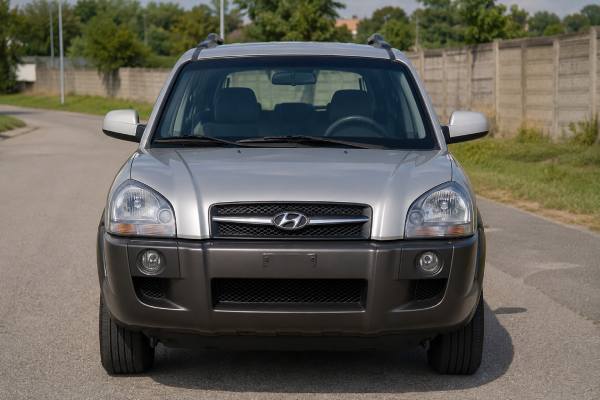
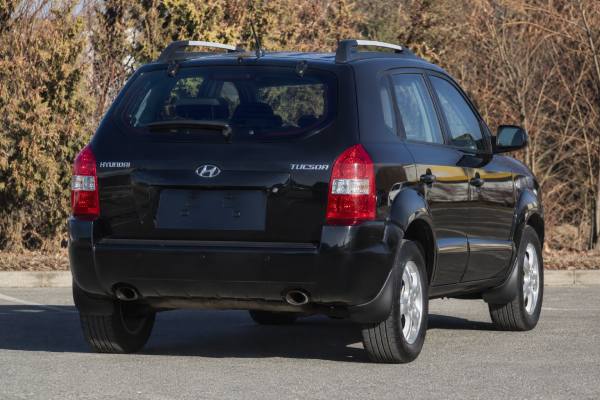
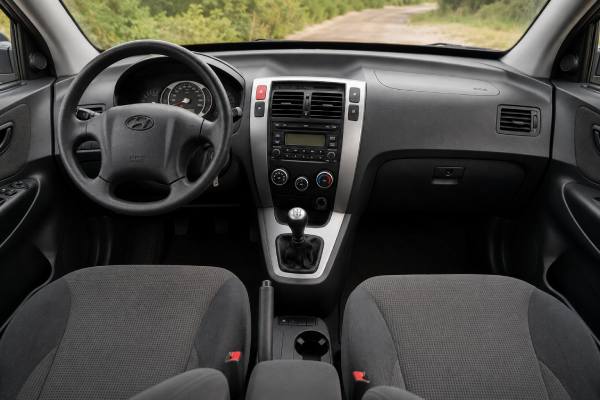
The 2008–2009 Hyundai Tucson 4WD with the 2.0 CRDi VGT diesel is a practical first-generation JM compact SUV aimed at buyers who want simple mechanicals, usable torque, and winter-road traction without the size or cost of a larger 4×4. In late 150 hp form, it sits near the top of the diesel Tucson range and is most appealing as a used family SUV, rural commuter, or light-duty tow vehicle.
It is not a modern crossover in refinement, safety technology, or cabin finish. Its strength is old-school usability: a torquey common-rail diesel, straightforward suspension, a roomy square body, and a selectable 4WD lock function for low-speed slippery conditions. The main buying challenge is age. A good Tucson CRDi can still make sense, but only if corrosion, timing-belt history, diesel-system health, and 4WD driveline condition check out.
Final Verdict
The 2008–2009 Hyundai Tucson JM 4WD 2.0 CRDi VGT 150 hp is a sensible buy for drivers who value torque, traction, simple controls, and low used prices more than modern refinement. It suits rural roads, winter commuting, dog-and-family use, and occasional towing better than sharp urban driving. Its biggest tradeoff is age-related maintenance: timing-belt proof, rust inspection, clutch and 4WD checks, injector health, and clean diesel intake systems matter more than mileage alone. Buy one only with clear service records, a dry engine bay, smooth cold starting, and evidence that fluids and belts were not neglected.
| Pros | Cons |
|---|---|
| Strong low-rpm diesel torque suits hills, loads, and rural driving | Cabin noise and vibration feel dated beside newer crossovers |
| On-demand 4WD adds useful grip in snow, mud, and wet fields | Not a true low-range off-roader for heavy trail use |
| Square body gives good visibility and practical cargo access | Boot is useful but smaller than many newer compact SUVs |
| D4EA-family diesel can last well with timely belt and oil service | Neglected examples risk turbo, EGR, injector, and clutch bills |
| Parts availability remains decent through Hyundai/Kia sharing | Rust, worn suspension, and seized brake parts are now common checks |
| Simple controls and limited electronics keep ownership straightforward | Safety tech is basic by current family-SUV standards |
Table of Contents
- 2008–2009 Tucson CRDi Overview
- Tucson JM 2.0 CRDi Specifications
- Trims, Options, and Safety
- Reliability, Common Issues, and Recalls
- Maintenance and Buying Guide
- Driving, Performance, and Economy
- Tucson CRDi Compared With Rivals
2008–2009 Tucson CRDi Overview
The late Hyundai Tucson JM 2.0 CRDi VGT 4WD is best understood as a durable, compact diesel SUV rather than a polished premium crossover. It offers useful torque, good visibility, a straightforward cabin, and enough all-weather grip for normal roads, tracks, snow, and wet grass.
The JM Tucson was Hyundai’s first-generation Tucson, sold before the ix35/Tucson replacement arrived. By 2008–2009, the design was no longer new, but the diesel 4WD versions had become attractive used buys because they combined compact dimensions with a relatively tough drivetrain. The 150 hp version is a late-market tune of Hyundai/Kia’s 2.0 CRDi VGT diesel family. Some catalogues group it closely with the 140 PS D4EA VGT version, so buyers should always confirm power output from registration data, VIN, engine label, and market documentation.
This model is a five-door, five-seat SUV with a transverse front-mounted diesel engine and an on-demand 4WD system. In normal road use, it behaves mostly like a front-drive SUV. When the front wheels slip, the system can send torque to the rear axle. Many versions also have a 4WD lock button for low-speed slippery conditions, although this is not a substitute for a low-range transfer case.
Its strongest appeal is honest usefulness. The seating position is high, the body is compact enough for town use, the tailgate opening is practical, and the diesel engine has enough mid-range pull for loaded driving. It works well for owners who want a reliable daily vehicle and are willing to maintain an older diesel properly.
The limitations are equally clear. The Tucson JM feels dated at motorway speed, the steering is not especially sharp, the automatic safety technology is minimal, and many surviving cars now need age-related work. Rust, worn suspension bushes, seized brake hardware, tired engine mounts, old coolant hoses, and neglected timing belts can turn a cheap purchase into an expensive one.
For buyers comparing it with a Toyota RAV4, Honda CR-V, Nissan X-Trail, Suzuki Grand Vitara, Kia Sportage, or early Volkswagen Tiguan, the Tucson’s value lies in simplicity and price. It is usually cheaper than the Toyota and Honda, softer and less off-road-focused than the Grand Vitara, and less refined than the Tiguan. A clean, well-serviced 4WD CRDi is worth paying more for than a cheaper car with patchy maintenance.
Tucson JM 2.0 CRDi Specifications
This version uses a 1,991 cc four-cylinder common-rail turbo diesel with variable-geometry turbocharging, paired with manual transmission and on-demand 4WD. The figures below focus on the late 150 hp diesel 4WD version, while noting where real-world listings and market documents may overlap with the closely related 140 PS CRDi VGT model.
| Item | Hyundai Tucson JM 2.0 CRDi VGT 4WD |
|---|---|
| Engine family | D4EA-family 2.0 CRDi VGT diesel |
| Fuel type | Diesel |
| Layout | Inline-four, transverse front engine |
| Displacement | 1,991 cc / 2.0 litres |
| Induction | Variable-geometry turbocharger with intercooler |
| Fuel system | Common-rail direct injection |
| Power | 110 kW / 150 hp / 150 PS, market dependent |
| Torque | 305 Nm (225 lb-ft) |
| Timing drive | Timing belt |
| Official combined fuel use | About 7.1 L/100 km (33 mpg US / 40 mpg UK) |
| CO₂ emissions | About 187 g/km |
| Emissions class | Euro 4 in many European-market examples |
| Item | Specification or practical note |
|---|---|
| Transmission | Manual gearbox, commonly six-speed on VGT 4WD listings |
| Drive type | On-demand 4WD / AWD |
| 4WD function | Automatic rear torque transfer with low-speed lock mode |
| Low range | Not fitted |
| Rear driveline | Propshaft, rear differential, and coupling unit |
| Item | Specification |
|---|---|
| Body style | Five-door compact SUV |
| Seats | Five |
| Length | 4,325 mm (170.3 in) |
| Width | 1,795 mm body width; some catalogues list 1,830 mm |
| Height | About 1,720–1,730 mm, depending on market and roof rails |
| Wheelbase | 2,630 mm (103.5 in) |
| Ground clearance | About 195 mm (7.7 in) |
| Curb weight | About 1,610–1,660 kg by trim and equipment |
| Gross vehicle weight | About 2,260 kg |
| Fuel tank | 58 litres (15.3 US gal) |
| Boot volume | About 325 litres seats up; about 1,375 litres folded |
| Braked towing capacity | Up to about 1,600 kg when correctly equipped |
| Item | Specification or useful reference |
|---|---|
| 0–100 km/h | About 12.0 seconds |
| Top speed | About 177 km/h (110 mph) |
| Common tyre size | 235/60 R16 on many higher-spec 4WD cars |
| Front suspension | MacPherson struts, coil springs, anti-roll bar |
| Rear suspension | Multi-link, coil springs, anti-roll bar |
| Front brakes | Ventilated discs |
| Rear brakes | Discs |
| Engine oil service fill | About 5.9 litres; total capacity about 6.5 litres |
| Common oil viscosity | 5W-30 or 5W-40 diesel-rated oil |
| Wheel-nut torque | About 90–110 Nm on many JM-era Hyundai references |
A note on power output is important. The earlier 2.0 CRDi VGT 4WD is widely listed at 103 kW / 140 PS, while late 2008–2009 examples in some markets are listed at 110 kW / 150 PS. Mechanically they are close enough that parts catalogues, used adverts, and insurance databases may blur the distinction. For maintenance and buying, condition matters more than the headline horsepower figure.
Trims, Options, and Safety
The 150 hp diesel 4WD Tucson was usually sold in better-equipped trims, often with alloy wheels, climate control, upgraded audio, and more complete airbag equipment. Safety is acceptable for its age, but it is far behind modern SUVs for crash-avoidance systems.
Trims, equipment, and identifiers
Trim names changed by market. In European and UK-style listings, late diesel 4WD examples often appear as Style, Premium, Limited, CDX, or equivalent high-grade trims. Lower trims could be front-wheel drive, use smaller wheels, or have less safety equipment, while 4WD diesel versions were commonly better specified.
Useful identifiers when inspecting a car include:
- CRDi or CRDi VGT badging on the tailgate.
- 4WD badging and a rear differential visible underneath.
- A propshaft running to the rear axle.
- A 4WD lock switch on the dashboard or centre area.
- Six-speed shift pattern on many VGT 4WD manual versions.
- Higher trim clues such as roof rails, alloy wheels, leather or part-leather trim, heated seats, cruise control, and climate control.
Do not rely on badges alone. Tailgate badges are easy to remove or replace. Confirm the engine, drivetrain, and transmission through the VIN plate, registration data, service invoices, and a physical underbody inspection.
Safety ratings and crash performance
The first-generation Tucson received period-appropriate but not outstanding safety results. In Euro NCAP testing of the 2006 European-market model, it scored four stars for adult occupant protection, three stars for child occupant protection, and one star for pedestrian protection. That rating belongs to an older test protocol and should not be compared directly with current Euro NCAP star ratings.
IIHS testing in the United States rated the 2005–2009 Tucson as Acceptable in the original moderate-overlap front test and Acceptable in the original side test when equipped with the relevant side airbags. Roof strength and head-restraint performance were weaker by later standards. ANCAP also recorded a four-star rating for the related model and noted that specification could vary by market.
In simple terms, the Tucson JM was competitive enough for a mid-2000s compact SUV, but it lacks the crash-avoidance layer expected today. A modern Tucson, RAV4, CR-V, Sportage, or Qashqai will generally offer stronger occupant protection structures, better whiplash protection, and far more active safety equipment.
Airbags, brakes, and driver assistance
Equipment varies, but higher-spec late Tucson models commonly include dual front airbags, front side airbags, curtain airbags, ABS, electronic brake-force distribution, traction control, and electronic stability control. Some base-market versions may have fewer airbags, so physically check the seat, pillar, and dashboard markings.
ISOFIX child-seat anchor points are typically fitted on the outer rear seats, with a three-point belt for the centre rear position. For a family buyer, check that the rear belts retract cleanly, the buckle stalks are not damaged, and the ISOFIX covers and anchor points have not been abused.
There is no modern ADAS in the current sense. Do not expect autonomous emergency braking, adaptive cruise control, lane centring, blind-spot monitoring, traffic-sign recognition, or camera-based driver assistance. Parking sensors may be fitted on some cars, but they are simple convenience aids rather than safety systems needing calibration.
Reliability, Common Issues, and Recalls
A well-maintained Tucson CRDi can be durable, but most problems now come from age, missed servicing, corrosion, and diesel short-trip use. The highest-risk areas are timing-belt history, turbo and EGR condition, clutch wear, driveline fluids, brake corrosion, and underbody rust.
| Issue area | How common | Cost risk | Typical signs |
|---|---|---|---|
| Timing belt overdue | Common on neglected cars | High | No invoice, belt noise, coolant leak near belt service parts |
| EGR and intake deposits | Common with short trips | Medium | Smoke, hesitation, limp mode, rough idle |
| Turbo actuator or boost leaks | Occasional | Medium to high | Low power, whistle, overboost or underboost faults |
| Injector or glow-plug issues | Occasional | Medium | Hard cold start, diesel knock, uneven idle |
| Dual-mass flywheel and clutch wear | Common at higher mileage | High | Rattle, vibration, slipping, heavy pedal |
| Rear differential or coupling neglect | Occasional | Medium to high | Binding, whining, clunks, delayed 4WD action |
| Suspension bushes and drop links | Common | Low to medium | Knocks, vague steering, uneven tyre wear |
| Brake corrosion and sticking calipers | Common with age | Medium | Hot wheel, dragging, pulsing, rusty rear discs |
| Body and underbody corrosion | Market dependent | Medium to high | Rusty subframes, sills, brake pipes, rear arches |
Engine and diesel-system issues
The D4EA-family CRDi engine is generally robust when serviced on time. Its cast-iron diesel character suits high mileage, but it does not tolerate old oil, dirty fuel, overheating, or ignored timing-belt intervals.
The timing belt is the main non-negotiable item. If there is no recent invoice showing the belt, tensioner, idlers, and preferably water pump were replaced, budget for the work immediately. A broken belt can cause major engine damage.
EGR valve contamination is common on older diesels used for town driving. Symptoms include hesitation, smoke, poor throttle response, and fault codes. Cleaning may help if wear is light, but a sticking or failed EGR valve should be replaced. Intake hoses and intercooler pipework should also be checked for splits, oil mist, and loose clamps.
Turbo problems are less universal than internet searches suggest, but they do happen. Look for smooth boost delivery, no heavy smoke under load, and no siren-like turbo noise. Variable-geometry mechanisms can stick if the car has spent years on short low-load trips. Boost-control hoses and sensors should be checked before condemning the turbo itself.
Fuel injectors and glow plugs are age-sensitive. A good engine should start cleanly from cold, settle quickly, and pull without heavy smoke. A lumpy cold idle, diesel knock, or strong exhaust smell can point to injector imbalance, compression issues, glow-plug failure, or air leaks in the fuel system.
Transmission, clutch, and 4WD system
The manual gearbox should shift cleanly when cold and hot. A vague change can be caused by linkage wear or old oil, while crunching into gears may indicate synchromesh wear. Clutch bite should be progressive, not at the very top of pedal travel.
The dual-mass flywheel deserves attention on any higher-mileage diesel manual. Listen for rattling at idle with the clutch released, vibration through the pedal, and knocking when shutting the engine off. A clutch and flywheel job can cost more than the price difference between a poor car and a good one.
For 4WD checks, test the car in a tight slow circle on full lock. It should not hop, bind, or thump. On a lift, inspect the propshaft, rear differential casing, coupling, mounts, and axle seals. A car that has never had driveline fluids changed may still drive, but old oil increases wear risk in the transfer and rear differential.
Chassis, brakes, and corrosion
Suspension wear is predictable at this age. Front drop links, control-arm bushes, ball joints, rear trailing-arm bushes, and dampers are all normal wear points. None is surprising, but a car needing all of them at once is no longer a cheap buy.
Brake corrosion is common on cars that sit outside or do low annual mileage. Rear discs often rust on the inner face, caliper sliders seize, and brake pipes can corrode in salt-heavy climates. During a test drive, check that the car rolls freely, brakes straight, and does not smell hot after normal driving.
Rust inspection should include sills, rear wheel arches, subframes, suspension mounting points, fuel tank straps, brake lines, rear differential mounts, the tailgate lower edge, and the underside around jacking points. A tidy body can hide expensive corrosion underneath.
Recalls and service actions
The best-known safety recall affecting many late-2000s Hyundai vehicles is the stop-lamp switch campaign. In affected vehicles, the brake-light switch could malfunction, causing brake lights not to illuminate, brake lights to stay on, cruise-control problems, gear-selector interlock issues, or stability-control warning lights. Hyundai’s remedy was switch replacement.
Because recall coverage differs by country and VIN, do not assume a car is clear because the model year matches. Check the VIN through the official Hyundai recall portal for the car’s market, and ask for dealer records showing completed campaigns.
There are no hybrid battery, high-voltage, onboard-charger, DC–DC converter, or regenerative-brake concerns on this diesel Tucson. Likewise, there is no modern ADAS camera or radar calibration issue after windscreen, bumper, or suspension repairs. The electronic systems are simpler, but old sensors, wiring plugs, ABS wheel-speed sensors, and earth points can still cause warning lights.
Maintenance and Buying Guide
The safest ownership strategy is to treat the Tucson CRDi as an older diesel that rewards preventative maintenance. Oil, filters, timing belt, coolant, brake fluid, and driveline oils matter more than cosmetic upgrades.
| Service item | Recommended interval for used-car ownership |
|---|---|
| Engine oil and oil filter | Every 15,000 km or 12 months; sooner for short trips |
| Engine air filter | Every 15,000–30,000 km; sooner in dusty use |
| Cabin pollen filter | Every 12 months |
| Fuel filter | Every 30,000 km, or sooner if fuel quality is poor |
| Timing belt kit | Follow market schedule; replace immediately if history is unclear |
| Coolant | About every 90,000 km or 5 years |
| Brake fluid | Every 2 years |
| Manual gearbox oil | Inspect for leaks; refresh around 60,000–100,000 km on older cars |
| Transfer and rear differential oil | Refresh around 60,000 km under severe or 4WD-heavy use |
| Auxiliary belts and hoses | Inspect yearly; replace cracked, swollen, or noisy parts |
| Brake pads, discs, sliders | Inspect at every service; clean and lubricate sliders as needed |
| Tyre rotation and alignment | Rotate every 10,000–15,000 km; align after suspension work |
| 12 V battery | Test yearly after 4 years of age |
Use a diesel-rated 5W-30 or 5W-40 engine oil that matches the car’s market requirements, especially if a diesel particulate filter is fitted. Many service references list about 5.9 litres for a normal oil change and about 6.5 litres total capacity. Manual gearbox oil, transfer oil, and rear differential oil must match the correct API grade and viscosity for the component; do not guess from a generic parts shelf.
Pre-purchase inspection checklist
Before buying, ask for a cold start. The engine should fire without extended cranking, idle evenly, and avoid heavy blue, white, or black smoke. A small puff from an older diesel is not unusual; persistent smoke is a warning.
Check these items carefully:
- Timing-belt invoice with date, mileage, tensioner, idlers, and water pump.
- Oil-change history with sensible intervals.
- Fuel-filter replacement history.
- Coolant condition and signs of leaks around radiator, hoses, thermostat, and water pump.
- Turbo boost smoothness and absence of limp mode.
- EGR/intake symptoms such as hesitation, smoke, or rough idle.
- Clutch bite point, flywheel noise, and gearbox synchro feel.
- 4WD operation, propshaft condition, rear differential leaks, and coupling noise.
- Brake pipe corrosion, rear disc condition, caliper sliders, and ABS lights.
- Suspension knocks, uneven tyre wear, and steering play.
- Rust on subframes, sills, rear arches, jacking points, and underbody seams.
- Interior water leaks, tailgate struts, window regulators, central locking, and air conditioning.
A good Tucson should feel mechanically calm. A tired one often reveals itself through multiple small faults: warning lights, dragging brakes, vague steering, clonks, smoke, poor boost, and missing service paperwork. One minor issue is normal on an older SUV; a cluster of issues usually means the cheapest car will be the most expensive.
Which examples to seek or avoid
The best buy is a late 4WD diesel with complete maintenance history, clean underside, recent belt kit, healthy clutch, matching tyres, and no drivetrain noises. Higher trim is worth having if the electrics work, but mechanical condition should outrank leather seats or upgraded audio.
Avoid cars with unexplained coolant loss, no timing-belt proof, heavy crankcase breathing, major oil leaks, grinding gears, 4WD binding, structural rust, or dashboard warning lights. Be cautious with vehicles used for heavy towing unless maintenance records show frequent fluid changes and clutch work.
Long-term durability is good when the basics are respected. The engine can cover high mileage, but the vehicle is now old enough that rubber, seals, mounts, suspension, brakes, and corrosion decide whether it remains economical to own.
Driving, Performance, and Economy
The Tucson CRDi 4WD drives like a traditional compact SUV: torquey and stable, but not sporty or especially refined. Its best performance comes in the mid-range, where the diesel’s 305 Nm torque makes normal overtaking and hill work easier than the horsepower figure suggests.
Around town, the engine feels strong once the turbo is awake. There can be some low-rpm lag if you ask for acceleration too early in a high gear, but it pulls well from the mid-range. The manual gearbox suits the diesel because it lets the driver keep the engine in its useful torque band. A healthy clutch should make it easy to move away smoothly without shudder.
At motorway speed, the Tucson is steady rather than quiet. Wind noise around the upright body, tyre noise from chunky SUV tyres, and diesel hum are all more noticeable than in newer crossovers. The ride is generally comfortable on rough roads, although worn bushes, old dampers, or mismatched tyres can make it feel loose.
Handling is safe and predictable. The steering is not especially communicative, and the high body leans if pushed through corners, but that is not what this car is for. It works best at relaxed pace on mixed roads, where the suspension absorbs poor surfaces and the engine does not need hard revs.
Braking feel should be firm and straight. A soft pedal, pulsing, dragging, or pulling to one side usually points to brake wear, air in the system, corroded discs, seized sliders, or old brake fluid.
Real-world fuel economy depends heavily on trip type and condition. Sensible expectations are:
- City driving: about 8.5–10.5 L/100 km (22–28 mpg US / 27–33 mpg UK).
- Open-road cruising: about 6.3–7.5 L/100 km (31–37 mpg US / 38–45 mpg UK).
- Mixed use: about 7.3–8.5 L/100 km (28–32 mpg US / 33–39 mpg UK).
Cold weather, roof bars, underinflated tyres, sticky brakes, old injectors, a dirty air filter, and short trips can all push consumption higher. Towing or carrying a full load can increase fuel use sharply, especially on hills, but the diesel torque makes moderate trailers feel manageable when brakes, tyres, cooling system, and clutch are in good condition.
The 4WD system is useful rather than rugged. In rain, snow, gravel, or muddy parking areas, it gives more confidence than a 2WD Tucson. The lock mode can help at low speed, but the car lacks low-range gearing, serious underbody protection, and the axle articulation of a dedicated off-roader. Tyres make a huge difference: a good all-season or winter tyre set transforms traction more than any badge on the tailgate.
Tucson CRDi Compared With Rivals
The Hyundai Tucson CRDi 4WD is best against rivals when price, simplicity, and diesel torque matter most. It loses ground when refinement, modern safety technology, cabin quality, and long-term rust resistance are priorities.
| Rival | How it compares with Tucson CRDi 4WD |
|---|---|
| Kia Sportage II 2.0 CRDi 4WD | Very similar platform and running gear; choose by condition and history |
| Toyota RAV4 diesel | Usually stronger resale and refinement, often more expensive to buy |
| Honda CR-V diesel | Roomier and more polished, but clean examples command higher prices |
| Nissan X-Trail dCi | More practical and outdoorsy, with its own diesel and rust concerns |
| Suzuki Grand Vitara diesel | Better off-road layout, less car-like and often less refined |
| Volkswagen Tiguan 2.0 TDI 4Motion | More refined and modern, but typically costlier and more complex |
| Hyundai ix35 2.0 CRDi 4WD | Newer and more refined, but usually higher priced than the JM Tucson |
Against the Kia Sportage of the same era, the Tucson is almost a condition-based choice. They share much of the same engineering, so buy the cleaner one with the better service history.
Against the RAV4 and CR-V, the Hyundai often wins on purchase price but loses on perceived quality and refinement. Toyota and Honda models can be more expensive, but they may also be easier to resell and feel more polished inside.
The Nissan X-Trail is a strong alternative for buyers who need a squarer, more load-friendly vehicle. It can feel more practical, but diesel condition and underbody rust still matter. The Suzuki Grand Vitara is better for buyers who genuinely need more off-road ability, while the Tucson is better for mostly-road use.
Compared with a Tiguan, the Tucson feels older and simpler. That simplicity can be a benefit for budget ownership, but the Volkswagen is quieter, more modern, and more composed when well maintained.
The best reason to choose this Tucson is not that it beats every rival on paper. It is that a clean, well-maintained example can deliver useful diesel SUV capability for modest money. The worst reason to buy one is simply because it is cheap. At this age, the right car is the one with proof, not promises.
References
- Hyundai Owners manuals | Hyundai Motor UK 2026 (Owner’s Manuals)
- Hyundai Tucson 2.0 CRDi Premium specifications 2026 (Specifications)
- 2006 Hyundai Tucson 2026 (Safety Rating)
- Hyundai Tucson | Safety Rating & Report | ANCAP 2026 (Safety Rating)
- Stop Lamp Switch Recall Campaign 2026 (Recall Campaign)
Disclaimer
This article is for informational purposes only and is not a substitute for professional diagnosis, inspection, or repair. Specifications, torque values, maintenance intervals, fluids, procedures, safety equipment, and recall applicability can vary by VIN, country, trim, production date, and previous repairs. Always verify critical information against the vehicle’s official service documentation and a qualified Hyundai technician before buying, servicing, towing with, or repairing the vehicle.
If this guide helped you, please consider sharing it on Facebook, X/Twitter, or your preferred social platform to support our work.