

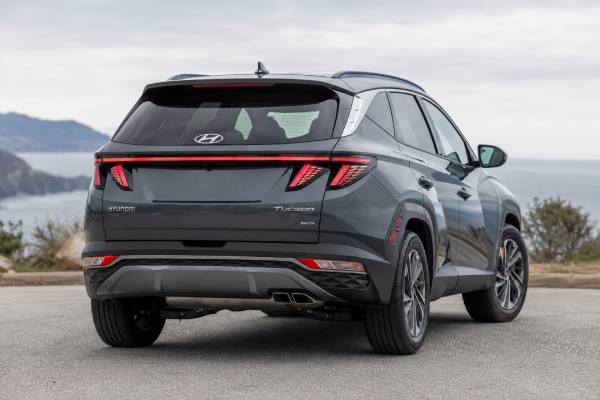

The fourth-generation Hyundai Tucson Hybrid with HTRAC AWD is one of the more rounded family SUVs from the early 2020s. It combines a turbocharged 1.6-litre petrol engine, a compact hybrid battery, a conventional 6-speed automatic gearbox, and an all-wheel-drive system that gives it better bad-weather traction than the front-wheel-drive hybrid versions.
For buyers, the appeal is simple: strong everyday performance, useful electric assistance in town, a roomy cabin, good safety equipment, and lower fuel use than a normal petrol SUV of similar size. The tradeoff is that the NX4 Tucson Hybrid is more complex than the non-hybrid petrol model, so used examples need proper service history, software updates, recall checks, and careful inspection of the hybrid, AWD, cooling, braking, and electronic systems.
Final Verdict
The 2021–2024 Hyundai Tucson HTRAC AWD Hybrid is a strong choice for drivers who want a practical family SUV with good equipment, smooth urban manners, confident winter traction, and noticeably better economy than a conventional petrol crossover. Its best quality is balance: it feels quick enough, spacious enough, and refined enough for daily family use without becoming expensive-performance-car territory. The main ownership tradeoff is complexity, because the turbo engine, hybrid system, 6-speed automatic, and AWD hardware all need correct maintenance. Buy one only with clean service records, completed recalls, healthy tyres, no warning lights, and ideally a dealer diagnostic scan of the hybrid and AWD systems.
| Pros | Cons |
|---|---|
| 230 PS hybrid system gives strong real-world response | Not as fuel-efficient on fast highways as in city use |
| HTRAC AWD improves traction in rain, snow, and gravel | AWD adds weight, fluids, tyres, and inspection points |
| 6-speed automatic feels more natural than many hybrid CVTs | Low-speed shifts can feel busy when the battery is low |
| Roomy rear seat and large boot suit family use | Hybrid parts make accident history especially important |
| Strong Euro NCAP and IIHS safety performance | ADAS repairs may require calibration after glass or body work |
Table of Contents
- NX4 Tucson HTRAC Hybrid overview
- Smartstream hybrid specifications and data
- Trims, safety ratings and driver assistance
- Reliability issues, recalls and service actions
- Maintenance schedule and used buying guide
- Driving, performance and real-world economy
- How the Tucson Hybrid compares to rivals
NX4 Tucson HTRAC Hybrid overview
The NX4 Tucson Hybrid is best understood as a comfort-focused family SUV with a useful performance boost from electrification, not as a dedicated off-roader or a plug-in vehicle. The HTRAC AWD version is the one to choose if you value all-weather grip more than the lowest possible fuel consumption.
This generation arrived with a much sharper design than the previous Tucson. The “parametric” grille, hidden daytime running lights, angular body surfacing, and wide cabin layout made it feel more modern than many compact SUVs of the same period. Underneath the styling, though, the formula is practical: five seats, a large boot, good visibility, easy entry height, and a broad trim range.
The hybrid system uses Hyundai’s Smartstream 1.6 T-GDi petrol engine working with an electric motor and a small lithium-ion polymer battery. Unlike Toyota’s hybrid setup, Hyundai uses a conventional 6-speed automatic transmission rather than an eCVT. That matters in everyday driving. The Tucson Hybrid feels more like a normal automatic SUV, with defined gear changes and familiar accelerator response.
HTRAC AWD sends drive to the rear wheels when traction or stability demands it. It is not a heavy-duty 4×4 system with low range, locking differentials, or serious rock-crawling hardware. Its real strength is wet roads, snow, steep driveways, gravel lanes, and loaded family trips where a front-drive SUV might spin its tyres more easily.
For model years 2021–2024, the exact equipment and ratings vary by market. European and UK versions commonly describe the system output as 230 PS, while North American HTRAC Hybrid models are often listed around 226–227 hp using SAE-style ratings. The practical difference is small. In either case, the Tucson Hybrid feels quicker than the non-hybrid petrol Tucson and has enough torque for relaxed overtaking.
The non-plug-in hybrid layout is also important. This model does not need external charging, does not have a charging flap, and does not deliver long EV-only range. The battery assists the petrol engine, allows short low-speed electric movement, captures braking energy, and smooths stop-start driving. Buyers who want meaningful electric-only commuting should look at the Tucson Plug-in Hybrid instead.
In ownership terms, the Tucson HTRAC Hybrid suits:
- families who need space, safety, and easy daily usability
- commuters who spend time in town and suburbs
- drivers in wet, snowy, or hilly areas
- buyers who want hybrid efficiency without home charging
- owners who prefer a conventional automatic feel over eCVT behaviour
It is less ideal for drivers who mainly do high-speed motorway driving, tow regularly near maximum capacity, or want the simplest possible long-term powertrain. For them, a diesel in some markets, a simpler petrol model, or a larger SUV may make more sense.
Smartstream hybrid specifications and data
The 2021–2024 Tucson HTRAC AWD Hybrid pairs a turbocharged 1.6-litre petrol engine with a front-mounted electric motor, a compact high-voltage battery, a 6-speed automatic gearbox, and Hyundai’s AWD hardware. The key technical point is that this is a full hybrid, not a mild hybrid and not a plug-in hybrid. It can move briefly on electric power, but the petrol engine remains central to performance.
| Item | Specification |
|---|---|
| Engine family | Hyundai Smartstream G1.6 T-GDi hybrid petrol |
| Engine layout | Inline 4-cylinder, DOHC, 16-valve, turbocharged |
| Displacement | 1,598 cc, 1.6 litres |
| Bore x stroke | 75.6 mm x 89.0 mm |
| Compression ratio | 10.5:1 |
| Fuel system | Turbocharged gasoline direct injection |
| Engine output | 180 PS at 5,500 rpm |
| Electric motor output | About 60 PS / 44 kW |
| System output | 230 PS / 169 kW, about 227 hp SAE in some markets |
| System torque | About 350 Nm / 258 lb-ft |
| Hybrid battery | 1.49 kWh lithium-ion polymer |
| External charging | None; self-charging full hybrid system |
| Item | Specification |
|---|---|
| Transmission | 6-speed automatic |
| Hybrid type | Full hybrid with electric assist and regenerative braking |
| Drive system | HTRAC all-wheel drive |
| Rear drive engagement | Automatic, based on traction and stability demand |
| Terrain functions | Market-dependent snow, mud, or sand-style drive programs |
| Plug-in charging hardware | Not fitted on the non-plug-in hybrid |
| Item | Specification |
|---|---|
| Body style | 5-door compact SUV |
| Seats | 5 |
| Length | 4,500 mm |
| Width | 1,865 mm excluding mirrors |
| Height | About 1,650–1,653 mm, depending on roof and wheels |
| Wheelbase | 2,680 mm |
| Turning circle | About 10.9 m |
| Curb weight | About 1,634–1,755 kg for AWD HEV versions |
| Fuel tank | 52 litres |
| Boot volume | Up to 616 litres seats up; up to 1,795 litres seats folded |
| Item | Specification or practical note |
|---|---|
| 0–100 km/h | About 8.3 seconds for AWD HEV versions |
| Top speed | About 193 km/h / 120 mph |
| Official combined economy | Roughly 5.6–6.0 L/100 km, depending on test cycle and trim |
| CO2 emissions | Often listed from roughly 130–150 g/km, depending on market and wheels |
| Braked towing | Common European ratings reach about 1,650 kg |
| Unbraked towing | About 750 kg in many markets |
| Engine oil | SAE 0W-20 full synthetic, API SP / ILSAC GF-6 type specification |
| Oil capacity | About 4.8 litres / 5.1 US qt with filter |
| AWD gear oils | Hypoid gear oil API GL-5, SAE 75W-85 type specification |
The most important specification detail for used buyers is not the headline power figure. It is the combination of systems: turbo direct-injection petrol engine, hybrid battery, inverter/DC-DC equipment, automatic transmission, transfer case, rear differential, regenerative braking, and ADAS sensors. A neglected example can still drive nicely on a short test drive, so maintenance records matter more than a polished advert.
Trims, safety ratings and driver assistance
Trim names differ by market, but the Tucson Hybrid’s best-value versions are usually the mid and upper trims because they combine the efficient powertrain with the safety and comfort equipment buyers expect. The main things to check are not just badges, but wheels, ADAS content, camera systems, seat equipment, tow hardware, and whether the car is truly AWD.
In the UK and many European markets, common trim names include SE Connect, Premium, Ultimate, N Line, and N Line S. In North America, Tucson Hybrid trims commonly include Blue, SEL Convenience, and Limited. Other markets use names such as Comfort, Executive, Prestige, Elite, Highlander, or Inspiration.
The mechanical differences between trims are usually modest. The core hybrid system and 6-speed automatic remain similar, while changes are more often in equipment, wheels, suspension options, and safety technology. Larger 19-inch wheels look better but can make the ride firmer and tyres more expensive. Smaller wheels generally ride better and can slightly help economy.
Useful trim and option features to look for include:
- blind-spot collision avoidance or blind-spot warning
- adaptive cruise control with stop-and-go
- lane following assistance and lane keeping assistance
- surround-view camera on upper trims
- blind-spot view monitor in the instrument display
- heated and ventilated front seats
- heated rear seats on some high trims
- panoramic roof, which adds light but also weight and potential rattle points
- electronic controlled suspension in some markets or option packs
- factory or dealer tow package, where approved for the VIN
Quick identifiers are simple. The non-plug-in Tucson Hybrid has Hybrid badging but no external charge port. HTRAC or AWD badging may be present depending on the market. Under the bonnet, orange high-voltage cables and hybrid warning labels identify the electrified system. Build plates, VIN decoders, and dealer records are more reliable than badges, especially on used imports.
Safety ratings
The NX4 Tucson performed well in major safety testing. Euro NCAP awarded the Tucson a five-star rating under the 2021 protocol, with strong adult and child occupant scores. The tested model was a 1.6 T-GDi HEV GLS, and the rating applies across a broad range of Tucson variants, including HEV AWD versions where listed.
Euro NCAP’s category scores were 86% for adult occupant protection, 87% for child occupant protection, 66% for vulnerable road users, and 70% for safety assist. The adult score is reassuring for family use, while the vulnerable-road-user result shows the usual SUV compromise: the driver-assistance systems help, but the front structure still matters in pedestrian impacts.
IIHS testing in the United States also rated the redesigned Tucson strongly. The 2022 Tucson earned Good results in several major crashworthiness categories, and ratings apply across related 2022–2024 Tucson models in many tests. Headlight and front-crash-prevention requirements changed over the years, so buyers comparing awards should check the exact model year, build date, and trim equipment.
Safety systems and ADAS
Core safety equipment commonly includes front airbags, front side airbags, curtain airbags, a centre airbag in many markets, stability control, anti-lock braking, tyre-pressure monitoring, multi-collision braking, ISOFIX/LATCH-style child-seat anchors on the outer rear seats, and automatic emergency calling in some regions.
Driver-assistance availability can include:
- forward collision avoidance with car, pedestrian, and cyclist detection
- lane keeping assist
- lane following assist
- intelligent speed limit assistance
- adaptive cruise control
- highway driving assist on upper trims
- rear cross-traffic collision avoidance
- blind-spot collision avoidance
- safe exit warning
- surround-view camera
- parking sensors and remote parking functions on selected versions
ADAS calibration is a practical ownership issue. A windscreen replacement, front bumper repair, wheel alignment, suspension repair, or accident repair can affect cameras, radar sensors, and parking systems. On a used Tucson, warning lights are not the only concern. Uneven lane-centering behaviour, false collision alerts, disabled sensors, or mismatched tyres can also point to calibration or repair-history problems.
Reliability issues, recalls and service actions
The Tucson HTRAC Hybrid has no single universal failure that defines the model, but it is sensitive to maintenance quality, software updates, correct fluids, and accident repair standards. Most expensive risks come from hybrid electronics, AWD hardware, cooling faults, neglected oil changes, and unresolved recalls.
| Area | Prevalence | Cost risk | What to check |
|---|---|---|---|
| Software, infotainment, sensors | Occasional | Low to medium | Updates, warning lights, cameras, parking sensors |
| Brake rotor corrosion | Occasional | Low to medium | Rear discs, vibration, rust lips, brake feel |
| 12 V supply problems | Occasional | Low to medium | Slow wake-up, no-start, reset messages |
| Turbo GDI oil neglect | Owner-dependent | Medium to high | Oil records, consumption, smoke, timing faults |
| HTRAC transfer/rear differential neglect | Uncommon | Medium | Fluid records, binding, whining, leaks |
| Hybrid battery or inverter failure | Rare | High | Dealer scan, cooling faults, warning messages |
Symptoms, causes and remedies
A used Tucson Hybrid should start cleanly, transition between petrol and electric assist smoothly, and show no hybrid-system warnings. Hesitation at very low speed can be normal if the car is balancing engine start, gear selection, and battery state of charge, but harsh engagement, repeated clunks, or warning lights are not normal.
Common checks include:
- Hybrid warning or reduced-power message: possible software, sensor, inverter, battery-management, cooling, or DC-DC issue. Remedy should start with a Hyundai diagnostic scan, not parts guessing.
- Flat or weak 12 V supply: possible discharged auxiliary battery function, parasitic drain, old 12 V battery where fitted, or module not sleeping. Confirm charging logic before replacing parts.
- Rough petrol-engine start after EV running: can be normal when cold, but persistent misfire points to plugs, coils, fuel quality, software, or engine-management faults.
- Brake noise or pulsing: often caused by corrosion because regenerative braking reduces friction-brake use. Cleaning, pad service, or discs may be needed.
- AWD binding, whine, or vibration: check tyres first. Mismatched tyre brands, tread depths, or sizes can upset AWD systems. Then inspect transfer case and rear differential.
- Knocks over bumps: look at anti-roll-bar links, suspension bushes, top mounts, and loose underbody shields.
- Water leaks or electrical faults after body repair: inspect the windscreen, roof, tailgate, camera wiring, rear lamps, tow module, and floor harness areas.
The Smartstream 1.6 T-GDi uses a timing chain, not a routine belt replacement item. A healthy chain should be quiet after start-up and should not set timing-correlation fault codes. Rattle, cam timing errors, rough running, or oil-pressure issues deserve immediate investigation. Long oil intervals, wrong oil, repeated short trips, and low oil level are the main enemies of this engine.
Direct injection can also allow intake-valve deposits over high mileage, although the hybrid’s operating pattern differs from a normal petrol car. Symptoms include rough idle, hesitation, and reduced economy. Good oil, proper service intervals, occasional longer drives, and correct diagnosis help prevent unnecessary work.
Hybrid and electrified-system concerns
The high-voltage battery is small and works in a controlled state-of-charge window, so major degradation is not usually obvious in normal use. A battery that constantly shows unusually low charge, triggers warning lights, or causes poor electric assist should be scanned with proper Hyundai-capable diagnostic equipment.
The Tucson Hybrid has no charge port, no onboard AC charger for external charging, and no public charging connector. However, it does have hybrid-specific parts such as the inverter, DC-DC converter, hybrid starter-generator, high-voltage battery pack, contactors, cooling loops, and orange high-voltage cabling. Accident damage around the front, underside, rear floor, or battery area should make a buyer cautious.
Regenerative braking reduces pad wear but can allow discs to corrode, especially in damp climates or on cars used for short gentle trips. During a test drive, perform several normal brake applications from moderate speed when safe. The pedal should feel consistent, and the car should not shudder, pull, or grind.
Recalls, service campaigns and VIN checks
Recall status depends on market, build date, equipment, and VIN. A notable U.S. campaign filed after the covered production period affects certain 2022–2024 Tucson vehicles equipped with optional OEM trailer wiring harnesses. The issue involves possible water intrusion into the trailer wiring control module, which can cause trailer or stop-lamp failure and, in rare cases, overheating or fire risk. The remedy is replacement of the affected harness/module, with Hyundai advising affected owners to park outside until repaired.
This does not mean every Tucson Hybrid has the issue. It means any used Tucson with trailer wiring deserves extra attention. Check the official Hyundai recall portal, NHTSA in the U.S., and dealer records. Ask for proof, not just verbal assurance.
Also ask the seller or dealer for:
- completed safety recalls and service campaigns
- proof of hybrid-system software updates
- transmission, AWD, and coolant service records
- evidence of ADAS calibration after windscreen or bumper work
- battery state-of-health or diagnostic report for higher-mileage cars
- accident-repair invoices if paintwork or panel gaps suggest damage
A clean diagnostic scan is especially valuable on this vehicle because not every developing hybrid, ADAS, or AWD issue produces an obvious dashboard warning during a short viewing.
Maintenance schedule and used buying guide
The Tucson HTRAC Hybrid rewards conservative maintenance. Follow the official schedule for the VIN, but for long-term ownership, shorter oil intervals and regular hybrid/AWD inspections are sensible, especially with city driving, cold starts, towing, dusty roads, or repeated short trips.
| Interval | Service items |
|---|---|
| Every 10,000–15,000 km or 12 months | Engine oil and filter, inspection, tyre rotation, brake check |
| Every service | Fluid leaks, coolant level, brake condition, tyres, lights, wipers |
| Every 20,000–30,000 km | Cabin filter, engine air filter inspection or replacement |
| Every 40,000 km or 2–3 years | Brake fluid replacement, deeper brake and suspension inspection |
| Every 60,000–100,000 km | Transmission fluid inspection or severe-use replacement guidance |
| Every 60,000–100,000 km | HTRAC transfer case and rear differential fluid inspection |
| About 100,000 km / 5 years | Coolant service based on market schedule and coolant condition |
| About 100,000–160,000 km | Spark plugs, depending on official market interval |
| At any mileage | Hybrid scan if warning lights, poor assist, or no-start symptoms appear |
Engine oil is critical. Use the correct 0W-20 full synthetic oil meeting Hyundai’s required API/ILSAC specification, and do not rely only on “universal” oil advice from a quick-lube shop. The turbocharged hybrid engine can suffer if oil is left too long, run low, or replaced with the wrong grade.
The timing chain has no routine replacement interval like a timing belt. Inspect it if there is cold-start rattle, cam timing fault codes, poor running, or oil-pressure history. The same logic applies to chain guides, tensioner, and variable valve timing hardware.
Brake fluid should not be ignored just because the pads last a long time. Hybrids often wear pads slowly, but the hydraulic system still absorbs moisture. Old brake fluid can damage components and reduce braking consistency.
For AWD models, tyres are part of the drivetrain. Replace tyres in matched sets where possible, keep tread depths even, and avoid mixing brands or sizes across axles. Uneven tyres can cause AWD binding, stability-control intervention, vibration, and premature wear.
Useful service-reference items include:
- engine oil: SAE 0W-20 full synthetic, correct API/ILSAC grade
- engine oil capacity: about 4.8 litres with filter
- brake fluid: DOT 4 type where specified
- transfer case and rear differential: API GL-5 SAE 75W-85 type gear oil
- wheel nuts: commonly around 107–127 Nm, but confirm for the exact wheels
- tyre pressures: follow the door-jamb label, especially with 19-inch wheels or heavy loads
Used buying checklist
Start with documents. The best Tucson Hybrid to buy is not always the lowest-mileage car. It is the car with traceable servicing, matching tyres, no accident concerns, completed recalls, and no electrical warning history.
Before buying, check:
- VIN, trim, engine, and AWD status against official records
- service invoices, not just dashboard service stamps
- oil-change dates and mileage
- coolant, brake fluid, transmission, and AWD service evidence
- completed recalls and service campaigns
- tyre brand, size, load rating, and tread depth on all four corners
- underside corrosion, especially subframes, suspension arms, brake lines, and fasteners
- engine oil leaks, coolant staining, and turbo oil seepage
- smooth start-up from cold
- smooth petrol-to-electric transitions
- all camera, parking, blind-spot, lane, and cruise functions
- tailgate operation, panoramic roof operation, and water stains
- tow wiring quality and recall status if a tow bar is fitted
On the test drive, use city streets, a faster road, rough surfaces, and a tight turning area. Listen for suspension knocks, drivetrain clunks, wheel-bearing hum, brake judder, and interior rattles. Confirm that the gearbox shifts cleanly and that the hybrid display shows normal charging and assist behaviour.
Recommended versions are usually mid-to-high trims with the safety systems you want, but without unnecessary cosmetic damage from huge wheels or neglected tyres. A well-kept Premium, Ultimate, Limited, or equivalent trim can be a better long-term car than a cheaper base example with poor records.
Avoid cars with unresolved hybrid warnings, mismatched tyres, accident damage near high-voltage components, missing service records, water leaks, non-functioning ADAS, or seller resistance to a diagnostic scan. These are not always deal-breakers on a simple petrol SUV, but they matter more on a hybrid AWD model.
Long-term durability should be good if the vehicle is serviced properly. The engine, transmission, hybrid battery, and AWD system are designed for normal family use, but they are not maintenance-free. Budget for tyres, brake servicing, fluid changes, software updates, and occasional sensors as the car ages.
Driving, performance and real-world economy
The Tucson HTRAC Hybrid feels stronger than its paper numbers suggest because the electric motor fills in torque before the turbo engine is fully awake. It is not a sporty SUV, but it is quick, calm, and easy to drive in daily use.
Around town, the car often pulls away smoothly with electric assist, then starts the petrol engine with little drama. The 6-speed automatic gives a more familiar feel than many hybrid CVTs, so drivers moving from a conventional automatic will adapt quickly. The gearbox can still feel busy when the battery is low, when climbing hills, or when the driver asks for quick acceleration after gentle cruising.
The ride is generally comfortable, especially on smaller wheels. On 19-inch wheels, sharp potholes and broken urban surfaces are more noticeable, but the Tucson still feels settled for a compact SUV. Steering is light and accurate rather than communicative. Body control is secure, with safe understeer if pushed hard. This is a car tuned for family confidence, not back-road excitement.
Cabin noise is well controlled at urban and suburban speeds. At motorway speeds, tyre roar and wind noise depend heavily on tyre choice and road surface. The engine can sound coarse when working hard, but it settles down during steady cruising.
Braking feel is one of the better aspects of the Tucson Hybrid, though like most hybrids it blends regenerative and friction braking. A well-maintained car should stop smoothly with no pulsing, grinding, or sudden change in pedal feel. Because regen does much of the light braking, discs can rust if the car is driven gently all the time.
Performance is more than adequate. Expect about 8.3 seconds from 0–100 km/h for the AWD hybrid and strong mid-range response for overtaking. The Tucson is happiest when driven smoothly. Sport mode sharpens the response, but it does not turn the car into a performance SUV. Eco mode is best for commuting and relaxed driving.
HTRAC AWD is useful rather than dramatic. In normal dry driving, the Tucson often behaves like a front-biased crossover. When the front tyres lose grip or the car needs stability support, torque can be sent rearward. In snow, rain, and gravel, good tyres make a bigger difference than the AWD badge alone. A Tucson HTRAC on poor tyres will not outperform a front-drive SUV on proper winter or all-season tyres.
Real-world economy depends strongly on speed and temperature. In city and suburban use, many drivers can see around 5.5–6.5 L/100 km, roughly 36–43 mpg US or 43–51 mpg UK. Mixed driving often lands around 6.0–7.0 L/100 km, roughly 34–39 mpg US or 40–47 mpg UK. Fast motorway use at 120 km/h can rise toward 7.0–8.2 L/100 km, roughly 29–34 mpg US or 34–40 mpg UK.
Cold weather reduces hybrid advantage. The petrol engine runs more often to heat the cabin and emissions system, the battery is less efficient when cold, and winter tyres increase rolling resistance. A 10–20% winter economy penalty is realistic in colder climates, and more is possible on very short trips.
For towing or heavy loads, the Tucson Hybrid feels stable within its rating, but fuel use rises quickly. Expect the engine to work harder on long grades, and be disciplined about transmission fluid, coolant condition, tyres, brakes, and tow-hitch wiring. If towing is a frequent need, a larger SUV or diesel alternative may be more relaxed.
How the Tucson Hybrid compares to rivals
The Tucson HTRAC Hybrid sits in a crowded field, but its mix of power, cabin space, equipment, and AWD availability makes it one of the stronger all-rounders. It is not the economy champion, and it is not the most entertaining SUV, but it is one of the easiest to recommend as a family vehicle.
| Rival | Where the Tucson is stronger | Where the rival may be stronger |
|---|---|---|
| Toyota RAV4 Hybrid AWD | More conventional automatic feel, bold cabin design | Outstanding hybrid reputation and strong resale values |
| Kia Sportage Hybrid AWD | Similar powertrain with a different design and cabin feel | Often has sharper pricing or trim packaging by market |
| Honda CR-V Hybrid AWD | Stronger turbo-assisted punch in many situations | Smooth hybrid tuning and excellent family practicality |
| Ford Kuga / Escape Hybrid AWD | More distinctive interior and strong equipment levels | Often efficient and easy to drive in urban use |
| Nissan Qashqai e-Power | AWD availability and larger SUV feel in many markets | Very EV-like low-speed driving character |
| Volkswagen Tiguan petrol AWD | Better city economy and more hybrid torque fill | More traditional European driving feel and cabin layout |
Against the Toyota RAV4 Hybrid, the Tucson feels more conventional because of its stepped automatic transmission. The Toyota’s hybrid system has a long reliability record and excellent resale strength, but some drivers prefer the Hyundai’s cabin layout, equipment, and less eCVT-like response.
Against the Kia Sportage Hybrid, the decision is mostly about styling, ergonomics, pricing, warranty, and dealer support. The two share broad mechanical DNA, so a better-maintained example of either is usually smarter than chasing a specific badge.
Against the Honda CR-V Hybrid, the Tucson is competitive on power and equipment. The Honda often feels polished and spacious, while the Hyundai may offer more visual drama and strong value on the used market.
Against non-hybrid AWD SUVs, the Tucson’s main advantage is city and suburban efficiency. A normal turbo-petrol AWD SUV may feel simpler and sometimes better for high-speed motorway use, but it usually cannot match the hybrid Tucson’s low-speed smoothness and fuel-saving ability.
The best reason to choose the Tucson HTRAC Hybrid is balance. It gives you a spacious cabin, strong safety credentials, real AWD traction, good equipment, and useful hybrid efficiency in one package. The best reason to avoid it is if you want the fewest possible long-term systems to maintain. In that case, a simpler petrol SUV may suit you better, even if it uses more fuel.
References
- Hyundai announces prices and specifications for new Tucson compact SUV 2020 (Manufacturer Specifications)
- TUCSON N Line Hybrid and Plug-in Hybrid – Pricing Specification and Technical information 2021 (Technical Data)
- Euro NCAP | Hyundai TUCSON 2021 (Safety Rating)
- 2022 Hyundai Tucson 2022 (Safety Rating)
- Part 573 Safety Recall Report 25V893 2025 (Recall Report)
Disclaimer
This article is for informational purposes only and is not a substitute for professional diagnosis, repair, inspection, or official service information. Specifications, torque values, service intervals, fluids, recall applicability, safety equipment, and procedures can vary by VIN, market, trim, production date, and equipment. Always verify details against the official owner’s manual, service documentation, recall database, and qualified Hyundai repair information for the exact vehicle.
If this guide helped you, please share it on Facebook, X/Twitter, or your preferred platform to support our work.