

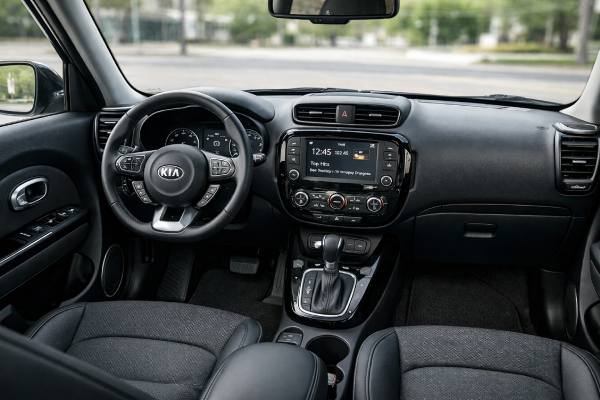

The facelifted 2017–2019 Kia Soul PS with the 1.6-litre G4FJ turbo engine is the version that gives the Soul genuine pace without changing its core personality. It still has the tall roof, upright seating, square cargo area, and easy visibility that made the Soul popular. What changes is the way it moves. With 201 hp, a broad torque band, and a 7-speed dual-clutch transmission, this is the Soul that finally feels quick enough to match its playful design.
That matters for ownership because the turbo model is not just a trim upgrade. It adds larger brakes, bigger wheels, more standard equipment, and a more serious highway character. At the same time, it asks for more care than the slower naturally aspirated cars. The direct-injection turbo engine and dry-clutch DCT need proper servicing, good tyres, and careful test-driving before purchase. Find a well-kept example, though, and the Soul Turbo remains one of the most distinctive and practical fast compact crossovers of its era.
Fast Facts
- The 1.6 turbo engine gives the Soul real midrange punch and much stronger passing performance.
- Tall seating, excellent outward visibility, and a square hatch make it easier to live with than many sporty rivals.
- Larger front brakes and the turbo trim’s chassis setup give it more confidence than the regular Soul.
- The 7-speed dual-clutch transmission is the main ownership caveat and needs a careful road test.
- A sensible oil-service interval is about 10,000 km or 6,500 miles, especially on mixed-use cars.
Explore the sections
- Kia Soul PS turbo essentials
- Kia Soul PS turbo specs
- Kia Soul PS turbo trim and safety
- Known weak points and recalls
- Maintenance schedule and buyer tips
- Real-world pace and manners
- Soul turbo versus key rivals
Kia Soul PS turbo essentials
The facelifted PS-generation Soul Turbo is the point where Kia took the model from quirky and practical to genuinely interesting. Earlier Souls were easy to recommend for packaging, visibility, and value, but they were never especially quick. The 2017 facelift changed that. Kia gave the top trim a 1.6-litre turbocharged direct-injection engine, paired it with a 7-speed dual-clutch automatic, added larger front brakes, and wrapped the package in sportier trim details. The result was a Soul that still behaved like a useful everyday crossover but no longer felt short of power.
That blend is the main reason this version stands out today. The Soul Turbo is not a hardcore performance car. It still rides on a simple front-strut and rear torsion-beam layout, and it still prioritizes cabin space and ease of use. But the extra torque transforms how the car feels in normal driving. It pulls harder from low and mid rpm, merges onto highways with less drama, and makes the bluff body feel lighter than it is.
The practical strengths are unchanged. You sit high, the glass area is generous, the doors open wide, and the cargo bay is more useful than many sleeker rivals. That makes the Turbo model appealing to buyers who want one car to do several jobs. It can commute, haul weekend luggage, carry adults in the back, and still feel quick enough to entertain on an empty on-ramp.
The ownership trade-off is straightforward. This is the most demanding PS Soul to maintain properly. The turbo engine is still a Kia direct-injection petrol unit, so intake-valve deposits, ignition upkeep, and oil discipline matter. The dual-clutch gearbox is the real dividing line between a good car and a frustrating one. When healthy, it shifts quickly and makes the car feel alert. When worn or badly calibrated, it can shudder, slip, or behave awkwardly at low speed.
In short, the 2017–2019 Soul Turbo is the enthusiast’s Soul, but not in the obvious way. Its real talent is combining real-world practicality with enough pace to make daily driving easier and more enjoyable. That is a rarer combination than it first appears.
Kia Soul PS turbo specs
The 2017–2019 Soul Turbo used Kia’s G4FJ 1.6-litre twin-scroll turbocharged four-cylinder. For this facelift PS model, the baseline market story is the North American Soul ! or Exclaim trim, which bundled the turbo engine with the 7-speed DCT and front-wheel drive.
| Powertrain and efficiency | Kia Soul PS 1.6 T-GDI |
|---|---|
| Engine code | G4FJ |
| Engine layout and cylinders | Inline-4, DOHC, 16 valves |
| Bore × stroke | 77.0 × 85.44 mm (3.03 × 3.36 in) |
| Displacement | 1.6 L (1,591 cc) |
| Induction | Twin-scroll turbocharger |
| Fuel system | Gasoline direct injection |
| Compression ratio | 9.5:1 |
| Max power | 201 hp (150 kW) @ 6,000 rpm |
| Max torque | 264 Nm (195 lb-ft) @ 1,500–4,500 rpm |
| Timing drive | Chain |
| Rated efficiency | 8.4 L/100 km (28 mpg US / 33.6 mpg UK) combined |
| Real-world highway @ 120 km/h | About 7.4–8.2 L/100 km (29–32 mpg US / 35–38 mpg UK) |
| Transmission and driveline | Figure |
|---|---|
| Transmission | 7-speed dual-clutch automatic, D7UF1 family |
| Ratios | 3.929 / 2.318 / 2.043 / 1.070 / 0.822 / 0.884 / 0.721 |
| Final drive | 4.643:1 (1,2,4,5) and 3.421:1 (3,6,7,R) |
| Drive type | FWD |
| Differential | Open |
| Chassis and dimensions | Figure |
|---|---|
| Front suspension | MacPherson strut |
| Rear suspension | Coupled torsion beam axle |
| Steering | Motor-driven power steering, 15.7:1 |
| Turns lock-to-lock | 2.85 |
| Brakes | Vented disc front / solid disc rear |
| Brake size | 304.8 mm / 261.6 mm (12.0 / 10.3 in) |
| Wheels and tyres | 18 × 7.5 in, 235/45 R18 |
| Ground clearance | 150 mm (5.9 in) |
| Length | 4,140 mm (163.0 in) |
| Width | 1,801 mm (70.9 in) |
| Height | 1,613 mm (63.5 in) |
| Wheelbase | 2,570 mm (101.2 in) |
| Turning circle | 10.6 m (34.8 ft) |
| Kerb weight | 1,466 kg (3,232 lb) |
| Fuel tank | 53.8 L (14.2 US gal / 11.8 UK gal) |
| Cargo volume | 685 L / 1,736 L (24.2 / 61.3 ft³), SAE |
| Performance and service data | Figure |
|---|---|
| 0–100 km/h | About 7.5–7.8 s |
| 0–60 mph | As quick as 6.3 s in magazine testing |
| Top speed | About 200 km/h (124 mph) |
| Braking distance | Open Kia data does not publish a 100–0 km/h figure; one U.S. test recorded 177 ft from 70 mph |
| Engine oil | API SN / ILSAC GF-5 5W-30 or 5W-40 by climate and market |
| Engine oil capacity | 4.5 L (4.8 US qt) |
| Coolant | Long-life ethylene glycol coolant, usually 50:50 mix |
| Transmission fluid | Verify by VIN and service manual before replacement |
| A/C refrigerant | R-134a, charge varies by equipment |
| Key torque specs | Wheel nuts 88–108 Nm (65–80 lb-ft); DCT actuator bolts 19.6–26.5 Nm (14.5–19.5 lb-ft) |
One detail worth stressing is that the turbo model is mechanically more focused than the regular Soul, but not radically different underneath. It still uses the same basic packaging and front-drive architecture. The extra pace comes mostly from the engine, transmission, and brake upgrade rather than from an all-new chassis concept. That is part of the car’s appeal: it feels special without becoming hard to understand or impossible to service.
Kia Soul PS turbo trim and safety
For the facelift years, the turbo engine was tied closely to the top-spec Soul trim. In North America, that meant the Soul ! or Exclaim. This matters because the 1.6T was never just an engine option dropped into a basic shell. Kia used it to create a more premium and more performance-flavored Soul, with different wheel, brake, and equipment choices that affect both daily use and used-market value.
The easiest way to identify a factory turbo car is by the package combination. The turbo model came with the 1.6T engine, 7-speed DCT, 18-inch alloy wheels, twin-tip exhaust, and larger front brakes. Inside, you usually see the D-shaped steering wheel, push-button start, upgraded trim materials, and the brighter, more stylized cabin treatment associated with the top trim. Many cars also have the Tech Package, which brought navigation, Harman Kardon audio, HID low-beam headlights, LED lighting elements, and a long list of driver-assistance features.
That trim structure means the turbo Soul is usually well equipped, but it also means buyers should pay close attention to what was optional and what was standard. Blind-spot detection and rear cross-traffic alert were available on upper trims, while forward collision warning, autonomous emergency braking, lane departure warning, and smart cruise control were package-dependent rather than universal. A seller describing every turbo car as “fully loaded” is often overstating it.
The facelift also sharpened the Soul’s passive-safety story. The underlying PS-generation body already had a good crash structure, but 2015-and-later cars benefited from front-end and occupant-compartment strengthening for better small-overlap performance. By the facelift years, the Soul’s safety case was solid for its class.
Key safety equipment usually includes:
- Six airbags.
- ABS, ESC, and vehicle stability management.
- Hill-start assist.
- LATCH or ISOFIX child-seat anchors.
- Rear camera display.
- Optional blind-spot and rear cross-traffic monitoring.
- Optional forward collision warning, autonomous emergency braking, lane departure warning, and smart cruise control on selected packages.
IIHS results are especially important here. The 2018 Soul earned strong crashworthiness scores, and cars equipped with optional front crash prevention and specific headlights qualified for Top Safety Pick+ treatment. That is a meaningful point in this class, because it shows the Soul Turbo was more than a style-first oddball. It had real structural credibility.
For buyers, the best trim advice is simple: seek the turbo car with the features you actually want, not just the most option boxes. The Tech Package is desirable, but a clean, well-serviced turbo without every gadget is usually a better long-term bet than a neglected fully loaded one.
Known weak points and recalls
The Soul Turbo’s reliability story is not catastrophic, but it is more nuanced than that of the 2.0-litre model. The engine itself is generally strong when serviced properly, yet this version adds the two things that raise ownership sensitivity: turbocharging and a dry-clutch DCT. In practice, the transmission is the system most likely to shape your verdict.
Common or recurring issues
- DCT low-speed shudder or slip: This is the best-known Soul Turbo ownership complaint. Symptoms include vibration when creeping away from a stop, inconsistent take-up, early upshifts, or an uneasy pause between gears. Kia issued service information covering clutch judder inspection, clutch replacement, actuator adjustment, and TCU logic updates on affected 7-speed DCT cars.
- Initial shift shock after DCT or clutch work: Kia also released guidance requiring TCU logic optimization after certain DCT, TCU, or double-clutch replacements. That tells you something important: correct software state matters on this transmission.
- Spark plugs and ignition coils: Misfires under boost, rough cold starts, or a flashing engine light under load often trace to plug or coil deterioration before they would on a low-stress naturally aspirated engine.
- Intake-valve carbon build-up: As with many direct-injection turbo petrol engines, deposit build-up can cause rough idle, weaker throttle response, and fuel-economy drift as mileage rises.
Occasional but important
- Oil seepage and PCV-related breathing issues: These are not defining flaws, but they are worth checking on older turbo cars that have seen long intervals or heat-heavy use.
- Tyre and alignment sensitivity: The 18-inch setup looks right on the car, but it is more vulnerable to pothole damage, uneven wear, and ride harshness than smaller-wheel Souls.
- Brake wear: The turbo’s pace and wheel package can make it harder on tyres and front brakes than the 2.0 model.
Recall and campaign priorities
The big recall story for 2017–2019 Souls is the airbag control unit campaign affecting certain cars from these years. The concern was that a fault could impair airbag operation. That is the first VIN check every buyer should do. Unlike some other Soul variants, the turbo does not carry the same public campaign pattern as the 2.0-litre Nu engine cars, so it is important not to mix powertrains when researching online.
A proper pre-purchase inspection should include:
- A true cold start.
- A slow-speed road test for DCT shudder.
- A harder acceleration test for misfire or boost hesitation.
- A diagnostic scan for transmission, misfire, and airbag history.
- Proof of recall completion and dealer campaign records.
- Close tyre, brake, and alignment inspection.
A well-sorted Soul Turbo can be satisfying and durable. A poorly sorted one usually announces itself during the first ten minutes of a careful test drive.
Maintenance schedule and buyer tips
This is a car that rewards preventive maintenance. The turbo engine runs hotter and works harder than the regular Soul engines, and the dual-clutch gearbox dislikes neglect, poor diagnosis, and stop-start abuse. The safest strategy is to service this model a bit earlier than the most optimistic schedule suggests.
| Item | Practical interval |
|---|---|
| Engine oil and filter | Every 10,000 km / 6,500 miles or 6–12 months |
| Engine air filter | Inspect every service; replace about every 20,000–30,000 km |
| Cabin filter | Every 12 months or 15,000–20,000 km |
| Spark plugs | About every 45,000–60,000 km on hard use; up to 75,000 km on easy use |
| Coolant | Around 5 years, then by condition and schedule |
| Brake fluid | Every 2 years |
| Brake inspection | Every service, especially front pad thickness and rear slide movement |
| Tyre rotation | Every 8,000–10,000 km |
| Alignment check | Annually or after pothole strikes and tyre-wear changes |
| Serpentine belt and hoses | Inspect every service |
| Timing chain | No fixed replacement interval; inspect on noise or timing-correlation symptoms |
| DCT behavior check | At every service road test |
| 12 V battery test | Annually from year 4 onward |
| Intake-valve cleaning assessment | As mileage rises if idle quality and response worsen |
Fluids and essentials
- Engine oil: 5W-30 is the safest default in many climates; 5W-40 can make sense in hotter use if it meets the required specification.
- Engine oil capacity: 4.5 L with filter.
- Fuel: regular 87-octane is allowed in North American guidance, though some owners notice the car feels stronger on premium.
- Transmission: verify fluid type and any service procedure by VIN-specific workshop information before work is done.
- Wheel nut torque: 88–108 Nm.
Used-buyer inspection checklist
- Confirm smooth DCT take-up from a stop.
- Check for surging, hesitation, or misfire under boost.
- Inspect for uneven tyre wear from the 18-inch setup.
- Look for service proof showing regular oil changes, not just occasional dealer visits.
- Scan for stored transmission and engine codes even if no warning light is present.
- Check Tech Package items carefully if fitted: HID lights, audio, navigation, heated seats, camera, and driver-assistance hardware.
- Verify airbag recall completion by VIN.
The best-used examples are usually stock cars with full records, healthy tyres, and a gearbox that feels calm rather than busy in traffic. Modified cars, cheap tyres, or vague “that’s just how the DCT feels” explanations should make you cautious. Long-term durability can be good, but only when the maintenance history shows that the previous owner understood the difference between a turbo Soul and a base commuter hatch.
Real-world pace and manners
The Soul Turbo feels quicker than its shape suggests, and that is part of its charm. There is a real disconnect between the boxy profile and the way the car gathers speed. The 1.6T gives it strong midrange shove, and because maximum torque arrives early, it rarely feels caught off boost in normal driving. On a daily commute, that means easier merges, less strain on grades, and better confidence when overtaking.
The transmission defines the experience. When the 7-speed DCT is healthy and well calibrated, it shifts quickly and gives the Soul a light, eager feel. Under moderate throttle, it can be pleasantly crisp. In stop-start traffic, though, it behaves like many dry-clutch units: a little more deliberate than a conventional automatic, a little more sensitive to heat and creeping, and occasionally less graceful than buyers expect. That does not ruin the car, but it does explain why some owners love the powertrain while others would rather have the smoother 2.0 with a torque-converter automatic.
Ride quality is acceptable rather than plush. The short wheelbase and 18-inch tyres mean sharp edges come through more clearly than in the smaller-wheel Soul trims. Still, body control is decent, and the turbo model feels more settled at speed than the old AM-generation car. Steering is light, fast enough, and predictable, though feedback is limited. The larger front brakes also help the car feel more confident than the regular Soul when pressed.
Real-world fuel use is respectable for a 201-hp boxy compact:
- City: about 9.0–10.5 L/100 km.
- Highway: about 7.0–8.0 L/100 km.
- Mixed use: about 8.0–9.0 L/100 km.
Magazine testing has shown that performance can improve on premium fuel, even though regular fuel is permitted. That is worth knowing for drivers who care about the last bit of response more than fuel cost.
Noise levels are mixed. The engine itself is fairly smooth, and straight-line highway stability is better than many expect. But tyre roar and wind noise can be noticeable, especially on rough pavement. That is the price of the Soul’s shape and wheel package.
The overall verdict is simple: the Soul Turbo is not a corner carver, but it is meaningfully fast, easy to place, and enjoyable in the way a quick practical car often is. It wins you over through usefulness first and pace second.
Soul turbo versus key rivals
The Soul Turbo competes in an unusual space. It is not quite a hot hatch, not quite a compact SUV, and not quite a mini-MPV. That makes its rival set broad, but it also explains why the car has kept a following.
Against the Nissan Juke Turbo, the Kia is the better practical tool. The Juke feels more eccentric and a little more playful, but the Soul is easier to see out of, easier to load, and more comfortable for rear passengers. For buyers who use the back seat and cargo area often, the Soul usually makes more sense.
Against the Honda HR-V, the Kia trades away some polish and some long-term calmness for stronger straight-line pace. The Honda feels more refined and more measured, but in turbo Soul form the Kia is much quicker and often more memorable to own. The choice comes down to whether you value smoothness or character.
Against the Mazda CX-3, the Soul loses on handling finesse and cabin finish. The Mazda is the sharper driver’s car and the more premium-feeling one. But the Soul fights back with better packaging, a roomier rear seat, a more useful hatch opening, and a less cramped everyday feel.
Against a Volkswagen Golf 1.8T or GTI, the Kia cannot match the lower, tidier road manners of a true hatchback. The VW feels more sophisticated and more cohesive at speed. Yet the Soul offers a higher driving position, more distinctive styling, and a cabin shape that many owners find more practical in daily life.
The more interesting comparison is actually within Kia’s own lineup. The regular 2.0 Soul is usually the easier car to recommend to a cautious buyer because the conventional automatic is smoother and simpler. The turbo model is the one to buy if you genuinely want the extra performance and are willing to accept the DCT as part of the package.
That is the Soul Turbo’s place in the market. It is not the most polished rival, and it is not the safest choice for buyers who hate transmission quirks. But it remains one of the few cars from this period that combines real pace, upright practicality, distinctive design, and honest day-to-day usefulness in one package.
References
- 2017 Soul – Overview 2016 (Official Overview)
- 2019 Kia Soul Specifications 2019 (Official Specifications)
- 2019 Kia Soul Features & Options 2019 (Official Features)
- 2018 Kia Soul 2018 (Safety Rating)
- Part 573 Safety Recall Report 22V-031 2022 (Recall Database)
Disclaimer
This article is for informational purposes only and is not a substitute for professional diagnosis, repair, or VIN-specific service information. Specifications, torque values, intervals, fluid requirements, procedures, and fitted equipment can vary by VIN, market, build date, and trim level, so always verify important details against official Kia service documentation for the exact vehicle.
If this guide was useful, please consider sharing it on Facebook, X/Twitter, or another social platform to support our work.