
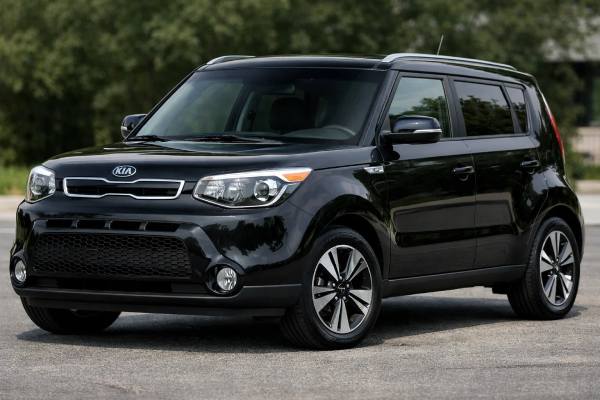


The 2014–2016 Kia Soul PS is the generation that turned the Soul from a clever niche car into a more mature all-rounder. It kept the upright shape and easy-access cabin that made the earlier car useful, but added a stiffer body, cleaner ride, quieter cabin, and a noticeably more polished interior. In 1.6-litre G4FD form, it also brought gasoline direct injection, chain-driven cam timing, and better official performance than the older naturally aspirated MPI setup. In many listings this engine is rounded to 130 hp, though official market figures often sit slightly above that. For owners, the real story is not the headline number. It is the balance of space efficiency, simple front-wheel-drive packaging, strong visibility, and manageable maintenance when the car has been serviced on time. The best PS-generation Souls feel durable, practical, and honest. The ones to avoid are the neglected cars with weak service history, overdue fluid work, and unresolved recall or catalyst issues.
What to Know
- Spacious cabin design for its footprint, with easy entry and a very usable square cargo area.
- Stiffer PS-generation body gives a calmer ride and better highway stability than the earlier Soul.
- The 1.6 GDI engine is efficient enough for mixed use and feels stronger than the old 1.6 MPI car.
- Direct injection means carbon build-up, ignition condition, and oil-service discipline matter more.
- Change engine oil every 12 months or 12,000 km in hard use, and rotate tyres about every 12,000 km.
What’s inside
- Kia Soul PS character and fit
- Kia Soul PS technical figures
- Kia Soul PS trims and protection
- Trouble spots and recall actions
- Service planning and buyer checks
- On-road feel and economy
- Soul PS against key alternatives
Kia Soul PS character and fit
The PS-generation Soul matters because it fixed most of the first car’s rough edges without losing the traits that made the model stand out. It is still a tall, square, front-wheel-drive compact with an emphasis on easy access and smart packaging, but the 2014 redesign gave it a more settled chassis, better structure, and a cabin that feels closer to a conventional compact car in quality. That shift is why many buyers looking at used Souls start their search with the PS rather than the earlier AM.
The 1.6 G4FD version suits owners who want the Soul’s shape and practicality without moving up to a heavier engine or a more complicated drivetrain. This direct-injection petrol engine gives the car enough energy for daily mixed use and feels more modern in the mid-range than the older 1.6 MPI. It is still not a fast crossover. The Soul’s job is to be easy to drive, roomy for its size, and simple to place in traffic. In that role, it works well.
One of the PS car’s biggest strengths is how intelligently it uses space. The seating position is upright, the glass area is generous, and the rear seat is genuinely useful for adults by small-crossover standards. The boot opening is wide and square, so the cargo area works better in practice than many rivals with more dramatic rooflines. This is one of those cars where body shape translates directly into daily convenience.
The second strength is balance. The Soul PS is not sporty, but it is more composed than the earlier car. It tracks better on faster roads, feels less busy over broken surfaces, and has a quieter, more mature road manner. That matters more than raw cornering grip for the way most Souls are used.
There are still caveats. Equipment varies sharply by market and trim. Some cars were sold with smaller wheels and simpler interiors, while others added bigger alloys, upgraded audio, camera systems, and more convenience features. The engine itself is also described differently across markets. Sellers often call it a 130 hp unit, while some official sources list 132 ps. That is why the VIN is still the safest way to verify parts and exact specification.
In ownership terms, the PS Soul makes most sense for buyers who value visibility, access, easy parking, and sensible running costs. It is less appealing if your priority is quiet high-speed touring or modern active safety technology. The Soul is at its best when you see it clearly: a clever, upright compact with better engineering maturity than its style-first image suggests.
Kia Soul PS technical figures
The PS-generation 1.6 GDI is one of those cars where the official spec sheet tells a useful story. It is a conventional front-wheel-drive five-door hatch-crossover with simple but well-judged hardware, moderate weight, and sensible service capacities. The engine is commonly rounded to 130 hp in classifieds, but the open European technical sheet lists it at 132 ps, which is effectively the same headline class for most buyers.
Powertrain and efficiency
| Item | Data |
|---|---|
| Code | G4FD |
| Engine layout and cylinders | Inline-4, DOHC, 4 cylinders, 4 valves per cylinder |
| Bore × stroke | 77.0 × 85.4 mm (3.03 × 3.36 in) |
| Displacement | 1.6 L (1,591 cc) |
| Induction | Naturally aspirated |
| Fuel system | Gasoline direct injection |
| Compression ratio | Market-dependent; verify by VIN documentation |
| Max power | 132 ps (97 kW) at 6,300 rpm, commonly listed as about 130 hp |
| Max torque | 161 Nm (119 lb-ft) at 4,850 rpm |
| Timing drive | Chain |
| Rated efficiency | 6.5–7.3 L/100 km manual, 7.6 L/100 km automatic |
| Real-world highway at 120 km/h | Usually about 6.8–7.8 L/100 km when healthy |
Transmission and driveline
| Item | Data |
|---|---|
| Transmission | 6-speed manual or 6-speed automatic |
| Drive type | FWD |
| Differential | Open |
Chassis and dimensions
| Item | Data |
|---|---|
| Suspension front / rear | MacPherson strut / coupled torsion beam axle |
| Steering | Electric motor-driven rack and pinion, 15.7:1 ratio |
| Brakes | 280 mm ventilated front discs, 262 mm solid rear discs |
| Wheels and tyres | 205/60 R16, 215/55 R17, or 235/45 R18 |
| Ground clearance | 143 mm (5.6 in) |
| Length / Width / Height | 4,140 / 1,800 / 1,593–1,618 mm |
| Wheelbase | 2,570 mm (101.2 in) |
| Turning circle | 10.6 m (34.8 ft) |
| Kerb weight | 1,212–1,398 kg depending on trim and gearbox |
| GVWR | 1,820 kg manual / 1,850 kg automatic |
| Fuel tank | 54 L |
| Cargo volume | 354 L seats up / 1,367 L seats folded, VDA method |
Performance and service capacities
| Item | Data |
|---|---|
| 0–100 km/h | 11.0 s manual / 11.7 s automatic |
| Top speed | 185 km/h manual / 180 km/h automatic |
| Braking distance 100–0 km/h | 35.5 m |
| Engine oil | 3.6 L (3.80 US qt), API SM or higher, ILSAC GF-4 or ACEA A5 or above |
| Coolant | 5.0–5.1 L, ethylene-glycol base coolant for aluminium radiator |
| Manual transmission fluid | 1.8–1.9 L, API GL-4 SAE 75W-85 |
| Automatic transmission fluid | 7.3 L, SP-IV specification |
| Brake fluid | 0.7–0.8 L, DOT-3 or DOT-4 |
| A/C refrigerant | R-134a, 550 g |
| A/C compressor oil | FD46XG, 110 g |
| Wheel-nut torque | 88–107 Nm (65–79 lb-ft) |
Safety and driver assistance
| Item | Data |
|---|---|
| Euro NCAP | 4 stars; Adult 75%, Child 82%, VRU 59%, Safety Assist 56% |
| IIHS | 2014 redesign scored Good in moderate overlap, side, roof, and head restraint tests; 2015 gained stronger small-overlap performance and Top Safety Pick status |
| Headlight rating | Not a meaningful IIHS rating point for these years |
| ADAS suite | No AEB, ACC, lane-centering, or full modern active-safety suite |
This is a compact crossover by theme, but mechanically it is still a straightforward small front-drive car. That simplicity is one reason it ages fairly well when maintenance stays current.
Kia Soul PS trims and protection
The smartest way to shop a 2014–2016 Soul PS is by configuration rather than badge name. Kia sold the PS across many markets with trim names that do not always translate cleanly from country to country, but the functional differences are consistent. Lower trims usually combine 16-inch wheels, cloth upholstery, simpler infotainment, and fewer convenience features. Higher trims add 17-inch or 18-inch wheels, upgraded audio, larger screens, rear camera systems, keyless entry, climate upgrades, contrast cabin trim, and appearance packages.
For used buyers, the most important trim difference is not the cosmetic one. It is the wheel and tyre package. The 16-inch cars are usually the easiest to live with. They ride better, tyres cost less, and the steering feels a little calmer over broken surfaces. The 18-inch cars can look sharper, but they ask more from the suspension and tend to increase noise and replacement cost. In everyday driving, the smaller-wheel setup often suits the Soul’s character better.
Most PS 1.6 GDI models share the same core mechanical layout. You are generally choosing gearbox, wheel size, convenience features, and audio tier rather than a different suspension tune or a major brake upgrade. That is useful, because it means condition and service history matter more than chasing one rare badge.
Safety also improved with the PS redesign. In European testing, the Soul PS earned a 4-star Euro NCAP rating with 75% adult occupant protection, 82% child occupant protection, 59% vulnerable road user protection, and 56% safety assist. The weak point was not basic structure. It was the lack of the newer active systems that later became necessary for higher scores. Lane support was unavailable, autonomous braking was not available, and the speed-assistance package was limited by the standards of the time.
In North America, the picture is also worth understanding by year. The redesigned 2014 Soul performed well in moderate overlap, side, roof strength, and head restraint testing. For 2015, IIHS notes that the front-end and occupant compartment structure were strengthened to improve small-overlap protection. That made 2015 and later cars the better choice for buyers who prioritize that specific crash scenario.
This matters because the PS Soul sits at a transition point in safety history. It gives you a stronger body and better crash structure than many older small crossovers, but it does not give you today’s advanced safety net. There is no convincing case for buying one because you want automatic emergency braking, lane-centering, or radar-based cruise. Buy it for passive safety, visibility, and practicality. Treat modern driver assistance as absent unless a specific regional package proves otherwise.
For families, that still leaves plenty to like: curtain airbags, child-seat anchors, stability control, a high seating position, and a body shape that is easy to place accurately. The best trim is usually the one with the equipment you actually use, not the one with the biggest wheel.
Trouble spots and recall actions
The 1.6 G4FD Soul PS is usually a manageable used car, but it is not a car you should buy blind. The direct-injection engine is more sensitive to service habits than the older 1.6 MPI, and by now every example is old enough for deferred maintenance to shape the ownership experience.
Here is the fault pattern that matters most:
- Common, low to medium cost: carbon build-up on intake valves.
Symptoms: rough idle, hesitant cold start, uneven throttle response, and a feeling that the engine has lost some smoothness.
Likely root cause: direct injection does not wash the backs of intake valves with fuel, so deposits accumulate over time.
Recommended remedy: confirm ignition health first, then clean the intake path properly if symptoms remain. - Common, low cost: ignition wear.
Symptoms: misfire under load, rough idle, flashing warning light, poor fuel economy.
Likely root cause: aging spark plugs or weak ignition coils.
Recommended remedy: replace plugs with the correct type, test coils, and check charging voltage. - Occasional, medium cost: oil consumption or oil neglect on poorly maintained cars.
Symptoms: low oil level between services, tappet noise on startup, dirty tailpipe deposits, catalyst stress.
Likely root cause: long service intervals, poor oil quality, or a history of running low on oil.
Recommended remedy: shorten oil intervals, monitor level closely, and avoid buying examples with vague service history. - Occasional, medium cost: suspension and wheel-bearing wear.
Symptoms: knocks over potholes, droning at speed, vague front-end feel, uneven tyre wear.
Likely root cause: mileage, rough roads, and larger wheel packages.
Recommended remedy: inspect dampers, top mounts, bushes, links, and bearings together rather than replacing one noisy part at a time. - Occasional, medium cost: brake corrosion on lower-mileage or mostly urban cars.
Symptoms: pulsing, uneven rear braking, seized slide pins, rust-lipped discs.
Likely root cause: age, short trips, and infrequent heavy braking.
Recommended remedy: clean and service the brake hardware early, not after parts are already binding.
The major service-action point is the catalytic-converter overheating recall on affected 1.6 GDI Soul models. The official campaign calls for upgraded catalyst overheating protection logic in the ECU and, where necessary, catalytic-converter replacement. Depending on damage, the engine may also need replacement. That makes recall completion one of the most important pre-purchase checks on a U.S.-market 2014–2016 Soul 1.6 GDI.
Chain-driven timing is a plus, but it does not mean “ignore forever.” Listen for cold-start rattle, scan for correlation faults, and treat noisy chains or delayed oil-pressure symptoms seriously. Manual gearboxes are usually sturdy if shift quality is clean. Automatics tend to last well when fluid is kept healthy, but neglected cars can show harsh engagement or lazy shift response.
Before buying, ask for full service history, proof of recall completion, recent fluid work, and a cold-start inspection. A well-kept PS Soul can be dependable. A poorly maintained one can hide costly small problems under an otherwise friendly design.
Service planning and buyer checks
The Soul PS is best owned with a preventive mindset. It is not unusually fragile, but the 1.6 GDI engine rewards owners who service it before symptoms appear. The official schedule is a good baseline, and a used-car buyer should tighten it slightly if history is incomplete.
Practical maintenance schedule
| Item | Practical interval | Notes |
|---|---|---|
| Engine oil and filter | Every 12 months or 7,500 miles normal; about 6,000–8,000 km shorter in hard use | 3.6 L; quality oil matters on the GDI engine |
| Air cleaner filter | Inspect at 15,000 miles; replace around 30,000 miles | Sooner in dusty driving |
| Cabin air filter | About every 15,000 miles or yearly | Helps blower performance and cabin air quality |
| Spark plugs | 105,000 miles / 84 months official for iridium | Replace earlier if history is unknown |
| Coolant | First at 120,000 miles / 120 months, then every 30,000 miles / 24 months | Baseline service is wise on older cars |
| Manual transaxle fluid | Inspect every 37,500 miles / 48 months | Practical refresh is worthwhile on used cars |
| Automatic transmission fluid | No regular normal replacement listed, but severe-use interval is 60,000 miles | Sensible fluid service helps older automatics |
| Drive belt | Inspect from 60,000 miles / 72 months, then every 15,000 miles / 24 months | Replace when cracked or weak |
| Valve clearance | Inspect at 90,000 miles / 72 months for 1.6 engine | Important if tappet noise appears |
| Tyre rotation | Every 7,500 miles / 12 months | Check pressure and tread wear at the same time |
| Brake fluid | Inspect yearly; practical replacement every 2–3 years | Age matters more than mileage |
| Brakes | Inspect pads, discs, hoses, and rear hardware every service | Corrosion is common on light-use cars |
| 12 V battery | Test yearly after year 4 | Low voltage can create misleading faults |
| Timing chain | Inspect by symptom, noise, or timing-correlation fault | No fixed change interval |
Useful fluid and torque data
| Item | Specification |
|---|---|
| Engine oil | 3.6 L, API SM or higher, ILSAC GF-4 or ACEA A5 or above |
| Manual transmission oil | 1.8–1.9 L, GL-4 SAE 75W-85 |
| Automatic transmission fluid | 7.3 L, SP-IV |
| Coolant | 5.0–5.1 L, ethylene-glycol coolant for aluminium radiator |
| Brake fluid | 0.7–0.8 L, DOT-3 or DOT-4 |
| A/C refrigerant | R-134a, 550 g |
| Compressor oil | FD46XG, 110 g |
| Wheel-nut torque | 88–107 Nm |
Buyer’s checklist
- Start the engine from cold and listen for timing-chain rattle, injector tick, or uneven idle.
- Check oil level and condition before the test drive.
- Confirm recall completion, especially catalyst-related campaigns.
- Inspect front suspension for knocks and the rear brakes for corrosion.
- Test all infotainment, camera, steering-wheel controls, and climate functions.
- Look for uneven tyre wear that may point to alignment, bush, or bearing issues.
- Prefer 16-inch or 17-inch cars for lower running cost unless you strongly want the 18-inch look.
Long term, the PS Soul 1.6 GDI can age well. The recipe is simple: buy a car with records, stay ahead of fluids and ignition service, and do not treat warning lights or oil loss as small issues.
On-road feel and economy
The Soul PS drives more like a polished compact hatch than its upright shape suggests. The first impression is ease. Visibility is strong, the seating position is natural, and the square body makes it simple to place in traffic or squeeze into narrow urban parking spots. That makes the Soul especially good in city use, where its size and glass area work in its favor.
The PS-generation chassis is calmer than the older Soul’s. Straight-line stability is better, the body feels more tied down over broken pavement, and the steering no longer gives the car the slightly busy feel of the first generation. It is still light rather than talkative, but that suits the Soul’s mission. It is a confidence-building car, not a playful one.
Ride quality depends heavily on wheel size. On 16-inch tyres the car usually feels balanced, with enough sidewall to absorb poor road surfaces cleanly. Seventeen-inch wheels are a fair compromise. Eighteens look the part, but they make the Soul feel firmer and noisier. If long-term comfort matters, smaller wheels are the better match.
The 1.6 GDI engine fits the car well. It is not strong at very low rpm, so it likes to be worked a little more than a turbo engine, but throttle response is clean and the extra sharpness over the old MPI unit is noticeable. The manual gearbox lets the driver make the most of that character. The automatic is smoother in traffic and suits the Soul’s relaxed nature, though it is slower and thirstier.
At speed, cabin noise is acceptable rather than outstanding. The Soul is quieter than the earlier model, but wind and tyre noise still build more quickly than in lower, sleeker hatchbacks. For a tall compact, though, the refinement is respectable.
Typical real-world economy
| Use case | Typical figure |
|---|---|
| City | 8.5–10.0 L/100 km |
| Mixed | 7.3–8.8 L/100 km |
| Steady 100 km/h | 6.1–6.8 L/100 km |
| Steady 120 km/h | 6.8–7.8 L/100 km |
| Cold-weather mixed use | Often 0.7–1.2 L/100 km worse than mild-weather use |
Key tested metrics
| Metric | Result |
|---|---|
| 0–100 km/h | 11.0 s manual / 11.7 s automatic |
| Top speed | 185 km/h manual / 180 km/h automatic |
| 100–0 km/h braking | 35.5 m |
| Turning circle | 10.6 m |
In daily use, the Soul PS wins by being easy to live with. It is not the fastest or the quietest rival, but it combines predictable manners, good access, and honest fuel use in a package that feels less awkward than the styling might suggest.
Soul PS against key alternatives
The Soul PS makes the most sense when you compare it with the cars people actually shop beside it. That is where its packaging and straightforward engineering stand out.
Against the Nissan Juke 1.6, the Soul is usually the more rational choice. The Juke has more visual drama and a slightly more playful image, but the Kia is easier to see out of, easier to load, and more comfortable for rear passengers. The Juke feels like a style-led small crossover. The Soul feels like a cleverly packaged tool.
Against the Skoda Yeti, the comparison is more mixed. The Yeti is often more mature on the motorway and can feel more substantial, especially in stronger engine forms. But the Soul fights back with simpler front-drive ownership, lower parts complexity in comparable trim, and a cabin layout that many drivers find easier to use. If you do not need the Yeti’s broader engine range, the Soul can be the lower-risk buy.
Against the Suzuki SX4 S-Cross, the Soul is the more upright and characterful car. The Suzuki often has the advantage if you want available all-wheel drive or slightly better long-distance economy. The Kia wins on access, rear-seat feel, and the usefulness of its square body. Buyers who prioritize cabin space over mechanical variety usually lean toward the Soul.
Against mini-MPV alternatives such as the Hyundai ix20 or Kia Venga, the Soul is the more modern-feeling option. Those cars can be just as practical, but they lean more heavily into pure utility. The Soul blends much of the same packaging logic with a higher driving position and a more crossover-like stance.
The decision becomes easier when you frame it by buyer type:
- Choose the Soul PS if you want visibility, easy entry, compact exterior size, and smart cabin packaging.
- Skip it if your priorities are strong motorway refinement, modern active safety, or especially brisk performance.
- Favor 2015–2016 cars if you want the later crash-structure improvements noted in North American safety testing.
- Favor lower to mid trims on 16-inch or 17-inch wheels if you care about comfort and tyre cost.
That is the Soul PS advantage in one line: it is one of the more honest small crossovers of its era. It does not promise rugged 4×4 capability or premium-car refinement. Instead, it offers easy daily usability, solid packaging, and manageable ownership when the maintenance history is right. For many used-car buyers, that is the smarter deal.
References
- Soul 2014 (Technical Specifications)
- Owner’s Manual – Dealer E Process 2015 (Owner’s Manual)
- Kia Soul – Euro NCAP Results 2014 2014 (Safety Rating)
- 2015 Kia Soul 2015 (Safety Rating)
- engine control unit (ecu) logic improvement (sc176) 2019 (Recall Database)
Disclaimer
This article is for informational purposes only and is not a substitute for professional diagnosis, repair, or VIN-specific service information. Specifications, torque values, service intervals, procedures, and equipment can vary by VIN, market, year, transmission, and trim, so always verify critical details against the official service documentation for the exact vehicle.
If this guide was useful, please share it on Facebook, X, or another social platform to support our work.