
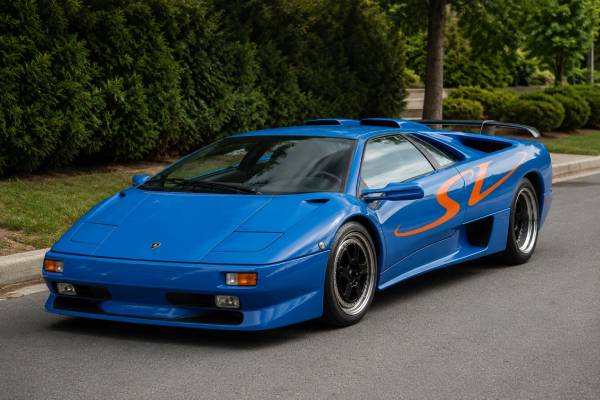
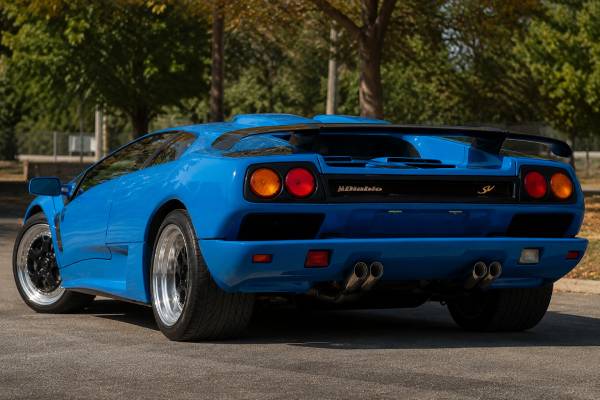
The Lamborghini Diablo SV is the rear-wheel-drive, higher-output Super Veloce version of the early Diablo, built from 1995 through 1998 before the fixed-headlight facelift arrived. It kept the classic mid-mounted Lamborghini V12 layout, used a 5.7-liter naturally aspirated engine rated at 510 hp, and stripped the Diablo idea back toward a more direct, aggressive, driver-focused form. The SV sat in a special place: less complex than the all-wheel-drive VT, more powerful than the early standard Diablo, and far more visually assertive thanks to its rear wing, revised cooling, and optional large “SV” side graphics.
Today, the Diablo SV matters because it captures the last rough-edged chapter of pre-Audi Lamborghini. Collectors value its manual gearbox, pop-up headlights, analog controls, limited supply, and wild 1990s character. Buyers also need to be careful, because condition, originality, service history, accident repair, and documentation can change both value and ownership risk dramatically.
Table of Contents
- Why the Diablo SV Matters
- V12 Specs, Chassis, and Performance Data
- Production Changes, Options, and Identification
- Design, Engineering, and Super Veloce Details
- Driving Character on Road and Track
- Maintenance, Reliability, and Restoration Risks
- Market Values and Buyer Checklist
Why the Diablo SV Matters
The Diablo SV matters because it is one of the purest road-going Diablo variants: a 510 hp, rear-wheel-drive, gated-manual V12 supercar built before the 1999 modernization softened some of the original car’s rougher edges. It revived Lamborghini’s Super Veloce name and gave the Diablo range a sharper, louder, more extroverted identity.
The Diablo itself began as Project 132, Lamborghini’s successor to the Countach. Development started in the mid-1980s, when the company needed a new flagship that could move beyond the Countach without losing the shock value that made Lamborghini famous. Marcello Gandini created the original design direction, while Chrysler, which owned Lamborghini during the Diablo’s final development phase, refined the shape for production. The result kept the Countach’s low nose, scissor doors, wide stance, and mid-engine drama, but added a more rounded 1990s form and more usable cabin.
The Diablo was unveiled in 1990 and remained in production until 2001. In early form, it used a 5.7-liter version of Lamborghini’s long-running 60-degree V12, mounted longitudinally behind the cabin. The base car was rear-wheel drive and could exceed 200 mph in ideal conditions, making it one of the defining poster cars of the decade.
By 1993, the Diablo VT introduced viscous all-wheel drive, power steering, and a more mature grand-touring personality. That car was easier to use, especially in poor traction, but it also added weight and mechanical complexity. The 1995 Diablo SV went in a different direction. It stayed rear-wheel drive, used more power, added a standard adjustable rear wing, and wore a more aggressive body package. “SV” stood for Super Veloce, a name Lamborghini had already used on the Miura SV and would later reuse on Murciélago and Aventador models.
For enthusiasts, the 1995–1998 SV is especially interesting because it belongs to the pop-up-headlight era. The later 1999 Diablo SV facelift brought fixed headlights, revised interior design, ABS, and more output, but the earlier P132 SV has the wilder original face and more period-correct feel. It is a bridge between the raw Countach school and the more developed Audi-era Lamborghinis that followed.
The SV’s significance is not only about speed. It represents a very specific ownership experience:
- a naturally aspirated Lamborghini V12 with no turbochargers or hybrid assistance
- a five-speed gated manual gearbox
- rear-wheel drive instead of the VT’s all-wheel-drive system
- dramatic scissor doors and pop-up headlights
- hand-built 1990s construction with meaningful variation between cars
- high visual impact without the later 6.0-liter Audi-era polish
Collectors care because the Diablo SV is rare, instantly recognizable, and tied to Lamborghini’s most dramatic pre-modern period. Buyers care because values now reward originality, strong history, complete books and tools, correct specification, and careful maintenance. Fans care because the car still feels outrageous: huge width, huge rear tires, a huge V12, and almost no modern filtering between driver and machine.
V12 Specs, Chassis, and Performance Data
The Diablo SV’s core specification is simple and serious: a 5,707 cc naturally aspirated Lamborghini V12, 510 hp, rear-wheel drive, and a five-speed manual transaxle. Its performance numbers vary slightly by source and market, but the car is generally described as a 200 mph-class supercar with 0–100 km/h acceleration in roughly four seconds.
| Category | Specification |
|---|---|
| Model | Lamborghini Diablo SV |
| Project / platform | P132 Diablo |
| Production period covered | 1995–1998 pop-up-headlight SV |
| Body style | Two-door, two-seat coupe |
| Layout | Longitudinal mid-engine, rear-wheel drive |
| Engine | 60-degree Lamborghini V12 |
| Displacement | 5,707 cc |
| Bore x stroke | 87 mm x 80 mm |
| Valvetrain | DOHC, four valves per cylinder |
| Induction | Naturally aspirated |
| Fuel system | Lamborghini electronic multi-point injection |
| Compression ratio | 10.0:1 |
| Maximum power | 510 hp at 7,100 rpm |
| Maximum torque | 580 Nm at 5,200 rpm |
| Transmission | Five-speed manual plus reverse |
| Clutch | Single dry plate, hydraulically operated |
| Final drive | ZF final drive with limited-slip differential |
| Lubrication | Dry sump |
| Fuel capacity | 100 liters |
The engine is the centerpiece. It is an evolution of Lamborghini’s classic V12 architecture, enlarged and modernized compared with earlier Countach units. Four camshafts, four valves per cylinder, dry-sump lubrication, and electronic injection gave the Diablo SV both high-rpm power and the ability to meet 1990s emissions requirements. It still feels old-school because it has no forced induction and no electronic torque blending. Throttle position, revs, gearing, and traction matter.
The chassis follows traditional Lamborghini practice for the period. The Diablo used a high-strength steel tube structure with aluminum alloy and composite body panels. The SV’s body and chassis are not modern carbon-tub engineering in the way later Lamborghinis became, but the structure was advanced for its time and built for very high-speed stability.
| Area | Specification |
|---|---|
| Structure | High-strength rectangular steel tube frame with composite carbon-fiber elements |
| Body materials | Aluminum alloy and composite materials |
| Front suspension | Independent unequal-length wishbones with anti-roll bar |
| Rear suspension | Independent unequal-length wishbones with anti-roll bar |
| Dampers | Electronically controlled adjustable system on many cars |
| Steering | Power-assisted rack and pinion |
| Front brakes | Brembo ventilated discs, 340 mm |
| Rear brakes | Brembo ventilated discs, 310 mm |
| Front tires | 245/40 ZR 17 |
| Rear tires | 335/30 ZR 18 |
| Wheelbase | 2,650 mm |
| Length | 4,470 mm |
| Width | 2,040 mm |
| Height | 1,105 mm |
| Weight | About 1,576 kg |
| Weight distribution | About 41 percent front / 59 percent rear |
The tire sizes explain much of the Diablo SV’s character. The rear 335-section tires are massive, especially for the 1990s, and they give the car huge mechanical grip when warm and fresh. The front tires are much narrower, so setup, tire condition, alignment, and driver inputs affect the balance. A neglected SV on old tires can feel nervous or dull; a properly maintained one feels far more precise.
Performance figures should be treated with care because testing standards, markets, gearing, tires, and conditions varied. A useful working range is:
| Metric | Figure |
|---|---|
| 0–100 km/h | About 3.9–4.1 seconds |
| Standing kilometer | About 20.8 seconds |
| Top speed | About 328 km/h / 204 mph |
The numbers are still serious, but the way the SV delivers them is more important. It has no dual-clutch launch routine, no stability-control safety net, and no all-wheel-drive traction advantage. It asks the driver to manage a heavy clutch, a gated manual, a wide body, and a strong rear weight bias.
Production Changes, Options, and Identification
The 1995–1998 Diablo SV is best identified by its rear-wheel-drive layout, pop-up headlights, adjustable rear wing, SV-specific body details, and 510 hp 5.7-liter V12. Production figures vary by source because some counts include the 1999 facelift SV and some separate special editions, so buyers should verify individual cars by VIN, build records, and Lamborghini Polo Storico documentation rather than relying only on broad totals.
The SV was introduced at the 1995 Geneva Motor Show. It was positioned as a more focused Diablo, but not as a stripped race special like the later SV-R. The standard SV coupe kept enough comfort equipment to be road usable, yet its identity was much more aggressive than the VT’s grand-touring character.
Key exterior identifiers include:
- pop-up headlights on 1995–1998 cars
- large adjustable rear wing
- revised front bumper with additional cooling ducts
- black rear lamp surrounds
- repositioned rear fog and reverse lamps
- side skirts
- large rear quarter intake treatment
- optional oversized “SV” graphics along the lower doors and rear quarters
- staggered wheel setup with very wide rear tires
The SV used rear-wheel drive, not the VT’s viscous all-wheel-drive system. That single detail matters for authenticity and driving character. A car advertised as an SV should not be confused with a VT that has been modified with SV-style bodywork or graphics.
Year-to-year changes
Early SVs from 1995 through 1997 largely define the classic pop-up-headlight formula: 510 hp, five-speed manual, rear-wheel drive, 17-inch front wheels, 18-inch rear wheels, and the high-impact SV look. Some equipment details changed by market, and individual cars could vary through factory orders or later owner changes.
For 1998, the Diablo range approached its transition point. Some late cars received updates associated with the final pre-facelift period, and the Monterey Edition appeared for the U.S. market. Buyers should be especially careful with 1998 cars because specification claims can blur between early SV, late SV, Monterey Edition, and the 1999 facelift SV.
Monterey Edition
The 1998 Diablo SV Monterey Edition was a U.S.-market special series of 20 cars. It is especially desirable because of its very small production run, American-market significance, vivid colors, and unique intake treatment. The Monterey Edition used the SE30/VT Roadster-style triple intake arrangement ahead of the rear wheels rather than the normal SV side intake design.
A genuine Monterey Edition should have strong documentation. The best examples carry original books, tools, window sticker, service records, special-edition identifiers, and clear ownership history. Because the visual differences are known and attractive, a buyer should be alert for standard SVs modified to resemble Monterey cars.
Factory options and personalization
The Diablo SV came from a period before today’s formal Ad Personam culture became a major business pillar, but factory and dealer-level variation still matters. Colors, interior trim, wing finish, audio equipment, luggage, market equipment, and graphics can all influence desirability.
Common value-sensitive details include:
- original paint color and whether it matches factory records
- original interior color, material, and stitching
- whether the large SV side graphics were factory-applied or added later
- body-colored or exposed-carbon rear wing treatment
- original wheels versus later replacements
- books, tools, jack, manuals, warranty booklet, and service invoices
- market specification, especially U.S., European, and right-hand-drive differences
Matching-numbers thinking applies, but not in the same way as with a 1960s classic. For a Diablo SV, the important point is that the VIN, engine, gearbox, body specification, paint, trim, and market identity align with factory records. Lamborghini Polo Storico certification can be valuable because it helps confirm authenticity, especially on cars with rare colors, major restoration work, or unusual provenance.
Design, Engineering, and Super Veloce Details
The Diablo SV looks the way it does because it was built to amplify the Diablo’s most extreme traits: width, low height, cooling demand, rear mass, and V12 drama. The design is not subtle, and that is the point.
The original Diablo shape carried Marcello Gandini’s wedge-era thinking into the 1990s, then softened it through Chrysler-era production development. Compared with the Countach, the Diablo is rounder and more integrated, but it is still huge, low, and theatrical. The SV turns that base shape into something more aggressive.
At the front, the SV uses pop-up headlights and a deeper bumper treatment with extra brake cooling. The nose is low and broad, and the front overhang gives the car a dramatic wedge stance. The headlights are one of the biggest reasons collectors now separate the 1995–1998 cars from the 1999 facelift. The later fixed lights are easier to live with and more modern, but the pop-ups are part of the original Diablo identity.
The side view is where the SV becomes unmistakable. The optional oversized “SV” graphics are not discreet, but they suit the car’s personality. Without the graphics, the SV can look cleaner and more elegant; with them, it becomes the full bedroom-wall version. Neither choice is automatically better, but originality matters. Factory graphics, correctly replaced graphics, and owner-added graphics should be documented honestly.
The rear wing is more than decoration. At very high speed, the Diablo needs stability, and the SV’s adjustable rear wing became one of its signature features. It also changes the car’s visual balance. Wingless Diablos can look cleaner, but an SV without its correct wing loses part of its identity unless there is clear factory documentation for an unusual specification.
Cooling shaped much of the Diablo’s bodywork. A mid-mounted V12 creates major heat-management demands, and the SV’s intakes, vents, and engine cover are part of that solution. On a healthy car, airflow, coolant temperature, oil temperature, and fan operation should all be stable. On a neglected car, the same design becomes a warning sign: blocked radiators, tired hoses, weak fans, old coolant, poor repairs, and heat-damaged wiring can turn an exotic shape into an expensive problem.
The cockpit experience
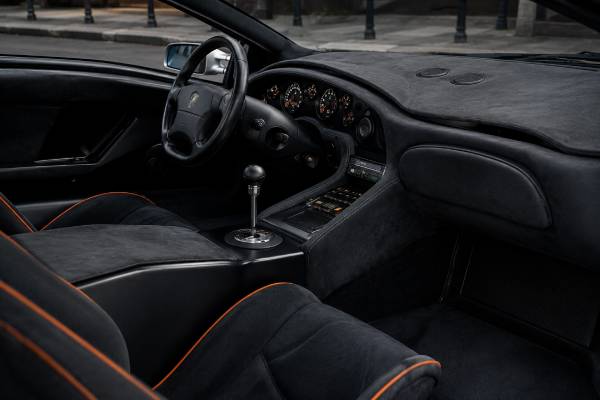
The Diablo SV cabin is more usable than a Countach cabin, but it is still a 1990s Italian exotic. The driving position is offset, the sills are wide, the windscreen is steeply raked, and rear visibility is limited. The dashboard and switches feel period-correct rather than modern. That is part of the appeal.
The key interior details to inspect are:
- seat bolster wear from climbing over wide sills
- sticky or damaged switches
- air-conditioning performance
- leather shrinkage around the dash and binnacle
- condition of carpets and sill trims
- evidence of aftermarket stereo, alarm, or immobilizer wiring
- correct gauges and warning lights
- operation of power windows and seat adjustments
Cabin originality matters because correct Diablo interior parts can be difficult and expensive to source. A retrim can look good in photos but still reduce collector confidence if it uses incorrect grain, stitching, color, or layout.
Sound and mechanical theater
The Diablo SV’s sound is central to the car. The V12 is smooth at low revs, harder-edged as it climbs, and intense near the top of the tachometer. Intake noise, mechanical vibration, and exhaust resonance are part of the experience. Many cars have aftermarket exhausts, and some sound spectacular, but originality matters for value. A car with its original exhaust included, even if a sport exhaust is fitted, is usually easier to justify.
The five-speed gated manual is another signature feature. Shift quality depends heavily on adjustment, gearbox condition, clutch health, fluid temperature, and driver technique. A good gearbox feels mechanical and deliberate. A bad one may baulk, grind, jump, or feel vague. Because transaxle work can be expensive, a test drive by someone who knows Diablos is essential before purchase.
Driving Character on Road and Track
The Diablo SV feels fast, wide, loud, and physical in a way modern supercars often do not. Its performance is still impressive, but its real appeal is the amount of attention and skill it demands from the driver.
Start with the basics: this is a large, low, rear-heavy car with a powerful naturally aspirated V12 and a manual gearbox. It does not shrink around the driver in traffic. The clutch is heavy compared with modern cars, the steering has real weight, and the body width requires constant awareness. In town, speed bumps, ramps, heat, and visibility are more important than horsepower.
On the open road, the SV makes more sense. The engine pulls cleanly from low revs, but it becomes much more alive as the revs rise. The long gearing means the driver can use second and third gear for a wide range of fast-road driving. The V12’s response is linear: no turbo surge, no electric fill, no artificial torque map. You ask for power, and the engine gives it in direct proportion to revs, throttle angle, and gear.
The gearbox is part of the ritual. It does not like careless inputs, especially when cold. Clean shifts need a deliberate hand and proper clutch timing. Once warm and well adjusted, the gated shift adds a sense of precision and occasion that modern paddle-shift cars cannot copy.
Steering feel is heavier and more talkative than in many modern exotics. Early Diablos without power steering were famously demanding; the SV’s power assistance makes it more manageable, but it is still not light. The front end responds best to smooth inputs. Rush the car into a corner and the mass becomes obvious. Set it up correctly, let the front take a clean line, and feed in the throttle with respect, and the SV feels stable and deeply satisfying.
The braking system is strong for its era, with large Brembo ventilated discs, but expectations should be period-correct. It does not have the repeated abuse tolerance of a modern carbon-ceramic setup. Brake feel, fluid age, pad compound, rotor condition, and cooling all matter. A car that is used hard needs more frequent brake inspection than one used for light road mileage.
Tires transform the car. The Diablo SV’s huge rear tires can give tremendous grip, but old tires are a major hazard. Low-mileage collector cars often sit on aged rubber that looks fine but has hardened. Any buyer should check tire date codes, size availability, and whether the tires suit road use, not just display. Fresh, correct, high-quality tires can make the car feel safer, quieter, and more predictable.
On track, the SV is exciting but expensive to run. It has the speed and presence for high-speed circuits, yet it is not a casual track-day tool. Heat, brakes, clutch wear, tire cost, bodywork risk, and parts availability make repeated track use a serious commitment. For most owners, the best use is fast road driving, concours events, careful touring, and occasional demonstration laps rather than heavy circuit work.
The SV’s most honest character summary is this: it is not easy, but it is rewarding. A modern Huracán or Revuelto is faster and safer for most drivers. A Diablo SV feels more dangerous, more mechanical, and more memorable at lower speeds. That is exactly why collectors want it.
Maintenance, Reliability, and Restoration Risks
A Diablo SV can be reliable when maintained by specialists, but deferred maintenance is brutally expensive. The car is not fragile in the ordinary sense; the risk comes from age, heat, poor storage, incorrect repairs, scarce parts, and owners who underestimate what a 1990s V12 Lamborghini needs.
The most important maintenance principle is simple: buy the best-documented, best-inspected car you can afford. A cheaper SV with missing history, old tires, weak air conditioning, clutch issues, cooling problems, accident repair, or electrical faults can quickly cost more than a stronger car bought at a higher price.
Engine and cooling system
The 5.7-liter V12 is robust when serviced correctly, but it is not tolerant of neglect. Heat management is critical. The cooling system should be inspected carefully, including radiators, fans, hoses, coolant pipes, expansion tank, thermostat behavior, and evidence of leaks or overheating.
Warning signs include:
- unstable coolant temperature
- fans that do not cycle correctly
- coolant smell after shutdown
- staining around hose joints or radiator areas
- oil leaks from cam covers, seals, or dry-sump lines
- poor hot starting
- rough idle from injection, ignition, or vacuum issues
- smoke on start-up or overrun
- incomplete service records
An engine-out service history is valuable when it shows meaningful work, not just removal and reinstallation. Look for documented replacement of age-sensitive components, proper valve checks where applicable, fuel-system inspection, ignition service, belts, hoses, fluids, and leak correction.
Gearbox, clutch, and driveline
The five-speed transaxle is one of the car’s most valuable and expensive components. It should shift cleanly when warm, with no grinding, jumping out of gear, or excessive noise. Cold stiffness is normal, but baulking after warm-up is not something to dismiss.
Clutch wear depends on use. City driving, poor technique, steep driveways, and repeated low-speed maneuvering can shorten clutch life. A pre-purchase inspection should estimate clutch condition and check hydraulics, release behavior, pedal feel, and service records.
Because the SV is rear-wheel drive, it avoids the VT’s additional front driveline complexity. That is a plus for buyers who want a purer and somewhat simpler Diablo. It does not make the car cheap to maintain.
Suspension, brakes, wheels, and tires
The suspension needs careful inspection because age affects bushings, dampers, joints, mounts, and alignment. Electronically controlled dampers, where fitted, must work correctly. A car that sits unevenly, tramlines badly, knocks, or feels vague may need significant suspension work.
Brake inspection should include rotors, pads, calipers, flexible hoses, hard lines, fluid age, and parking brake operation. The car’s value makes small brake defects worth correcting properly. Cheap pads or incorrect components are false economy.
Wheels deserve close attention. Original three-piece OZ wheels are part of the car’s identity. Check for cracks, poor refinishing, incorrect hardware, corrosion, and evidence of curb damage. Replacement wheels may improve appearance, but they can hurt originality unless the factory wheels come with the car.
Electrical and cabin systems
Electrical issues are common on aging exotic cars, and the Diablo is no exception. The problem is often not one major design flaw, but decades of heat, battery drain, alarms, stereos, immobilizers, storage, and owner modifications.
Check:
- battery condition and charging output
- fuse box condition
- warning lights at key-on and after start
- window operation
- lighting, including pop-up headlight motors
- air conditioning and ventilation
- seat motors
- alarm and immobilizer wiring
- stereo wiring
- instrument behavior
- fan operation
Air conditioning matters more than some buyers expect. A Diablo cabin can get hot, and weak air conditioning may point to leaks, obsolete parts, or poor previous repairs.
Body, corrosion, and accident repair
The Diablo’s body uses aluminum and composite materials over a steel tube structure. Corrosion inspection is still important, especially around the frame, suspension pick-up points, lower areas, fasteners, and any place where moisture or poor repair work can hide.
Accident damage is a major value issue. The car’s width, low nose, expensive panels, and specialist construction mean even minor-looking repairs can be serious. Check panel gaps, paint thickness, underbody condition, wheel alignment, glass fit, door operation, headlight fit, and evidence of structural repair. A specialist familiar with Diablos should inspect the car on a lift.
Restoration quality varies widely. A shiny repaint can hide poor preparation, incorrect materials, or repaired accident damage. An interior retrim may hide water damage or wiring work. A mechanical refresh may omit the expensive items. Documentation should be detailed, with invoices from recognized specialists and photos where possible.
Market Values and Buyer Checklist
The Diablo SV now sits firmly in collector-supercar territory, and values reward originality, low mileage, rare specification, complete history, and documented specialist maintenance. As of 2026, public auction and valuation data place strong 1998 Diablo SV examples around the mid-six-figure dollar range, with rare specifications and special editions commanding more.
The market has changed because the Diablo is no longer just a used exotic. It is now a historical Lamborghini, a 1990s cultural object, and one of the last analog V12 supercars before modern electronics reshaped the segment. Buyers who once stretched to buy Diablos as depreciated dream cars now compete with collectors who care about preservation, certification, and provenance.
Value drivers include:
- confirmed SV identity and correct market specification
- original color and interior combination
- low but believable mileage
- complete service history
- recent major service by a recognized Lamborghini specialist
- original books, tools, manuals, jack, warranty records, and accessories
- original wheels, exhaust, stereo, and trim
- factory SV graphics or documented correct replacement
- no accident history
- high-quality paint with no hidden structural concerns
- Lamborghini Polo Storico certification or supporting factory documentation
- rare Monterey Edition status, when genuine and documented
Cars to be careful with include:
- cars with missing early history
- cars imported without clear federalization or market documentation
- cars wearing SV parts but lacking SV proof
- cars with aftermarket twin-turbo conversions or heavy modifications
- cars with old tires, old fluids, and “display-only” maintenance
- cars with repaint history but no photos or invoices
- cars with weak gearbox synchros or clutch issues
- cars with non-working air conditioning or electrical faults
- cars sold immediately after long storage without proper recommissioning
A modified Diablo SV is not automatically a bad car. Some exhausts, cooling upgrades, protective film, modern tires, and reversible improvements can make ownership easier. But the more permanent the modification, the more it narrows the buyer pool. Engine conversions, body changes, incorrect interiors, non-original colors, and missing factory parts can reduce collector confidence unless the car has exceptional history.
Pre-purchase inspection checklist
Use a Diablo specialist, not a general exotic-car shop, for inspection. The cost is small compared with the risk.
| Area | What to verify |
|---|---|
| Identity | VIN, market specification, SV authenticity, engine and gearbox records |
| Documentation | Books, tools, manuals, invoices, ownership history, factory records |
| Engine | Leak-down or compression where appropriate, leaks, cooling behavior, service history |
| Gearbox | Warm shift quality, synchros, noise, clutch condition, hydraulic operation |
| Cooling | Radiators, fans, hoses, coolant age, temperature stability |
| Suspension | Dampers, bushings, joints, alignment, electronic damper function |
| Brakes | Rotor condition, pads, calipers, hoses, fluid, parking brake |
| Body | Paint depth, panel fit, underbody, accident repair, corrosion, composite damage |
| Interior | Leather originality, dash shrinkage, switches, air conditioning, seat motors |
| Electrical | Headlights, windows, fans, gauges, charging, alarm, immobilizer, wiring modifications |
| Wheels and tires | Original wheel condition, tire age, correct sizes, damage, refinishing quality |
The best Diablo SV to buy is not always the lowest-mileage car. A carefully used car with regular specialist maintenance can be better than a museum-mile car that needs recommissioning. Very low mileage helps value only when the car is preserved correctly and serviced on time. Long storage without fluid changes, tire replacement, seal inspection, and fuel-system care can create expensive hidden work.
For long-term collectability, the outlook remains strong. The Diablo SV has the right ingredients: manual gearbox, naturally aspirated V12, limited supply, pre-modern Lamborghini character, dramatic design, and a famous badge. It also sits in a sweet spot between the Countach, which has already become a blue-chip icon, and the Murciélago, which brought Lamborghini into a more modern era. The SV is raw enough to feel special and developed enough to use, provided the owner accepts the cost of proper care.
The sensible buying advice is direct: prioritize authenticity, condition, and documentation over color alone. A bright, famous-looking SV with poor history is a risk. A well-documented car in a slightly less obvious color can be the better purchase. For a collector-grade example, pay close attention to factory records, originality, service quality, and whether every claimed detail can be proven.
References
- Lamborghini Diablo’s 30th anniversary with Cesare Cremonini 2020
- Lamborghini Diablo: celebrating 35 years of an icon 2025
- Lamborghini Diablo SV – Specs & Performance – LamboCars 2010
- 1998 Lamborghini Diablo SV | Hagerty Valuation Tools 2026
- Recall Campaign | Lamborghini.com 2026
Disclaimer
This article is for informational purposes only and is not a substitute for professional diagnosis, repair, appraisal, or inspection. Specifications, torque values, service intervals, parts, procedures, and market equipment can vary by VIN, market, production date, and individual vehicle history. Always verify details against official Lamborghini service documentation, factory records, and a qualified marque specialist before buying, servicing, or restoring a Lamborghini Diablo SV.
If this guide helped you, please share it on Facebook, X/Twitter, or your favorite enthusiast community to support our work.