
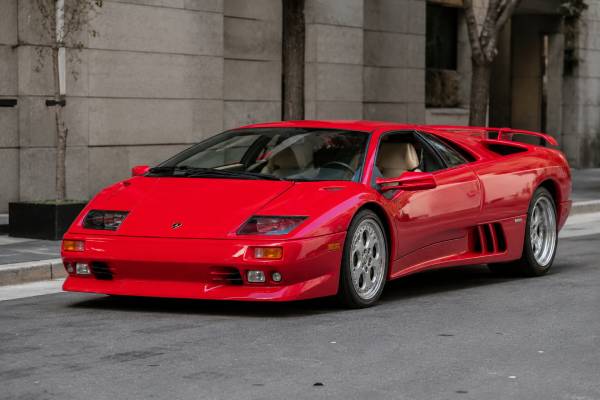
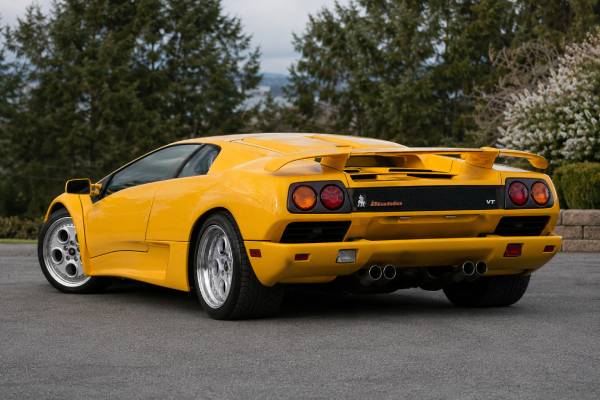
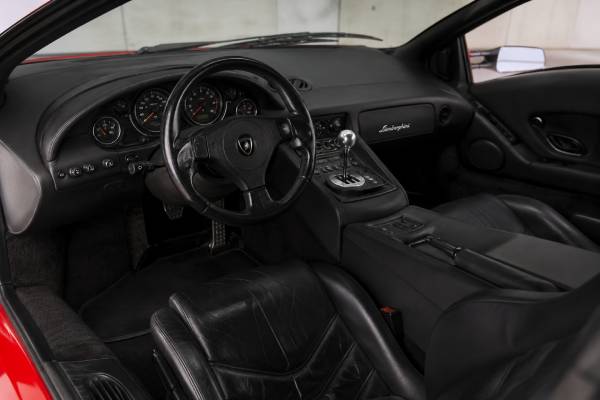
The 1999–2000 Lamborghini Diablo VT is the late 5.7-liter, variable-valve-timing version of Lamborghini’s P132 V12 supercar, built just before the Audi-reworked Diablo 6.0 arrived. It kept the raw Marcello Gandini-era shape, the gated five-speed manual, the longitudinal mid-mounted V12, and the Viscous Traction all-wheel-drive system, but gained the most important factory updates of the original-body Diablo line: fixed headlights, a redesigned cabin, 18-inch wheels, larger brakes, ABS, and a 530 hp version of the 5.7-liter V12.
For buyers and collectors, this VT matters because it sits in a narrow and desirable window. It is more usable and sorted than earlier Diablos, less common than the later 6.0 VT, and still carries the old-school Diablo character. It is dramatic, analog, difficult to fake properly, and expensive to correct when neglected.
Table of Contents
- Why the 1999 Diablo VT Matters
- V12 Specs, Chassis, and Performance Data
- Production, Versions, Options, and Identification
- Design, Engineering, and Diablo VT Details
- How the Diablo VT Drives
- Maintenance, Reliability, and Restoration Risks
- Market Values and Buying Checklist
Why the 1999 Diablo VT Matters
The 1999–2000 Diablo VT is best understood as the final evolution of the original 5.7-liter Diablo VT, not as the later Diablo VT 6.0. It combines the early Diablo’s dramatic shape and hand-built feel with late-model improvements that made the car easier to drive, stop, cool, and live with.
The Diablo began as Lamborghini’s Countach replacement under the P132 project. It had to keep Lamborghini’s V12 flagship identity while moving the company into the 1990s: more speed, more comfort, better high-speed stability, and a shape that still looked outrageous enough to sit above Ferrari and Porsche in the supercar imagination. The original Diablo arrived in 1990 as a rear-drive V12 coupe with more than 200 mph capability, no power steering at launch, and very little electronic help.
The VT arrived in 1993 and changed the car’s personality. “VT” stands for Viscous Traction, Lamborghini’s torque-splitting all-wheel-drive system. The car still felt rear-biased, but when the rear tires lost grip, the viscous coupling could send torque forward. That made the Diablo less intimidating in poor conditions and more secure under heavy throttle, especially compared with the rear-drive early cars.
The 1999 update is the reason this specific VT is so interesting. Lamborghini was newly under Audi Group ownership, but this model still predates the heavily revised Diablo 6.0. It received a meaningful facelift rather than a full redesign. The most visible change was the deletion of pop-up headlights in favor of fixed units. The cockpit also changed from the earlier cliff-like dashboard to a more integrated, modern shape. Mechanically, the 5.7-liter V12 gained variable valve timing and output rose to about 530 hp, with torque around 605 Nm. ABS also became part of the package, supported by larger brakes and 18-inch wheels.
That combination gives the late 5.7 VT a distinct identity:
- It is more refined than the 1993–1998 VT.
- It is rarer than the later Diablo 6.0 VT.
- It keeps the 5.7-liter engine rather than the 6.0-liter Audi-era development.
- It has the key late updates without losing the old Diablo feel.
- It is still a gated-manual, naturally aspirated V12 Lamborghini with no modern dual-clutch, stability-control, or touchscreen-dominated character.
The Diablo VT also sits in an important brand transition. It was one of the last Lamborghinis from the turbulent pre-modern era, yet it also received early benefits from improved quality expectations after Audi took control. For collectors, that makes the 1999–2000 VT more than a facelifted Diablo. It is a bridge between the wild Countach-descended era and the more disciplined Murciélago, Gallardo, and Aventador period that followed.
V12 Specs, Chassis, and Performance Data
The key specification is simple: a 5,707 cc naturally aspirated Lamborghini V12 with variable valve timing, mounted longitudinally behind the cabin and paired with a five-speed gated manual. The VT’s all-wheel-drive system adds weight, but it also gives the car better traction and a calmer high-speed character than the rear-drive SV.
| Category | Specification |
|---|---|
| Model | Lamborghini Diablo VT, late 5.7 VVT facelift |
| Project code | P132 Diablo family |
| Production period | 1999–2000 model-era, before Diablo VT 6.0 production became the main line |
| Body styles | Two-seat coupe and VT Roadster |
| Engine | 60-degree Lamborghini V12, aluminum alloy block and heads |
| Displacement | 5,707 cc / 5.7 liters |
| Bore x stroke | 87 mm x 80 mm |
| Valvetrain | DOHC, four valves per cylinder, chain drive, variable valve timing |
| Induction | Naturally aspirated |
| Fuel system | Sequential multi-point electronic injection |
| Compression ratio | 10.0:1 |
| Maximum power | 530 hp at 7,100 rpm |
| Maximum torque | 605 Nm at 5,500 rpm |
| Lubrication | Dry sump |
| Cooling | Pressurized water cooling with twin radiators and oil cooling |
| Transmission | Five-speed manual with gated shifter |
| Drivetrain | Viscous Traction all-wheel drive |
| Clutch | Hydraulically operated dry single-plate clutch |
The chassis layout is classic Diablo. The V12 sits longitudinally behind the cabin, and the gearbox runs forward in the traditional Lamborghini fashion. The frame uses high-strength steel rectangular tubing, while the body combines aluminum alloy panels and composite materials. By modern carbon-tub standards it is not light, but it is strong, dramatic, and very much part of the car’s character.
| Area | Detail |
|---|---|
| Wheelbase | 2,650 mm |
| Length | About 4,470 mm |
| Width | About 2,040 mm |
| Height | About 1,115 mm for Roadster; coupe figures vary slightly by source and market |
| Weight | About 1,625 kg |
| Weight distribution | About 43/57 front/rear |
| Suspension | Independent front and rear unequal-length wishbones with anti-roll bars |
| Dampers | Electronically controlled shock absorber system on VT models |
| Steering | Power-assisted rack and pinion |
| Front brakes | Ventilated and drilled discs, about 355–365 mm depending on specification |
| Rear brakes | Ventilated and drilled discs, about 335 mm |
| ABS | Kelsey-Hayes / Lucas-derived ABS on facelift cars |
| Front tires | 235/35 ZR18 on many facelift VT Roadsters |
| Rear tires | 335/30 ZR18 on many facelift VT Roadsters |
| Top speed | About 335 km/h / 208 mph |
| 0–100 km/h | About 3.9–4.0 seconds |
| Fuel capacity | About 100 liters / 26 US gallons |
| Luggage capacity | About 140 liters |
Figures vary slightly between coupe, Roadster, market, and source, especially where horsepower is expressed as PS, bhp, or hp. The practical takeaway is that the facelift VT is a 530 hp-class Diablo with genuine 200 mph potential and much stronger braking hardware than early cars.
Production, Versions, Options, and Identification
The late 5.7 VT is collectible partly because exact numbers are small and partly because the model is easy to confuse with earlier VTs, VT Roadsters, SVs, and later 6.0 VTs. A buyer should identify the body style, model year, VIN, factory equipment, and market specification before discussing value.
The facelifted Diablo range included the SV, VT coupe, VT Roadster, GT, and then the later VT 6.0. The car covered here is the 5.7-liter VT with variable valve timing, not the 6.0-liter VT. That distinction matters because the 6.0 has different bodywork, a larger engine, a more Audi-influenced development phase, and a different market position.
For the 1999 VT coupe, production was very limited, and reliable model-specific totals are often quoted as approximate rather than absolute. Many references place facelift VT coupe production around the low hundreds, while the facelift VT Roadster is commonly described as about 100 units, with the Millennium Roadster counted separately in some tallies. Because Lamborghini documentation and later registry data can vary, provenance matters more than repeating a single neat number.
Key late 5.7 VT identifiers include:
- fixed exposed headlights rather than pop-up headlights
- redesigned integrated dashboard
- 18-inch wheels
- standard ABS
- larger brake package
- 5.7-liter V12 with variable valve timing
- gated five-speed manual
- VT all-wheel drive
- late-style front and rear treatment on certain market cars
- vertical rear brake ducts on U.S.-specification VT coupes
The Roadster has its own identification points. It uses a removable roof panel and a different engine-cover arrangement to allow roof storage and cooling. The body has larger side and upper intakes than the coupe, and the front bumper and brake duct treatment differ from earlier fixed-roof cars. On the late Roadster, the 18-inch wheel and VVT engine package makes it especially desirable.
Important versions near this model
| Variant | Main difference | Buyer relevance |
|---|---|---|
| 1993–1998 Diablo VT | Earlier AWD car, pop-up headlights, lower-output 5.7 V12 | Usually less expensive, but more old-school and less updated |
| 1999–2000 Diablo VT 5.7 VVT | Facelifted 5.7 VT with fixed lights, VVT, ABS, 18-inch wheels | The focus of this guide; rare and highly usable for a 5.7 Diablo |
| 1999–2000 Diablo VT Roadster 5.7 VVT | Open-top VT with removable roof and late 5.7 VVT updates | More theatrical and often more valuable than the coupe |
| Diablo SV MY1999 | Rear-drive, lighter, more aggressive personality | Appeals to drivers who prefer sharper rear-drive behavior |
| Diablo GT | Track-focused, 6.0-liter, rear-drive, very low production | Much rarer and usually far more expensive |
| Diablo VT 6.0 | Larger 6.0-liter V12, revised body and more Audi-era polish | More modern and often more valuable, but a different car |
Factory options and market equipment can affect desirability. A rear wing may be original, dealer-installed, or later added. Audio upgrades, carbon trim, luggage, special colors, and market-specific bumpers can all influence value if properly documented. The 1999 Alpine Edition, for example, was a U.S.-market special tied to Alpine audio equipment and trim details, not a mechanical performance package.
The strongest cars have complete ownership records, factory books, tools, original paint where possible, correct wheels, known service history, and no unexplained modifications. A non-original exhaust is common and not always fatal to value, but missing original parts should lower the price because Diablo-specific parts are expensive and can be slow to source.
Design, Engineering, and Diablo VT Details
The late Diablo VT looks cleaner and more modern than the early car, but it still has the same wide, low, wedge-shaped violence that made the Diablo famous. The fixed headlights, reshaped details, and updated interior sharpened the car without turning it into the smoother, more polished Diablo 6.0.
Marcello Gandini’s original design language remains obvious: cab-forward proportions, a low nose, huge side intakes, scissor doors, a broad rear deck, and a stance that makes almost any modern sports car look narrow. Chrysler-era final surfacing softened some of Gandini’s harder proposal details, but the Diablo still feels like a Countach successor rather than a polite grand tourer.
The 1999 facelift changed the front identity. The exposed headlight assemblies removed the older pop-up look and gave the car a more contemporary face. Some enthusiasts prefer the drama of pop-up lights, but the fixed-light cars have their own appeal because they mark the final development stage of the 5.7 Diablo body.
The cabin update is just as important. Earlier Diablos have a high, abrupt dashboard and a more kit-like sense of layout. The facelift interior uses a smoother, integrated dashboard that feels more finished and more usable. It still is not a modern ergonomic benchmark. The driving position is low and offset, rear visibility is limited, the nose is difficult to judge, and the cabin can become hot in traffic. But the late dashboard makes the car feel less crude without removing the sense of occasion.
Engineering details that define the VT include:
- Viscous Traction AWD: The system is not a modern active torque-vectoring setup. It is a mechanical traction aid designed to send torque forward when rear slip occurs.
- Rear-biased feel: The car does not drive like a front-led AWD car. The rear tires still dominate the experience.
- Dry-sump V12: The lubrication system helps manage oil supply during high lateral loads and allows better packaging.
- Electronic dampers: The VT’s adjustable damping was advanced for its time, but age and service history now matter more than original showroom novelty.
- Large cooling needs: The Diablo’s side intakes, radiators, oil cooling, and engine-bay airflow are not decoration. Cooling system condition is central to reliability.
- Massive rear tires: The 335-section rear tires are a major part of the car’s stance, grip, and replacement-cost reality.
The sound is one of the car’s defining features. At low speed the V12 has a heavy mechanical presence, with intake noise, cam-chain character, clutch sound, and exhaust resonance all mixing together. At higher rpm it becomes harder-edged and more urgent. A stock exhaust keeps the car more valuable and less tiring; an aftermarket system may sound spectacular, but it can drone, trigger heat issues, or hurt collectability if the original parts are gone.
How the Diablo VT Drives
The late Diablo VT is fast, physical, wide, and surprisingly secure once moving, but it is never casual. It rewards calm inputs, warm fluids, fresh tires, and a driver who respects how much mass and width sits behind the cabin.
The V12 is the centerpiece. It does not feel turbocharged, boosted, or artificially sharpened. Response builds directly with throttle angle and revs. Below the midrange, the car is tractable but still heavy and mechanical. Above 4,000 rpm, it feels alive; toward the top end, the 5.7 VVT engine pulls with a clean, hard edge that suits the car’s personality.
The five-speed gated manual is a major part of the appeal. It should feel mechanical rather than light. A healthy car has a deliberate shift action, and the best results come from unhurried movements through the gate. Cold second-gear stiffness is common on many older exotics, but serious grinding, jumping out of gear, or a vague linkage should be treated as a major inspection point.
The VT all-wheel-drive system makes the car easier to deploy than a rear-drive Diablo, especially on imperfect roads. It does not make the car small. You still manage a very wide body, large rear tires, a long rear section, and limited visibility. The front end can feel heavy compared with an SV, and the steering is more assisted than the earliest Diablos, but the tradeoff is confidence. On fast roads, the VT feels planted and stable.
Ride quality is firm but not impossibly harsh when the suspension is healthy. Tired dampers, old tires, incorrect alignment, and aged bushings can make the car feel nervous or crashy. A properly sorted late VT should not feel loose or frightening at normal speeds. If it does, assume deferred maintenance before blaming the original design.
Braking is much improved over earlier expectations. The facelift car’s larger discs and ABS make it more usable in real traffic and more reassuring at speed. Still, brake feel is period-correct, not modern carbon-ceramic. The pedal should be firm and consistent. Pulsation, pulling, ABS warning lights, or a long pedal require investigation.
Daily usability is limited but not nonexistent. The car can be driven in traffic, but clutch heat, cooling-system health, visibility, cabin temperature, and ride height all matter. The front overhang and low body demand care. The Roadster adds open-air drama, but also more attention to seals, roof-panel fit, wind noise, and storage condition.
The best description is simple: the Diablo VT is not the sharpest Diablo, not the lightest Diablo, and not the most modern Diablo. It may be the best-balanced 5.7-liter Diablo for someone who wants drama, usability, rarity, and a real analog V12 experience in one car.
Maintenance, Reliability, and Restoration Risks
A Diablo VT is reliable only when treated like a hand-built V12 exotic with age-sensitive systems, specialist service needs, and expensive parts. Neglected cars can look spectacular in photos and still require six-figure corrective work.
The engine itself is strong when maintained properly. The danger is not that every V12 is fragile; it is that heat, age, old hoses, poor storage, incorrect repairs, and deferred service create expensive failure chains. Cooling issues, fuel-system deterioration, oil leaks, electrical faults, and clutch wear are more important than ordinary used-car mileage.
Common inspection areas include:
- cooling hoses, radiators, fans, thermostat operation, and signs of overheating
- oil leaks around the dry-sump system, cam covers, lines, and seals
- fuel hoses, injectors, pumps, tanks, and old rubber components
- clutch condition, release behavior, hydraulic system, and service records
- gearbox synchros, linkage adjustment, and differential noise
- front drivetrain components on VT cars, including viscous coupling behavior
- suspension dampers, actuators, bushings, ball joints, and alignment condition
- brake discs, calipers, ABS operation, hoses, and fluid age
- wiring harness condition, warning lights, alternator output, and battery drain
- air-conditioning performance and control operation
- headlight, window, wiper, and dashboard switchgear function
- roof seals, roof hardware, and engine-cover fit on Roadsters
The clutch is a major cost driver. A Diablo clutch can last a long time in skilled hands, but parking maneuvers, hill starts, traffic, and show-car loading can wear it quickly. A car with low mileage but many short-distance movements may have more clutch wear than expected.
Electrical issues deserve respect. The Diablo comes from an era before Lamborghini’s modern production discipline, and many cars have had alarm systems, stereo equipment, battery tenders, aftermarket exhaust electronics, or old repairs added over decades. A tidy, original wiring loom is valuable. A car with mystery switches, nonfunctional warning lights, or spliced wiring should be priced carefully.
The Roadster adds extra risk. Check the removable roof panel, seals, latches, storage mounts, water entry, wind noise, and any marks on the rear deck from roof storage. Replacement or correction of Roadster-specific parts can be difficult.
Body and chassis condition are critical. The Diablo uses aluminum and composite panels over a steel structure, so accident repair quality matters more than ordinary corrosion talk. Look for uneven panel gaps, overspray, repaired composite edges, cracked mounting areas, non-original fasteners, poor paint match, and signs that the car has been lifted incorrectly. A proper pre-purchase inspection should include underside examination on a lift by a Lamborghini specialist.
Documentation is not optional. A strong Diablo file should include service invoices, mileage trail, ownership history, books, tools, key sets, emissions documents where relevant, and proof of major service work. For a collector-grade car, originality and paperwork can be as important as mechanical condition.
Market Values and Buying Checklist
The late 5.7 Diablo VT now sits in a serious collector market, not a depreciated exotic market. Values depend heavily on body style, mileage, originality, color, documentation, market specification, and recent specialist maintenance.
As of the current collector-car market, driver-quality early VTs often trade below the best late Roadsters and exceptional 6.0 VTs. The 1999–2000 VT Roadster is usually the stronger-value version of the 5.7 VVT cars because it combines open-top rarity with the final 5.7 updates. Coupe values are harder to generalize because public sales are less frequent, and the difference between an average car and an outstanding car can be very large.
A practical value view is:
| Type of car | Typical market behavior | Buyer note |
|---|---|---|
| Project or neglected VT | May appear tempting but can become the most expensive car to own | Avoid unless priced far below market and inspected by a specialist |
| Driver-quality coupe | Often valued below top Roadsters and 6.0 VTs | Best choice for use if history is strong and cosmetics are honest |
| Low-mileage original coupe | Harder to price because sales are infrequent | Documentation, paint, and original parts matter heavily |
| Late VT Roadster | Usually commands a premium over comparable coupes | Roof condition, seals, and originality are major value drivers |
| Special specification or rare color | Can outperform standard colors if factory-documented | Verify through records, not seller description alone |
| Modified car | Value depends on reversibility and quality | Missing original exhaust, wheels, or trim should affect price |
Do not buy a Diablo VT on mileage alone. A 2,000-mile car with old fluids, ancient tires, weak hydraulics, and no recent major service can be worse to own than a 15,000-mile car maintained by a known specialist. Storage history matters because long inactivity damages fuel systems, seals, batteries, tires, and brake components.
Buyer inspection checklist
Before committing, verify these items in order:
- Confirm VIN, model year, market specification, and whether the car is a true late 5.7 VVT VT.
- Check whether it is a coupe, Roadster, Alpine Edition, or another special specification.
- Review service records for clutch work, cooling-system renewal, brake work, suspension service, and recent fluids.
- Confirm the condition and age of tires, not just tread depth.
- Inspect paint depth, panel gaps, underbody condition, and evidence of accident repair.
- Test all electrical systems, including windows, lights, warning lamps, HVAC, stereo, and fans.
- Check for leaks after warm-up and after the road test.
- Drive the car from cold and hot, noting clutch take-up, gearbox synchros, steering, braking, and cooling behavior.
- Confirm original books, tools, spare items, roof hardware for Roadsters, and any removed factory parts.
- Get a written inspection from a Lamborghini specialist before negotiating final price.
Examples to seek and avoid
Seek a car with known ownership, original body panels, correct wheels, stock or reversible exhaust, recent major service, clean wiring, functioning ABS, healthy cooling, and complete accessories. A Roadster should include a properly fitting roof panel and clean seal condition.
Avoid cars with vague import history, missing VIN documentation, unexplained mileage gaps, hot-running behavior, gearbox noise, heavy clutch slip, warning lights that do not illuminate during bulb check, cheap repaint work, poorly installed audio or alarm systems, and sellers who cannot explain when the car was last serviced by someone qualified.
Long-term collectability looks strong. The Diablo VT has the right ingredients: naturally aspirated V12, manual gearbox, scissor doors, low production, brand significance, and a direct connection to Lamborghini’s pre-modern era. The best late 5.7 VVT cars should remain desirable because they offer a rare mix of usability and rawness. The wrong car, however, can erase any market upside through repair costs. Buy condition and history first, color and mileage second.
References
- Lamborghini Diablo’s 30th anniversary with Cesare Cremonini 2020
- Lamborghini Diablo VT MY1999 Guide & History | LamboCARS.com 2010
- Lamborghini Diablo VT Roadster MY1999 – Specs & Performance – LamboCars 2015
- 1999 Lamborghini Diablo VT | Arizona 2017 | RM Sotheby’s 2017
- Lamborghini Diablo VT Market – CLASSIC.COM 2026
Disclaimer
This article is for informational purposes only and is not a substitute for professional diagnosis, repair advice, valuation advice, or a specialist pre-purchase inspection. Specifications, torque values, service intervals, repair procedures, equipment, and market details can vary by VIN, market, body style, production date, and individual vehicle history. Always verify important details against official service documentation, factory records, and a qualified Lamborghini specialist.
If this guide helped you, please share it on Facebook, X/Twitter, or your favorite car community to support our work.