
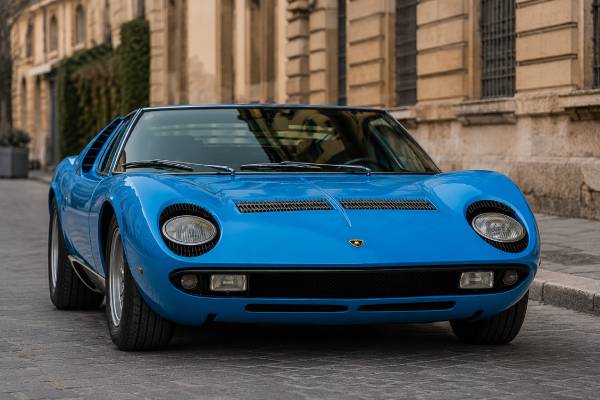
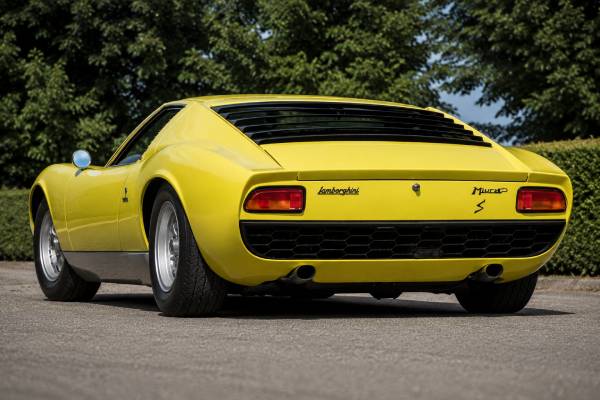
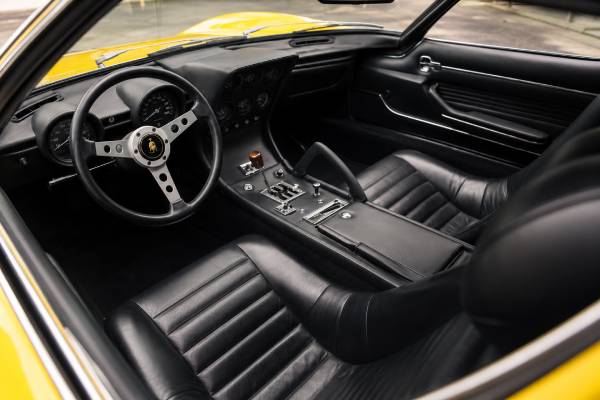
The Lamborghini Miura P400 is the car that turned Lamborghini from a fast grand-tourer maker into the company most closely linked with the mid-engine supercar. Built around the Tipo L105 chassis and the transversely mounted L406 V12, the original P400 placed a 3.9-liter twelve-cylinder engine behind the seats at a time when most serious road cars still followed a front-engine GT layout. The result was low, dramatic, loud, demanding, and genuinely new.
For collectors, the P400 matters because it is the earliest Miura and the purest version of the concept. For enthusiasts, it matters because it explains so much of what came later: the Countach, Diablo, Murciélago, Aventador, and modern Lamborghini identity all trace part of their character back to this car. Buying one today is not normal classic-car shopping. It is an authenticity, documentation, restoration-quality, and specialist-inspection exercise.
Table of Contents
- Why the Original Miura P400 Still Matters
- L406 V12 Specs, Chassis, and Performance Data
- Production Identity and Factory-Correct Details
- Bertone Bodywork and Transverse V12 Engineering
- What the Miura P400 Feels Like to Drive
- Maintenance, Restoration, and Known Miura Risks
- Market Values, Authenticity, and Buying Checks
Why the Original Miura P400 Still Matters
The Miura P400 matters because it made the mid-engine layout desirable, glamorous, and commercially real in a production road car. It was not Lamborghini’s first car, but it was the model that gave the brand its lasting supercar personality.
Lamborghini had already built elegant front-engine grand tourers such as the 350 GT and 400 GT. Those cars proved that Ferruccio Lamborghini could challenge established Italian luxury-performance brands, but they did not rewrite the sports-car rulebook. The Miura did. When it appeared publicly at the 1966 Geneva Motor Show, its proportions alone made older GTs look conventional: low nose, cab-forward cockpit, broad rear haunches, and a V12 placed between the driver and rear axle.
The P400 name explains the concept. “P” stands for posteriore, referring to the rearward engine position, and “400” refers to the approximate four-liter displacement. The car used Lamborghini’s V12 architecture in a layout inspired by racing practice, but it was sold as a road car with leather, a full cabin, luggage space, and the visual drama of Italian coachbuilding.
Its creation also shows why the Miura feels different from later, more formal supercars. A young engineering team, closely associated with Gian Paolo Dallara, Paolo Stanzani, and Bob Wallace, developed a compact chassis and drivetrain package that pushed Lamborghini beyond the traditional front-engine GT formula. Bertone then clothed the mechanical layout in a body shaped under Marcello Gandini’s direction. The result was both technically radical and visually soft enough to look beautiful rather than brutal.
The P400 sits at the beginning of the Miura line. Later P400 S and P400 SV versions gained power, comfort, detail changes, and important mechanical revisions, but the earliest P400 remains the car that introduced the idea. Its appeal is therefore not only speed or rarity. It is the combination of first-series identity, Bertone design, early Lamborghini engineering, and the unfiltered character of a machine created before the supercar formula became standardized.
Today the P400 is collectible for several linked reasons:
- It is the first production Miura variant and the closest to the original show-car idea.
- It carries the famous “eyelash” headlight surrounds, one of the model’s defining visual signatures.
- It uses the early shared engine and gearbox lubrication layout, important for authenticity but also relevant to maintenance risk.
- It belongs to the short, hand-built period when Lamborghini was still a small manufacturer rather than a global luxury group.
- It has deep concours relevance, especially when restored to correct factory colors, trim, and mechanical specification.
The Miura was not a race car adapted for the road, and it did not build its reputation through factory motorsport success. Its significance is broader. It changed what wealthy road-car buyers expected a flagship performance car to look like, where its engine should be, and how dramatic a road car could feel.
L406 V12 Specs, Chassis, and Performance Data
The P400’s key specification is simple: a 3.9-liter naturally aspirated V12 mounted transversely behind the cabin, driving the rear wheels through a five-speed manual gearbox. The details matter because originality, drivability, cooling, lubrication, and service cost all depend on this unusual layout.
| Item | Specification |
|---|---|
| Model | Lamborghini Miura P400 |
| Internal type | Tipo L105 chassis, L406 V12 engine |
| Production era | 1966–1969, with some sources separating regular P400 production from later P400 S introduction |
| Engine | 60-degree naturally aspirated V12 |
| Displacement | 3,929 cc |
| Bore x stroke | 82 mm x 62 mm |
| Induction | Four triple-choke Weber carburetors |
| Output | 350 hp at 7,000 rpm |
| Torque | 355 Nm at 5,000 rpm |
| Transmission | Five-speed manual transaxle |
| Drivetrain | Rear-wheel drive |
| Engine layout | Transverse mid-engine, behind the seats and ahead of the rear axle |
| Claimed 0–100 km/h | About 6.7 seconds |
| Claimed top speed | About 280 km/h |
| Factory-listed curb weight | About 985 kg in period manufacturer data |
The L406 engine is a development of Lamborghini’s early V12 family, but the Miura installation is what makes it special. Instead of sitting lengthwise in front of the cabin, the V12 is turned sideways and mounted low behind the seats. This keeps the wheelbase short and gives the Miura its compact side profile, but it also makes heat control, access, and lubrication more complex than on a conventional front-engine GT.
The gearbox and engine are packaged as a compact assembly. On early Miuras, the engine and transmission share lubrication, a clever packaging solution but one that makes oil quality, contamination control, and correct rebuilding especially important. Later Miura SV production moved to separate lubrication, which is one reason the SV is often considered more developed mechanically. For a P400 buyer, the shared-sump layout is not a defect by itself. It is part of the car’s original engineering. It simply requires informed maintenance.
| Area | P400 detail |
|---|---|
| Body design | Bertone coupe body styled under Marcello Gandini |
| Body structure | Steel central structure with lightweight front and rear body sections |
| Suspension | Independent suspension with coil springs and telescopic dampers |
| Steering | Unassisted rack-and-pinion |
| Brakes | Four-wheel disc brakes |
| Wheels and tires | Period 15-inch center-lock wheels with high-speed 205-section tires |
| Wheelbase | About 2,500 mm |
| Overall length | About 4,360 mm |
| Overall width | About 1,760 mm |
| Overall height | About 1,100 mm |
The figures still look serious, but the numbers need period context. A 280 km/h top-speed claim in the late 1960s placed the Miura among the fastest road cars in the world. The 0–100 km/h figure is quick rather than shocking by modern standards, but modern comparison misses the point. The P400 delivered that pace with carburetors, no electronic safety net, narrow tires by current standards, no power steering, and a cabin placed close to the front axle.
Production Identity and Factory-Correct Details
The P400 is the first Miura series, but production numbers and year boundaries need careful handling because early Lamborghini records, later registrations, and transitional cars do not always align neatly. A buyer should treat identity as a document-backed question, not a detail to assume from a sales description.
Most accepted histories put the original P400 before the P400 S and SV, with total Miura production across all versions a little over 760 cars. Lamborghini’s own modern history material gives official production context for the P400, S, and SV, while many registries and market sources count early cars and transitions slightly differently. For the buyer, the exact lesson is practical: verify the chassis number, engine number, body number, original color, original interior, delivery date, and market specification against factory documentation.
The P400’s desirability comes from its early-series purity. Compared with later versions, it usually has the cleaner original cabin treatment, the famous eyelash headlights, and fewer luxury additions. The P400 S added more comfort, more power, and detail changes. The SV later brought wider rear bodywork, revised suspension, wider rear tires, more power, and, on later cars, separate engine and gearbox lubrication.
Important P400 identification points
A correct P400 should be checked through several layers, not one visible feature. The following items matter most:
- Chassis identity: The chassis number should match factory records and the car’s known history.
- Engine identity: A matching or correct-type L406 V12 is a major value factor.
- Body-number consistency: Hand-built bodywork means body numbers and panel history deserve close inspection.
- Original color and trim: Factory colors and interior materials can strongly affect value, especially if rare or attractive.
- Early-series details: Eyelash headlights, early trim, dashboard details, switches, wheel type, carburetor specification, and period-correct finishes all matter.
- Market equipment: Lighting, instruments, bumpers, and compliance changes may differ depending on destination market.
- Restoration evidence: A beautiful restoration is not enough; it must be correct in the details.
Factory documentation is central to a serious purchase. Lamborghini Polo Storico certification, historical archive support, older registration documents, invoices, restoration photography, specialist reports, and concours judging records all add confidence. A car with missing documentation may still be good, but the price should reflect the added uncertainty.
Colors, interiors, and special-order appeal
Miuras are especially sensitive to color because the body shape depends so much on surface and proportion. Bright period colors such as orange, lime green, yellow, and red suit the car’s theatrical nature, while silver, blue, and darker shades can make it look more elegant and less poster-like. Originality usually wins over personal taste. A factory-correct repaint in the original color is usually preferable to a fashionable color change, even when the new shade is desirable.
Interior originality is just as important. Seat pattern, dashboard material, gauges, switchgear, steering wheel, carpets, door panels, and headliner condition should all be assessed. A retrimmed cabin can look fresh but still lose value if the grain, stitching, perforation, color, or hardware is wrong.
Because early Miuras were hand-built, small differences are normal. That does not mean every deviation is acceptable. The best cars have an explanation for their details, backed by records rather than assumptions.
Bertone Bodywork and Transverse V12 Engineering
The Miura looks the way it does because the whole car was packaged around a transverse mid-mounted V12. Its beauty is not decoration added after engineering; it is the visible result of a radical mechanical layout.
The front is extremely low because the engine is not there. The cockpit sits forward, the windshield is raked, and the rear body swells around the engine bay. The long front lid, low roof, and broad rear section create tension from every angle. The headlights, with their black “eyelash” surrounds, give the P400 a face no later Lamborghini quite repeated.
Bertone’s body also solved practical problems. The rear clamshell gives access to the engine area, while the rear window louvers help release heat. Side intake openings feed the engine bay and add visual drama. The front and rear body sections are light and delicate compared with modern structures, which is part of the car’s charm and part of its restoration difficulty.
Inside, the Miura is more intimate than its reputation suggests. It is not a large car. The driver sits low, with pedals offset by the wheel wells and the engine directly behind the cabin. The main gauges are simple and prominent, and the view forward over the low nose is one of the car’s great pleasures. Rear visibility, cabin heat, and noise are part of the experience rather than problems that can be engineered away without changing the car’s character.
Why the transverse V12 was so bold
A transversely mounted V12 in a road car created several advantages:
- It kept the wheelbase compact.
- It concentrated mass near the center of the car.
- It gave the body its low nose and dramatic proportions.
- It separated the Miura from front-engine rivals immediately.
It also created compromises:
- Engine-bay heat is significant.
- Service access is tight.
- Carburetor tuning requires expertise.
- The shared lubrication system on early cars demands careful oil discipline.
- Noise and vibration reach the cabin easily.
- Cooling-system health is critical in traffic and hot weather.
This balance of brilliance and compromise is central to the P400. Later supercars refined the formula. The Miura invented much of the emotional template.
Sound and sensory character
The Miura’s sound is not only exhaust noise. Much of the drama comes from intake, valvetrain, carburetors, and the fact that the engine sits just behind the occupants. At low speed it can feel mechanical and busy. At higher revs the V12 becomes smoother, harder, and more urgent. Compared with later Lamborghinis, the P400 is less insulated and less theatrical by design. It does not need drive modes, valves, or amplification. The mechanical layout does the work.
That sensory quality is one reason originality matters. Exhaust changes, incorrect carburetors, poor engine mounts, modern sound insulation, and non-standard cooling modifications can alter how the car feels. Sensible upgrades may improve usability, but collectors should know exactly what has changed and whether the original parts remain with the car.
What the Miura P400 Feels Like to Drive
A good Miura P400 feels fast, alive, hot, and physical, but it does not drive like a modern supercar. It rewards mechanical sympathy more than aggression.
The first lesson is warm-up. The V12 should not be rushed from cold. Oil temperature, coolant temperature, carburetor behavior, and gearbox feel all improve after the car has settled. A well-sorted P400 will idle cleanly once warm and pull strongly, but carbureted engines respond to setup, weather, fuel quality, and recent use. A poorly tuned car can feel flat, smoky, hesitant, or uneven.
The throttle response is one of the great pleasures. The engine does not deliver modern turbocharged torque, but it builds speed with a sharp, clean rise through the rev range. The sound hardens as the revs climb, and the car feels lighter and more focused once moving quickly. Period performance figures only tell part of the story. The engine’s location, induction noise, low seating position, and exposed controls make ordinary acceleration feel special.
The five-speed gearbox should feel mechanical and deliberate. It is not a quick modern shift, and forcing it when cold is a mistake. Synchro condition, clutch adjustment, engine tune, and linkage setup all affect the experience. A heavy or obstructive gearbox may be normal when cold, but persistent grinding, jumping out of gear, or major noise under load points to expensive work.
Steering is unassisted, so effort is high at parking speed. Once moving, the steering becomes one of the car’s strengths: direct, detailed, and more delicate than the Miura’s wild appearance suggests. The short wheelbase and mid-engine balance make the car feel alert, but old tires, tired dampers, worn bushings, or poor alignment can make it nervous.
Brakes should be judged by period standards. A P400 cannot be driven like a modern carbon-ceramic supercar. Pedal effort, braking distance, fade resistance, and tire grip all reflect 1960s technology. Fresh tires, correct hydraulic condition, rebuilt calipers, good pads, and properly set suspension make a huge difference.
In normal use, the Miura is demanding:
- The cabin can get hot.
- Rear visibility is limited.
- Ground clearance is low.
- The clutch can be heavy.
- The steering is slow at parking speeds.
- Carburetors dislike neglect.
- Traffic exposes cooling weaknesses.
- The car feels wide and precious on narrow roads.
On an open road, though, a sorted P400 makes sense. It flows rather than attacks. The car is at its best when the driver works with the gearbox, keeps the engine in its happy range, and treats the chassis with respect. It is not a machine for careless late braking or abrupt throttle lifts. It is a high-value, mid-engine classic with real performance and a very small margin for neglect.
Maintenance, Restoration, and Known Miura Risks
Miura ownership is specialist ownership. Reliability depends less on the model’s reputation and more on whether a specific car has been restored, maintained, and driven by people who understand early Lamborghinis.
The engine itself is strong when properly built, lubricated, cooled, and tuned. The danger is not the V12 concept; it is age, poor previous work, long storage, overheating, incorrect parts, and deferred maintenance. A Miura that has spent years as a static collection piece may need major recommissioning before it can be used safely.
Mechanical areas that need close attention
- Lubrication: Early shared engine and gearbox lubrication makes correct oil choice, cleanliness, and rebuild quality critical.
- Cooling system: Radiator condition, fans, hoses, water pump, thermostat function, and coolant flow must be excellent.
- Carburetors: Weber setup affects starting, idle, throttle response, plug condition, fuel smell, and drivability.
- Ignition: Distributors, coils, leads, plugs, timing, and advance curves need specialist setup.
- Fuel system: Old tanks, pumps, lines, filters, and carburetor seals can create both drivability problems and fire risk.
- Gearbox: Synchros, bearings, selector adjustment, and oil contamination can turn into major rebuild costs.
- Clutch: Heavy action, slipping, judder, or poor release may indicate wear or setup problems.
- Suspension: Bushings, dampers, springs, wheel bearings, and alignment affect both safety and value.
- Brakes: Calipers, hoses, master cylinder, servo, discs, and fluid condition should be treated as safety-critical.
- Wheels and hubs: Center-lock hardware must be correct, undamaged, and properly maintained.
Body, chassis, and restoration risks
The most expensive Miura problems often sit in the structure and bodywork. Corrosion, accident repairs, heat damage, poor panel fit, and incorrect restoration details can cost more than a buyer expects. The Miura’s body is complex, low, and hand-finished. Restoring one correctly is not the same as repainting an ordinary classic coupe.
Key inspection areas include:
- Front chassis sections and suspension pickup points
- Sills, floors, lower bulkheads, and inner structures
- Rear chassis areas near the engine and suspension
- Door fit, clamshell fit, and panel gaps
- Evidence of old collision repair
- Heat damage around the engine bay
- Correct louvers, grilles, hinges, catches, and trim
- Previous paint thickness and filler use
- Signs that body panels came from another car
A shiny Miura can still be a poor car. Thick paint, incorrect seams, missing body numbers, uneven panel gaps, and undocumented “restoration” work are warning signs. The best restorations are supported by photographs, invoices, parts records, and expert names. Even then, the work should be inspected independently.
Originality versus usability is a real decision. Some owners add improved cooling fans, discreet ignition upgrades, modern tire choices, or small reliability improvements. These may make the car easier to use, but they should be reversible and documented. Major modifications, engine swaps, color changes, non-original interiors, or incorrect body changes can reduce collector appeal.
Parts availability is better than it once was for some items, partly because high values justify careful reproduction and factory heritage support. That does not make ownership easy. Correct parts can still be expensive, slow to source, or dependent on specialist networks. Labor is the larger issue. A Miura should be maintained by a workshop with direct experience in early Lamborghini V12 cars.
Market Values, Authenticity, and Buying Checks
A Miura P400 is now a seven-figure collector car, and the best examples trade on authenticity, condition, provenance, and restoration quality more than mileage alone. The cheapest car is rarely the safest buy.
Market guides and recent auction data place ordinary-to-good P400 examples around the high six figures to low seven figures, with strong cars commonly above that and exceptional examples commanding much more. Recent public sales and market benchmarks often show P400 values around the $1.5 million to $2 million range, while rarer, better-restored, better-documented, or more desirable Miura variants can exceed that significantly. Exact value changes with currency, venue, color, originality, restoration standard, and buyer confidence.
The P400 does not always bring the same money as the ultimate SV, but it has its own collector logic. It is the original form of the Miura, and early-series purity has become increasingly important as top collectors look beyond simple horsepower rankings.
| Value factor | Why it matters |
|---|---|
| Factory identity | Correct chassis, engine, body, color, trim, and delivery records reduce risk |
| Matching numbers | A correct original engine and drivetrain can add major value |
| Restoration quality | Correct specialist work is valuable; cosmetic-only work can hide expensive problems |
| Original color | Factory-correct colors are usually preferred over later fashion changes |
| Provenance | Known ownership, period records, and event history strengthen confidence |
| Certification | Factory heritage verification or respected specialist documentation improves trust |
| Mechanical freshness | A recently and correctly serviced car can be safer than a dormant display car |
| Completeness | Tools, books, records, original parts, and rare trim pieces matter |
Buyer inspection checklist
A serious pre-purchase inspection should include these steps:
- Confirm chassis, engine, gearbox, and body numbers against factory or specialist records.
- Review ownership history, old titles, registration papers, invoices, photographs, and restoration files.
- Check whether the car has Lamborghini Polo Storico documentation or can be submitted for certification.
- Inspect the chassis and body on a lift with a Miura specialist, not a general classic-car shop.
- Measure paint thickness and look for filler, poor repairs, corrosion, and panel replacement.
- Verify carburetor type, ignition equipment, wheels, interior trim, instruments, lights, and early-series details.
- Test the cooling system, fans, oil pressure, charging system, fuel system, and hot restart behavior.
- Drive the car long enough to assess gearbox, clutch, brakes, steering, temperature stability, and suspension behavior.
- Budget for immediate service even if the car appears ready to use.
- Confirm that any upgrades are documented, reversible, and supplied with original parts where possible.
Cars to seek are documented, structurally sound, mechanically fresh, and correct in color and trim. Cars to avoid are those with uncertain identity, missing engine history, poor panel fit, heavy cosmetic restoration, vague auction descriptions, no specialist invoices, or “fresh paint” with no structural evidence.
Long-term collectability looks strong because the P400 is not just another rare Lamborghini. It is the origin point of the brand’s mid-engine road-car identity and one of the most important Italian cars of the 1960s. That does not make every example a good investment. The spread between a correct car and a compromised car can be enormous, and restoration costs can overtake any apparent discount quickly.
The best buying advice is direct: buy the most authentic, best-documented, best-inspected P400 you can afford, and keep enough budget for expert care after purchase. A Miura rewards patience, but it punishes shortcuts.
References
- Lamborghini History – Miura | Lamborghini.com 2026 (Manufacturer History)
- Lamborghini Miura – Technical Specifications, Pictures, Performance 2026 (Manufacturer Specifications)
- Lamborghini Miura: The first Supercar in history 2026 (Manufacturer History)
- 1969 Lamborghini Miura P400 | Hagerty Valuation Tool® 2026 (Valuation Guide)
- Lamborghini Miura – P400 Market – CLASSIC.COM 2026 (Auction Market Database)
Disclaimer
This article is for informational purposes only and is not a substitute for professional diagnosis, repair, valuation, or restoration advice. Specifications, torque values, service intervals, procedures, factory details, and equipment can vary by VIN, market, production date, and individual vehicle history. Always verify details against official service documentation, factory records, and a qualified Lamborghini specialist before buying, repairing, restoring, or driving a Miura P400.
If this guide helped you, please share it on Facebook, X/Twitter, or your favorite enthusiast community to support our work.