

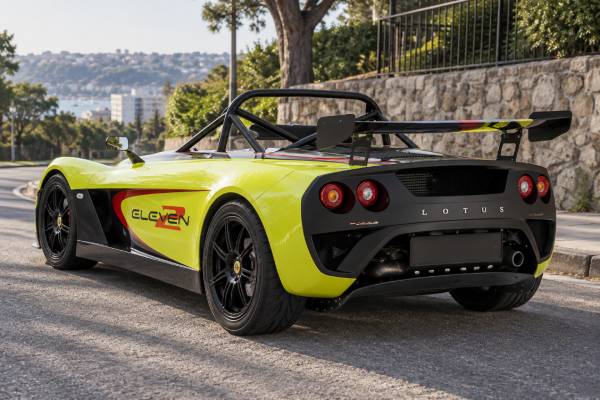
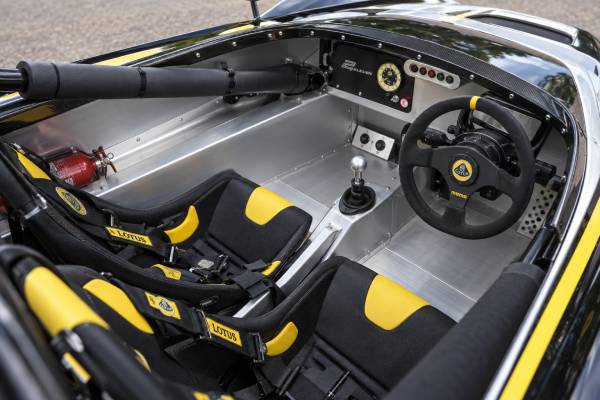
The Lotus 2-Eleven Launch Edition is the original, most visually distinctive form of Lotus’s Type 123 track-day car. Introduced in 2007, it combined a supercharged Toyota-derived 1.8-liter 2ZZ-GE four-cylinder with an exceptionally light open body, a six-speed manual gearbox, rear-wheel drive, and hardware developed around repeated circuit use. In base form Lotus quoted only 670 kg (1,477 lb), while the U.K. road-going SVA specification gained lighting, emissions equipment, road hardware, and additional mass. The result was a car whose 252 bhp mattered less than the way that power worked with low weight, strong brakes, real aerodynamic aids, and an Elise/Exige-based bonded-aluminum chassis.
For buyers today, the Launch Edition should be treated as a specialist competition-influenced machine rather than a stripped roadster. Correct specification, accident history, track maintenance, cooling and lubrication health, and evidence of sympathetic setup matter far more than odometer mileage alone.
Table of Contents
- What Makes the Launch Edition Different
- Technical Specifications and Factory Hardware
- Performance on Road and Track
- Chassis, Aerodynamics, and Driver Controls
- Maintenance and Track Preparation
- Inspection Priorities and Common Wear Areas
- Buying, Originality, and Ownership Strategy
What Makes the Launch Edition Different
The Launch Edition is best understood as the 2-Eleven’s opening specification, not merely a paint package. Lotus introduced the model in 2007 with a dedicated Lotus Sport identity, distinctive black, silver, and yellow graphics, and separate road-going and track-only configurations aimed at customers who wanted very different levels of legal equipment and aerodynamic focus.
Its roots go back to Lotus Sport’s earlier “Circuit Car” project. The production 2-Eleven kept the Elise/Exige family’s bonded aluminum structure and transverse mid-engine layout, but removed doors, a conventional roof, much of the upper body structure, and most comfort equipment. Lotus also developed lightweight composite body panels using a core-mat construction, shaped the body around cooling and aerodynamic requirements, and gave the car an integrated roll-over structure.
The Launch Edition’s factory appearance is important to collectors. Lotus service information identifies B111 Lotus Sport Black and B115 Arctic Silver as the two primary body colors, with yellow, black, and silver styling decals. Vulnerable areas were protected with stone-chip film. A genuine car may have acquired replacement film, repainted panels, or refreshed decals over nearly two decades, so originality should be judged from invoices, photos, build documentation, and the quality of any restoration rather than by assuming every surviving graphic is factory-applied.
There were two principal Launch Edition forms:
- U.K. Road Going Version: prepared for Single Vehicle Approval, with full road lighting, catalyst and road-compliance equipment, and a road-oriented single-plane rear wing.
- Track Only Version: intended for private circuits, with the more aggressive front splitter and high-downforce carbon-fiber rear wing, competition-focused driver’s seat, and limited road equipment.
That distinction affects more than appearance. Track cars were not supplied with normal road type approval outside the U.K., and Lotus’s service notes specifically separate track-use chassis identification from U.K. SVA cars. Anyone considering registration today should investigate the legal status of the individual chassis in the country where it will be used rather than assuming that parts from a road version make a track chassis registrable.
The Type 123 identity also appears in the VIN coding. Lotus service documentation identifies the vehicle-type characters as 123 and uses different chassis-specification characters for U.K. SVA right- and left-hand-drive cars and track-only left- and right-hand-drive cars. On a purchase inspection, matching the VIN, build plate, paperwork, and physical equipment is a useful first defense against a car that has been converted or reconstructed without clear history.
Technical Specifications and Factory Hardware
The Launch Edition is a gasoline-only ICE car with a transversely mounted, supercharged 2ZZ-GE behind the cockpit, a six-speed manual transaxle, and rear-wheel drive. Its defining engineering combination is the 252 bhp output at 8,000 rpm and a base dry weight of 670 kg, supported by track-oriented oil control, cooling, brakes, tires, and chassis geometry.
| Specification | Value |
|---|---|
| Engine | Toyota-derived 2ZZ-GE inline four-cylinder with Lotus calibration |
| Displacement | 1,796 cc (1.8 L) |
| Valvetrain | DOHC, 16 valves, VVTL-i variable valve timing and lift |
| Induction | Magnuson MP62 Roots-type supercharger with integral bypass valve |
| Charge cooling | Air-to-air chargecooler/intercooler |
| Maximum boost | 0.5 bar (7 psi) |
| Maximum power | 255 PS (252 bhp / 188 kW) at 8,000 rpm |
| Maximum torque | 242 Nm (179 lb-ft) at 7,000 rpm |
| Drive | Rear-wheel drive |
| Specification | Value |
|---|---|
| Transmission | Six-speed manual transaxle |
| Clutch | Uprated cover and friction plate for 2-Eleven duty |
| Standard differential | Open bevel-gear differential |
| Traction control | Lotus Traction Control; variable traction and launch control available |
| Optional limited-slip differentials | Torsen-type or competition plate-type units were offered |
| Specification | Value | Condition |
|---|---|---|
| Length | 3,822 mm (150.5 in) | U.K. SVA specification |
| Width | 1,709 mm (67.3 in) | Excluding mirrors |
| Width | About 1,735 mm (68.3 in) | Including mirrors |
| Height | 1,112 mm (43.8 in) | At kerb weight |
| Ground clearance | 95 mm (3.7 in) | Factory technical data |
| Base-car dry weight | 670 kg (1,477 lb) | Launch technical data |
| SVA unladen weight | 745 kg (1,642 lb) | Including full fuel tank |
| Maximum weight | 895 kg (1,973 lb) | Including occupants |
| Specification | Value | Context |
|---|---|---|
| 0–60 mph | 3.8 seconds | Lotus launch claim |
| 0–100 mph | 9.1 seconds | Lotus launch claim |
| Maximum speed | Up to 155 mph (249 km/h) | Launch specification; gearing and aero configuration affect real result |
| Power-to-weight ratio | 376 bhp per tonne | Base-car figure |
| Specification | Value |
|---|---|
| Standard front wheel | 6.5J × 16 cast alloy |
| Standard rear wheel | 7.5J × 17 cast alloy |
| Optional forged front wheel | 7J × 16 |
| Optional forged rear wheel | 8J × 17 |
| Front tire | 195/50 R16 Yokohama Advan A048 LTS |
| Rear tire | 225/45 R17 Yokohama Advan A048 LTS |
| Brake discs | 288 mm ventilated, cross-drilled discs |
| Brake hardware | AP Racing front calipers, Pagid RS14 pads, stainless braided hoses |
| ABS | Four-channel, track-tuned anti-lock braking system |
| Specification | Value | Notes |
|---|---|---|
| Engine-oil refill | 6.4 L | Including filter and Accusump |
| Oil-cooler circuit | Additional 3.5 L | Normally remains filled during routine oil service |
| Oil-pressure reserve | Accusump reservoir | Supports pressure during demanding track use |
| Oil cooling | Twin front-mounted oil coolers | Factory 2-Eleven hardware |
| Spark plug | NGK PFR7G | Factory service-note specification |
| Spark-plug gap | 0.8 mm | Factory service-note specification |
| 12-volt battery | Odyssey PC680, 17 Ah | Lightweight AGM-type battery |
The figures also explain why apparently small changes can alter the character of a 2-Eleven. Adding road equipment, a passenger, fuel, heavier wheels, or different aero parts moves the car meaningfully away from the 670 kg headline number. When comparing examples, use the actual specification in front of you instead of treating every “Launch Edition” as mechanically identical.
Performance on Road and Track
The Launch Edition’s speed comes from response, low mass, and cornering ability as much as outright engine output. A 252 bhp engine sounds modest beside modern high-performance cars, but in a car this light it produces acceleration that still feels serious and makes braking zones, tire temperature, and driver inputs arrive quickly.
The 2ZZ-GE is happiest when worked. Peak power comes at 8,000 rpm and peak torque at 7,000 rpm, so the engine rewards deliberate gear selection and a willingness to use the upper part of the rev range. The supercharger broadens the delivery compared with a naturally aspirated high-lift 2ZZ, reducing the sense that the driver must wait for one narrow high-rpm surge. On circuit, that matters because the car can be balanced with throttle through faster corners and pulled cleanly from medium-speed exits without relying on a large-displacement engine’s low-rpm torque.
Acceleration numbers should still be read in context. Lotus’s launch material quoted 3.8 seconds to 60 mph and 9.1 seconds to 100 mph. Car and Driver later recorded a 3.8-second 0–60 mph run and 12.2-second quarter mile from a 2-Eleven, while also reporting a lower 150 mph drag-limited maximum speed. Differences in aero configuration, test method, surface, tires, and weather are enough to explain why a single top-speed figure should not be treated as universal.
More important is how little mass the brakes and tires must manage. The 2-Eleven can shed speed with less kinetic energy than a much heavier road car at the same velocity, yet repeated track use still generates substantial heat. Pagid RS14 pads, braided lines, ABS tuning, and the car’s low weight give it the foundation for consistent braking, but only when fluid, discs, pads, wheel bearings, and tires are in proper condition.
Road use changes the equation. The tiny aeroscreen gives little weather protection. Visibility is open but wind load is high, storage is minimal, and the low nose is vulnerable to steep ramps. The 95 mm factory ground-clearance figure alone should make an owner cautious around speed humps and trailer ramps. A helmet or eye protection may also be sensible even where not legally required, especially at speed, because stones and debris that would strike a windshield on a normal car reach the cockpit much more directly.
On track, the 2-Eleven’s approachable side is part of its appeal. Lotus retained ABS and traction-control strategies rather than making the car deliberately intimidating. That allows a driver to learn the chassis progressively, but electronics cannot compensate for cold semi-slick tires, poor geometry, old dampers, or an abrupt setup. The fastest route to confidence is usually correct mechanical condition and a neutral baseline alignment, not immediately maximizing wing angle or reducing traction-control intervention.
Chassis, Aerodynamics, and Driver Controls
The 2-Eleven is not simply an Exige with its roof removed. Lotus revised the chassis details, suspension geometry, body airflow, and aero package to suit a much lower, lighter, open competition-oriented car.
The bonded aluminum tub is related to the Elise/Exige platform, but the 2-Eleven uses full-height side members because it has no conventional doors. That improves the structural logic of the open cockpit while making entry a literal step-over exercise. Unique front upper wishbones and steering arms accommodate the low ride height, and a rear chassis brace strengthens the rear suspension mounting area for hard circuit loads.
Factory service data gives a mid-laden ride height of 100 mm front and 110 mm rear under its stated load condition. That rake is part of the intended geometry and aerodynamic balance. A car that has been lowered simply to look more aggressive may have compromised bump travel, steering behavior, splitter clearance, and underbody airflow. Inspect ride height and corner weights rather than assuming adjustable platforms are in a sensible position.
The Launch Edition’s road and track aero packages should be treated as balanced systems. The track front splitter and adjustable carbon-fiber rear wing were intended to work together. Lotus’s own parts documentation cautions that the track splitter should be matched with the track rear wing to maintain aerodynamic balance. Fitting one end of the package without the other may change high-speed behavior in a way that is hard to diagnose from low-speed road driving.
Suspension options add another layer. Lotus offered a stiffer five-position adjustable front anti-roll bar and Öhlins gas-pressurized two-way adjustable remote-reservoir dampers with adjustable spring platforms. Those parts are valuable when properly serviced and set up, but more adjustment is not automatically better. Before changing clicks, spring platforms, camber, or wing angle, record the current configuration and establish whether the dampers are healthy.
The electronic controls are similarly purposeful. Standard Lotus Traction Control uses wheel-speed information and engine management to reduce wheelspin. Variable traction control and launch control, where fitted, allow a driver to alter the permitted slip level. The system is a performance tool, not a modern stability-control safety net with steering-angle and yaw intervention of the kind found on newer road cars. A driver who turns it down should understand that the car remains light, powerful, and sensitive to tire condition.
One detail worth checking on any prospective purchase is the differential. The standard configuration used an open differential, but both Torsen-type and plate-type limited-slip units were offered. A plate LSD can materially change behavior on power and on overrun, depending on ramp setup. If the seller claims an LSD, documentation or a specialist inspection is preferable to guessing from how the car feels in a short test drive.
Maintenance and Track Preparation
A well-maintained 2-Eleven should be managed by track hours, heat cycles, and inspection findings as well as calendar time and mileage. Lotus explicitly produced a dedicated maintenance schedule and a pre-track-session checklist for the model, reflecting the reality that one hard circuit day can matter more than many gentle road miles.
The lubrication system deserves special attention. The engine uses an Accusump oil-storage reservoir and twin front-mounted oil coolers. During normal oil service, Lotus specifies a 6.4-liter refill including the filter and Accusump, while noting that an additional 3.5 liters remains in the oil-cooler circuit and is not normally drained. That arrangement means a careless technician can misinterpret total system volume, overfill the engine, or fail to appreciate how much oil can remain in long cooler lines.
After any engine failure that may have released debris, the oil coolers and lines require much more scrutiny than a routine oil change. Contaminants trapped in a remote cooler circuit can damage a replacement engine. This is one reason a rebuilt or replacement-engine car needs detailed invoices explaining what was flushed or renewed, not just a receipt for the engine itself.
The supercharger and charge-air system also need inspection. Listen for abnormal bearing or nose-drive noise, look for oil staining and damaged hoses, and check that the intake ducts feeding the engine bay and chargecooler are intact. Heat-soaked or poorly routed ducting can reduce consistency on a long session even when the engine appears healthy in a short road test.
Before every serious track outing, inspect at least the following:
- engine-oil level and any evidence of leakage from the engine, oil lines, Accusump, or coolers;
- brake-pad thickness, disc condition, fluid age, hose condition, and pedal feel;
- tire age, heat-cycle condition, tread, sidewalls, pressures, and wheel-bolt security;
- wheel bearings, ball joints, toe links, dampers, springs, and visible suspension fasteners;
- splitter, diffuser, rear-wing mounts, body fasteners, and underbody damage;
- coolant level, coolant hoses, charge-air ducting, and signs of fluid spray in the engine bay;
- harness condition and date where motorsport rules make expiry relevant;
- battery security and terminal condition.
The lightweight Odyssey battery is another ownership clue. It saves mass but has less reserve than a large conventional road-car battery. Cars stored for long periods should be maintained with an appropriate charger rather than repeatedly jump-started. Lotus’s service information notes that the car’s normal usage may not restore a deeply discharged battery fully after a jump start.
Brake fluid should be selected for the car’s duty and changed before it becomes the weak point in the system. Lotus referenced Castrol SRF as an optional racing fluid in its service documentation. Regardless of brand, use a fluid compatible with the system and change it according to condition and track workload. A high-boiling-point fluid is not a substitute for healthy caliper seals, adequate pad thickness, or properly bedded friction material.
Inspection Priorities and Common Wear Areas
The most expensive 2-Eleven problems are usually tied to track history, impact damage, overheated consumables, neglected fluids, or poorly documented modifications rather than to one universal defect. A pre-purchase inspection should therefore focus on evidence of use and repair across the whole car.
Start with the chassis. The bonded aluminum tub is durable when undamaged, but it is not a conventional steel shell that should be casually straightened or welded after an impact. Look for distorted suspension pickup areas, damaged extrusions, crushed jacking points, unusual sealant, drilled holes, or repairs around the full-height side members. If anything is questionable, involve a Lotus specialist familiar with bonded chassis construction.
The composite body is sacrificial compared with the tub, but repair quality still matters. Inspect the splitter, wheel arches, rear transom, diffuser area, rear scuttle, and wing mounts for cracking or poorly supported repairs. The car has no conventional bumpers, and Lotus warned that its body does not provide the same low-speed impact protection as a normal road car. Cosmetic damage can therefore reveal a harder strike underneath.
Next, assess the running gear as a system. A048 tires may look usable while being too old or too heat-cycled to deliver their intended grip. Worn dampers can allow excessive platform movement that feels like a tire problem. Incorrect toe can make the car nervous, while aggressive negative camber can produce inner-edge tire wear that is easy to miss from outside the wheel arch.
Brake condition is equally revealing. Blueing, heat checking, tapered pad wear, cracking around drilled holes, or a long pedal suggests the car deserves closer attention. Track cars can consume pads and discs without abuse, so worn components are not automatically a reason to walk away; the concern is whether the owner treated those parts as planned consumables and kept records.
Engine inspection should include cold start, hot restart, idle quality, fluid condition, leaks, supercharger sound, and operation across the rev range. The 2ZZ-GE’s high-rpm nature means a low-mileage car that has spent most of its life at circuit speeds may have experienced far more demanding use than a higher-mileage road example. Ask how often oil was changed, whether oil pressure was ever logged, whether the engine has been over-revved, and whether the oil-control system has been serviced correctly.
Finally, inspect safety equipment rather than treating it as decoration. Harness webbing, mounting points, seat shells, extinguisher systems, roll-over structure, and any added cage components should suit the intended use. For competition, current event regulations may require equipment that differs from the original Launch Edition specification.
Buying, Originality, and Ownership Strategy
Buy the best-documented, correctly configured car you can find, even if it has more track miles than a neglected “collector” example. The 2-Eleven was designed to be driven hard, so disciplined maintenance and transparent history are more valuable than unusually low mileage with long periods of storage.
A sensible buying process begins with identity. Confirm the VIN, Type 123 coding, Lotus Sport build plate, road or track chassis specification, and whether the car still has the equipment appropriate to that configuration. Compare old photos and invoices with the current aero package, seats, harnesses, wheels, dampers, differential, exhaust, and engine hardware.
Originality has several layers. A Launch Edition in its black, silver, and yellow scheme with correct bodywork and period components will usually be more collectible, but sympathetic reversible upgrades can make a track car better to own. The key is avoiding a car whose history has been erased by undocumented parts swapping. Retain removed factory components when practical, and keep every invoice and setup sheet.
Budget beyond the purchase price. Tires, pads, discs, fluids, damper servicing, geometry, transport, and track-day fees can easily exceed ordinary road-car running costs. If the car will be driven on track regularly, a trailer and tow vehicle may be more sensible than trying to preserve road legality at all costs. Track-only chassis also avoid the legal uncertainty of attempting to register a car that Lotus never supplied with road approval for that market.
Before agreeing a price, ask for evidence of the following:
- recent service with correct oil procedure and clear fluid records;
- alignment and corner-weight data if the suspension is adjustable;
- age and specification of tires and harnesses;
- brake-disc and pad condition;
- damper service history, especially for adjustable Öhlins units;
- engine or gearbox work, including any missed-shift or over-rev history;
- accident, body, splitter, wing, or chassis repairs;
- whether the standard open differential or an optional LSD is fitted;
- original parts retained after modifications;
- legal status and registration documents for any road-going example.
For the right owner, the Launch Edition remains unusually focused even by modern standards. Its appeal is not that it produces huge numbers on a dyno; it is that the car turns a relatively compact 1.8-liter engine, low mass, mechanical feedback, and carefully developed track hardware into a coherent package. Preserve that balance, maintain it like a competition-influenced machine, and the 2-Eleven can still deliver the kind of direct experience that made it notable when it appeared in 2007.
References
- Lotus 2-Eleven – A track day dominator | Lotus Cars 2026
- LOTUS 2-ELEVEN 2007 SERVICE NOTES Pdf Download | ManualsLib 2007 (Service Notes)
- Lotus Sport News 2008 (Lotus Sport Brochure)
- 2008 Lotus 2-Eleven 2008
- Lotus 2-11 news – Eleventh heaven – 2007 2007
- Lotus 2-eleven 2007
Disclaimer
This article is for informational purposes only and is not a substitute for professional diagnosis, inspection, repair, or motorsport preparation. Specifications, torque values, service intervals, procedures, and legal requirements can vary by VIN, market, equipment, and later modification; verify all work against official Lotus service documentation for the individual vehicle.
If this guide was useful, please consider sharing it on Facebook, X/Twitter, or another enthusiast community to support our work.