
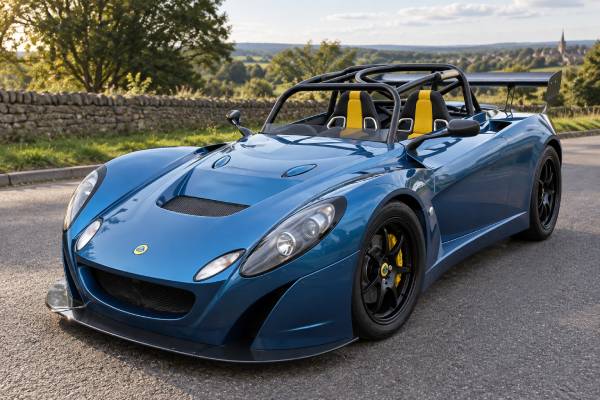
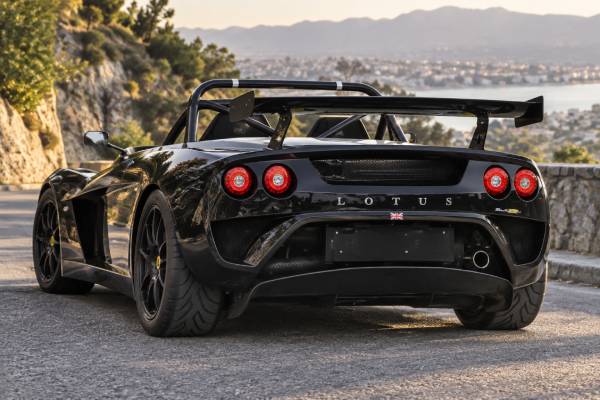
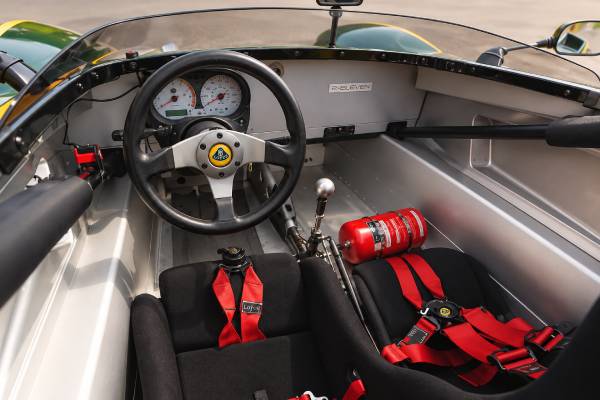
From 2008 through 2010, the 252 hp Lotus 2-Eleven remained the sharp end of the regular Type 123 range: a supercharged, open-cockpit machine built around extreme lightness rather than headline engine size. Its 1,796 cc 2ZZ-GE used a Magnuson MP62 supercharger, charge cooling, high-flow fueling, twin oil coolers, and an Accusump system to produce 255 PS (252 bhp) at 8,000 rpm and 242 Nm at 7,000 rpm. Lotus quoted a 670 kg dry weight for the base car, 0–60 mph in 3.8 seconds, and 150 mph maximum speed. By this period, however, “252 hp 2-Eleven” did not automatically mean one fixed equipment package. Road/SVA and track configurations, optional Öhlins dampers, different aero, larger brakes, limited-slip differentials, and a later Lotus Sport 260 PS upgrade all complicate identification. This guide isolates the standard 252 hp supercharged specification and explains how its powertrain, chassis, track systems, service needs, and provenance fit together.
Table of Contents
- The 2008–2010 Supercharged Car in Context
- What the Supercharger Changes
- Lotus 2-Eleven 252 hp Specifications and Technical Data
- Aero, Brakes, and Chassis as One System
- How to Run It on Track
- Supercharged Maintenance and Failure Prevention
- How to Identify a Correct 252 hp Car
The 2008–2010 Supercharged Car in Context
The 2008–2010 252 hp 2-Eleven is best understood as the continuing supercharged Type 123, not as a new model replacing the 2007 Launch Edition. Lotus retained the 255 PS powertrain while broadening the 2-Eleven program around it, so later cars can combine the familiar engine output with a wider range of road, track, suspension, brake, body, and safety equipment.
That distinction matters because the 2-Eleven changed commercially more than it changed mechanically. The original 2007 car arrived as a highly specified, supercharged statement piece. In 2008 Lotus added a 190 PS naturally aspirated entry model and turned many previously associated features into selectable packages or standalone options. The 255 PS supercharger system remained available, meaning a 2008–2010 252 hp car might have been ordered as a supercharged configuration rather than necessarily wearing the original Launch Edition’s presentation.
The core engineering remained formidable. Lotus’s current heritage archive lists Type 123, a 1,796 cc supercharged four-cylinder, 252 bhp, six-speed transmission, and a 670 kg headline weight. Period service information identifies engine code N in the VIN for the 255 bhp supercharged specification and records separate chassis codes for UK SVA and track-only configurations. Those identifiers are more useful today than paint schemes or decals, which are easy to alter.
Contemporary road tests explain why the car’s reputation persisted beyond the launch season. Car and Driver described a remarkably usable spread of supercharged torque for circuit work, while evo found that the 2-Eleven combined extreme speed with a surprisingly compliant road demeanor in road-legal form. In 2009, the 2-Eleven won evo’s Track Car of the Year competition, posting the second-fastest lap of the group while scoring strongly for involvement and reward. By then the car was not merely a novelty; it had become an established reference point for lightweight track machinery.
The later period also introduced a potential source of confusion: Lotus Sport offered a 260 PS upgrade for the 2-Eleven. The 2009 parts program described it as a small increase over the original 255 PS calibration with improved throttle response and drivability. A car fitted with that upgrade is mechanically related but is no longer strictly the 252 hp specification covered here. Sellers sometimes round outputs, quote PS as hp, or describe every supercharged car as “260,” so invoices and ECU history matter.
The same caution applies to the GT4 Supersport. That competition derivative used a different specification, including more power and dedicated race hardware. It should not be folded into a normal 252 hp road/track 2-Eleven simply because both carry Type 123 and a supercharged 2ZZ-GE. For ownership and valuation, exact configuration is more informative than the broad model name.
What the Supercharger Changes
The supercharger changes the 2-Eleven less by creating a dramatic “boost hit” than by filling in the 2ZZ-GE’s torque delivery. Lotus paired a low-pressure Magnuson MP62 Roots-type unit with charge cooling, revised fueling, and dedicated engine management so the engine could pull harder across a lap while still making peak power at 8,000 rpm.
Service notes specify up to 0.5 bar (7 psi) of boost. The MP62 includes an integral bypass valve, which recirculates air under idle and part-throttle conditions to reduce unnecessary pumping work and noise. Under load, the blower supplies the airflow required for the 252 bhp rating. An air-to-air chargecooler manages intake temperature, with ducting and a rear-mounted heat exchanger integrated into the unusual open body.
Lotus did not treat forced induction as a bolt-on accessory. The 255 PS installation uses a higher-output fuel pump and high-flow injectors, along with unique ECU programming. The clutch was uprated, and the supercharged variants received twin front-mounted air/oil coolers as standard. An Accusump oil reservoir adds a pressure reserve for conditions in which sustained cornering could otherwise challenge oil supply. These details are why a home-made conversion should not be assumed equivalent to a factory supercharged car.
The output figures also reveal the character. Maximum torque is 242 Nm at a high 7,000 rpm, not a diesel-like plateau just above idle. That means the engine remains an enthusiastic, rev-dependent 2ZZ-GE even with forced induction. The benefit is that it does not fall as far out of its strongest zone between corners or after an imperfect upshift. Contemporary testers noticed that the power delivery was smoother and required fewer corrective gear changes than an unblown high-cam engine.
Heat is the price of sustained output. Compressing intake air raises temperature, while long high-rpm sessions add load to engine oil, coolant, gearbox, brakes, and rear body airflow. The 2-Eleven’s cooling package was engineered for this environment, but its effectiveness depends on clean heat exchangers, intact ducting, healthy fans, sound hoses, correct fluid levels, and unobstructed airflow. A car can make full power for a short road pull while still being poorly prepared for a twenty-minute track session.
The powertrain also changes how traction systems matter. The standard open differential works with Lotus Traction Control, while optional variable traction and launch control allowed the driver to adjust intervention. Optional Torsen and plate-type limited-slip differentials were also available. More torque at the rear axle makes tire condition, differential behavior, alignment, and throttle technique more consequential than the headline acceleration time suggests.
Lotus 2-Eleven 252 hp Specifications and Technical Data
The standard supercharged specification combines 252 bhp with unusually low mass, but the published weight depends on which definition and equipment level is being quoted. Lotus service data separates the 670 kg dry base figure from a 745 kg SVA unladen figure that includes a full fuel tank, so those numbers should not be presented as contradictory measurements of the same condition.
| Item | Specification |
|---|---|
| Engine | Toyota 2ZZ-GE inline 4-cylinder |
| Displacement | 1,796 cc (1.8 L) |
| Valvetrain | DOHC, 16 valves, VVTL-i |
| Induction | Magnuson MP62 Roots-type supercharger |
| Maximum boost | 0.5 bar (7 psi) |
| Charge cooling | Air-to-air chargecooler system |
| Maximum power | 188 kW / 255 PS / 252 bhp at 8,000 rpm |
| Maximum torque | 242 Nm (179 lb-ft) at 7,000 rpm |
| Specific output | 142 PS/L (140 bhp/L) |
| Fuel system | High-output pump with high-flow injectors and dedicated ECU calibration |
| Measure | Figure |
|---|---|
| 0–60 mph | 3.8 seconds |
| 0–100 km/h | 4.0 seconds |
| 0–100 mph | 8.9 seconds |
| Quarter mile | 12.2 seconds |
| 80–120 km/h in 4th | 3.6 seconds |
| 80–120 km/h in 5th | 5.3 seconds |
| Maximum speed | 241 km/h (150 mph) |
| Power-to-weight ratio | 376 bhp per tonne using Lotus base-car figure |
The quoted acceleration assumes favorable surface and tire conditions and should be treated as period manufacturer performance, not a promise for every surviving car. Launch-control starts in particular impose severe loads on the clutch, driveshafts, gearbox, and tires; repeating them to verify a brochure figure is a poor diagnostic method.
| Item | Lotus service figure |
|---|---|
| Overall length, SVA | 3,822 mm (150.5 in) |
| Overall width, excluding mirrors | 1,709 mm (67.3 in) |
| Overall width, including mirrors | Approx. 1,735 mm (68.3 in) |
| Overall height | 1,112 mm (43.8 in) |
| Ground clearance | 95 mm (3.7 in) |
| Dry weight, base car | 670 kg (1,477 lb) |
| Unladen weight, SVA with full fuel tank | 745 kg (1,643 lb) |
| Maximum weight including occupants | 895 kg (1,973 lb) |
| System | Specification |
|---|---|
| Engine oil refill | 6.4 L including filter and Accusump |
| Oil cooler circuit | Additional 3.5 L contained in circuit; not normally drained in routine service |
| Oil cooling | Twin front-mounted air/oil coolers |
| Oil-pressure reserve | Accusump storage reservoir |
| Main radiator | Horizontal front radiator with twin electric fans |
| Transmission | 6-speed manual |
| Clutch | Uprated diaphragm-spring cover and uprated friction plate |
| Standard differential | Open bevel differential with Lotus Traction Control |
| Optional differentials | Torsen LSD or competition plate-type LSD |
| Item | Specification |
|---|---|
| Chassis | Bonded aluminum Elise/Exige-derived tub with 2-Eleven revisions |
| Suspension | Double wishbones front and rear |
| Mid-laden ride height | 100 mm front / 110 mm rear |
| Standard wheel size | 6.5J x 16 front / 7.5J x 17 rear |
| Optional forged wheel size | 7J x 16 front / 8J x 17 rear |
| Period tire type | Lotus-specific Yokohama A048 LTS |
| Brake pads | Pagid RS14 motorsport pads front and rear in service specification |
| Brake hoses | Steel braided |
| Optional front brakes | 308 mm two-piece discs with AP Racing 4-piston calipers |
Aero, Brakes, and Chassis as One System
The 2-Eleven’s speed comes from a system, not from 252 hp in isolation. Low mass reduces the work demanded from the tires and brakes, aerodynamic options increase high-speed load, and suspension settings determine whether that extra load becomes confidence or imbalance.
The body itself was engineered around removable lightweight panels rather than conventional road-car protection. Lotus’s “core mat” construction placed a permeable mat between glass-fiber layers and resin, producing panels intended to approach carbon fiber’s strength-to-weight benefits while remaining easier to manufacture and repair. The lack of normal doors, roof, and full windscreen strips mass from high on the car but also removes everyday weather and impact protection.
At speed, the rear wing and front splitter must be considered together. Lotus offered a more aggressive carbon rear wing with an enlarged front splitter for balanced downforce. Fitting a large wing without the matching front device can move aerodynamic balance rearward; changing wing angle alters that balance again. Inspect mounting points and the rear structure carefully because aero loads are transmitted into the car, not merely into decorative bodywork.
Braking follows the same systems logic. Standard motorsport pads, braided lines, and track-oriented discs could provide extraordinary deceleration because the car is so light. The optional 308 mm front discs and four-piston AP Racing calipers added thermal capacity. They did not eliminate the need for correct pad material, fluid condition, bedding, cooling laps, or inspection. Lotus’s own service literature explicitly treats brake pads and discs as consumables under circuit use.
Suspension choice can be just as significant as brake choice. The adjustable Öhlins package gave the 2-Eleven remote-reservoir, two-way damping and adjustable spring platforms, and Lotus later offered a race-valved Öhlins option aimed at A048-type treaded race tires. More adjustment is valuable only if the owner knows the baseline. Random click settings, altered spring rates, changed ride height, and aggressive alignment can easily make a supposedly upgraded car worse than a factory-sorted one.
Finally, tires connect every subsystem. Grip determines how much braking force, cornering load, and power can be transmitted. A modern tire with a different carcass or compound can change steering effort, breakaway behavior, damper requirements, and hot pressure targets. The objective is not to freeze the car in 2009; it is to preserve a coherent setup and make any changes deliberately.
How to Run It on Track
A 252 hp 2-Eleven should be approached like a small competition car with number plates available in some markets, not like an ordinary sports car that happens to attend track days. Preparation, warm-up, session management, and post-session inspection are part of its performance envelope.
Before the first fast lap, establish cold tire pressures, wheel security, fluid levels, brake-pad life, disc condition, and pedal feel. Confirm that the splitter and wing are secure, that nothing obstructs radiator or oil-cooler airflow, and that the chargecooler ducting is intact. A loose body fastener or partially blocked heat exchanger may appear minor in the paddock and become important at speed.
Warm the car progressively. Engine oil, gearbox oil, tires, dampers, and brakes do not reach useful operating conditions simultaneously. The 2ZZ-GE’s willingness to rev makes it tempting to use the full 8,000 rpm power peak immediately, but there is no advantage in asking cold lubricants and cold tires to absorb maximum load. Build pace over the opening laps while checking gauges, steering feel, and brake response.
Variable traction control can be a training tool rather than an obstacle. If fitted, start with a conservative intervention level and reduce assistance only when tire condition, track surface, and driver consistency justify it. The system cannot correct poor braking points or an overcommitted corner entry. Nor does it repeal physics on cold semi-slicks or standing water.
Launch control deserves even more restraint. Lotus service documentation warns that the technique creates extreme transmission loads and shortens component life. It calls for instant clutch engagement rather than slipping and specifies recovery time before repeated starts. In modern ownership there is little reason to spend clutch and gearbox life on demonstration launches unless competition demands it.
During a session, watch for trends rather than isolated sensations. A brake pedal that lengthens, a steering wheel that moves off center, rising coolant temperature, power that softens, new vibration, or rear-end behavior that changes lap by lap are reasons to back off. A supercharged car can continue to feel spectacular while heat is quietly degrading fluid, pads, tires, or intake temperature.
Use the final lap to cool the machine. Reduce braking intensity, keep air moving through the radiators, and avoid parking with the foot brake clamped hard on very hot discs. After stopping, inspect for leaks, fluid smells, tire damage, loose fasteners, and unusual heat. Record hot tire pressures and setup changes while they are fresh. Fast track driving becomes safer and more repeatable when the car is treated as data to be managed, not just an adrenaline device.
Supercharged Maintenance and Failure Prevention
Preventive maintenance on the supercharged 2-Eleven is mainly about protecting heat control, lubrication, and high-load driveline components. The 2ZZ-GE foundation is familiar, but the 252 hp installation adds enough dedicated hardware that a generic Elise service checklist is not sufficient.
Begin with the induction path. Inspect the supercharger belt drive, intake plumbing, chargecooler connections, bypass-valve operation, and ducting. Oil mist around joints, rubbing pipes, loose clamps, cracked hoses, or damaged heat-exchanger fins can reduce efficiency before they create an obvious fault code. A car that hesitates, misfires, or loses power at high load should be diagnosed rather than repeatedly “tested” at full throttle.
Next is the oil system. The service figure of 6.4 liters includes the filter and Accusump, while the cooler circuit holds additional oil that is not normally drained during routine servicing. That distinction matters when judging fill quantity after repairs or when the cooler circuit has been opened. Check the Accusump and its valve arrangement for correct operation, and treat any history of engine debris contamination seriously because remote coolers and lines can retain particles.
Cooling deserves its own inspection. The front radiator uses two electric fans controlled at staged temperatures, while separate front oil coolers and the rear chargecooler circuit handle additional heat. Verify fan operation, hose integrity, clean fins, unobstructed ducts, and stable temperatures under sustained load. A system that behaves normally in traffic may reveal weakness only after repeated high-rpm laps.
Transmission maintenance depends partly on differential specification. The standard open differential does not introduce special friction-plate service. The Torsen option likewise has no special oil requirement in Lotus’s supplement. The competition plate differential is different: Lotus specifies inspection and cleaning of the plates every 15,000 miles (25,000 km). For a track-heavy car, elapsed track use and differential behavior may justify attention sooner than road mileage alone suggests.
Clutch condition matters because the factory fitted an uprated cover and friction plate for the supercharged application. Check bite consistency, release, hydraulic behavior, and signs of slip at high load. A clutch damaged by repeated launches may still feel acceptable during gentle road driving. Likewise, driveshaft joints and boots should be inspected for heat damage and grease loss near the rear powertrain.
Brakes, wheel bearings, toe-control hardware, ball joints, dampers, and tires should be considered routine track consumables or inspection items. If the car has AP four-piston fronts, identify the exact disc and caliper generation before ordering components. If it has Öhlins dampers, ask when they were last professionally serviced. If it still wears an old set of A048s because they “look original,” budget for tires rather than treating aged rubber as a collectible asset.
Service intervals, fluid types, torque values, and internal engine procedures should always be taken from documentation appropriate to the individual VIN and installed parts. The 2-Eleven’s option-rich history means there is no substitute for knowing what is actually on the car.
How to Identify a Correct 252 hp Car
A correct 2008–2010 252 hp 2-Eleven is identified by records and hardware, not by graphics. Start with the VIN, then work outward through the engine system, chassis specification, factory options, later Lotus Sport upgrades, and current legal status.
Lotus service data gives useful VIN clues. Character 4 identifies the 2ZZ supercharged 255 bhp engine specification as “N” in the relevant coding, characters 6–8 identify vehicle type 123, and the chassis-specification character distinguishes UK SVA right- or left-hand drive from track-only left- or right-hand drive. VIN systems can change by model year and market, so use the correct factory decoding reference rather than applying one internet chart to every car.
Physically verify the forced-induction package. The MP62 supercharger, chargecooler plumbing, high-output fuel system, twin front oil coolers, Accusump, appropriate ECU history, and uprated clutch-related hardware should form a coherent package. A missing cooler, improvised pipework, aftermarket pulley, nonstandard ECU, or unexplained injector change is not automatically bad, but it changes the question from “Is this original?” to “Who engineered and validated this combination?”
Separate 252 hp cars from later 260 PS upgrades. Lotus Sport’s 2009 catalog offered ECU-related upgrade part ALS3M0352F specifically for the 2-Eleven, promising a modest power increase and better response over the original 255 PS tune. If that upgrade is claimed, look for an invoice, dealer or Lotus Sport documentation, and a calibration history. Do not infer it from a dyno sheet alone, because different dynos and correction methods produce different numbers.
Then document the chassis options. Note whether the car has standard or Öhlins dampers, standard or wider forged wheels, basic or AP four-piston front brakes, standard or track aero, open/Torsen/plate differential, road or track lighting, standard or competition seats and harnesses, and any carbon panels or tonneau. Photograph part numbers where practical. A detailed configuration record makes future servicing dramatically easier.
Check structural condition before cosmetics. The bonded aluminum tub, suspension pickups, rear subframe area, roll-over structure, splitter mounts, and wing supports deserve specialist inspection. Composite body panels can often be repaired, but a poorly repaired chassis or distorted suspension pickup is a different level of problem. Uneven tire wear, unexplained alignment limits, cracked paint around mounts, or inconsistent panel fit should prompt deeper investigation.
Finally, judge the car by how honestly its history explains its present form. A heavily used track car with meticulous invoices, regular fluid service, damper rebuilds, brake records, engine data, and documented upgrades can be a better purchase than a cosmetically perfect example with missing history. Conversely, originality can carry value when it is genuinely supported by factory records. The 252 hp 2-Eleven is a machine whose appeal lies in engineering coherence; the strongest purchase is the one where the paperwork and the hardware tell the same story.
References
- Lotus 2-Eleven – A track day dominator | Lotus Cars (2026)
- Lotus 2-Eleven Service Notes Supplement (2007)
- 2008 Lotus 2-Eleven (2008)
- Lotus 2-Eleven | evo (2007)
- Lotus Scoops EVO Car of the Year Double (2009)
- 2009 Lotus Sport Brochure | PDF | Vehicles | Suspension (Vehicle) (2009)
Disclaimer
This article is for general informational purposes only and is not a substitute for professional diagnosis, repair, inspection, or motorsport preparation. Specifications, torque values, intervals, setup procedures, and legal requirements can vary by VIN, market, equipment, and modification history. Verify maintenance and repair work against the correct official Lotus, Toyota, and component-manufacturer documentation for the individual car. If this guide was useful, share it with other Lotus owners on Facebook, X, or your preferred enthusiast community.