
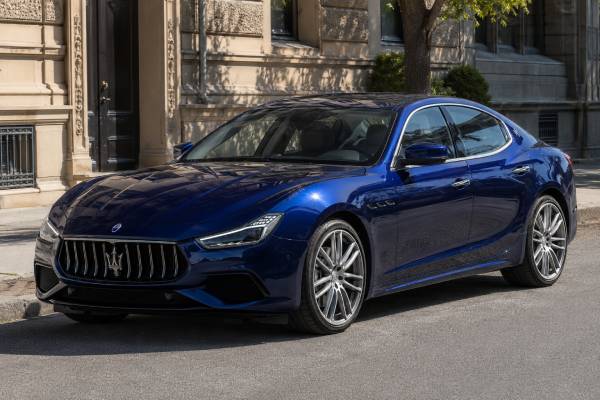
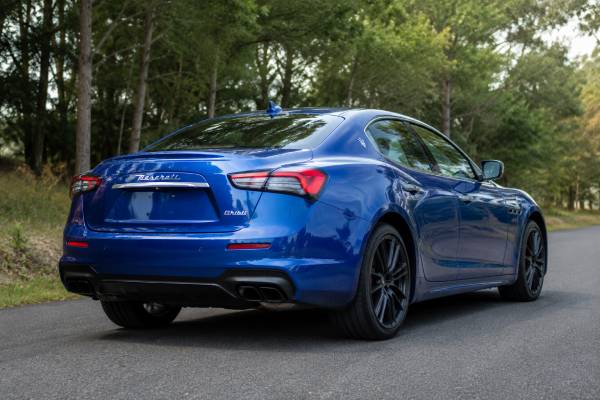
The Maserati Ghibli GT Hybrid is the late-production version of the brand’s first electrified sedan, not a plug-in Ghibli and not a four-cylinder economy special. It pairs a turbocharged 2.0-liter GME engine with a 48-volt belt starter-generator and an electrically driven eBooster, producing 330 hp and 450 Nm while retaining rear-wheel drive and an eight-speed automatic. For the 2021–2023 period, the important change was positioning: Maserati reorganized much of its range around GT, Modena, and Trofeo identities, and the Hybrid commonly became the Ghibli GT in international markets. That naming can create confusion because some countries also sold a V6-powered GT. A badge is therefore only the beginning of identification. The four-cylinder engine, 48-volt hardware, market build sheet, VIN data, and emissions documents must agree. A well-kept GT Hybrid offers lighter front-end response, useful midrange boost, and lower official consumption than the V6 cars. Its buying risks are different, however, because battery condition, belt-drive hardware, software, cooling, and electrical diagnosis matter alongside ordinary turbo-engine maintenance.
Table of Contents
- Why GT Became the Hybrid Gateway
- The 48-Volt GT Hybrid System
- Trim Reset, Options, and Model Years
- Electrified Details in a Familiar Shape
- Efficiency, Response, and Road Feel
- Maintaining the eBooster-Era Ghibli
- A Practical GT Hybrid Buying Guide
Why GT Became the Hybrid Gateway
The GT Hybrid became the entry point to the late Ghibli range because it combined the newer electrified powertrain with a comfort-led equipment theme. It was intended to reduce fuel use and emissions without changing the Ghibli into a plug-in or removing the rear-driven character that distinguished the sedan.
Maserati introduced the Ghibli Hybrid in 2020 as its first electrified production model. The basic M157 body and rear-drive architecture remained, but the familiar V6 was replaced by a 2.0-liter turbo four-cylinder linked to a 48-volt system. For the later model years covered here, Maserati also simplified its public trim story. GT emphasized grand touring and everyday luxury, Modena moved toward a sportier presentation, and Trofeo represented the V8 flagship.
That clean hierarchy was not identical everywhere. In many European and international markets, “Ghibli GT” usually meant the 330 hp Hybrid. In the United States, where this mild-hybrid Ghibli was not the mainstream offering, GT could identify a 345 SAE-hp 3.0-liter V6. Used-car advertisements often ignore that distinction, and imported cars may be listed according to whichever database the seller uses. The safest description is therefore the full one: Ghibli GT Hybrid, GME T4, 48 volts, 2.0 liters, and 330 hp.
The model mattered strategically as much as mechanically. It showed how Maserati could use electrification to sharpen response rather than merely chase a laboratory economy number. The eBooster helps fill torque while the conventional turbocharger builds pressure, and the belt starter-generator recovers energy during deceleration. There is no useful electric-only driving mode, no external charging socket, and no large traction battery under the floor.
Its reputation depends heavily on expectations. The car feels quick enough for daily use and reaches serious motorway speed, but it is not a substitute for the 430 hp Modena S or 580 hp Trofeo. It also does not deliver the silent urban operation associated with a full hybrid. It is best understood as a mature Ghibli whose turbo response, accessory drive, and energy recovery were redesigned around a compact 48-volt system.
The 48-Volt GT Hybrid System
The powertrain uses electricity mainly to recover energy and improve response. Its 48-volt components assist the combustion engine, but the rear wheels are driven through the eight-speed automatic rather than by a separate traction motor.
| Item | Specification |
|---|---|
| Engine | GME T4 2.0-liter turbocharged inline-four |
| Hybrid hardware | 48-volt belt starter-generator, battery, DC/DC conversion, and electric eBooster |
| System output | 330 hp at 5,750 rpm |
| Maximum torque | 450 Nm from approximately 2,250 rpm |
| Transmission | ZF eight-speed automatic |
| Drivetrain | Rear-wheel drive |
| 0–100 km/h | Approximately 5.7 seconds |
| Top speed | Approximately 255 km/h |
| Front suspension | Double wishbones |
| Rear suspension | Five-link layout |
| Steering | Electric power assistance |
| Fuel tank | About 80 liters |
The engine belongs to the Global Medium Engine family, but Maserati’s calibration and supporting systems make the installation specific to the car. Direct injection, turbocharging, variable valve control, and the eBooster work together to produce a broad torque curve. The electric compressor is valuable at low engine speed because it can move air before exhaust flow has fully accelerated the conventional turbocharger.
A belt starter-generator replaces a conventional alternator role and connects to the crankshaft by belt. During braking or overrun, it can convert motion into electrical energy. During acceleration, it can assist the engine’s accessory drive and help the system respond promptly. The stored energy is held in a compact 48-volt battery, while a converter supports the car’s ordinary 12-volt network.
This arrangement is called a mild hybrid because electrical power cannot propel the sedan independently in normal use. The battery is much smaller than the pack in a plug-in vehicle, and charging occurs automatically. Owners do not select a charging schedule or find a public charger. The tradeoff is that the fuel-saving effect is more modest than in a strong hybrid, especially during short cold journeys.
Official performance figures place the car between ordinary premium four-cylinder sedans and the faster Ghibli V6s. The 5.7-second sprint depends on conditions, fuel, tires, and launch technique. More important in daily use is the 450 Nm torque plateau, which lets the gearbox use higher ratios without making the car feel dormant.
Trim Reset, Options, and Model Years
The GT label describes the late trim position, while “Hybrid” identifies the powertrain. Buyers should verify both because equipment changed by country, option package, and production date even when the exterior badge looked the same.
For 2021, some cars continued to be advertised simply as Ghibli Hybrid. As the GT/Modena/Trofeo language spread through the range, the comfort-focused version became Ghibli GT Hybrid or Ghibli GT in many markets. Registration documents may use a shortened commercial name, an internal type, or only an engine displacement. A factory build sheet is the best way to reconcile these labels.
Common GT themes included bright exterior details, a relatively restrained wheel design, leather seating, wood or open-pore trim choices, and a broad standard comfort package. Exact content varied. Some markets bundled driver aids, premium audio, Skyhook suspension, heated rear seats, ventilated front seats, or privacy glass; elsewhere these remained optional.
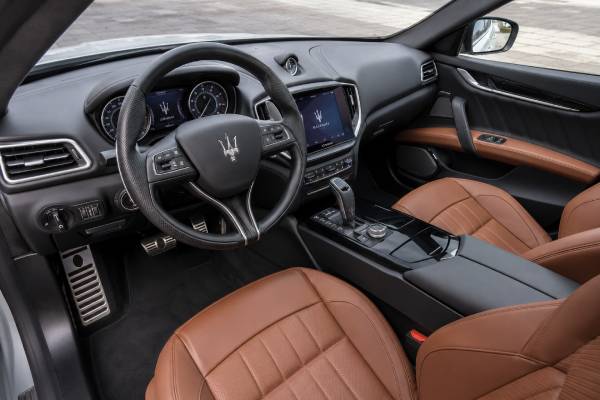
The late Ghibli’s 10.1-inch Maserati Intelligent Assistant touchscreen is an important dividing line from older cars. It uses an Android-based operating environment and offers a more modern interface than the earlier 8.4-inch unit. Wireless or wired smartphone functions, navigation, connected services, voice control, and audio specification depend on model year and region. A buyer should test the actual car rather than rely on a sales brochure written for another country.
Documents that establish the exact version
- Factory build data tied to the complete VIN.
- Original invoice, order sheet, or market price list.
- Registration and emissions certificate showing displacement and fuel type.
- Engine-bay view confirming the four-cylinder GME installation and 48-volt labels.
- Diagnostic scan showing the hybrid control modules and original vehicle configuration.
Production-year boundaries can be misleading because registration may occur months after manufacture. A car sold in 2023 may have been built under an earlier specification, while a late 2021 build may already carry the newer trim presentation. Inspect the production label and software information rather than assuming the registration year describes every component.
Factory wheels require special attention. Larger wheels can make the GT look more like a Modena, and previous owners often swap them. Confirm the wheel part numbers, widths, offsets, tire sizes, and pressure-monitoring compatibility. A mixed set may create vibration or steering pull even on a rear-drive car.
The most important production distinction is not a decorative package but whether the vehicle has the expected powertrain. A dealer advertisement that calls a V6 “GT Hybrid,” or calls a four-cylinder imported GT a V6, should stop the purchase process until the VIN and engine are checked.
Electrified Details in a Familiar Shape
The GT Hybrid looks deliberately familiar because Maserati wanted electrification to fit the Ghibli identity rather than advertise a separate body style. The most meaningful changes are in airflow, electrical packaging, controls, and small color details.
The M157 proportions remain: a long bonnet, low roof, frameless side glass, short rear deck, and three vents behind each front wheel. The grille and boomerang rear lamps identify the later design phase. Hybrid cars may use blue trim accents as a visual shorthand for electrification, but individual orders and later cosmetic work can remove them.
Under the bonnet, packaging is denser in some areas than a simple cylinder-count comparison suggests. The turbocharger, eBooster plumbing, belt starter-generator, 48-volt wiring, power electronics, cooling circuits, and emissions hardware all need space and thermal control. Orange high-voltage cables associated with full EVs are not the defining feature here; this is a lower-voltage system, though it still requires trained service procedures.
The eBooster is not an electric motor attached to the wheels. It is an electrically driven compressor in the intake system. Its purpose is to build charge pressure promptly when exhaust energy is not yet sufficient for the main turbo. The result should be a clean, progressive surge rather than a distinct electrical event that the driver feels switching on.
Energy recovery is also meant to be transparent. During deceleration, the belt starter-generator replenishes the 48-volt battery. The brake pedal still operates the hydraulic braking system, so the car does not have the pronounced blended-brake sensation of some strong hybrids. Any abrupt drag, warning message, belt noise, or inconsistent restart deserves diagnosis.
Inside, the major engineering improvement is the later infotainment and assistance architecture. The 10.1-inch display is sharper and faster than the old system when healthy. Electric power steering supports lane-related assistance functions, while cameras and radar can provide adaptive cruise, blind-spot monitoring, traffic-sign information, or surround views depending on equipment.
The cabin still uses physical controls for several frequent tasks, which helps on the move. The transmission selector, drive modes, damper control, and exhaust behavior should be tested for correct response. Owners sometimes assume a delayed screen or intermittent camera is harmless because the engine runs, but network faults can spread across multiple modules after low voltage or water intrusion.
Sound engineering was important because a four-cylinder cannot naturally reproduce the V6’s note. Maserati tuned the intake and exhaust to give the car a recognizable voice, especially in Sport. The result is purposeful but different, with less low-frequency richness and more emphasis on turbocharged four-cylinder urgency. A heavily modified exhaust can introduce drone and may hide a failed valve or catalyst issue.
Efficiency, Response, and Road Feel
On the road, the GT Hybrid feels lighter at the nose and stronger in the middle of the rev range than its displacement suggests. It rewards smooth, flowing driving more than repeated full-throttle launches.
The first useful impression should be refinement. The engine should start quickly, settle without belt chirp, and move away without hesitation. Stop-start operation varies with battery charge, temperature, climate demand, steering angle, and other conditions, so it will not activate every time. Repeated warning messages or rough restarts are not normal operating strategy.
At low speed, the eight-speed automatic keeps revs down and uses the electric assistance to reduce the pause before boost. A healthy system feels coordinated. If the transmission hunts, the engine surges, or power arrives in steps, possible causes include software adaptation, ignition faults, boost leaks, sensor errors, battery state, or eBooster control—not simply the character of a mild hybrid.
Sport mode sharpens the accelerator and transmission and gives the exhaust more presence. The engine delivers its best work through the broad middle range. It will rev past the torque peak, but there is little reason to imitate a naturally aspirated engine and hold every gear to the limiter. Manual paddle shifts are most useful when setting up an overtake or controlling speed on a descent.
The reduced front mass can be felt in direction changes. Steering is electrically assisted and does not provide the texture of the earliest hydraulic-steering Ghiblis, yet the car turns cleanly and feels less nose-heavy than a diesel. Alignment, front control arms, wheel condition, and tire construction strongly affect this impression.
Ride quality depends on wheel size and damper specification. A GT on 19-inch wheels can be an excellent long-distance car, absorbing sharp edges while maintaining body control. Large wheels make turn-in look and feel more immediate but increase impact noise and the chance of cracked or bent rims. Skyhook should make a noticeable, controlled difference without becoming harsh or floaty.
Rear-wheel drive keeps the chassis balanced, but 450 Nm can still overwhelm poor rear tires in cold or wet conditions. Stability control intervenes early enough for daily safety. A buyer should not treat mismatched budget tires as a minor negotiating point; they change braking, wet grip, steering response, and the behavior of electronic aids.
The brakes feel conventional because there is no complex brake-by-wire blending at the pedal. They should be progressive and straight. Pulsation, a long pedal, hot-wheel odor, or uneven disc surfaces indicate work. Regeneration during overrun does not eliminate friction-brake corrosion on a car that sits.
Official economy can be better than the V6, but real results depend on trip length and speed. The system gains the most from warm, mixed driving with repeated opportunities to recover energy. Short winter journeys may show little benefit because the engine, catalyst, cabin, and battery all need conditioning. Sustained high-speed use is governed mainly by aerodynamics and combustion fuel demand.
Maintaining the eBooster-Era Ghibli
The correct maintenance approach treats the GT Hybrid as both a modern turbocharged car and a networked 48-volt vehicle. A general service history is useful, but invoices should show that technicians understood the hybrid architecture and used Maserati-capable diagnostics.
Oil quality and level matter because the turbocharger and variable-valve systems depend on clean lubrication. Follow the market- and VIN-specific schedule, and shorten intervals when the car makes frequent short journeys or sits for long periods. An annual oil change can be sensible even when mileage is low. Check for seepage, oil odor, damaged undertrays, and evidence that the correct filter and specification were used.
The cooling inspection must cover more than the main radiator. Examine reservoirs, hoses, pumps, charge-air cooling, electric fans, and dried deposits around connections. The eBooster and turbo system add heat, while blocked condenser fins or poorly repaired front ducting reduce airflow. Any repeated coolant top-up requires a pressure test and proper diagnosis.
Both electrical systems deserve testing. The ordinary 12-volt battery can cause widespread warnings even when the 48-volt battery is healthy. Load-test it, check charging behavior, inspect grounds, and scan all modules. The 48-volt battery’s state of health and fault history should be read with suitable equipment; a dashboard without warnings is not a complete test.
Hybrid-specific warning signs
- Persistent 48-volt, charging, stop-start, or reduced-performance messages.
- Belt chirp, dust, fraying, tensioner movement, or accessory-drive vibration.
- Hesitation before boost, inconsistent torque, or eBooster-related fault codes.
- Rough engine restart or stop-start operation accompanied by voltage faults.
- Cooling-fan behavior, hot smells, or repeated thermal warnings.
- Software versions that do not match completed manufacturer campaigns.
The belt starter-generator makes belt condition more important than on a conventional alternator setup. Inspection should include pulleys, tensioners, alignment, contamination, and service history. Replacement procedures may require specific tools and electronic checks. A shop that treats it like an ordinary accessory belt may miss the cause of repeated wear.
Ignition coils, spark plugs, injectors, fuel pressure, intake leaks, oxygen sensors, particulate-filter strategy where fitted, and turbo controls can all affect drivability. A full scan should include pending codes, misfire counts, fuel trims, boost targets, and readiness monitors. Recently cleared monitors may indicate that a seller reset faults before inspection.
The ZF automatic should engage promptly and shift smoothly when cold and hot. Fluid policy varies by market literature, but age, heat, and use still matter. Any service must follow the correct fill temperature and fluid specification. Harsh shifts can originate from engine torque irregularity, mounts, software, or internal transmission wear, so guessing is expensive.
Chassis maintenance remains conventional but not cheap. Check front arms, rear links, dampers, wheel bearings, brakes, and tire wear. The heavy sedan can wear inner shoulders without obvious steering pull. Measure brake discs rather than judging only the visible lip, and replace tires by compatible axle sets.
Late infotainment, camera, radar, and lighting systems can require coding or calibration after repairs. Confirm that the windscreen is correct, cameras are aligned, and every assistance mode completes its self-test. Water entry, aftermarket trackers, audio work, or poor battery replacement can create intermittent network faults.
A Practical GT Hybrid Buying Guide
Buy the best-documented GT Hybrid, not the lowest-mile example or the one with the most blue badges. Identity, battery health, software status, accident quality, and complete operation should determine the decision.
Begin with the VIN before traveling. Ask for a build sheet, registration document, emissions data, service invoices, and clear engine-bay photographs. Confirm 1,995 cc displacement, the GME four-cylinder installation, rear-wheel drive, and the expected 48-volt modules. Resolve any listing that describes a 3.0-liter V6 or Q4 system.
Arrange a fully cold start. The seller should not warm the car or connect a booster immediately before arrival. Listen for belt chirp, rattles, uneven idle, and abnormal turbo noise. Watch the cluster during self-test and note whether hybrid, engine, steering, brake, or assistance warnings remain.
Pre-purchase inspection priorities
- Perform a complete module scan before clearing anything; record software, configuration, fault frequency, and readiness status.
- Test the 12-volt battery under load and read available 48-volt battery health and charging data.
- Inspect the belt starter-generator drive, eBooster plumbing, cooling circuits, turbo system, leaks, and underbody.
- Drive from cold through town, rough roads, steady cruise, moderate boost, manual shifts, and controlled braking.
- Test the MIA screen, cameras, radar, lane functions, lights, seats, climate, audio, keys, and connected features.
- Measure tires and brakes, inspect wheel barrels, and obtain a proper alignment report if wear is uneven.
- Review paint depth, panel fit, sensor mounting, glass markings, and front cooling ducts for accident evidence.
During the road test, power should build smoothly without a dead interval followed by a sudden surge. The transmission should not flare or bang, and the car should track straight. Stop-start may remain unavailable for legitimate reasons, but the scan should explain whether battery charge or a stored fault is responsible.
After the drive, let the car idle and recheck it hot. Look for coolant smell, oil smoke, fan problems, fresh leaks, a hot wheel, or new codes. Examine the underside for damaged aerodynamic panels and previous jacking errors. Hybrid labels and protective covers should be intact.
Calculate a first-year reserve rather than spending the full budget on purchase price. Tires, brakes, a conventional battery, overdue fluids, belt-drive work, software updates, windscreen calibration, and a missing key can quickly absorb the apparent saving on a cheap car.
Modifications should be conservative and documented. Unknown engine software can disturb torque coordination, emissions readiness, thermal limits, and warranty eligibility. Lowering, wheel spacers, oversized wheels, nonstandard batteries, or added electrical devices create additional variables in a car already dependent on precise network communication.
The GT Hybrid suits an owner who wants the late Ghibli cabin, rear-drive balance, useful performance, and lower fuel demand without charging. It is less suitable for someone expecting electric-only commuting, Q4 winter traction, or the sound and effortless top-end of the V6.
A strong example should have a coherent identity, stable voltage, quiet belt system, smooth boost, current software, even tires, and evidence of knowledgeable servicing. When those points are satisfied, the GT Hybrid is not merely the economical Ghibli. It is a distinct final-phase interpretation of the M157: lighter in front, electronically more mature, and engineered around response rather than cylinder count.
References
- New Ghibli Hybrid: the first electrified vehicle in Maserati’s history 2020 (Manufacturer News)
- Ghibli Hybrid – Performance Charged (Manufacturer Model Page)
- Maserati 2022 new trims: GT, Modena and Trofeo 2021 (Manufacturer News)
- Ghibli | 1966 2022 (Model Brochure)
Disclaimer
This article is for informational purposes and does not replace professional diagnosis, repair, coding, calibration, or a vehicle-specific inspection. Specifications, hybrid controls, fluids, intervals, equipment, software, and warranty terms vary by VIN, market, and production date. Verify every important detail with official documentation for the exact car.
Please share this guide on Facebook, X/Twitter, or an enthusiast community if it was helpful. Sharing supports more detailed model-specific resources.