
The 2020–2021 Maserati Ghibli Hybrid matters less for electric-only driving than for being the brand’s first electrified car. Its system combines a 2.0-liter turbocharged four-cylinder engine with a 48-volt belt starter-generator, a rear-mounted battery, a DC converter, and an electrically driven eBooster compressor. Total output is 330 hp with 450 Nm, sent only to the rear wheels through a ZF eight-speed automatic. The car cannot travel as a pure EV and it does not plug in; the electrical hardware recovers energy, supports accessories, enables smoother stop-start operation, and helps fill the turbo’s low-speed response. Official performance—about 5.7 seconds to 100 km/h and 255 km/h—places it close to the earlier 330 hp V6 while reducing engine size and introducing a new technical direction. Its short launch-era production window also overlaps the 2021 Ghibli refresh, with boomerang-style rear lights and a larger 10.1-inch multimedia system. Used buyers must therefore verify both the hybrid hardware and the exact model-year equipment. Battery condition, software updates, belt drive, cooling, eBooster operation, and specialist diagnostic access matter as much as ordinary engine service. This guide explains the first Ghibli Hybrid’s architecture, driving feel, ownership risks, and purchase checks.
Table of Contents
- The First Electrified Maserati
- Hybrid System, Output, and Chassis Data
- Launch Specification and Short Production Run
- Blue Details and 48-Volt Engineering
- How the eBooster Changes the Drive
- Hybrid Battery, Software, and Service Needs
- Buying an Early Ghibli Hybrid
The First Electrified Maserati
The Ghibli Hybrid opened Maserati’s electrification era, but it did so with a mild-hybrid system focused on response and energy recovery rather than electric range. It remains a petrol-powered sports sedan whose electrical components support the combustion engine. Its distinct hardware demands verification beyond ordinary petrol-engine service records and mileage.
Maserati introduced the car during a period when emissions rules were tightening and the M157 platform was approaching its final years. A full plug-in conversion would have demanded extensive packaging and weight changes. The 48-volt solution allowed the company to reduce engine displacement, recover braking energy, and improve low-speed boost without redesigning the entire sedan around a large traction battery.
The engine is a longitudinal 2.0-liter turbocharged four-cylinder from the GME family. A belt starter-generator replaces a conventional alternator arrangement and can recover energy during deceleration. The stored energy feeds the 48-volt network and the eBooster, an electric compressor that builds intake pressure before exhaust flow fully drives the main turbocharger.
This setup is commonly misunderstood. The eBooster is not a drive motor connected to the wheels. The 48-volt battery is not sized for electric commuting. The car does not have a charging socket. Its hybrid label describes the electrical support and energy-management system, not a selectable zero-emission mode.
Maserati calibrated the package to produce 330 hp and 450 Nm, preserving performance close to the earlier base V6. The four-cylinder changes the sound and texture, yet the quick torque response gives the car a distinct advantage in normal traffic. It also reduces mass over the front axle compared with some six-cylinder configurations, while placing the hybrid battery toward the rear to help distribution.
The model’s historical position is clear: it is the bridge between combustion-only Ghiblis and Maserati’s later electrified products. That significance may interest collectors, but condition remains more important than “first hybrid” status. Short production does not make a faulty battery, obsolete module, or damaged eBooster inexpensive.
Used examples should be evaluated by technicians who understand both the M157 network and 48-volt safety. A general workshop may service the engine oil but miss hybrid fault history, state-of-charge behavior, DC converter issues, or software campaigns.
Hybrid System, Output, and Chassis Data
The Ghibli Hybrid pairs a 1,998 cc turbo four-cylinder with a 48-volt belt starter-generator and electric eBooster. System output is 330 hp and 450 Nm, with rear-wheel drive and an eight-speed automatic.
| Platform | M157 |
|---|---|
| Engine family | GME T4 |
| Engine | 2.0-liter turbocharged inline four-cylinder |
| Displacement | 1,998 cc |
| Hybrid voltage | 48 volts |
| Electrical components | Belt starter-generator, battery, DC converter, and eBooster |
| Maximum system output | 330 CV, approximately 243 kW at 5,750 rpm |
| Maximum torque | 450 Nm |
| Transmission | ZF eight-speed automatic |
| Drivetrain | Rear-wheel drive |
| 0–100 km/h | Approximately 5.7 seconds |
| Top speed | Approximately 255 km/h |
During deceleration, the belt starter-generator converts some kinetic energy into electrical energy. The 48-volt battery stores it, and a DC converter supports the vehicle’s lower-voltage electrical system. When the driver requests torque at low engine speed, the eBooster can compress intake air before the exhaust-driven turbo is fully active.
The system still depends on petrol combustion for propulsion. There is no traction motor in the transmission and no published electric-only range. Stop-start events can be faster and smoother than with a conventional starter, but exact behavior depends on battery state, temperature, climate demand, and software.
| Body style | Four-door, five-seat sports sedan |
|---|---|
| Length | Approximately 4,971 mm |
| Width | Approximately 1,945 mm excluding mirrors |
| Height | Approximately 1,461 mm |
| Wheelbase | 2,998 mm |
| Trunk capacity | Approximately 500 liters |
| Fuel capacity | 70 liters |
| Representative curb weight | Approximately 1,878–1,950 kg by equipment and market method |
| Suspension | Double-wishbone front and five-link rear |
| Steering | Electric power assistance |
The battery sits in the rear area rather than under the entire floor. This helps balance the lighter four-cylinder engine and preserves the cabin and trunk concept. Packaging should be inspected after any rear collision or water entry because the battery, converter, wiring, and control modules need dry, undamaged surroundings.
Brakes remain conventional friction units rather than a radically different brake-by-wire system. Energy recovery occurs through the belt generator during suitable deceleration, so pedal behavior remains familiar. The exact blend may still change with battery state and software, but the driver should not feel severe inconsistency or warning messages.
Launch Specification and Short Production Run
The 2020–2021 launch cars occupy a narrow but visually important point in Ghibli production. They introduced electrification alongside the late M157 exterior and multimedia refresh.
Maserati revealed the Hybrid in 2020, with market introduction centered on the 2021 model period. Depending on country, registration date may not match the factory model year. The build date and VIN therefore matter more than the date first placed on the road.
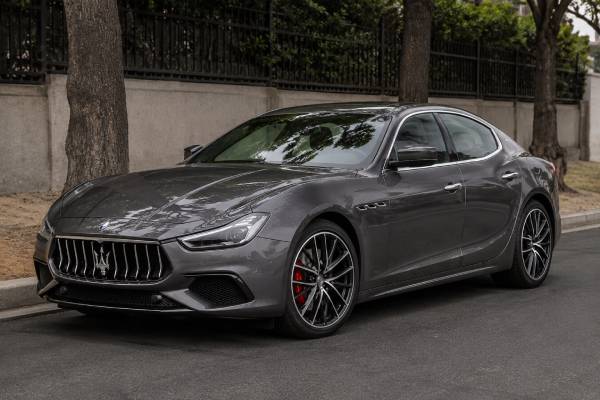
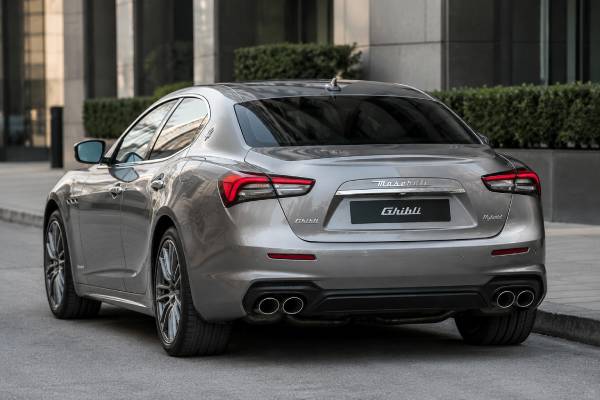
The car uses the refreshed front grille, boomerang-inspired rear light graphic, and a 10.1-inch Maserati Intelligent Assistant interface in many specifications. Blue accents identify electrification: the side vents, brake calipers on some cars, stitching, and other details may use the color. These cues can be repainted or added, so they do not prove the powertrain.
Equipment often follows GranLusso or GranSport themes rather than the later GT and Modena hierarchy. GranLusso emphasizes comfort and formal materials, while GranSport uses more assertive bumpers, sport seats, and trim. Market packaging can combine features differently.
Items to verify through the factory record
- GME T4 48-volt hybrid powertrain and 330 CV output.
- Original market, production date, and emissions specification.
- GranLusso, GranSport, or other equipment line.
- Wheel diameter, brake package, and Skyhook or passive suspension.
- Driver-assistance cameras, radar, blind-spot monitoring, and adaptive lighting.
- MIA screen, connected-service hardware, audio, and navigation region.
- Factory blue details and interior trim.
The short transition period creates parts questions. Some components are shared with later GT Hybrid cars, while others relate to the launch trim structure. Control modules, wiring, sensors, and software should be ordered and programmed by VIN.
A heavily optioned Hybrid is appealing only when all features work. Test seat ventilation, sunroof, soft-close doors, premium audio, cameras, adaptive cruise, lane systems, and lighting. Low battery voltage or network faults can make several functions fail together.
Blue Details and 48-Volt Engineering
The Hybrid’s most distinctive engineering is hidden, while its visible identity relies on restrained blue accents. The body remains the familiar Ghibli shape rather than adopting a separate eco-oriented design.
Maserati Centro Stile’s long hood, deep grille, three fender vents, and flowing rear shoulders remain intact. The revised tail lamps reference the boomerang form associated with the 3200 GT. Blue details provide a visual link to electrification without changing the basic proportions.
The four-cylinder engine creates more room and less mass at the front than the V6. The 48-volt belt system sits around the engine accessory drive, while the eBooster joins the intake path. High-current wiring, connectors, cooling needs, and control units add a layer of complexity not present on earlier petrol models.
A 48-volt system is lower voltage than a full battery-electric vehicle, but it still requires correct safety procedures. Technicians should identify isolation points, follow shutdown instructions, and avoid probing high-current circuits casually. After collision or water damage, the system needs a specialist assessment before energizing.
The battery’s rear location supports weight distribution. It also makes trunk and rear-body condition important. Water near the battery compartment, signs of rear impact, altered wiring, or missing covers should stop the purchase until the system is tested.
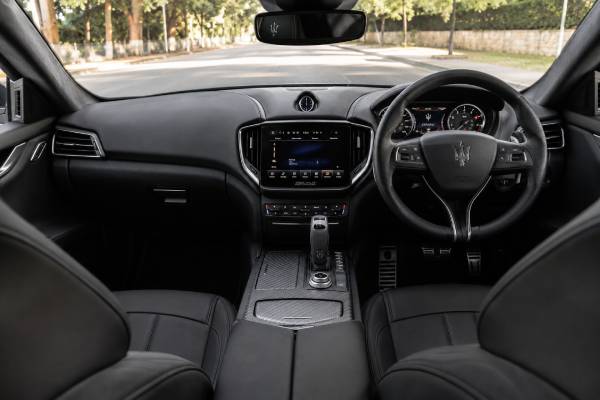
Inside, blue stitching and other accents may identify the model, but the main improvements are the later infotainment screen and updated graphics. The driving position remains low, with fixed metal paddles and a broad console. The digital interface is more modern than early M157 systems but still depends on software support and a healthy 12-volt supply.
Hybrid-specific visual checks
- Inspect belt-generator drive components, tensioners, and protective covers.
- Check 48-volt connectors and wiring for repairs, corrosion, or collision damage.
- Examine the rear battery area for moisture and disturbed trim.
- Verify that all blue exterior details match the build record rather than a cosmetic conversion.
- Test the eBooster response through diagnostic data, not sound alone.
- Confirm that the MIA screen, cameras, audio, and connected functions operate consistently.
The exhaust note is electronically and mechanically tuned to preserve some Maserati drama. It cannot sound identical to the V6 because the firing order and displacement differ. A buyer should judge smoothness, response, and absence of rattle rather than expecting a perfect imitation of six cylinders.
How the eBooster Changes the Drive
The eBooster makes the Hybrid feel stronger at the beginning of an acceleration event than a conventional small turbo engine. Its purpose is to reduce waiting for exhaust flow, not to add a separate burst of wheel torque.
At low rpm, the electric compressor can build intake pressure quickly. As the main turbocharger becomes effective, the system transitions without an obvious handover. A healthy car should respond smoothly rather than surge in two separate steps.
The 450 Nm output is lower than the 580 Nm of a Ghibli S, but it is available in a useful range and moves the sedan with authority. The 5.7-second official sprint reflects the car’s weight and rear-drive traction. It is quick rather than explosive.
Normal mode keeps the gearbox in taller ratios and makes best use of the assisted low-speed response. Sport mode sharpens the throttle, holds gears, and changes exhaust behavior. The four-cylinder has a different upper-range character from the V6; it feels most convincing when the driver uses the midrange rather than repeatedly chasing the limiter.
Rear-wheel drive gives the Hybrid a familiar Ghibli balance. The lighter engine can make the front feel willing, although the overall car remains substantial. Stability control manages traction, and correct rear tires are essential in wet weather.
Electric steering is light in town and integrates with active lane functions. It lacks some of the hydraulic texture of early Ghiblis but suits the late car’s technology. A crooked steering wheel, wandering, or assistance warning may indicate alignment, camera calibration, tire, or suspension issues.
Ride quality depends on wheels and damping. Nineteen-inch tires are a sensible compromise. Twenty- and 21-inch options look dramatic but reduce compliance and increase rim risk. Skyhook should produce a clear, controlled difference without warning messages or leaking dampers.
Energy recovery can change with battery state, but brake pedal feel should remain predictable. A pull, vibration, or long pedal points to ordinary brake or chassis faults, not normal hybrid behavior. The friction brakes still carry the main high-speed stopping load.
In city use, stop-start operation should be prompt and smooth. Repeated failure to restart, long cranking, or system-unavailable messages call for battery and software diagnosis. On the motorway, the car settles into eighth gear and delivers quiet, efficient cruising relative to petrol V6 models.
Hybrid Battery, Software, and Service Needs
Ownership depends on the health of both electrical systems. The 48-volt battery supports the hybrid functions, while the conventional low-voltage battery powers and wakes the wider vehicle network.
A weak 12-volt battery can produce misleading hybrid, transmission, steering, infotainment, parking-brake, and assistance faults. Test it under load, verify the charging strategy, and use the correct replacement. Cars stored for long periods benefit from an approved maintainer.
The 48-volt battery should be assessed through diagnostic state, fault history, temperature behavior, and charge acceptance. A dashboard without a warning is not enough. Replacement cost and parts availability should be researched by VIN because battery and control revisions can occur.
The belt starter-generator places extra importance on belt condition, tensioner alignment, pulleys, and contamination. Noise, dust, slipping, or charging faults require immediate inspection. Replacing only the belt without finding a misaligned pulley or failed tensioner can lead to repeat failure.
The eBooster and conventional turbo share the task of air delivery. Underboost, hesitation, or inconsistent response may arise from electrical supply, compressor control, sensors, intake leaks, main-turbo issues, or software. Recorded live data under load is essential.
Broader maintenance priorities
- Use the exact engine oil and interval appropriate to VIN and use pattern.
- Pressure-test the cooling system and inspect pumps, hoses, reservoirs, radiators, and fans.
- Check ignition coils, spark plugs, injectors, fuel pressure, and intake sealing.
- Inspect engine and transmission mounts for vibration.
- Examine control arms, dampers, wheel bearings, brakes, and alignment.
- Confirm software updates and calibration after camera, radar, or module replacement.
Software quality is part of the powertrain. Updates can affect energy management, stop-start behavior, diagnostics, infotainment, and driver assistance. A specialist should review version history and open campaigns rather than updating modules at random.
Water entry is a serious risk because modules and battery hardware sit in protected body areas. Inspect the trunk, rear quarters, sunroof drains, lamps, front carpets, and connector seals. Poor aftermarket audio or tracking systems can create parasitic drain and communication faults.
Recall status must be checked by VIN. Later M157 campaigns can involve seat belts, fuel-system components, and other items depending on market. Hybrid-specific service actions may be recorded through the manufacturer network even when they are not public safety recalls.
Parts planning is more important than on a conventional four-cylinder sedan. The GME engine has broader group applications, but Maserati-specific hybrid controls, wiring, cooling pieces, software access, and body-mounted battery hardware may not be available from ordinary repair suppliers. Before buying in a region with limited dealer support, identify a workshop that can obtain factory information, program modules, and safely isolate the 48-volt system. An extended warranty can have real value only when its contract explicitly covers the battery, eBooster, converter, starter-generator, diagnostics, and labor rather than excluding electrified components as wear or high-voltage equipment.
Buying an Early Ghibli Hybrid
Buy an early Hybrid only after a specialist confirms the 48-volt system, eBooster, software, and both batteries. A conventional petrol-car inspection is necessary but not sufficient.
Request the VIN, factory build list, service invoices, software history, both keys, and a cold-start appointment. Confirm that the car is the launch-era Hybrid rather than a later GT Hybrid, and establish its trim line, original market, wheel and brake specification, suspension, and driver assistance.
Inspection sequence for the 48-volt Ghibli
- Inspect structure, paint, front and rear collision areas, undertrays, wheels, tires, and signs of water entry.
- Start fully cold and observe engine response, belt noise, charging behavior, warning lamps, and stop-start availability.
- Scan every module, including hybrid control, battery, DC converter, engine, transmission, steering, and assistance systems.
- Review 48-volt state data, fault history, eBooster command, boost pressure, readiness monitors, and software versions.
- Test all infotainment, cameras, lighting, seats, climate, locks, audio, and assistance functions.
- Drive through low-rpm acceleration, steady cruise, rough pavement, braking, and repeated stop-start events.
- Inspect the hot car on a lift for leaks, belt condition, cooling issues, suspension wear, and damaged hybrid wiring.
The written report should identify immediate safety work, overdue service, battery or software concerns, near-term chassis wear, and cosmetic issues. Price a 48-volt battery, DC converter, belt starter-generator, eBooster, large brakes, tires, and adaptive dampers before calling any example cheap.
Avoid flood-damaged cars, poorly repaired rear impacts, unresolved hybrid warnings, repeated low-voltage history, or unknown wiring additions. A recently cleared fault memory with incomplete readiness is especially concerning.
Modifications should be conservative. Engine tunes can alter boost, thermal load, torque management, and hybrid coordination. Nonstandard audio, remote-start, tracker, or lighting installations can create parasitic draw and network problems. Documentation and reversibility are essential.
The early Ghibli Hybrid suits a buyer who wants the first electrified Maserati and understands that it is a mild hybrid, not an EV. It offers responsive low-speed performance, distinctive late-M157 styling, and useful touring ability. A verified, updated, dry, and fault-free example can be rewarding. A car with unclear battery health or weak specialist support should be left alone regardless of mileage or price.
References
- New Ghibli Hybrid: the first electrified vehicle in Maserati’s history 2020 (Manufacturer News)
- Ghibli Hybrid – Performance Charged 2021 (Model Page)
- Maserati_Ghibli_Digital_Catalogue_EN.pdf 2021 (Model Brochure)
- Part 573 Safety Recall Report 21V-703 2021 (Recall Database)
Disclaimer
This article is informational and does not replace professional hybrid-system diagnosis, repair, calibration, or a vehicle-specific inspection. Specifications, voltage-isolation steps, torque values, fluids, intervals, software procedures, and parts vary by VIN, market, build date, and equipment. Use the official service information for the exact vehicle.
Please share this guide on Facebook, X/Twitter, or an enthusiast community if it helped. Sharing supports more detailed technical and ownership articles.