
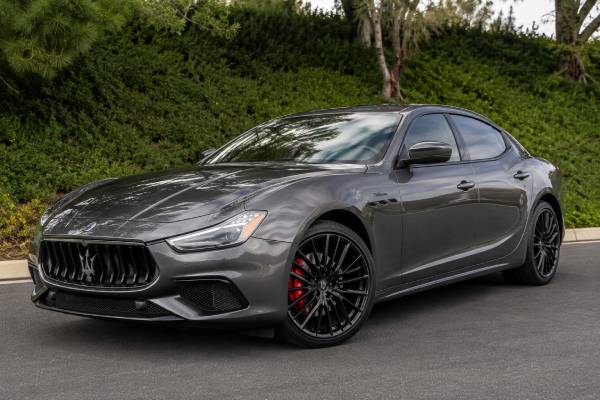
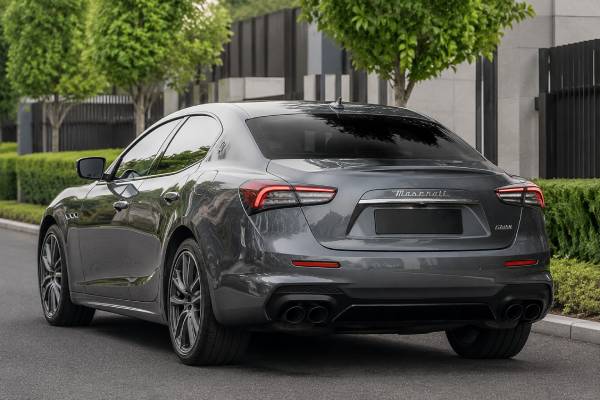
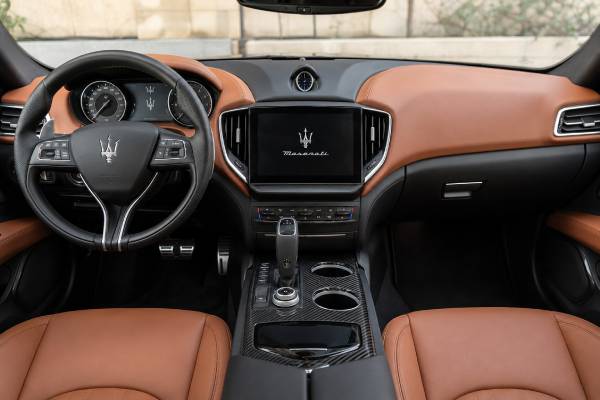
The 430 hp Maserati Ghibli Modena is the high-output, rear-wheel-drive V6 version sold under the late Modena naming system in markets such as North America. Its official U.S. rating is commonly shown as 424 SAE hp, while European-style metric conversion and many databases round the model to 430 hp. Both figures can describe the same F160 3.0-liter twin-turbo V6, but the badge alone cannot prove that specification because some international markets used “Modena” for a 350 hp car and “Modena S” for the 430 hp version. The correct identification requires the VIN, original market paperwork, build data, drivetrain, and official output standard. Mechanically, this Modena combines 580 Nm of torque, an eight-speed ZF automatic, rear-wheel drive, a limited-slip differential, late electric steering, and the updated 10.1-inch infotainment system. It is quicker and more forceful than the 350 hp Ghibli without the additional front driveline of Q4 or the running costs of the V8 Trofeo. A good example can be a satisfying final-phase sports sedan, but neglected tires, brakes, cooling, suspension, software, or battery health can quickly erase any purchase-price advantage.
Table of Contents
- Understanding the 430 hp Modena Name
- High-Output V6 Specifications
- North American Trim Logic and Equipment
- Modena Styling with S-Level Hardware
- Rear-Drive Performance and Usability
- What the Stronger V6 Demands
- Buying a 430 hp Modena Correctly
Understanding the 430 hp Modena Name
The key fact is regional: a late Ghibli Modena does not have one universal engine rating. In North America, Modena generally identified the stronger 424 SAE-hp V6; in several international markets, a 350 hp Modena sat below a 430 hp Modena S.
Maserati adopted GT, Modena, and Trofeo trim identities as the M157 entered its final years. The plan was simple in principle. GT represented elegant long-distance use, Modena added a sportier attitude, and Trofeo marked the V8 flagship. Existing engines, however, differed from country to country, so the commercial names were adapted to local lineups rather than applied as one global mechanical code.
That distinction explains why this assignment uses 430 hp even though a U.S. window sticker or brochure may state 424 hp. SAE net horsepower and metric horsepower are different measurement conventions. The numbers are close enough that sellers often round them, but buyers should preserve the wording used by the car’s original documents when evaluating authenticity or comparing performance.
The 430 hp rear-drive Modena effectively carries the output once associated with the Ghibli S. It keeps the later body details, driver aids, electric steering, and MIA infotainment while dispensing with the older S badge in relevant markets. The car therefore combines a mature chassis with the strongest production V6 calibration offered below Trofeo.
Rear-wheel drive is an important part of its identity. The Q4 version uses a transfer case and front driveline to add traction; this car sends all power to the rear limited-slip differential. That reduces mechanical complexity and preserves clean steering duties at the front, though it also places greater demands on rear-tire quality and the driver in cold or wet conditions.
A 430 hp claim should never be accepted from badges or an online decoder alone. Confirm engine calibration, market code, drivetrain, output units, and original model description. A correctly identified 424 SAE-hp U.S. Modena is consistent with the 430 hp topic; a 350 hp international Modena with added badges is not.
High-Output V6 Specifications
The high-output Modena uses the 2,979 cc F160 twin-turbo V6 and produces about 430 metric horsepower with 580 Nm of torque. The eight-speed automatic and rear differential convert that output into a manufacturer 0–100 km/h time of roughly 4.9 seconds.
| Item | Specification |
|---|---|
| Engine | F160 60-degree twin-turbocharged V6 |
| Displacement | 2,979 cc |
| Fuel delivery | Direct petrol injection |
| Output | 424 SAE hp in U.S. literature; approximately 430 metric hp |
| Torque | 428 lb-ft; approximately 580 Nm |
| Transmission | ZF eight-speed automatic |
| Drivetrain | Rear-wheel drive with mechanical limited-slip differential |
| 0–60 mph | Approximately 4.9 seconds |
| Top speed | Approximately 178 mph; 286 km/h |
| Front suspension | Double-wishbone independent suspension |
| Rear suspension | Five-link independent suspension |
| Steering | Electric power-assisted rack |
| Wheelbase | 2,998 mm |
| Fuel capacity | About 80 liters |
The aluminum V6 uses two turbochargers, direct injection, variable valve timing, and Maserati-specific intake, exhaust, cooling, and control systems. Ferrari involvement in production during this period is part of the engine’s history, but it remains more accurate to call it Maserati’s F160 family than to reduce it to a “Ferrari engine.”
Compared with the 350 hp calibration, the high-output version sustains stronger airflow and torque delivery at higher demand. The 580 Nm peak gives the car immediate midrange thrust, while the additional horsepower becomes more apparent as speed rises. Fuel quality, thermal condition, ignition health, and boost control all matter when the engine is asked to produce its rated output.
The ZF transmission offers eight closely spaced ratios and a tall cruising gear. In normal mode it keeps engine speed low; Sport makes downshifts more available and holds ratios longer. Large fixed paddles allow manual control without rotating away from the driver’s fingers. Engagement should be prompt, and full-throttle shifts should be decisive rather than violent.
Rear drive sends torque through a propeller shaft and differential to the rear wheels. There is no Q4 transfer case or front half-shaft system. This simplifies inspection but does not eliminate driveline wear: mounts, joints, differential seals, wheel bearings, and rear tire condition can still create vibration or noise.
The chassis uses double wishbones at the front and a five-link rear arrangement. Skyhook adaptive damping was widely fitted in this trim, with sensors and electronically controlled dampers adjusting response. The system should alter body control when selected without producing warnings, leaks, clunks, or a permanently stiff ride.
Brake specification can vary by market and option, but the car uses large ventilated discs and multi-piston front calipers. Wheel diameter often ranges from 19 to 21 inches. Exact tire sizes, load indices, and speed ratings should be taken from the build sheet and door placard rather than copied from a different Modena.
Published acceleration assumes proper tires and conditions. A used example that is noticeably slower may have ignition, boost, fuel, heat-management, transmission, or brake-drag issues. Performance verification should be safe and diagnostic, not an excuse for repeated uncontrolled launches.
North American Trim Logic and Equipment
In the North American late lineup, Modena was the performance V6 trim above GT and below Trofeo. Its equipment combined darker styling, a stronger engine, and a broad technology package, but individual cars still vary substantially.
A typical 2022 or 2023 U.S.-market Ghibli Modena lists the 424 hp V6, rear-wheel drive, eight-speed automatic, sport exterior details, and a 10.1-inch Maserati Intelligent Assistant screen. A 2021-titled car may sit near the naming transition, so its production date and original window sticker are especially important.
Standard and optional features may include Skyhook suspension, sport seats, full-grain leather, carbon or piano-black trim, heated and ventilated front seats, heated rear seats, a heated steering wheel, remote start, wireless charging, navigation, Apple CarPlay, Android Auto, and premium audio. Availability and bundling changed, and connected functions may now depend on subscription or network support.
Driver-assistance hardware can include adaptive cruise control, forward-collision warning, automatic emergency braking, lane keeping, active blind-spot assistance, traffic-sign recognition, a surround-view camera, and parking sensors. These systems add real daily value only when the cameras, radar, windscreen, wheel alignment, software, and calibration are correct.
Factory evidence worth preserving
- Original Monroney label or market invoice showing Modena, output, drivetrain, and options.
- Complete build sheet tied to the VIN.
- Both keys, owner literature, wheel-lock key, inflator kit, and original accessories.
- Service invoices showing dealer campaigns, software, fluids, plugs, brakes, and tires.
- Records for windscreen, bumper, camera, radar, or alignment work.
The Modena badge can be added in minutes, and black exterior parts are easy to retrofit. Wheel designs also migrate between trims. Visual cues are therefore secondary. A true high-output car should be supported by engine and market data, and a scan should show factory configuration rather than unexplained module coding.
Options affect cost more than headline desirability. Twenty-one-inch wheels can look excellent but are vulnerable to bends and expensive tires. Premium audio amplifiers and speakers are costly when faulty. Carbon trim can delaminate or scratch. A panoramic or power sunroof should be checked for drains, seals, noises, and smooth operation.
Interior color is a major value factor because late Ghiblis are often dark inside. Tan, red, or two-tone leather can make a car more distinctive, but dye wear, bolster damage, sun shrinkage, and poor repair are visible. Inspect the headliner, dashboard stitching, door tops, switch coating, and glossy console under strong light.
A U.S.-specification car exported elsewhere may need navigation, lighting, radio, emissions, or connected-service changes. Ask who performed the conversion and whether factory diagnostics still recognize the complete configuration. Imported status is not automatically negative, but undocumented alteration should reduce confidence.
Modena Styling with S-Level Hardware
The rear-drive Modena combines late M157 styling with the mechanical role once filled by Ghibli S. Its design is less theatrical than Trofeo, yet it communicates performance through stance, dark detailing, brakes, and sound.
The M157 body remains a strong piece of proportion. The front axle sits well forward, the bonnet is long, the cabin is set back, and the roof falls into a short rear deck. Frameless door glass and the three front-fender vents distinguish it from more formal executive sedans. The shape also creates compromises, including limited rear headroom and a long nose that is difficult to judge in tight spaces.
Late boomerang rear lamps and the revised grille modernize the design. Modena typically uses black window surrounds, darker grille elements, sport bumpers, and more assertive wheels. Caliper color and carbon details vary. Trofeo has additional V8-specific cues, so a Modena wearing copied vents or badges should be compared with factory photographs and option data.
Cooling and sensor packaging are part of the exterior engineering. The bumper directs air to radiators, charge coolers, brakes, and air-conditioning components while carrying radar and parking sensors. A cosmetically acceptable front repair can still leave cracked ducts, displaced shutters, blocked heat exchangers, or misaligned radar brackets.
The cockpit mixes traditional Maserati signals with late digital updates. The analog-style instrument layout, prominent clock, stitched dashboard, and fixed metal paddles provide character. The MIA touchscreen improves speed and resolution, but the interface must communicate with many vehicle modules. Random reboots or missing functions deserve a scan and voltage test.
The exhaust is a functional part of the car’s identity. In normal driving, valves restrain the V6; Sport opens the system and makes shifts and throttle changes more audible. Failed actuators, loose internal baffles, aftermarket pipework, or software that forces valves open can create drone and may complicate emissions inspection.
Weight distribution and packaging influence the visual stance. Rear-drive hardware avoids the extra front driveline used by Q4, helping the steering feel less burdened. The car remains a substantial sedan, so springs, dampers, bushings, and wheel alignment must all be healthy for the intended stance to translate into precise road behavior.
The best design specification is not always the largest wheel or darkest package. A Modena on correct 20-inch wheels with an unusual leather color may be more usable and easier to preserve than a 21-inch car that has suffered repeated curb and pothole damage. Originality, condition, and coherent options matter together.
Rear-Drive Performance and Usability
This Modena feels fast because 580 Nm arrives early and only the rear axle has to deploy it. It is more playful and mechanically direct than Q4, but it demands better tires and more judgment when grip is limited.
At low speed, a healthy car should be calm. The engine starts cleanly, the automatic selects Drive without a long pause, and the throttle responds progressively. Rough idle, shuddering creep, or a hard engagement can come from ignition faults, mounts, adaptations, battery voltage, or transmission problems.
Normal mode makes the car an easy commuter. The gearbox shifts early and the exhaust remains subdued. A small accelerator movement accesses enough torque for traffic, while a deeper input prompts one or more downshifts. The engine should not surge, whistle abnormally, or hesitate as boost builds.
Sport changes the experience substantially. Throttle mapping sharpens, gears are held, and the valved exhaust opens. The V6 pulls hard through the midrange and continues strongly toward the upper rev band. Manual paddle control is useful on a winding road because the transmission will otherwise select a higher ratio once the driver relaxes the accelerator.
Rear-drive balance is apparent when turning into a bend. The front tires steer without also receiving engine torque, and the limited-slip differential helps the car accelerate out. Stability control remains an important safety system; disabling it on public roads turns tire quality, temperature, and surface contamination into much larger risks.
Electric steering is accurate but filtered. It should build effort smoothly, remain stable around center, and return cleanly. A car that follows ruts, pulls under braking, or sits with an off-center wheel needs tire, wheel, alignment, brake, and suspension inspection before any judgment about steering character.
Ride quality is highly specification-dependent. Skyhook and 20-inch wheels can provide a good compromise between control and compliance. Twenty-one-inch tires reduce the cushion over sharp impacts and make bent rims more likely. Worn dampers can create a confusing combination of float on large waves and harshness over small edges.
The brakes provide strong stopping power when discs, pads, fluid, tires, and calipers are healthy. A rear-drive car may show rear-tire wear before brake weakness, but neither should be assumed from mileage. Measure disc thickness and runout, inspect inner surfaces, and compare wheel temperatures after a normal drive.
High-speed touring is where the car feels most complete. The long wheelbase gives stability, eighth gear reduces engine speed, and the V6 retains immediate passing power. Wind noise around repaired glass, vibration from bent wheels, or an exhaust drone can make a fast car tiring, so the road test should include sustained legal motorway speed.
The 430 hp Modena is not a track-special model. Fluid temperature, tire load, brake heat, and vehicle mass limit repeated hard laps. For road use, its strength is the breadth between quiet cruising and strong acceleration rather than a single launch number.
What the Stronger V6 Demands
The high-output F160 needs disciplined maintenance because heat, boost, and torque expose weak ignition, cooling, driveline, and tire components. A complete history and a specialist inspection are more valuable than low mileage without evidence.
Use the correct oil specification and verify level by the prescribed procedure. Inspect the engine, turbo lines, covers, and underbody for seepage. Oil odor after a drive, blue smoke, or frequent top-ups requires diagnosis. Cars used mainly for short journeys still need time-based service because condensation and fuel dilution accumulate.
Cold-start behavior reveals a great deal. The engine should crank promptly, settle evenly, and remain free of persistent mechanical rattle. Spark plugs and ignition coils are predictable maintenance points. Injectors, fuel-pressure control, intake leaks, oxygen sensors, and turbo actuators can also cause misfire or reduced performance. Scan pending codes, counters, and readiness monitors.
Cooling inspection should include radiators, condensers, fans, pumps, reservoirs, hoses, charge-air circuits, and dried residue. Debris trapped between heat exchangers reduces capacity. A small front impact can bend cores or crack fittings. Repeated coolant loss or a sweet smell after shutdown is not normal consumption.
Battery voltage is central to late-M157 reliability. A weak 12-volt battery can produce faults in the transmission, steering, parking brake, seats, lighting, infotainment, cameras, radar, and keyless system. Load-test it, verify charging and grounds, and use a suitable maintainer for storage.
The automatic transmission should be assessed with the engine because irregular torque can imitate gearbox faults. Delayed engagement, flares, bangs, or repeated adaptation errors need proper diagnosis. Fluid service requires the correct specification, temperature, level process, and leak inspection; generic flushing is not a substitute.
High-output ownership cost centers
- Rear tires, especially soft high-performance compounds on large wheels.
- Front and rear brake discs, pads, caliper service, and aged fluid.
- Engine and transmission mounts, propeller-shaft joints, and differential seals.
- Front control arms, rear links, wheel bearings, Skyhook dampers, and alignment.
- MIA display, premium audio, cameras, radar, adaptive LED lamps, and coded modules.
- Windscreen replacement and assistance-system calibration.
Check VIN-specific recalls and campaigns through an official source. Late cars may be affected by actions involving seat-belt or fuel-system components depending on production population. Completed recall work does not replace ordinary inspection, and software service actions may not appear in public recall searches.
Modification risk is higher on the stronger engine because software tuning is tempting. Unknown calibrations can increase boost, heat, fuel demand, driveline load, and emissions problems while hiding the original cause of warning lights. A stock car with verifiable service is usually easier to value and diagnose.
Buying a 430 hp Modena Correctly
The right purchase process proves the version first, then measures condition. Never price a 430 hp Modena until the original market, output standard, rear-drive configuration, and factory options are documented.
Ask for the VIN, original window sticker or invoice, build sheet, registration, service records, and both keys. Confirm that 424 SAE hp or the equivalent 430 metric-hp description appears in appropriate factory material. Check that the car is rear-wheel drive; a Q4 is a separate assignment with different service needs.
Arrange the inspection with the engine fully cold and without a battery booster hiding weak voltage. Observe cluster self-test, cranking speed, exhaust smoke, idle, belt and turbo noise, and initial gearbox engagement. Scan all control modules before any codes are erased.
Seven checks before agreeing a price
- Verify VIN, market, engine output, drivetrain, option codes, keys, and recall status.
- Inspect paint depth, panel structure, glass markings, bumper sensors, cooling ducts, undertrays, and jacking points.
- Test oil and coolant condition, leaks, boost delivery, fuel trims, misfires, charging voltage, and thermal behavior.
- Drive from cold through parking, rough surfaces, steady cruise, strong but safe acceleration, manual shifts, and controlled stops.
- Measure tire age and wear across each tread; inspect wheel barrels and obtain alignment data where needed.
- Test Skyhook, exhaust valves, parking brake, MIA, audio, cameras, radar, lights, climate, seats, locks, and every assistance function.
- Re-scan the hot vehicle and obtain written estimates for every fault and overdue service item.
A road test should reveal smooth, repeatable power. A single hard run is less informative than transitions between low-load cruise, moderate boost, deceleration, and restart. Watch for steering pull, brake vibration, wheel-bearing hum, suspension knocks, driveline shunt, or a narrow-speed vibration.
Afterward, inspect for fresh fluid traces, hot-wheel odor, fan operation, and newly stored codes. A lift inspection should cover structure, suspension joints, dampers, brake inner faces, differential, propeller shaft, exhaust, and missing shields. Photographs help compare the findings with estimates.
Build a realistic first-year budget. Four tires, large brake discs, a battery, plugs, fluids, an alignment, a missing key, or camera calibration can cost more than the difference between two advertised examples. Paying more for documented recent work can be rational when the parts and labor are verifiable.
Avoid cars whose identity depends on the seller’s explanation. A genuine high-output Modena has paperwork and module configuration that agree. Likewise, avoid unknown tuning, deleted emissions monitors, improvised suspension, mixed wheels, or electrical accessories spliced into factory networks unless a specialist can reverse and document the work.
Choose this rear-drive version over Modena Q4 when steering purity, lower driveline complexity, and dry-road balance matter most. Choose Q4 for regular winter or wet-weather traction. Choose Trofeo only when the V8’s performance and collection significance justify much higher operating exposure.
The best 430 hp Modena is not necessarily the lowest-mile or most heavily optioned car. It is the one that starts cleanly, builds boost evenly, shifts correctly, tracks straight, stops without vibration, operates every module, and has a coherent factory identity. That evidence turns a confusing late badge into a clear and rewarding ownership proposition.
References
- Maserati_Ghibli_Digital_Catalogue_EN.pdf 2022 (U.S. Model Brochure)
- Maserati 2022 new trims: GT, Modena and Trofeo 2021 (Manufacturer News)
- Ghibli | 1966 2022 (Model Brochure)
- Part 573 Safety Recall Report 21V-703 2021 (Recall Database)
Disclaimer
This article is for informational purposes and does not replace professional diagnosis, repair, coding, calibration, or a vehicle-specific inspection. Specifications, horsepower standards, equipment, fluids, intervals, software, and warranty terms vary by VIN, market, and production date. Verify all details with official documentation for the exact vehicle.
Please share this guide on Facebook, X/Twitter, or an enthusiast community if it was helpful. Sharing supports more detailed model-specific resources.