
The rear-wheel-drive Maserati Ghibli S is the sharpest early M157 for drivers who value balance more than all-weather launch traction. Built from 2013 through 2016, it pairs the 410 hp version of the F160 twin-turbo V6 with a ZF eight-speed automatic, a mechanical limited-slip differential, hydraulic steering, and no Q4 front driveline. That combination gives it the speed of the launch-era flagship engine with less weight and fewer driven components than the S Q4. Its official 0–100 km/h time sits around five seconds, but the more important qualities are the 550 Nm midrange, the natural steering effort, and the way the rear axle communicates power delivery. Used examples now vary enormously. Some remain carefully maintained grand tourers; others have old tires, tired suspension, low-voltage faults, undocumented software, or cosmetic S conversions. A strong purchase therefore depends on identity checks, a true cold start, a complete module scan, and an inspection by a shop familiar with modern Maseratis. This article covers the exact 410 hp rear-drive S, how it differs from other early Ghiblis, what it costs to keep right, and what buyers should verify before committing.
Table of Contents
- The Rear-Drive S in Context
- The 410 hp Hardware in Detail
- How Early S Cars Were Configured
- What Separates the S Visually and Mechanically
- Rear-Drive Performance on Real Roads
- Maintenance Risks Behind the Performance
- A Focused Ghibli S Buying Plan
The Rear-Drive S in Context
The Ghibli S was the high-output rear-drive choice in the original M157 range. It offered almost all the straight-line pace of the S Q4 while preserving the simpler, more traditional layout of power going only to the rear wheels.
When Maserati launched the modern Ghibli, it needed more than one petrol personality. The 330 hp car served as the accessible V6, the S raised output to 410 hp, and the S Q4 added intelligent all-wheel drive. The rear-drive S sat between them in marketing terms but occupied a distinct dynamic niche. It was not merely a base car with an engine tune. Its extra torque, stronger acceleration, wheel and brake choices, and sporting equipment made it the version aimed at drivers who intended to use the chassis.
The model arrived during Maserati’s expansion into the premium executive class. That business goal explains the spacious four-door body and broad option catalog, yet the S still carries several enthusiast-friendly decisions. The engine sits behind the front axle as far as the package allows, the transmission drives a rear limited-slip differential, the front suspension uses unequal-length wishbones, and the steering remains hydraulically assisted. These choices were increasingly uncommon as rivals moved toward electric steering and highly filtered responses.
Today, the rear-drive S appeals for two reasons. First, it is genuinely quick without the weight and service exposure of the Q4 transfer system. Second, its 410 hp calibration rewards revs more than the 330 hp tune. The car still produces substantial low-speed torque, but it pulls harder through the middle and upper ranges, giving the fixed paddles and Sport mode a stronger purpose.
Early Ghibli values fell sharply after the warranty years, which created a gap between purchase price and proper running cost. The S magnifies that gap because it can consume rear tires and brakes faster when driven hard. A bargain example with neglected cooling, worn control arms, old tires, and multiple warning lights can require a major first-year reset. A more expensive car with invoices and correct parts is often the cheaper route.
The 410 hp Hardware in Detail
The 410 hp S uses the F160 2,979 cc twin-turbo V6, calibrated for 550 Nm and paired with a rear-drive ZF eight-speed automatic. Period figures place 0–100 km/h at about 5.0 seconds and top speed near 285 km/h.
| Production years covered | 2013–2016 |
|---|---|
| Chassis code | M157 |
| Engine family | F160 60-degree twin-turbo V6 |
| Displacement | 2,979 cc |
| Injection | Direct petrol injection |
| Maximum output | 410 CV, approximately 301 kW |
| Maximum torque | 550 Nm at approximately 1,750–5,000 rpm |
| Transmission | ZF eight-speed torque-converter automatic |
| Driven wheels | Rear wheels |
| Differential | Mechanical limited-slip type |
| 0–100 km/h | Approximately 5.0 seconds |
| Maximum speed | Approximately 285 km/h |
The two turbochargers allow the engine to produce a wide torque plateau rather than one narrow peak. In everyday driving, the car can accelerate strongly without a downshift. At higher throttle, the gearbox drops several ratios and the engine continues pulling toward its 5,500 rpm power peak. That combination separates the S from the base calibration, which feels more focused on midrange ease.
The eight-speed automatic has several jobs. It must creep smoothly in traffic, keep engine speed low at cruise, respond quickly in Sport mode, and protect the driveline during high-torque shifts. Healthy cars change ratio without flare or a delayed bang. Adaptation, software, battery voltage, engine performance, and fluid condition can all affect behavior, so shift complaints require a full diagnosis rather than an immediate transmission replacement.
| Body | Steel-intensive four-door sedan with selected aluminum panels |
|---|---|
| Length | Approximately 4,971 mm |
| Width | Approximately 1,945 mm excluding mirrors |
| Wheelbase | 2,998 mm |
| Height | Approximately 1,461 mm |
| Representative curb weight | Roughly 1,810–1,900 kg by equipment and market |
| Front suspension | Double wishbones |
| Rear suspension | Five-link independent system |
| Steering | Hydraulic power assistance |
| Fuel tank | 80 liters |
Brake specification can vary with market, wheel package, and production detail, but the S uses substantial ventilated hardware suited to its speed. Caliper color is not a reliable way to identify the system because colors were optional and can be changed. Measure disc condition, verify part numbers, and inspect the caliper bodies rather than judging from appearance.
Wheel choice alters grip, compliance, and cost. Nineteen-inch staggered tires suit the car well and are common. Twenty-inch wheels sharpen initial response and fill the arches, but they increase impact harshness and bend risk. Whatever the diameter, the S needs premium tires with the correct load and speed ratings. A high-output rear-drive sedan on old or low-grade rubber cannot deliver its intended handling.
The optional Skyhook system changes damping electronically. It improves body control when working and can soften the car for long trips, but leaking or internally worn units are expensive. Passive-damper cars are simpler, though they still need sound springs, top mounts, bushes, and alignment.
How Early S Cars Were Configured
No single equipment list defines every 2013–2016 Ghibli S. Maserati varied standard features, packages, safety systems, and trim by country, so a buyer must establish the original market and production date.
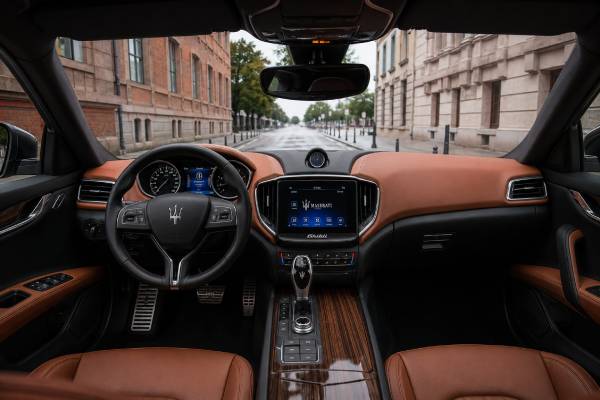
The launch body is easy to recognize by its original bumpers, early lamp graphics, and first-generation center console. Inside, the car uses an 8.4-inch touch interface with physical controls around it, an analog clock, and a spring-return electronic shifter. Later M157 updates changed these areas, which makes retrofitted parts possible. A newer-looking screen, grille, wheel, or steering wheel does not change the underlying model year.
Early S cars could be ordered as restrained executive sedans or highly personalized sporting cars. Available equipment included full leather, different seat designs, wood or carbon-fiber trim, Alcantara headlining, heated rear seats, ventilation, premium audio, adaptive headlights, a sunroof, soft-close doors, parking cameras, blind-spot assistance, Skyhook damping, several caliper colors, and multiple wheel designs.
Identity checks that prevent expensive mistakes
- Decode the VIN and obtain the factory option record.
- Confirm 410 hp rear-drive specification rather than 330 hp, Q4, or a later 430 hp calibration.
- Match the original engine and transmission identifiers to the records.
- Verify the sales market before ordering emissions, lighting, or electronic parts.
- Compare suspension, brakes, wheels, seats, trim, and driver-assistance equipment with the build sheet.
- Treat added S badges or later-style bumpers as cosmetic until the mechanical identity is proven.
A true S does not need every available option to be desirable. Some buyers prefer passive suspension, smaller wheels, and fewer powered accessories because those choices reduce future repair exposure. Others value Skyhook, premium leather, and a rare color combination. Condition should decide the ranking. A fully optioned car with failed soft-close doors, damaged carbon trim, a leaking sunroof, and non-working audio is not more valuable than a modest car that works correctly.
Service records also help authenticate use. An S that has spent years on mismatched rear tires, cheap brake pads, or repeated tuning changes may have been treated as disposable performance. A lower-option car with regular alignment reports, matching tires, and detailed fluid invoices often presents a stronger ownership story.
What Separates the S Visually and Mechanically
The S looks deliberately close to the ordinary Ghibli, but its character comes from output, rear-drive calibration, and supporting hardware rather than one dramatic body change. The most important distinctions are underneath the styling.
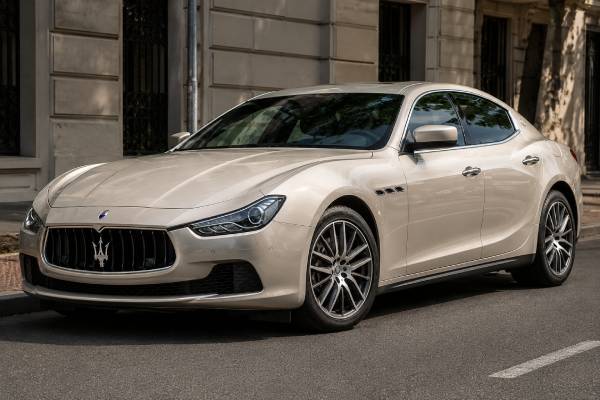
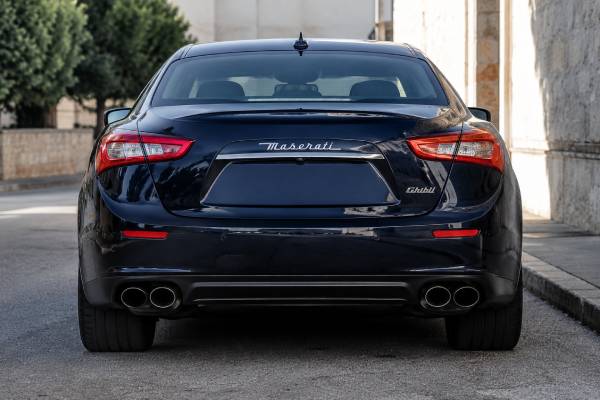
The exterior uses the same essential Maserati vocabulary as other launch cars: a concave grille carrying the Trident, three vents behind each front wheel, a long hood, a rising shoulder, and four exhaust outlets. The shape came from Maserati Centro Stile and gives the sedan a coupé-like profile. Its low roof and thick rear pillars look elegant but restrict rear headroom and outward visibility.
The body is primarily steel, with aluminum used for the hood, doors, suspension pieces, and other selected components. Correct collision repair matters because aluminum work requires different tools and methods. Poorly aligned doors, disturbed fasteners, inconsistent seam sealer, paint texture changes, or corrosion around previous repairs deserve investigation.
Mechanically, the S relies on the same sophisticated basic geometry as the range but asks more from every consumable. The double-wishbone front end manages wheel angle through travel, while the five-link rear suspension controls toe and camber under load. With 550 Nm going through the rear tires, bush condition and alignment directly affect traction. A car with worn rear links may feel unstable even if the engine is healthy.
The cockpit reinforces the sporting brief. The driver sits low, the hood remains visible, and the fixed aluminum paddles are large enough to use without searching. The steering wheel has meaningful weight, and the analog instruments are easy to read. Leather, stitching, carbon fiber, wood, and Alcantara can create a rich environment, though some shared switches and lower trim pieces are less special.
Details to inspect rather than admire
- Check grille slats, lower intakes, and undertrays for parking or road impacts.
- Look for lamp condensation and water traces in the trunk, headliner, and footwells.
- Operate every seat motor and memory setting while listening for strain or clicking.
- Examine dashboard leather for shrinkage and carbon trim for lifting clearcoat.
- Confirm that the exhaust valves change behavior without rattles or warning faults.
- Test the touch screen, amplifier, Bluetooth, navigation, cameras, and all climate zones.
The exhaust note is an important S feature. In Sport mode, the valves allow a stronger, harder-edged V6 sound. The system should not buzz, clank, or remain stuck in one state. A noisy exhaust can also hide a misfire, loose shield, cracked mount, or nonstandard modification, so a buyer should compare sound with scan data and underbody condition.
Rear-Drive Performance on Real Roads
The Ghibli S is fast enough to feel serious, yet its best quality is the way speed builds through the rear axle rather than the absolute 0–100 km/h figure. It rewards smooth inputs and good tires more than aggressive launches.
In the normal drive setting, throttle mapping is measured and the gearbox reaches the higher ratios quickly. This makes the S easy to use in traffic despite its output. Selecting Sport wakes the car up: pedal response sharpens, the transmission holds gears, downshifts become more immediate, and the exhaust grows louder. The engine’s 550 Nm arrives early, but the 410 hp tune continues to pull as revs rise.
On a dry road, the limited-slip differential helps both rear tires share the work. The car can rotate progressively under power, but electronic stability control remains an important safety layer. Cold tires, rain, polished surfaces, or a mid-corner bump can use the available grip quickly. The S should be driven as a powerful grand tourer, not treated as a drift car on public roads.
Hydraulic steering supplies weight and texture that later electric-steering Ghiblis do not duplicate exactly. The front end responds best when the driver brakes in a straight line, releases the pedal smoothly, and gives the tires time to take a cornering load. Sudden steering on oversized or aged front tires can make the car feel reluctant, while correct geometry produces a clean, confident turn-in.
The long wheelbase gives the S excellent motorway stability. It tracks calmly at speed and makes overtaking effortless. In town, the wide body, low nose, and noticeable turning circle demand more attention. Cameras and parking sensors should work because replacing damaged bumper trim or wheels can erase any saving from buying a cheaper car.
Ride quality ranges from refined to harsh depending on specification. Nineteen-inch wheels and healthy dampers provide a good balance. Twenty-inch cars transmit sharper edges, and low tire pressure used to soften the ride can damage sidewalls and rims. Skyhook can control float on fast roads, but a failed damper or sensor may leave the system inconsistent.
Braking performance should feel repeatable. The pedal should not pulse, travel excessively, or pull the car to one side. Heavy vibration can involve discs, wheel hubs, control arms, or tires, so replacing pads alone may not solve it. After a test drive, unequal wheel heat may reveal a dragging brake.
A healthy S feels stronger than its age suggests. Boost should rise smoothly, the engine should not stumble at full load, and the gearbox should not flare between shifts. Reduced power, surging, smoke, or misfire under boost calls for diagnosis of ignition, fueling, air leaks, turbo control, and exhaust restrictions. Performance claims are useful only after basic health is proven.
Maintenance Risks Behind the Performance
The S does not require exotic-car rituals, but it does require performance-car discipline. Low voltage, old fluids, poor tires, cooling leaks, and deferred suspension work can create a chain of faults that makes a fundamentally good car appear far worse.
Start with the battery and charging system. The M157 uses many networked modules, and voltage loss can trigger unrelated warnings. A correct battery, clean terminals, proper registration or reset procedure where required, and a maintainer during storage are basic ownership tools. Repeated jump-starting without fixing the cause can corrupt settings or stress electronics.
The F160 should be assessed cold. Listen for prolonged rattle, check for smoke, watch idle stability, and inspect for oil or coolant traces. Ignition coils, spark plugs, injectors, sensors, intake leaks, and boost-control components can all produce misfires. Scan live data and readiness status; a recently cleared fault memory may hide an unresolved problem.
Cooling deserves a pressure test when history is uncertain. Hoses, plastic fittings, seals, reservoirs, radiators, pumps, and fans age under heat. A sweet odor after shutdown, dried residue, low level, or temperature movement is not normal. Small leaks should be repaired before they become overheating events.
High-cost areas to inspect early
- Front and rear control-arm joints, bushes, and alignment adjusters.
- Skyhook dampers, wiring, and top mounts where fitted.
- Large brake discs, caliper seals, hoses, and parking-brake operation.
- Bent wheels, cracked inner rims, and aged staggered tires.
- Engine, transmission, and differential mounts.
- Differential seals, driveshaft joints, and rear wheel bearings.
- Infotainment, amplifier, camera, seat, and blind-spot modules.
The rear tires provide a useful record of the car’s health. Heavy inner wear can signal geometry or bush problems. A much newer pair at the rear than the front may simply show normal replacement, but repeated cheap rear tires can suggest hard use or poor budgeting. The car should have matching performance characteristics across the axle and sensible compatibility front to rear.
Transmission complaints need context. A rough shift can come from adaptation, engine torque irregularity, low voltage, mounts, software, or fluid condition. Service must use the correct fluid, fill temperature, and procedure. Random additives or generic flush equipment are poor substitutes for diagnosis.
Electrical repair should begin with scan results, wiring diagrams, power supply, grounds, and water-entry checks. Replacing modules by guess can become extremely expensive, and some replacements require coding. The same principle applies to the electronic parking brake, adaptive lights, climate system, and active safety functions.
VIN-specific recall status should be checked before purchase. Certain early cars were included in campaigns involving rear suspension tie rods and front-seat wiring, among other market-dependent actions. Completed work should appear in official records or invoices. An open campaign may be free to correct, but parts availability and local eligibility should be confirmed.
Routine care must extend beyond engine oil. Brake fluid, coolant condition, spark plugs, filters, accessory components, air conditioning, wheel alignment, tire age, and underbody inspection all matter. Short trips and long storage periods can be as harmful as high mileage because they encourage battery weakness, condensation, and seized components.
A Focused Ghibli S Buying Plan
Buy a Ghibli S only after confirming that it is the 410 hp rear-drive version and after pricing every immediate fault. The strongest example will usually have complete invoices, four proper tires, a clean scan, and no attempt to hide the cold start.
Request the VIN before traveling. Use it to establish production date, market, engine output, drivetrain, original options, and campaign status. Compare the build record with the actual wheels, brakes, seats, suspension, trim, and electronics. A trunk badge has no evidentiary value by itself.
Study the service file for patterns. Regular oil changes are expected, but useful history also covers plugs, coolant work, batteries, brake fluid, suspension, tires, alignment, software, air conditioning, and fault diagnosis. Consecutive invoices from a knowledgeable specialist show more than a book containing stamps without detail.
Seven steps for the inspection
- Inspect paint, glass, panel gaps, fasteners, wheel barrels, undertrays, and lower suspension for collision or curb damage.
- Start the engine cold and observe cranking time, smoke, noise, idle, warning lights, and charging voltage.
- Scan every available module and retain the report before codes are erased.
- Operate all comfort, safety, lighting, multimedia, locking, seat, and climate functions.
- Test the car at parking speed, on rough pavement, at steady cruise, under moderate boost, and during controlled braking.
- Recheck the hot engine bay and underside for fresh leaks, odors, fan issues, or uneven brake temperature.
- Put the car on a lift and inspect structural points, cooling connections, driveline seals, bushes, dampers, brakes, and exhaust.
A specialist pre-purchase inspection is essential because generic shops may not recognize model-specific scan data, module configuration, suspension variants, or Maserati service information. Ask for a written estimate divided into safety work, overdue maintenance, near-term repairs, and cosmetic choices.
Calculate the first year before negotiating. Tires, front and rear brakes, a battery, missing key, leaking damper, control arms, and infotainment work can each be meaningful. Several together can exceed the price difference between a neglected car and an excellent one. Reserve money for baseline service even when the seller claims nothing is due.
Treat tuning cautiously. The F160 responds to software, but extra boost increases heat and driveline demand. A modified car should have documentation identifying the calibration, fuel requirement, supporting work, and ability to return to stock. Unknown tunes, removed emissions equipment, wheel spacers, extreme lowering, or improvised wiring reduce value unless the buyer specifically wants a project.
The rear-drive S is best for an owner who appreciates steering feel, engine response, and high-speed touring enough to maintain the car proactively. It is less suitable for year-round use on poor tires, repeated short journeys, or ownership based on the lowest monthly payment.
Walk away when identity is unclear, the seller refuses a cold start, scan readiness is incomplete, the car has multiple network faults, or the inspection reveals structural repair of uncertain quality. There are enough Ghiblis available that patience is cheaper than rationalizing a compromised S. A verified, well-kept car delivers the point of the model: strong V6 performance, real rear-drive character, and distinctive Italian design in a usable four-door package.
References
- All-new Maserati Ghibli premiering in Shanghai 2013 (Manufacturer Press Release)
- Maserati at the Geneva Motor Show 2015 (Manufacturer News)
- Defect Information Report 2016 (Recall Database)
- Part 573 Safety Recall Report 17V-046 2017 (Recall Database)
Disclaimer
This guide is informational and is not a replacement for professional diagnosis, repair, or a pre-purchase inspection. Specifications, torque settings, fluids, intervals, software steps, and procedures can differ by VIN, market, build date, and equipment. Check the official workshop, owner, campaign, and parts information for the exact vehicle before servicing it.
Please share the article on Facebook, X/Twitter, or a Maserati community when it helps. That support makes further detailed guides possible.