
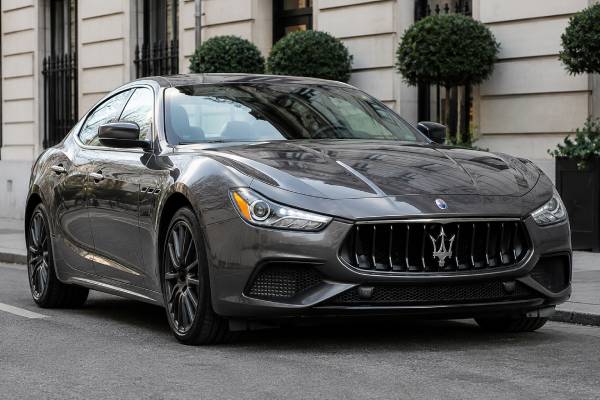
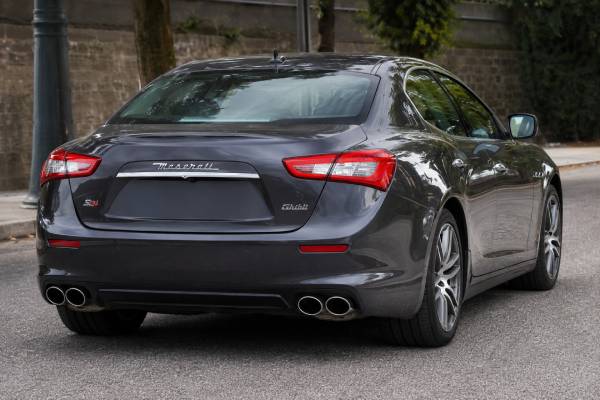
The 430 hp Maserati Ghibli S is the most powerful rear-wheel-drive V6 version of the M157 before the Trofeo changed the range with a V8. Sold from 2017 through 2021 in markets where the rear-drive S remained available, it combines the uprated F160 twin-turbo V6 with 580 Nm, a ZF eight-speed automatic, a limited-slip differential, and a chassis that sends every unit of drive torque through the rear tires. Official figures of about 4.9 seconds to 100 km/h and 286 km/h at the top end make it genuinely fast, but its appeal is more specific than a number: it has less front driveline mass than the Q4, cleaner steering behavior, and a willingness to adjust its line under power. This production period also spans hydraulic and electric steering, the 2018 facelift, GranLusso and GranSport packages, and the 2021 multimedia update. Those changes make one “Ghibli S” quite different from another. Maintenance quality is decisive because 580 Nm exposes old tires, worn rear suspension, weak mounts, cooling leaks, and poor engine calibration quickly. This guide explains the 430 hp rear-drive car, the factory distinctions that matter, how it behaves, and what a serious buyer should inspect.
Table of Contents
- The Strongest Rear-Drive V6 Ghibli
- 430 hp Specifications and Dynamic Hardware
- S Trim Changes Before Trofeo
- Performance Design Without V8 Excess
- How 580 Nm Feels Through Rear Tires
- Service Costs and High-Output V6 Risks
- A Buyer’s Checklist for the Ghibli S
The Strongest Rear-Drive V6 Ghibli
The 430 hp S sits at the performance peak of the rear-drive six-cylinder range. It delivers the later F160’s full output without the Q4 transfer case, front differential, or front half-shafts.
Maserati increased the S from 410 to 430 CV as part of the M157’s mid-cycle development. Torque rose from 550 to 580 Nm, and the car gained stronger high-speed acceleration while preserving the same basic front-engine, rear-drive architecture. The update helped the Ghibli remain competitive against increasingly powerful executive sedans.
The model’s identity is not only its power rating. Removing the all-wheel-drive hardware saves weight and keeps the front wheels dedicated to steering. The result is a more traditional Maserati response, especially in warm, dry conditions. The driver feels the rear axle accept torque, and the limited-slip differential helps the car drive out of bends without requiring front assistance.
That layout also demands respect. A 580 Nm sedan on worn summer tires can lose rear grip quickly in cold rain. Stability control is a core part of the road package, not an obstacle to enjoyment. The S is most rewarding when its tires, alignment, dampers, and rear links are in excellent condition and the driver uses smooth throttle.
The 2017–2021 span gives the car two distinct personalities. Early examples can retain hydraulic steering and the original exterior. The 2018-on version adopts electric assistance, revised bumpers, more driver-assistance systems, and GranLusso or GranSport themes. In 2021, updated rear lights and infotainment modernize the cabin further.
Before the V8 Trofeo, the S was the version for buyers who wanted maximum rear-drive pace without moving to all-wheel drive. After Trofeo arrived, the S became a subtler alternative: nearly 300 km/h capability, a lighter nose, lower fuel and brake demands than the V8, and fewer visual signals.
Current values can make the car look deceptively accessible. Purchase price may resemble an ordinary used sedan, but tires, brakes, adaptive dampers, turbocharged-engine diagnostics, and electronic repair remain premium items. The correct comparison is not monthly finance cost; it is total condition plus the first year of baseline work.
430 hp Specifications and Dynamic Hardware
The later Ghibli S uses a 2,979 cc twin-turbo V6 producing 430 CV and 580 Nm. Rear-wheel drive, an eight-speed automatic, and a limited-slip differential define the power path.
| Platform code | M157 |
|---|---|
| Engine family | F160 |
| Engine | 60-degree, twin-turbocharged V6 |
| Displacement | 2,979 cc |
| Injection | Direct petrol injection |
| Maximum output | 430 CV, approximately 316 kW at 5,750 rpm |
| Maximum torque | 580 Nm at approximately 2,250–4,000 rpm |
| Transmission | ZF eight-speed automatic |
| Drivetrain | Rear-wheel drive |
| 0–100 km/h | Approximately 4.9 seconds |
| Top speed | Approximately 286 km/h |
| Fuel capacity | 80 liters |
The F160 calibration gives the S a wider performance envelope than the base V6. At small throttle openings it can behave calmly, but boost and torque rise decisively when the gearbox selects a lower ratio. Peak power arrives at 5,750 rpm, encouraging the driver to use more of the rev range than in the diesel or 350 hp model.
The eight-speed transmission provides smooth cruising and rapid multi-gear downshifts. In Sport mode, it holds gears, sharpens changes, and works with the open exhaust valves to make the car more immediate. The fixed aluminum paddles allow manual control without moving relative to the column.
| Body | Four-door, five-seat sports sedan |
|---|---|
| Length | Approximately 4,971 mm |
| Width | Approximately 1,945 mm excluding mirrors |
| Wheelbase | 2,998 mm |
| Representative curb weight | Approximately 1,850–1,950 kg, depending on equipment and market |
| Front suspension | Double wishbones |
| Rear suspension | Five-link independent layout |
| Steering | Hydraulic on the earliest cars; electric on the principal 2018-on specification |
| Brakes | Ventilated Brembo system, with larger multi-piston hardware on many versions |
| Trunk capacity | Approximately 500 liters |
The S often appears with staggered 19-, 20-, or 21-inch tires. A wider rear footprint helps deploy torque but increases replacement cost. Twenty-one-inch wheels provide little sidewall protection on broken roads. Bent inner barrels can create vibration that wheel balancing cannot cure.
Skyhook adaptive suspension is desirable for buyers who want both long-distance comfort and firmer body control. Its electronically controlled dampers are expensive when worn, so a non-leaking unit that still controls rebound matters more than the presence of a dashboard mode.
Brake specification should be verified physically. Caliper paint is cosmetic and can be changed. Disc diameter, thickness, condition, pad material, hoses, and fluid age determine whether the system is ready for the car’s speed.
S Trim Changes Before Trofeo
A 2017 Ghibli S and a 2021 Ghibli S share 430 hp but differ in steering, styling, technology, and market naming. The VIN and production date are essential to understanding the car.
The 2017 model year bridges the original M157 design and the later facelift. Some markets received the higher-output engine before the complete exterior and electronic update. These cars can combine 430 hp with hydraulic steering, a pairing that attracts enthusiasts.
The 2018 update introduced electric power steering, restyled bumpers, available adaptive LED lamps, and expanded assistance functions. Maserati organized equipment around GranLusso and GranSport. GranLusso used more formal details and luxury materials; GranSport emphasized aggressive exterior elements, sport seats, larger wheels, and available carbon trim.
In 2021, boomerang-inspired rear lamp graphics and a larger 10.1-inch multimedia screen gave the Ghibli a more contemporary appearance. Connected services, navigation, and software support varied by market. A late screen or tail-lamp conversion on an earlier car should not be mistaken for a factory late model.
Identification questions to settle before purchase
- Is the car a factory 430 CV rear-drive S?
- Which market sold it, and how was the output quoted locally?
- Does it have hydraulic or electric steering?
- Is the suspension passive or Skyhook?
- Which brake and wheel package was fitted at the factory?
- Are GranLusso, GranSport, or other badges supported by the build list?
- Have assistance cameras, radar units, or lamps been replaced and calibrated?
The 430 CV figure may appear as approximately 424 hp in North American material because metric and SAE horsepower are not identical. That is a unit difference, not evidence of a separate engine. Advertisements that mix 430 hp, 430 CV, and 424 hp should still be checked against the market record.
Factory options affect desirability, but the condition of each option is more important. A carbon-fiber cabin with lifting clearcoat, a sunroof with blocked drains, or premium audio with a failed amplifier can cost more to correct than the feature adds to value.
Performance Design Without V8 Excess
The 430 hp S expresses performance through stance, wheels, trim, and sound rather than the hood vents and overt aggression of the later Trofeo. It is fast without advertising itself as the top model.
The M157 shape came from Maserati Centro Stile. Its grille sits low and wide, the front fender vents break up the long side, and the roof flows into pronounced rear shoulders. The body looks compact from a distance but measures nearly five meters in length and almost two meters in width.
GranSport equipment can make the S visually assertive through larger intakes, dark trim, sport seats, carbon elements, and broad wheels. GranLusso produces a quieter, more formal car with wood, leather, and elegant detailing. Either can carry the same engine. Buyers should choose the condition and character they prefer rather than assume one is mechanically faster.
The structure is steel-intensive with aluminum used in the doors, hood, and selected chassis parts. Correct crash repair is especially important around the front suspension and rear wheel housings because alignment affects how 580 Nm reaches the road. Paint quality alone cannot reveal whether geometry is true.
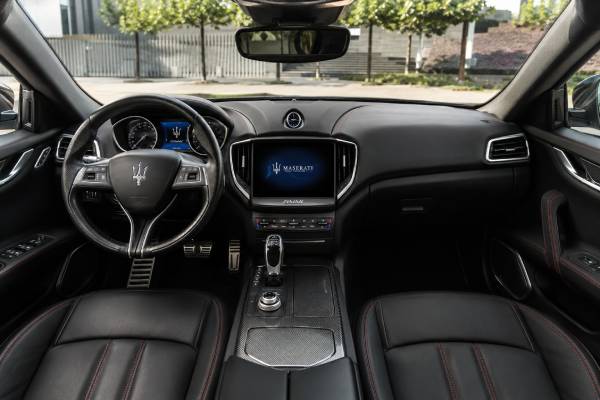
The interior places the driver low behind a wide console. Fixed paddles, clear analog gauges, and the visible hood support the sporting feel. Early infotainment can be slow; late MIA hardware is more modern. All systems share the need for stable voltage and correct module coding.
High-value visual and functional checks
- Inspect the front splitter area, lower grilles, undertrays, and parking sensors for impact damage.
- Check wide rear wheels for cracked barrels, weld repairs, and curb damage.
- Look for moisture in lamps, trunk, battery compartment, headliner, and carpets.
- Operate every seat function, memory setting, window, mirror, lock, and climate zone.
- Examine stitched leather for shrinkage and carbon trim for delamination.
- Verify camera, radar, blind-spot, adaptive-light, and infotainment operation.
The valved exhaust gives the S much of its emotional identity. Sport mode should produce a clean change in tone without rattling. A permanently loud car may have modified valves or removed components. Nonstandard exhaust work should be inspected for heat shielding, sensor placement, leaks, and legal compliance.
How 580 Nm Feels Through Rear Tires
The 430 hp S feels urgent from the middle of the rev range and progressively more alive as speed rises. Its rear-drive layout makes throttle input an active part of the handling balance.
Normal mode keeps the first part of the accelerator gentle and allows the transmission to reach taller gears. The car can commute without feeling nervous. Sport mode changes the atmosphere immediately: the gearbox holds lower ratios, the throttle reacts sooner, and the exhaust becomes more vocal.
From a rolling start, the engine’s 580 Nm makes overtaking effortless. At higher rpm, the 430 hp tune keeps pulling rather than flattening early. The gearbox can drop several gears quickly, but it should do so without flare, a delayed slam, or repeated hunting.
Rear traction depends on temperature, surface, and tire condition. In dry weather on premium tires, the differential helps the car accelerate cleanly. On cold, wet pavement, the same torque can overwhelm the rear axle. Smooth steering and throttle are more effective than relying on electronic intervention after grip has already gone.
Hydraulic-steering examples provide more texture and natural effort. Electric-steering cars are lighter and integrate with lane support, but some drivers find the response less detailed. Alignment and front-suspension health influence either system. A worn arm or bent wheel can make the car wander or tramline.
The long wheelbase gives the S a planted high-speed character. It prefers open bends to tight hairpins, where its mass becomes more obvious. Healthy dampers keep the body controlled over crests and compressions. Worn units allow a second movement after a bump or make the rear feel unsettled under power.
Wheel size shapes ride quality. Nineteen-inch tires provide useful compliance, 20-inch sets sharpen turn-in, and 21-inch wheels prioritize appearance. Road noise, pothole impact, and replacement cost rise with diameter. Pressure should follow the exact load and wheel specification.
Brakes need to feel consistent from the first stop to the last. Pulsation may come from disc variation, hub contamination, or suspension movement. Pull can indicate tires, alignment, or caliper problems. A test drive should include moderate legal-speed braking and a temperature comparison afterward.
The S is usable in town, but its width and low front end require care. On the motorway, it becomes calm and efficient relative to its performance. The strongest examples make the transition from quiet cruise to rapid acceleration without warnings, vibration, smoke, or hesitation.
Service Costs and High-Output V6 Risks
The 430 hp engine is most vulnerable to the same things that affect other F160 cars—heat, ignition faults, leaks, and poor voltage—but higher load makes symptoms appear sooner. Preventive maintenance is cheaper than diagnosing a chain of secondary faults.
A cold start should be clean, with no prolonged rattle, heavy smoke, or unstable idle. Coils and spark plugs work hard under boost. Misfire under load can damage catalysts if ignored. Live data should include misfire counts, fuel trims, boost behavior, and readiness status.
Cooling-system integrity is essential. Inspect reservoir level, hose connections, radiators, pumps, fans, and dried residue. Pressure-test when history is unclear. A small leak can become an overheating event during high-load driving, and repeated top-ups are not a repair.
Battery and charging health should be confirmed before evaluating electronic faults. Low voltage can set messages for steering, transmission, suspension, parking brake, driver assistance, and infotainment. Use the correct battery and a maintainer during storage.
Items that can change the ownership budget
- A full set of correct high-performance tires, especially in 20- or 21-inch sizes.
- Large brake discs, pads, caliper work, and fresh high-quality fluid.
- Front control arms, rear links, wheel bearings, and alignment.
- Skyhook dampers, top mounts, springs, and sensors.
- Cooling-system repairs hidden behind undertrays.
- Infotainment, cameras, radar, amplifiers, seat modules, or key replacement.
The transmission should be evaluated together with engine torque delivery. Rough changes may result from mounts, adaptation, software, low voltage, or an engine fault. Fluid service requires the exact specification, temperature, and fill procedure. Generic flushing can create problems.
Rear differential seals and mounts deserve inspection because all torque passes through that assembly. Listen for whine, clunk, or vibration on acceleration and coast. Check driveshaft joints and support components on a lift.
Safety campaigns depend on VIN and market. Later Ghiblis were included in recalls involving fuel-system and seat-belt components in certain populations. Confirm completion officially. Imported vehicles may carry records from another national system.
Electrical repairs should be diagnostic, not speculative. Water intrusion, weak grounds, damaged bumper wiring, or incorrect coding can imitate module failure. A Maserati-capable scan is necessary because generic readers may show only powertrain codes.
A Buyer’s Checklist for the Ghibli S
Buy the 430 hp S that proves its identity and condition, not the one with the loudest exhaust or biggest wheels. A complete inspection should demonstrate that the engine, rear driveline, electronics, and chassis can support the advertised performance.
Request the VIN, build sheet, service invoices, both keys, tire dates, and permission for an independent cold-start inspection. Verify output, market, steering type, suspension, brakes, trim line, and original options. Check whether the car has engine software, exhaust, suspension, or wheel modifications.
Inspection sequence
- Examine paint, panel gaps, structural areas, undertrays, front cooling openings, wheel barrels, and tire wear.
- Start the engine cold and observe cranking, noise, smoke, idle, charging voltage, coolant level, and warning lights.
- Scan every module before codes are cleared; save fault, readiness, and freeze-frame information.
- Test all seats, windows, locks, lights, cameras, sensors, climate functions, audio, navigation, and assistance systems.
- Drive at parking speed, on broken pavement, at steady cruise, under moderate boost, and during controlled braking.
- Inspect the hot car for fresh leaks, odors, fan operation, uneven brake heat, and newly stored codes.
- Raise the car and check suspension, differential, driveshaft, mounts, cooling connections, brakes, and exhaust.
The specialist’s written estimate should separate immediate safety work, overdue service, near-term wear, and cosmetic improvements. Add tires, brakes, dampers, cooling work, missing keys, and electronic faults before judging whether the asking price is attractive.
A modified S can be good when the work is transparent. Obtain the exact tune file, fuel requirement, dyno or diagnostic records, invoices, and original parts. Unknown boost increases, removed emissions equipment, crude exhaust work, extreme lowering, and nonstandard wheel offsets introduce heat, traction, and resale risks.
Service history should show more than oil changes. Look for plugs, batteries, brake fluid, coolant repairs, filters, tire replacement, alignment, suspension work, software updates, and diagnostic invoices. Repeated code clearing or several owners in a short period deserves a careful explanation.
The 430 hp rear-drive S is ideal for a driver who wants strong V6 pace and a more traditional balance than the Q4. It is not the best choice for frequent snow use without proper seasonal tires or for an owner unwilling to maintain high-performance consumables.
Approve the purchase only when the specification is verified, the structure is honest, the scan is credible, and the first-year budget remains comfortable after known work. A healthy S delivers one of the M157 range’s most satisfying combinations: discreet looks, real speed, and rear-driven character just below the V8 era.
References
- EN_Maserati-MY19-MiniBook-Ghibli.pdf 2019 (Model Brochure)
- Maserati_Ghibli_Digital_Catalogue_EN.pdf 2021 (Model Brochure)
- Management Summary of Maserati Safety Recall Campaign 378 2018 (Recall Database)
- Part 573 Safety Recall Report 21V-703 2021 (Recall Database)
Disclaimer
This guide is informational and does not replace professional diagnosis, repair, calibration, or an inspection of the individual vehicle. Specifications, torque values, fluids, intervals, software routines, and service procedures vary by VIN, market, build date, and equipment. Consult the official technical documentation for the exact car before performing work.
Please share this article on Facebook, X/Twitter, or a Maserati community if it was helpful. That support helps create more detailed ownership guides.