
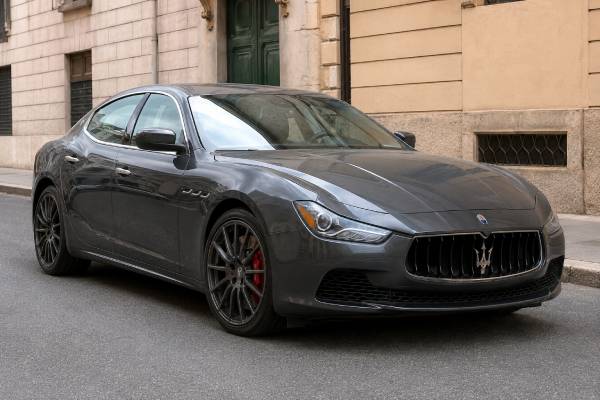
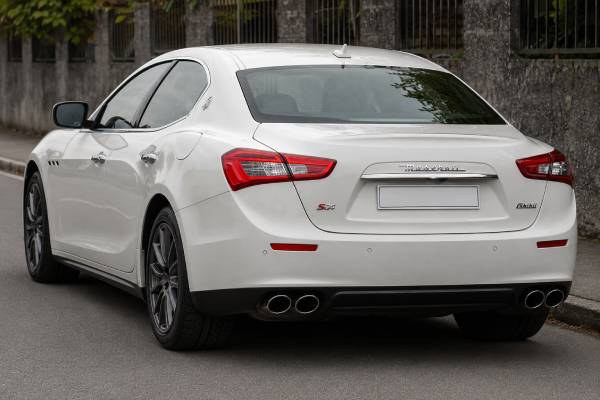
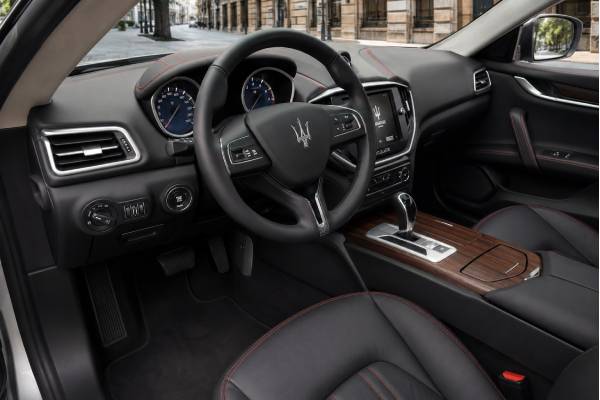
The 410 hp Maserati Ghibli S Q4 was the launch-era M157’s all-weather performance flagship. It combined the high-output F160 twin-turbo V6 with a rear-biased Q4 all-wheel-drive system, an eight-speed automatic, hydraulic steering, and the long-wheelbase stability of Maserati’s new executive sedan platform. In normal steady driving, the system favored the rear axle; when acceleration or low grip demanded help, it could direct torque forward. The result was a claimed 0–100 km/h time of about 4.8 seconds, slightly quicker than the rear-drive S, without turning the car into a nose-heavy front-drive-based sedan. That capability also adds inspection points. Matching tires, transfer-case behavior, front driveline condition, alignment, battery voltage, and software matter more on a Q4 than on a rear-drive car. As these 2013–2016 examples age, the best purchases are not necessarily the lowest-mileage or most heavily optioned. They are the cars with verified identity, consistent service, correct tires, clean diagnostic records, and no unexplained driveline vibration. This guide explains the early S Q4’s engineering, road character, production details, maintenance needs, and a practical process for buying one intelligently.
Table of Contents
- Why Q4 Defined the Early Flagship
- The 410 hp V6 and Q4 System
- Model-Year Changes and Identification
- Design Details Built Around Traction
- How the S Q4 Delivers Its Speed
- Q4-Specific Maintenance and Known Issues
- Choosing a Strong S Q4 Example
Why Q4 Defined the Early Flagship
The early S Q4 was the quickest and most broadly usable petrol Ghibli at launch. It gave Maserati the acceleration expected of a modern performance sedan while keeping the brand’s traditional rear-drive behavior in normal conditions.
The M157 Ghibli arrived in 2013 as part of Maserati’s effort to expand beyond the Quattroporte and two-door GranTurismo. The company entered a class where customers expected four-season traction, advanced electronics, and easy everyday speed. Q4 answered that requirement without adopting a transverse engine or a front-drive foundation. The car remained longitudinal, and the front axle received drive through added hardware only when needed.
That distinction matters. Many all-wheel-drive sedans feel as if the front wheels are permanently pulling the car. The S Q4 was engineered to feel rear-driven through most ordinary running. Its transfer system monitors wheel speed, steering, throttle, yaw, and other inputs, then varies torque distribution when traction changes. The design improves launches, wet-road exits, and winter mobility, but it does not overcome poor tires or careless driving.
The 410 hp F160 tune made the Q4 the range’s headline performer before later 430 hp and V8 versions appeared. Its 550 Nm torque output was strong enough to expose the limits of two driven wheels in cold weather, so the extra front-axle assistance was meaningful rather than decorative. The claimed 4.8-second sprint to 100 km/h placed the car among serious German rivals while the exhaust note and Italian body gave it a different emotional appeal.
Today, the early S Q4 is interesting as the first modern all-wheel-drive Maserati sedan of its size. It also represents the original M157 formula before the 2018 electric-steering and driver-assistance update. Enthusiasts may value its hydraulic steering and simpler cabin interface, while daily drivers appreciate the added traction.
Ownership reputation depends heavily on condition. Q4 components add weight, seals, bearings, shafts, and control logic. None of those make failure inevitable, but they make mismatched tires, neglected fluids, collision damage, and diagnostic shortcuts more consequential. A well-kept example can feel cohesive and secure. A neglected one may display shudder, vibration, warning messages, or uneven tire wear that sellers dismiss as normal all-wheel-drive behavior.
The 410 hp V6 and Q4 System
The S Q4 uses a 2,979 cc twin-turbo V6 rated at 410 CV and 550 Nm, linked to a ZF eight-speed automatic and Maserati’s electronically managed Q4 driveline. Its engineering priority is rapid traction without sacrificing rear-drive balance.
| Platform | M157 |
|---|---|
| Engine code | F160 |
| Engine layout | 60-degree, twin-turbocharged V6 |
| Displacement | 2,979 cc |
| Fuel delivery | Direct petrol injection |
| Peak output | 410 CV, approximately 301 kW |
| Peak torque | 550 Nm at approximately 1,750–5,000 rpm |
| Transmission | Eight-speed ZF automatic |
| Drivetrain | Q4 intelligent all-wheel drive |
| 0–100 km/h | Approximately 4.8 seconds |
| Top speed | Approximately 284 km/h |
| Fuel capacity | 80 liters |
The F160 engine uses two turbochargers and direct injection to produce a wide torque band. It can move the car briskly from low rpm, yet the 410 hp calibration still gains urgency as the engine approaches its power peak. Sport mode changes throttle mapping, shift strategy, and exhaust-valve operation, making the response more immediate without altering the basic mechanical output.
Q4 adds a compact transfer arrangement, front propeller shaft, front differential, and half-shafts. Under steady grip, the system keeps a strong rear bias. When it predicts or detects slip, it sends part of the available torque forward. The exact split changes continuously, so a dashboard graphic or marketing maximum should not be interpreted as a fixed operating condition.
Tire circumference is critical. Four tires may show the same printed size yet differ in actual rolling radius because of brand, construction, wear, or pressure. Large differences force the driveline to reconcile unequal wheel speeds and can create heat or binding. The safest practice is a matched set, correct pressures, similar tread depth, and replacement in a way approved for the exact vehicle.
| Body style | Four-door executive sedan |
|---|---|
| Length | Approximately 4,971 mm |
| Width | Approximately 1,945 mm excluding mirrors |
| Wheelbase | 2,998 mm |
| Representative curb weight | About 1,900–1,950 kg, depending on equipment and market |
| Front suspension | Double wishbones |
| Rear suspension | Five-link independent layout |
| Steering | Hydraulic power assistance |
| Brakes | Ventilated Brembo discs with specification varying by market |
The extra driveline mass sits mainly forward of the cabin, but the car retains balanced proportions and a near-even static distribution. Its front suspension still has dedicated control arms rather than a strut, helping it manage tire angle under load. Optional Skyhook adaptive dampers widen the range between cruising comfort and firmer body control.
Model-Year Changes and Identification
Early S Q4 cars look similar across 2013–2016, yet production date, sales market, option content, and component revisions can change parts compatibility and value. The factory record should guide identification.
The launch design uses the original grille, bumpers, lamp signatures, and rear treatment. The cabin has an 8.4-inch touch interface, an analog clock, large fixed shift paddles, and the early spring-return selector. Later M157 components can be retrofitted, so appearance alone cannot establish model year or output.
North America was an important Q4 market because all-weather performance appealed to buyers in snow-belt regions. Other markets offered different trim combinations, lighting, navigation, emissions hardware, and safety packages. A car imported from another country may be attractive, but the owner should understand radio compatibility, map support, lamp legality, parts sourcing, campaign coverage, and resale implications.
Build-sheet items worth confirming
- The 410 hp F160 calibration rather than a 330 hp base version.
- Genuine Q4 driveline equipment and the original market description.
- Passive or Skyhook damping.
- Brake package, wheel diameter, and factory tire sizing.
- Seat type, leather specification, trim material, and headliner.
- Adaptive lights, cameras, blind-spot monitoring, premium audio, and soft-close doors.
- Original paint and caliper colors where collector originality matters.
Wheel and badge swaps are common. A rear-drive car can wear Q4 or S emblems, while an S Q4 may have later wheels or a facelift-style grille. The VIN, underbody hardware, build list, and scan data provide a stronger answer than cosmetic cues.
Option quantity should not outrank condition. Soft-close doors, ventilated seats, a sunroof, premium sound, and carbon trim increase appeal only when they work. A simpler car with intact leather, healthy electronics, and correct tires may be a more dependable purchase than a fully loaded example requiring several modules and trim repairs.
Production revisions also matter during service. Sensors, lamps, infotainment parts, brakes, and wiring can change within one nominal model. Use the chassis number when ordering. A used module with the same connector may still need coding or may not support the car’s equipment set.
Design Details Built Around Traction
The S Q4 hides its all-wheel-drive hardware beneath the same low, rear-biased proportions as the rest of the early Ghibli range. That restraint is the design’s strength: the car does not advertise traction with raised suspension or bulky bodywork.
Maserati Centro Stile gave the M157 a long hood, swept cabin, tapered side glass, and muscular rear shoulder. The concave grille and three fender vents make the car immediately recognizable. Four exhaust outlets support the performance message, while subtle Q4 badging identifies the driveline.
Packaging the front differential and shafts without ruining the stance required careful use of space around the engine, oil system, steering, and front suspension. The result preserves a conventional longitudinal layout. Q4 does not turn the car into an off-road vehicle; ground clearance remains that of a low sports sedan, and front undertrays, bumper edges, and wheels remain vulnerable to winter debris and parking impacts.
The structure uses steel extensively, with aluminum in the hood, doors, and selected suspension components. A collision near the front corners can affect wheel geometry, cooling parts, Q4 shafts, sensors, and aluminum panels at the same time. Buyers should look beyond cosmetic paint quality and confirm that alignment values are achievable without unusual adjustment.
Inside, the S Q4 shares the driver-focused elements of the range. The seat can be set low, the hood is visible, and the fixed metal paddles flank a hydraulically assisted steering wheel. The cockpit can feel special with full leather, open-pore wood, carbon fiber, or Alcantara, although some switches and lower plastics reflect the higher-volume strategy behind the car.
Inspection points tied to design and packaging
- Check front underbody covers for damage that may expose driveline or cooling components.
- Inspect wheel wells for nonstandard tire contact, broken liners, and evidence of suspension repair.
- Look for moisture around the trunk, lamps, sunroof drains, and front carpets.
- Test headlamps, cameras, sensors, mirrors, seats, climate zones, and all keyless functions.
- Examine dashboard leather, door trim, carbon clearcoat, and headliner attachment.
- Confirm that exhaust valves operate without rattles and that all four outlets are secure.
The early multimedia system is now one of the cabin’s age markers. It should boot consistently, retain settings, connect to a phone, display cameras, and play through every speaker. A screen upgrade can improve daily use, but poorly integrated electronics may create battery drain or network communication faults.
Rear accommodation is usable rather than limousine-like. The wheelbase gives good legroom, but the falling roof reduces headroom. The trunk offers roughly 500 liters, though the opening is narrower than the volume suggests. In winter use, check the trunk seals and battery area carefully for moisture.
How the S Q4 Delivers Its Speed
The S Q4’s defining sensation is immediate, secure acceleration. It can use more of the V6’s torque from low speed than the rear-drive S, especially when the road is cool, damp, or uneven.
In normal mode, the car feels composed rather than hyperactive. The gearbox shifts early, the exhaust stays quieter, and Q4 intervention is difficult to notice. Pressing deeper into the throttle produces a strong midrange surge. Sport mode brings faster responses, more audible exhaust, and a willingness to hold gears closer to the engine’s power band.
A hard launch demonstrates the system’s advantage, but repeated launch-style starts are not necessary to judge health. Smooth acceleration from low speed in several gears is more useful. There should be no front driveline clunk, shudder through the floor, steering tug, warning message, or delayed torque transfer. Vibration that changes with speed may come from wheels, tires, shafts, bearings, or mounts.
The hydraulic steering remains one of the car’s most engaging features. Q4 adds hardware and mass to the front, so the wheel can feel slightly less delicate than in the rear-drive S, but it still builds effort naturally. Correct front tires and alignment are essential. Uneven wear or mixed tire models can create tramlining that owners wrongly blame on the system.
Cornering balance stays rear-led. On entry, the long wheelbase encourages a smooth line rather than abrupt rotation. Under power, the rear axle does most of the work until the control system asks for help. The car feels planted on a fast sweeping road and confidence-inspiring in poor weather, but its weight becomes clear in tight repeated bends.
Ride quality follows wheel choice. Nineteen-inch tires generally suit mixed use. Twenty-inch wheels sharpen appearance and initial response but transmit potholes more harshly. Skyhook can reduce float and control body movement, yet no damper setting can compensate for a bent rim, overaged tire, or worn control arm.
Brakes should stop the car with a firm, consistent pedal. Because the S Q4 is heavy and fast, worn discs, low-quality pads, old fluid, or seized caliper hardware reveal themselves quickly. Test for pull, vibration, noise, and heat imbalance. Do not perform repeated maximum-effort stops on an unknown used car.
City use exposes the Ghibli’s size. The nose is low, the body is broad, and the turning circle is noticeable. In contrast, motorway travel is a strength. The eighth gear lowers engine speed, the chassis settles, and Q4 adds reassurance when weather changes. Wind noise should be modest; excessive roar often points to tires, alignment, door seals, or previous body repair.
Q4-Specific Maintenance and Known Issues
The Q4 system is not automatically fragile, but it depends on matched rolling circumference, sound mounts and bearings, clean electronic inputs, and correct service. Tire neglect is the easiest preventable threat.
Measure all four tires, including tread depth and age. A pair replaced much later than the other can create a significant diameter difference. Check that sizes match the factory stagger, pressures are correct, and no wheel is bent. If one tire must be replaced, consult a Maserati specialist about acceptable tread variation and whether a full set is safer.
During the road test, listen and feel at parking speed, moderate acceleration, steady cruise, and full-lock maneuvering. Binding, hopping, a repeated knock, floor vibration, or warning lights require investigation. Potential causes include tires, transfer hardware, front differential, shafts, CV joints, bearings, mounts, or software. Diagnosis should isolate the fault rather than replace the most expensive component first.
The car’s electronics need stable voltage. A weak battery can cause Q4, transmission, suspension, parking-brake, and driver-assistance messages that appear unrelated. Test battery capacity and charging voltage, inspect grounds, and use a suitable maintainer when the car is stored.
Other age-related priorities
- Pressure-test the cooling system and inspect plastic fittings, hoses, pumps, radiators, and fan operation.
- Scan the F160 for misfires, fuel-trim issues, boost-control faults, and incomplete readiness monitors.
- Check engine, transmission, and transfer-system mounts for excessive movement.
- Inspect front control arms, rear links, dampers, springs, and alignment hardware.
- Measure brake discs and inspect calipers, hoses, and the electronic parking brake.
- Test the infotainment, amplifier, cameras, seat wiring, lighting, and climate electronics.
The V6 should start cleanly and idle evenly. Spark plugs, coils, injectors, sensors, intake leaks, or boost-control problems can reduce output. Oil or coolant leaks should be traced before purchase, not described as normal seepage. A hot smell after the test drive deserves an underbody inspection with shields removed where practical.
Transmission behavior is influenced by engine torque quality, adaptation, software, fluid condition, and battery voltage. Delayed engagement, repeated flare, or harsh shifts need specialist diagnosis. Any fluid service must use the exact specification and fill process.
Recall and campaign status varies by VIN and market. Early Ghiblis were included in actions involving rear suspension tie rods and front-seat wiring among other issues. Verify completion through official records. Imported cars may require additional effort to establish eligibility or history.
A service file should cover fluids, filters, spark plugs, tires, brakes, alignment, batteries, cooling repairs, and software work. Low annual mileage is not proof of good condition. Storage can age tires, weaken the battery, corrode brakes, and dry seals.
Choosing a Strong S Q4 Example
The right S Q4 is a verified, unmodified car that accelerates without shudder, carries four compatible tires, and passes a full specialist inspection. A low advertised price should never replace those requirements.
Before viewing, request the VIN, build sheet, service invoices, tire details, both keys, and confirmation that the engine will be cold. Establish whether the car is a genuine 410 hp S Q4, which market supplied it, and whether any open campaigns remain. Ask directly about tuning, wheel changes, suspension changes, collision repair, water entry, and recurring warning lights.
A disciplined pre-purchase sequence
- Inspect the body, paint, glass, undertrays, wheel barrels, suspension mounting areas, and front-corner repair evidence.
- Start from cold and observe cranking, smoke, noises, idle quality, charging voltage, and warning-lamp behavior.
- Perform a Maserati-capable scan of every module before faults are cleared.
- Test all cabin, lighting, safety, locking, camera, seat, audio, and climate functions.
- Drive at low speed on full lock, then at steady road speed, under moderate boost, over broken pavement, and during controlled braking.
- Reinspect the hot car for leaks, odors, fan operation, unequal wheel temperatures, and new stored faults.
- Raise the car and inspect the transfer path, front differential, shafts, seals, cooling system, suspension, brakes, and structure.
The pre-purchase report should price immediate safety items, overdue maintenance, near-term wear, and optional cosmetic work separately. This makes negotiation rational. Four tires, large brakes, two dampers, a battery, control arms, and a missing key can turn a cheap Q4 into an expensive one very quickly.
Service history should be detailed enough to show what fluids and parts were used. Repeated work on the same driveline symptom without a clear resolution is a warning. So is a recent code clear with incomplete readiness, especially when the seller claims the car has no faults.
Modifications deserve extra scrutiny on a Q4. Higher boost increases torque through the transmission and transfer system. Nonstandard tire sizes or wheel offsets can disturb rolling circumference and geometry. Lowering can alter shaft angles and alignment. A modified example needs invoices, calibration information, and evidence that all four tires and supporting systems were considered.
The S Q4 makes sense for a driver who wants launch-era hydraulic steering, V6 character, and year-round traction in one sedan. It does not suit someone unwilling to buy matched premium tires or to use specialist diagnostics. When identity, structure, electronic health, and driveline condition are all confirmed, the car remains a distinctive alternative to more common all-wheel-drive performance sedans. When any of those points are uncertain, continuing the search is the safer financial decision.
References
- All-new Maserati Ghibli premiering in Shanghai 2013 (Manufacturer Press Release)
- Maserati at the Geneva Motor Show 2015 (Manufacturer News)
- Defect Information Report 2016 (Recall Database)
- Part 573 Safety Recall Report 17V-046 2017 (Recall Database)
Disclaimer
This article provides general information and cannot replace professional diagnosis, repair, or an inspection of the specific car. Specifications, fluid requirements, torque values, intervals, software routines, and service procedures vary by VIN, market, production date, and fitted equipment. Confirm every technical decision with the official documentation for the exact vehicle.
Please share this article on Facebook, X/Twitter, or an enthusiast forum if it proved helpful. Sharing supports future in-depth vehicle guides.