
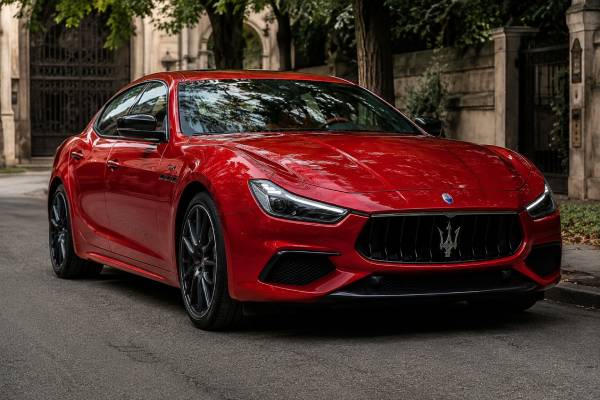
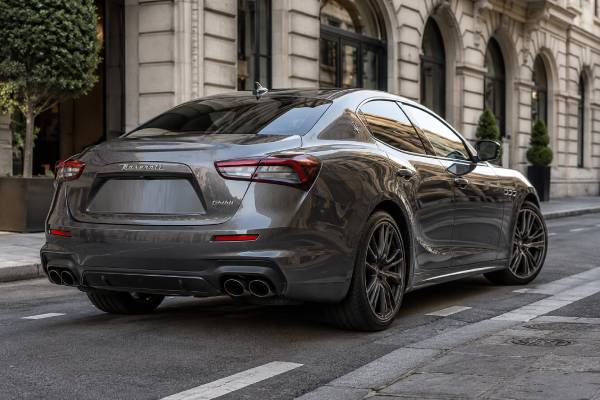
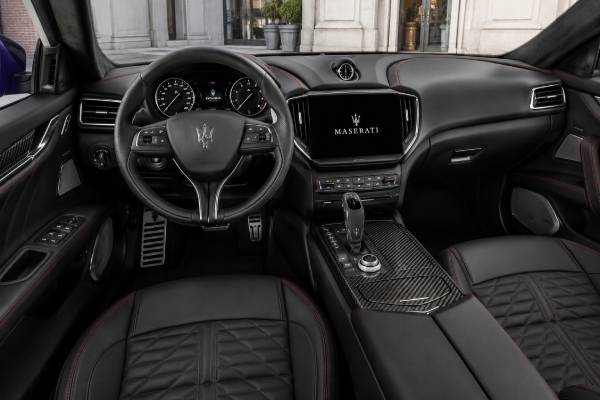
The Maserati Ghibli Trofeo is the V8 version many enthusiasts expected from the M157 from the beginning. Introduced in 2020 for the 2021 model era and sold through the final V8 years, it installs the 3.8-liter F154 twin-turbo engine in the rear-wheel-drive Ghibli, producing 580 hp and 730 Nm. Official figures of about 4.3 seconds from 0–100 km/h and 326 km/h make it one of the fastest series-production sedans of its period. The transformation goes beyond engine output. Trofeo adds Corsa mode, launch control, revised stability calibration, larger cooling demands, hood extraction vents, stronger brakes, performance-oriented trim, and a chassis setup intended to handle sustained speed. It remains a comfortable four-door, but its tires, brakes, heat management, fuel use, and service costs sit above the V6 range. Used examples are still relatively young, yet condition can vary because launch-control use, track days, tuning, old tires, and deferred software updates leave evidence. A proper purchase therefore requires a cold start, full module scan, cooling pressure test, brake measurement, tire-age check, and inspection for collision or underbody damage. This guide explains the Trofeo’s engineering, driving behavior, maintenance needs, and the evidence buyers should demand.
Table of Contents
- The V8 Ghibli Maserati Finally Built
- F154 V8, Brakes, and Trofeo Numbers
- Trofeo Production and Factory Equipment
- Corsa Hardware and Aggressive Design
- What 580 hp Feels Like in a Ghibli
- Heat, Tires, Brakes, and V8 Maintenance
- Buying a Trofeo with Eyes Open
The V8 Ghibli Maserati Finally Built
The Trofeo turned the Ghibli from a fast executive sedan into a genuine high-speed flagship. Its significance comes from placing Maserati’s 580 hp twin-turbo V8 in the smallest four-door M157 body while retaining rear-wheel drive.
For most of the Ghibli’s life, the strongest versions used the F160 V6. They offered ample pace but left room above them in a range that already included V8 Quattroporte and Levante models. Trofeo filled that gap late in the platform’s life, giving the Ghibli a powertrain and identity able to challenge top-tier German performance sedans.
The F154 engine changes the car’s character at every speed. Its 730 Nm torque plateau arrives early, yet the engine continues building power toward 6,750 rpm. That combination creates immediate acceleration and a stronger upper-range pull than the V6. The exhaust note is deeper and less dependent on electronic enhancement.
Rear-wheel drive makes the package unusually direct. Maserati did not pair the V8 Ghibli with Q4, so the rear tires handle all propulsion. Electronic stability control, an active limited-slip differential strategy, careful throttle mapping, and high-performance tires are essential to making the output usable.
Corsa mode distinguishes Trofeo from ordinary Sport settings. It sharpens engine and transmission response, reduces stability intervention, changes damper behavior, opens the exhaust, and enables launch control. The mode is designed for maximum performance, but it also increases stress on tires, brakes, mounts, driveline, and cooling.
The model arrived as Maserati prepared to end its long V8 chapter. That gives Trofeo historical weight even before considering the final 334 Ultima. It is not a numbered limited edition in ordinary form, so value still depends on mileage, color, options, service history, originality, and condition.
A low used price compared with the original sticker can be misleading. The Trofeo’s brake discs, wide tires, engine cooling, electronic dampers, and V8-specific parts remain expensive. The car should be purchased like a high-performance luxury model, not like an ordinary Ghibli with a larger engine.
F154 V8, Brakes, and Trofeo Numbers
The Trofeo uses a 3,799 cc, 90-degree twin-turbo V8 rated at 580 hp and 730 Nm. An eight-speed ZF automatic sends power to the rear wheels, producing a claimed 326 km/h maximum speed.
| Platform code | M157 |
|---|---|
| Engine family | F154 |
| Engine | 90-degree twin-turbo V8 |
| Displacement | 3,799 cc |
| Fuel system | Direct petrol injection |
| Maximum output | 580 hp at approximately 6,750 rpm |
| Maximum torque | 730 Nm at approximately 2,250–5,250 rpm |
| Transmission | ZF eight-speed automatic |
| Drivetrain | Rear-wheel drive |
| 0–100 km/h | Approximately 4.3 seconds |
| Top speed | Approximately 326 km/h |
| Fuel capacity | 80 liters |
The engine uses two turbochargers and substantial cooling hardware to deliver a broad torque band. Normal driving does not require high rpm; the car can accelerate hard from the middle of the tachometer. Under full load, the engine continues pulling beyond the point where the V6 versions begin to feel finished.
The eight-speed automatic receives Trofeo-specific calibration. It shifts smoothly in normal use, becomes faster in Sport, and responds most aggressively in Corsa. The transmission should engage Drive and Reverse cleanly, and full-load changes should be decisive without flare or repeated harshness after the system is warm.
| Body | Four-door, five-seat performance sedan |
|---|---|
| Length | Approximately 4,971 mm |
| Width | Approximately 1,945 mm excluding mirrors |
| Height | Approximately 1,461 mm |
| Wheelbase | 2,998 mm |
| Representative curb weight | Approximately 1,960–2,020 kg by market method |
| Suspension | Double-wishbone front, five-link rear, Skyhook adaptive damping |
| Steering | Electric power assistance |
| Brakes | Large Brembo ventilated system with high-performance calibration |
| Trunk capacity | Approximately 500 liters |
Trofeo brakes are designed for high road speed, but they are still wear items. Disc thickness, surface condition, pad depth, caliper seals, fluid age, and wheel heat should be measured. A visually clean caliper does not prove the system is healthy.
Twenty-one-inch wheels and wide performance tires are common. Correct tire model, age, pressure, load rating, and matching axle pairs are vital. Hardened tires can make the car dangerous before tread reaches the legal limit.
Trofeo Production and Factory Equipment
Trofeo production began with the 2021-era refresh and continued through the 2023 model years, with equipment changing by country. The engine and core performance identity remained consistent, but software, packages, colors, and assistance systems evolved.
Launch cars use the boomerang-inspired rear lamp graphic and 10.1-inch Maserati Intelligent Assistant system. They also carry Trofeo-specific badges, darker exterior details, and hood vents. The later GT, Modena, and Trofeo trim strategy placed this version clearly at the top of the range.
Market specifications differ. Some countries quote 580 CV, others use 580 hp or a related local conversion. Driver-assistance packages, brake colors, interior materials, carbon trim, audio, seat functions, and connected services can vary. The factory build record is the only reliable way to confirm one car’s equipment.
Factory details worth documenting
- Original market, production date, and power-output convention.
- Trofeo-specific engine, cooling, suspension, brake, and exhaust hardware.
- Wheel design, tire specification, and brake-caliper finish.
- Exterior carbon, interior carbon, leather, Alcantara, and stitching choices.
- Driver-assistance cameras, radar, blind-spot monitoring, and adaptive lighting.
- Premium audio, sunroof, seat ventilation, soft-close doors, and connected services.
- Any special paint, dealer-installed protection, or factory personalization.
Because Trofeo parts can be added to lesser Ghiblis, badges and bumpers do not prove identity. The VIN, engine, hood, cooling layout, exhaust, brakes, software, and build sheet must agree.
Originality becomes more important as the cars age. Engine tunes, exhaust changes, lowering springs, spacers, or nonstandard wheels may improve one owner’s experience but affect heat, traction, legality, warranty, and resale. A modified car should retain its original parts and full documentation.
Service plans or extended warranties can be valuable if they cover the V8, turbo system, cooling, electronics, adaptive dampers, and labor. Read exclusions carefully. A contract that excludes “performance use,” software, diagnostic time, or consequential damage may offer less protection than expected.
Corsa Hardware and Aggressive Design
Trofeo’s design changes are functional as well as visual. Hood vents extract heat, larger openings feed cooling, and darker details distinguish the car without changing the Ghibli’s basic long-hood proportions.
The M157 body came from Maserati Centro Stile and already had a low grille, three side vents, a sweeping roof, and broad rear shoulders. Trofeo adds a more forceful front treatment, carbon accents in some specifications, red or model-specific details, and four prominent exhaust outlets.
The hood vents deserve inspection because they are exposed to water, debris, and repair work. Drain paths, seals, heat shielding, and painted edges should be intact. A poorly repaired front collision can disturb the hood, radiators, coolers, radar, bumper ducts, and front suspension simultaneously.
Cooling airflow matters more than on a V6. The engine, charge air, transmission, and brakes generate substantial heat. Missing undertrays, blocked radiator faces, damaged ducts, or nonstandard grilles can reduce margin during hot-weather or high-load driving.
Inside, Trofeo combines a low driving position with sport seats, fixed metal paddles, a modern touch screen, and available carbon fiber or Alcantara. Corsa mode has a dedicated control and changes multiple systems at once. Every mode, display, and warning function should operate; a seller should not describe a disabled mode as a harmless software quirk.
Condition checks around the special hardware
- Inspect hood vents, ducting, radiator faces, lower grilles, and underbody panels.
- Check front splitter and rocker areas for curb or loading damage.
- Examine 21-inch wheels inside and out for cracks, bends, welds, and heat damage.
- Test exhaust-valve movement and listen for rattles or leaks.
- Verify Corsa, launch-control availability, Skyhook response, and stability-system warnings.
- Inspect carbon trim, seat bolsters, leather, and Alcantara for wear consistent with mileage.
The 10.1-inch MIA system should boot quickly, display cameras, retain settings, and connect reliably. Audio amplifiers, screens, cameras, and radar are expensive. Low voltage or aftermarket wiring can create faults that appear unrelated.
Rear-seat and trunk practicality remain similar to other Ghiblis. The car can carry four adults and luggage, which is part of its appeal. That practicality should not obscure its performance-car heat and tire needs.
What 580 hp Feels Like in a Ghibli
The Trofeo feels dramatically stronger than every V6 Ghibli, especially once the V8 is delivering full torque and the gearbox holds the engine in its power band. It remains stable and refined, but the rear tires become a central part of every hard acceleration event.
In normal mode, the car can be surprisingly restrained. The throttle is progressive, the transmission reaches high gears, and the exhaust settles. This makes traffic and motorway cruising easy, although fuel consumption remains substantial.
Sport mode brings faster responses and a louder exhaust. Corsa goes further by sharpening shifts, changing damping, reducing stability intervention, and enabling launch control. The driver should use Corsa only with warm tires, adequate space, and an understanding that reduced electronic assistance does not increase grip.
Launch control produces the claimed acceleration when conditions are suitable, but it should not be used repeatedly on an unknown car. A buyer can assess health through smooth rolling acceleration, consistent boost, clean shifts, and absence of wheel-hop, driveline clunk, or warning messages.
The rear-drive balance remains clear. Under power, the car can tighten or widen its line depending on throttle and grip. The stability system is important because 730 Nm can exceed the rear tires quickly in rain or low temperature. Tire age is as significant as tread depth.
Electric steering is accurate and appropriately weighted at speed, though it does not provide the hydraulic texture of early M157 cars. The front end responds well for a large sedan, and the long wheelbase supports confidence in fast sweepers. Tight repeated corners reveal the nearly two-tonne mass.
Skyhook keeps the body controlled without making normal driving intolerable. Twenty-one-inch wheels still transmit sharp impacts. A Trofeo that crashes over bumps may have excessive pressure, hardened tires, bent wheels, or tired dampers rather than an inherently harsh setup.
Brakes should provide a firm pedal and repeatable deceleration. Track or mountain use can leave heat checking, pad deposits, discolored hardware, and old fluid. Measure rather than guess. Carbon-ceramic brakes are not a universal standard item, so identify the actual system fitted.
At high cruise speed, the car feels composed and the V8 has immense reserve. Public-road testing should remain legal and conservative. Stability, vibration, fluid temperature, and warning-free operation matter more than proving the advertised maximum speed.
Heat, Tires, Brakes, and V8 Maintenance
Trofeo reliability depends on controlling heat and replacing consumables before they compromise the car. Tires and brakes are safety items, while cooling and oil service protect the V8 and turbochargers.
A cold start should be prompt and even. Listen for persistent rattle, check smoke, and watch the idle settle. The F154’s ignition, injection, boost control, and emissions systems should be scanned for stored and pending faults. Misfire under load can damage catalysts and should never be ignored.
Cooling inspection should include reservoirs, pumps, hoses, radiators, charge-air cooling, fans, ducts, and dried residue. A pressure test is justified when history is incomplete. After a road test, inspect for heat odor, coolant traces, oil seepage, and fan behavior.
Engine oil must meet the exact specification and be changed according to use, not only maximum dashboard intervals. Track days, repeated short trips, extreme heat, or frequent high-load driving justify a more conservative plan. Turbochargers depend on clean oil and controlled shutdown temperatures.
Major ownership cost areas
- Twenty-one-inch high-performance tires, often in wide staggered sizes.
- Large brake discs, quality pads, caliper service, and fluid changes.
- Skyhook dampers, suspension arms, wheel bearings, and alignment.
- Cooling radiators, pumps, hoses, fans, and ducting.
- Turbo, ignition, injector, sensor, and exhaust-system diagnosis.
- Screens, cameras, radar, amplifiers, keys, and control modules.
The battery and charging system deserve routine testing. Low voltage can set faults across engine, transmission, suspension, parking brake, active safety, and infotainment. A stored Trofeo should use an appropriate maintainer.
Transmission behavior should remain smooth in normal mode and quick in Corsa. Repeated harsh engagement, flare, or overheating messages require investigation of adaptation, mounts, software, fluid condition, and internal operation. Fluid service must follow the exact temperature and filling procedure.
Inspect differential, driveshaft, rear mounts, and half-shafts for leaks, vibration, or clunk. All 730 Nm passes through the rear driveline. Wheel-hop from poor tires or aggressive launches increases stress.
VIN-specific recalls and service campaigns must be checked. Later Ghiblis were included in seat-belt and fuel-system actions in some markets. Manufacturer software or service updates may also exist outside public recall listings.
Tire temperature deserves separate attention on a car with this output. Cold ultra-high-performance tires can provide far less grip than their dry-weather reputation suggests, while overheated tires lose precision and can develop pressure changes that alter balance. A track-used car should have records for pressures, alignment, and replacement dates rather than only a photo of tread. Inspect each sidewall and inner shoulder for heat cycling, feathering, flat spots, or pickup. Aftermarket semi-slick tires may improve dry grip but worsen rain behavior and road noise. The correct road tire is often the safer ownership choice unless the car has a dedicated track setup, transport plan, and frequent inspection routine.
Buying a Trofeo with Eyes Open
The right Trofeo is original or transparently modified, fully serviced, on fresh premium tires, and free from cooling, brake, scan, or collision concerns. A clean cosmetic presentation is only the beginning, and independent verification remains essential before purchase in all markets.
Ask for the VIN, factory build sheet, complete invoices, tire dates, brake measurements, both keys, software history, and any track-use disclosure. Arrange a cold start and an inspection by a Maserati specialist familiar with the F154 and late M157 electronics.
Trofeo purchase procedure
- Inspect paint, structure, hood vents, cooling openings, lower aero, undertrays, wheels, and tire wear.
- Start fully cold and observe smoke, noise, idle, charging voltage, warning lamps, and coolant level.
- Scan every module, saving faults, readiness, freeze-frame data, over-temperature history where available, and software versions.
- Test Corsa, Skyhook, exhaust valves, launch-control readiness, cameras, radar, seats, climate, audio, locks, and lighting.
- Drive through low-speed maneuvers, steady cruise, moderate boost, rough pavement, and controlled braking without abusing the car.
- Reinspect hot for leaks, odors, fan operation, unequal brake heat, and newly stored codes.
- Put the car on a lift to check cooling, turbo plumbing, mounts, differential, driveshaft, suspension, brakes, exhaust, and structure.
A written estimate should include all immediate maintenance and consumables. Four tires, brake discs and pads, two dampers, a battery, cooling repairs, or damaged carbon can materially change the deal. Price parts and labor before negotiation.
Tuned cars require complete evidence. Obtain the software provider, calibration version, fuel requirement, dyno data, supporting hardware, and original file. Extra boost and torque raise heat and driveline load. Unknown tunes, removed catalysts, or improvised exhaust work reduce confidence.
Track use is not automatically disqualifying if maintenance is excellent. Look for frequent brake and fluid service, tire records, alignment reports, and documented inspections. A car used hard but maintained correctly may be better than one repeatedly launched on the street without records. Verify that any track timing device, camera, harness mount, extinguisher bracket, or data logger was installed without drilling structural areas or damaging the electrical network. Removed accessories can leave hidden holes, pinched trim, and parasitic drains.
The Trofeo suits an owner prepared for V8 fuel use, high-performance consumables, and specialist care. In return, it delivers a rare combination of 326 km/h capability, deep V8 character, four-door practicality, and restrained Italian style. Buy only when the car’s history, cooling, tires, brakes, electronics, and structure all support that promise.
References
- Launch of Trofeo: the most powerful Maserati collection 2020 (Manufacturer News)
- Ghibli Trofeo 2023 (Model Page)
- Ghibli. You’re not like everyone else. 2022 (Technical Guide)
- Part 573 Safety Recall Report 21V-703 2021 (Recall Database)
Disclaimer
This article is for informational purposes and is not a substitute for professional diagnosis, repair, performance-car inspection, or track-safety advice. Specifications, torque values, fluids, intervals, software routines, and procedures vary by VIN, market, production date, and equipment. Verify all work with the official technical documentation for the exact vehicle.
Please share this guide on Facebook, X/Twitter, or a Maserati community if it was useful. Sharing supports the creation of more detailed performance-car resources.