
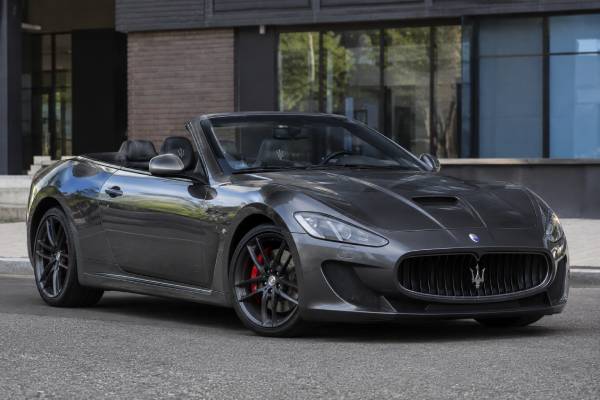
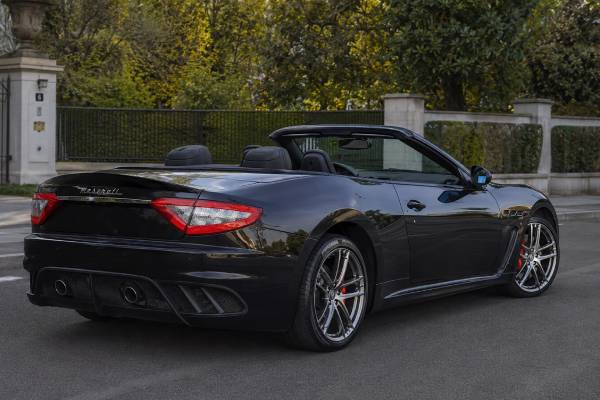
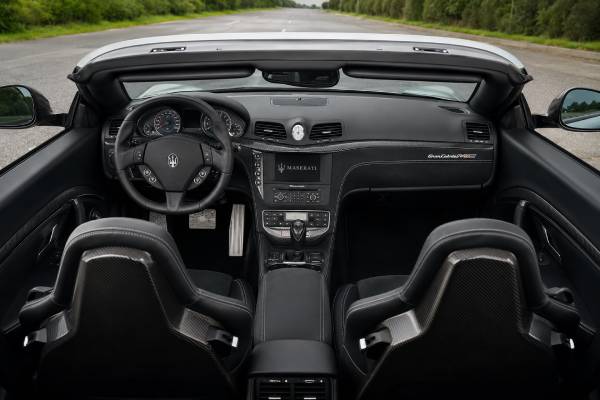
The Maserati GranCabrio MC is the most focused factory version of the M145 four-seat convertible. It uses the 460 hp, 4.7-liter naturally aspirated V8 and six-speed MC Auto Shift automatic, but its identity comes from more than engine output. Maserati Corse-inspired bodywork lengthens the car, reduces aerodynamic lift, improves cooling, and gives it a sharper visual stance. A dedicated fixed-rate suspension, strong Brembo brakes, sport seats, carbon-fiber details, and more assertive exhaust calibration move the MC closer to the character of the GranTurismo MC Stradale while preserving a power roof and genuine rear seating.
That combination is unusual. The MC is neither a lightweight roadster nor a soft grand tourer, and it should not be evaluated by either standard alone. It remains a heavy luxury convertible, yet it responds with more discipline than a standard GranCabrio. The 2013–2019 span also includes special editions and the Model Year 2018 restyling, so buyers must verify build date, market specification, and original equipment. This guide explains the MC’s unique engineering, the differences that establish authenticity, what the car feels like at speed, the systems that create ownership cost, and the inspection process needed before paying a premium for the range-topping badge.
Table of Contents
- The Most Focused M145 Convertible
- MC Engine, Aero, and Chassis Specs
- Production Evolution and Special Versions
- Maserati Corse Influence in Detail
- Speed, Balance, and Open-Air Theater
- MC-Specific Maintenance and Risks
- Buying an Authentic, Well-Sorted MC
The Most Focused M145 Convertible
The GranCabrio MC is the dynamic flagship of the M145 convertible family. It pairs the strongest 460 hp V8 tune with functional aerodynamic bodywork and a firmer chassis, while retaining the four-seat and touring qualities that made the GranCabrio distinctive.
Maserati revealed the model in 2012 for the following sales period, drawing clear links to the GranTurismo MC Stradale, Trofeo race cars, and the company’s Maserati Corse programs. The convertible could not copy the coupe’s lightest, most track-oriented configuration because it needed a folding roof, structural reinforcement, automatic transmission, and rear seats. Instead, engineers applied the racing influence where it suited the open car: airflow, stability, braking, body control, seating, controls, and visual clarity.
The MC body is about 48 mm longer than the regular GranCabrio. New front and rear treatments manage air more deliberately, and Maserati reported reduced lift at 140 km/h—about 10 percent at the front and 25 percent at the rear compared with the standard shape. Those figures explain why the styling looks more purposeful. Splitters, ducts, side details, and the rear profile are working parts of the package, not just decorative add-ons.
Under the hood is the 4,691 cc V8 rated at 460 hp and 520 N·m. The engine drives the rear wheels through a six-speed ZF automatic with MC Auto Shift programming. The same nominal output appears in the later GranCabrio Sport, but the MC’s fixed-rate dampers, aero body, seating, brake calibration, and trim produce a more committed experience.
The MC occupies an important historical position as one of Maserati’s last naturally aspirated V8 convertibles. It arrived before the brand’s shift toward turbocharged engines, all-wheel-drive grand tourers, and battery-electric performance. Its appeal therefore combines objective rarity with a type of response no longer offered: gradual torque, increasing induction noise, and an exhaust note that becomes more intense as the tachometer approaches 7,000 rpm.
The model’s reputation today depends on condition. The aggressive appearance attracts modifications, and ordinary GranCabrios are sometimes fitted with replica MC bumpers, wheels, and badges. A real MC with complete factory trim, straight bodywork, correct suspension, and full history is materially different from a converted car. Authenticity verification must precede any value discussion.
MC Engine, Aero, and Chassis Specs
The MC’s headline figures are 460 hp, 520 N·m, roughly 4.9 seconds to 100 km/h, and a top speed near 289–291 km/h. Its most meaningful technical differences are the longer aero body and dedicated suspension rather than the small performance advantage over the Sport.
| Item | Specification |
|---|---|
| Engine | 90-degree naturally aspirated V8 |
| Displacement | 4,691 cc |
| Maximum output | 460 hp at 7,000 rpm |
| Maximum torque | 520 N·m at 4,750 rpm |
| Transmission | Six-speed MC Auto Shift automatic |
| Drivetrain | Rear-wheel drive with limited-slip differential |
| 0–100 km/h | About 4.9 seconds |
| Top speed | About 289–291 km/h, depending on published data |
| 100–0 km/h braking | Approximately 35 m under test conditions |
The aluminum V8 uses four valves per cylinder and electronic fuel injection. It delivers peak torque at 4,750 rpm, so the car becomes notably stronger as revs rise. Unlike a turbocharged engine, it does not produce maximum shove immediately. That progressive delivery is central to its character and also makes traction easier to manage when the surface is dry and the tires are warm.
| Item | Specification |
|---|---|
| Body structure | Reinforced steel unitary four-seat convertible |
| Front suspension | Independent double wishbones |
| Rear suspension | Independent multi-link |
| Damping | MC-specific fixed-rate dampers |
| Steering | Hydraulic power-assisted rack and pinion |
| Front brakes | 360 x 32 mm ventilated dual-cast discs |
| Rear brakes | 330 x 28 mm ventilated discs |
| Typical tires | 245/35 ZR20 front; 285/35 ZR20 rear |
| Wheelbase | 2,942 mm |
| Length | About 4,920–4,933 mm, by model-year measurement |
| Width | 1,915 mm excluding mirrors |
| Height | About 1,380 mm |
| Fuel tank | 75 liters |
| Luggage capacity | About 173 liters |
The front discs use a dual-cast design that combines an iron friction ring with an aluminum hat, reducing unsprung mass compared with a one-piece iron assembly. Six-piston front and four-piston rear Brembo calipers provide strong braking. Exact part numbers, caliper colors, and market equipment should still be confirmed by VIN.
Maserati selected fixed-rate dampers for consistent control rather than the Sport’s electronically variable Skyhook system. That does not make the MC a rigid race car, but it reduces the range of ride adjustment and places more importance on correct springs, bushings, tires, and alignment. Nonstandard lowering springs can quickly upset the intended balance.
Production Evolution and Special Versions
The MC was produced through a period of cosmetic evolution rather than major powertrain change. Early cars established the core package, the 2014 Centennial Edition added unique colors and trim, and MY18 revised the grille, aerodynamics, cabin controls, and infotainment.
A correct early MC normally shows the deeper front splitter, large side openings, vented hood, extended side treatment, specific rear bumper and exhaust layout, MC wheels, sport seats, carbon-fiber cabin elements, and model-specific badging. Details vary by market, so factory build information is the final authority.
The Centennial Special Edition celebrated Maserati’s 100th anniversary. It was available on the GranCabrio MC and GranTurismo MC Stradale, with tri-coat exterior colors, special wheel finishes and center caps, anniversary logos, and vivid interior color accents. A Centennial car should be authenticated as a complete factory specification; colored trim and badges can be copied.
For MY18, Maserati streamlined both GranTurismo and GranCabrio ranges to Sport and MC. The new hexagonal “sharknose” grille took inspiration from the Alfieri concept, lower ducts were redesigned, and the rear bumper became cleaner while remaining distinct between Sport and MC. Aerodynamic drag for the GranCabrio improved from a quoted 0.35 to 0.33.
The interior update brought an 8.4-inch capacitive Maserati Touch Control Plus display, Apple CarPlay, Android Auto, a rotary controller, revised drive-mode buttons, an updated analog clock, and Harman Kardon audio in many markets. These changes improve daily usability, but a late car still relies on the same fundamental M145 structure, V8, six-speed automatic, hydraulic steering, and folding-roof system.
Factory personalization produced wide variation in appearance. Buyers could select numerous paint colors, leather or leather-and-Alcantara combinations, contrast stitching, carbon-fiber packages, caliper colors, and wheel finishes. Common MC-specific or desirable items include:
- Carbon-fiber front and interior trim.
- Deeply shaped front seats with integrated headrests.
- Alcantara accents and contrasting Trident embroidery.
- MC-design 20-inch wheels.
- Dark exterior details and model-specific exhaust outlets.
- Wind blocker, parking sensors, heated seats, and upgraded audio.
Conversions need special caution. A standard GranCabrio or Sport can accept replica body parts, but it will not gain the MC’s complete factory suspension, aero validation, trim, or identity. Poor replicas often show uneven gaps, incorrect duct mesh, missing underbody panels, mismatched exhaust placement, and bumper surfaces that do not align with the fenders. Even a visually convincing conversion should be valued as the original model described by its VIN.
Maserati Corse Influence in Detail
The MC translates racing lessons into a road convertible through airflow control, brake capacity, body support, and driver touchpoints. Its value is the integration of those elements rather than any single carbon-fiber part.
At the front, a deeper splitter and large openings direct air toward cooling systems and reduce lift. Hood vents help manage pressure and temperature. Side skirts organize flow along the body, while the rear bumper and diffuser area stabilize the wake and visually frame the exhausts. Maserati’s quoted lift reductions at speed are meaningful on a car capable of nearly 290 km/h, where small changes in airflow produce large force differences.
The body’s extra length is concentrated in the model-specific exterior treatment rather than the wheelbase. Passenger space therefore remains the same as other GranCabrios. The long wheelbase still gives the MC four individual seats and stable high-speed behavior. Structural reinforcement in the sills, floor, and bulkheads compensates for the missing fixed roof, though some movement over sharp bumps is normal for a large convertible.
Fixed-rate dampers distinguish the MC from the Sport. Their calibration aims to keep the body settled without waiting for an electronic mode change. The setup can feel busy on damaged surfaces, especially with old tires or worn joints, but a healthy car should not crash over every imperfection. Harshness is often amplified by incorrect tire pressures, cheap tires, bent wheels, or lowering modifications.
The braking system reflects the car’s mass and speed. Large dual-cast front discs provide thermal capacity and lower hat weight, while multi-piston calipers distribute pressure across large pads. Brake cooling and correct fluid matter during repeated hard use. The system is powerful, but it does not make a two-tonne convertible immune to heat or wear.
Inside, carbon-fiber trim, sport seats, metal paddles, and MC graphics create a more focused environment. The driving position remains comfortable enough for long trips, and the rear seats are not removed. That choice separates the GranCabrio MC from stripped two-seat track specials. It offers family or passenger practicality with a more aggressive sensory layer.
The fabric roof preserves the body’s low profile and folds into a compartment behind the cabin. The roof and four-seat packaging restrict luggage volume to about 173 liters. Soft bags work better than rigid cases. Roof operation depends on synchronized frame movement, latches, sensors, side-window indexing, and a strong electrical supply, making it one of the car’s most important inspection areas.
The exhaust has an active role in the car’s personality. In relaxed settings, the V8 can remain civilized. Sport operation brings quicker throttle and shift responses and a more open exhaust voice. The best sound arrives under load through the upper rev range, where intake and exhaust notes combine. An aftermarket system may add volume, but the factory system better preserves the contrast between touring calm and full-throttle theater.
Speed, Balance, and Open-Air Theater
The GranCabrio MC feels less like a lightweight sports car than a large grand tourer with disciplined reflexes. It excels in fast sweepers, strong braking zones, and open-road acceleration, where the aero body and firmer chassis can work without the width becoming a burden.
The V8 is smooth below 3,000 rpm and increasingly urgent above 4,000. Full performance requires revs, which gives the driver a clear build-up rather than a sudden turbocharged hit. The throttle responds naturally, and the exhaust develops from a deep background note into a metallic howl near 7,000 rpm.
The six-speed automatic is well matched to road use. It moves away smoothly, handles traffic without clutch drama, and shifts unobtrusively in normal driving. Sport and manual paddle use make it more assertive, though it cannot match the response speed of a modern eight-speed or dual-clutch unit. A healthy gearbox should still act consistently; unexplained hesitation, flare, or harsh engagement is a fault, not vintage charm.
Hydraulic steering gives the front axle natural weight. The MC turns with more authority than the standard GranCabrio, but its long wheelbase keeps responses progressive. On a smooth road, the car takes a set and holds a stable line. Mid-corner bumps reveal both the structural reality of an open body and the importance of fresh dampers, bushings, and tires.
The rear-wheel-drive balance is friendly when the tires are warm and conditions are dry. The limited-slip differential helps transfer power, and stability control provides an essential safety net. The car’s mass stores considerable energy, so speed can build more quietly than expected. Drivers should leave margin for changing surfaces, cold rear tires, and brake temperature.
Brake feel is strong and confidence-inspiring when the discs, pads, fluid, and suspension are healthy. Repeated high-speed stops still generate heat. A softening pedal, vibration, pulling, or steering shake requires attention. Track use is possible, but tires, brakes, fluids, and cooling should be prepared, and the driver must respect the convertible’s weight.
Ride quality is firmer than the Sport and lacks an adaptive comfort setting. On good pavement, the MC feels composed and purposeful. On broken urban streets, it can feel busy. Excessive tramlining or impact harshness should trigger checks of tire model, date, pressure, wheel runout, alignment, and control-arm condition before condemning the factory calibration.
With the roof lowered, the powertrain becomes the centerpiece. Front occupants receive manageable airflow, and an optional wind blocker improves two-person touring. Rear occupants experience more turbulence but have usable space. Roof-up refinement remains respectable, while whistles or water marks reveal adjustment problems.
MC-Specific Maintenance and Risks
The MC’s most costly problems come from deferred maintenance combined with expensive model-specific parts. Mechanical inspection must cover the shared M145 systems and the unique aero panels, suspension, brakes, wheels, and trim that justify the MC premium.
V8, cooling, and exhaust
Start the engine completely cold. Listen for persistent metallic noise, watch for smoke, and confirm a stable idle. Inspect for oil leakage around covers, seals, hoses, and the underside. Scan misfire counters and fault memory rather than assuming a smooth idle proves health. Plugs, coils, injectors, intake leaks, wiring, and mechanical condition can all influence combustion.
Cooling problems can become catastrophic. Examine the expansion tank, radiators, hose connections, water-pump region, fans, and undertrays for staining or damage. Temperature must remain stable in traffic and after a hard road test. Service history should show regular oil and filter changes plus time-based renewal of brake fluid, coolant, filters, plugs, and belts according to the specific market schedule.
Check active exhaust operation and inspect valves, vacuum or electrical controls, hangers, joints, and rear silencers. A permanently loud system may have been modified to bypass faults. Confirm that any aftermarket exhaust is legal, well supported, and supplied with the original parts.
Gearbox, differential, and mounts
Test the automatic when cold and hot. Delayed selection, flare, shudder, or violent shifts need specialist diagnosis. Inspect fluid leaks, cooling, software adaptations, mounts, driveshaft components, and differential condition. Noise on overrun, vibration under acceleration, or a clunk when loading the driveline can be expensive to trace.
MC dampers, brakes, wheels, and bodywork
Confirm that the car retains the correct MC suspension rather than generic dampers or lowering springs. Look for leaks, uneven ride height, broken springs, tired bushings, ball-joint play, and alignment-related tire wear. Fixed-rate dampers can deteriorate gradually, reducing control without creating an electronic warning.
Measure the dual-cast front discs and rear discs, inspect pads and calipers, test the parking brake, and check fluid age. Replacement with correct-quality parts is costly. Examine MC wheels for cracks, bends, welds, incorrect refinishing, and missing markings. Tires must be a matching high-performance set with appropriate age, size, load, and speed ratings.
Low splitters and extended bumpers are vulnerable to curbs and ramps. Inspect the underside, mounting tabs, ducting, wheel-arch liners, undertrays, and paint transitions. Poorly repaired carbon or composite pieces can look acceptable from standing height while being fractured underneath. Genuine replacement panels may be scarce.
Roof, electronics, and cabin
Cycle the roof more than once, checking frame symmetry, latch operation, fabric tension, window indexing, seals, sensors, and warning messages. Inspect drains and search the trunk and footwells for moisture. Water intrusion can damage modules and wiring long after the first leak.
The M145 is voltage-sensitive. Confirm battery type and condition, alternator output, connections, and parasitic draw. A maintainer is sensible during storage. Scan all modules and test seats, climate control, audio, infotainment, navigation, parking sensors, keys, lights, mirrors, steering-wheel controls, and tire-pressure monitoring.
Carbon lacquer can cloud or crack, leather can shrink or lift, soft-touch controls can become sticky, and Alcantara can wear. Correct restoration matters more on an MC because its trim is part of the model identity. Retain every original component removed for an upgrade.
Buying an Authentic, Well-Sorted MC
Buy an MC only after proving both identity and condition. The correct VIN, factory equipment, aero body, suspension, brakes, interior, and history should form one consistent record; a collection of replica parts does not.
Request factory build data and compare it with the car. Check model designation, production date, paint, upholstery, options, wheel specification, market equipment, and any limited-edition status. Review invoices, mileage history, ownership records, keys, manuals, tools, tire inflator, and accessories. A missing wind blocker is minor; a missing build trail on a heavily modified car is not.
An MC-focused inspection should include:
- Cold-start engine assessment and full control-module scan.
- Cooling-system examination, leak inspection, and stable-temperature road test.
- Automatic gearbox, differential, mounts, and driveline checks when cold and hot.
- Measurement of brake discs and pads plus inspection of calipers and hoses.
- Verification of MC dampers, springs, wheels, tires, alignment, and ride height.
- Examination of splitters, bumpers, vents, ducts, undertrays, and panel mounting points.
- Multiple roof cycles, water-drain checks, glass alignment, and moisture search.
- Paint-depth readings and assessment of structural or cosmetic accident repair.
Compare early and MY18 cars on their actual merits. Early models have the original front design and may feel more closely connected to the first MC concept. MY18 cars add improved smartphone integration, a larger interface, revised controls, refreshed bumpers, and a more angular grille. Neither is inherently more reliable solely because of appearance or registration date.
Centennial Edition cars deserve an additional authenticity review. Confirm the VIN-specific specification, paint, wheels, center caps, badges, seat colors, stitching, and plaque details. Pay a premium only when those elements are complete and original or properly documented.
Budget for immediate work with written specialist estimates. Tires, brakes, suspension, fluids, belts, plugs, battery, roof repairs, carbon refinishing, and bumper restoration can rapidly erase the apparent savings of a cheap car. Insurance and replacement-body-part availability should be checked before purchase, not after an incident.
Reject examples with unresolved overheating, wet modules, repeated low-voltage faults, poor replica bodywork, uncertain structural repairs, inconsistent mileage, persistent transmission problems, or sellers who prevent an independent inspection. A high-mileage car with continuous maintenance can be safer than a low-mileage car that sat neglected.
The strongest purchase case is a car that has been used regularly, warmed correctly, stored dry, serviced by knowledgeable specialists, and kept close to factory specification. In that form, the GranCabrio MC offers something few cars can match: the functional drama of Maserati Corse-inspired engineering, a high-rev V8, four adult seats, and a roof that opens the entire experience to the sky.
References
- Maserati GranCabrio MC international debut at the Paris International Motor Show 2012 2012
- GranCabrio MC 2012
- Maserati GranTurismo MC Stradale and GranCabrio MC Centennial Special Editions 2014
- MY18 GranTurismo & GranCabrio star at Goodwood Festival 2017
- Maserati Guides & Documentation for your vehicle 2026
Disclaimer
This article is for informational purposes and is not a substitute for professional diagnosis, repair, authentication, or inspection. Specifications, torque values, service intervals, equipment, and procedures vary by VIN, market, and production date. Verify all details against official service documentation and factory records for the specific vehicle. Please share this guide on Facebook, X/Twitter, or another enthusiast community if it was useful; sharing supports our work.