
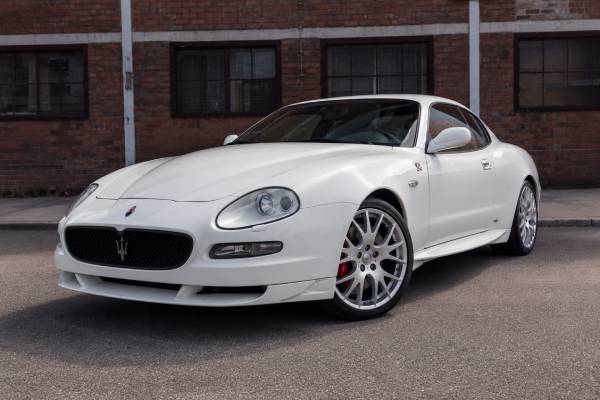
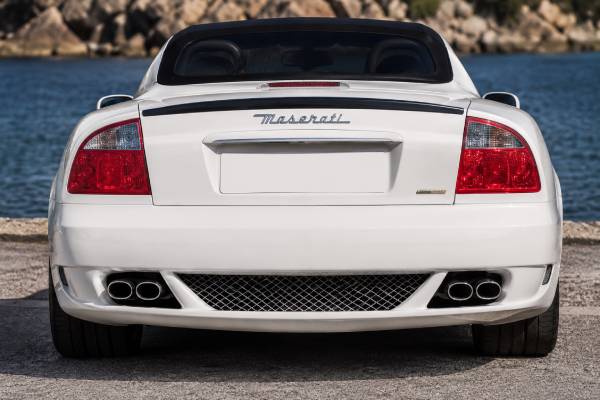
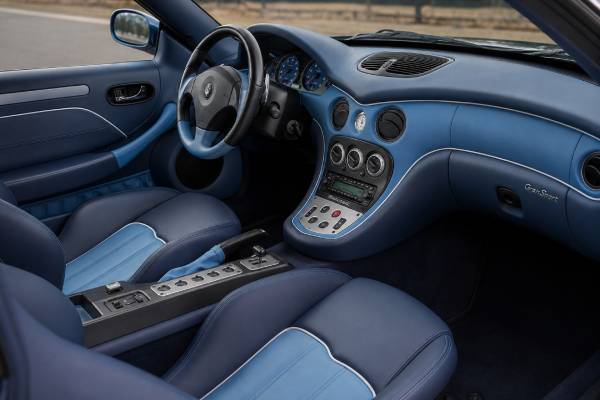
The 2007 Maserati GranSport 10th Anniversary is a Japan-only final-run special created to mark ten years of cooperation between Maserati and importer Cornes & Co. Just 35 cars were produced: 18 in Nero Carbonio with a tan-toned cabin and 17 in Bianco Eldorado with a blue interior. Each combined standard 400 hp GranSport mechanicals with Italian tricolor fender emblems, anniversary sill plates, a center-tunnel plaque, ball-polished 19-inch wheels, a carbon rear spoiler, pale-blue instruments, and distinctive blue-flecked carbon trim. Rarity makes the model appealing, but it also raises the cost of mistakes. A missing plaque, incorrect interior color, refinished trim, undocumented export history, or substituted wheel can materially affect authenticity. Mechanical inspection remains equally important. The Cambiocorsa clutch and hydraulics, Skyhook suspension, cooling system, electrical supply, sticky cabin finishes, and age-sensitive tires all need specialist attention. The strongest example preserves its Japanese records and unique parts while driving like a properly maintained GranSport, not a static display piece.
Table of Contents
- The Japan-Only Finale with Cornes
- Standard GranSport Performance Specifications
- Thirty-Five Cars and Two Colorways
- Anniversary Cabin and Exterior Details
- Driving a Rare Final-Run GranSport
- Japan-Market Aging and Service Challenges
- Authenticating and Buying One Today
The Japan-Only Finale with Cornes
The full identity of this car is the Maserati and Cornes 10th Anniversary GranSport. Commissioned for Japan in 2007, it celebrated a decade of partnership with Cornes & Co while giving the M138 coupé a highly specific farewell specification.
Cornes has long served the Japanese market for imported luxury and performance cars. The anniversary edition reflects that relationship more than a global Maserati milestone. It was built for domestic Japanese sale, so its paperwork, delivery records, dealer servicing, and equipment history often begin in Japanese. Cars now found in Europe, North America, or elsewhere should have a traceable export path from that original market.
The timing matters. Maserati introduced the GranSport in 2004 as a more dynamic evolution of the M138 Coupé, and the larger GranTurismo was ready to replace it by 2007. Rather than change the mature mechanical package, the Cornes edition combined a controlled production run with two prescribed color schemes and numerous visual details. This approach made it collectible without disturbing the balanced character that had already defined the GranSport.
Only 35 were made. That figure is small enough that every surviving car matters, yet it should not encourage buyers to ignore condition. A rare car with weak documentation, deteriorated trim, old tires, clutch faults, or accident repair can require more money and effort than an excellent standard GranSport. Conversely, a well-kept anniversary car offers a clear story, a distinctive appearance, and the same practical four-seat layout as the normal coupé.
The edition is separate from both the MC Victory and the Contemporary Classic. The MC Victory used racing-linked seats, steering, aero details, and numbered production. The Contemporary Classic used traditional leather, coordinated piping, polished wheels, and vintage-themed instruments. The Cornes car mixes elements of luxury and motorsport presentation but has its own Japanese-market rationale, color split, blue-flecked carbon, anniversary markings, and tricolor fender flags.
Its reputation today rests on three qualities. First, it is genuinely scarce. Second, it represents the end of a compact Maserati GT line with a naturally aspirated V8 and rear transaxle. Third, its details are difficult to recreate convincingly as a complete set.
Standard GranSport Performance Specifications
The 10th Anniversary uses the standard GranSport’s 4,244 cc M138P V8 and six-speed Cambiocorsa transaxle. The special edition did not receive a factory increase beyond 400 hp, so its acceleration, top speed, brakes, and suspension geometry follow the regular coupé.
| Item | Specification |
|---|---|
| Body structure | Steel monocoque coupé with front and rear subframes |
| Seating | Four |
| Engine code | M138P, Ferrari-Maserati F136-family V8 |
| Configuration | 90-degree aluminum V8, 32 valves, four overhead camshafts |
| Displacement | 4,244 cc |
| Bore × stroke | 92.0 × 79.8 mm |
| Compression ratio | 11.1:1 |
| Induction | Naturally aspirated electronic fuel injection |
| Lubrication | Dry sump |
| Maximum power | 400 hp at 7,000 rpm |
| Maximum torque | 452 Nm at 4,500 rpm |
| Maximum engine speed | 7,600 rpm |
| Transmission | Six-speed Cambiocorsa automated manual |
| Drivetrain | Rear transaxle, rear-wheel drive, limited-slip differential |
| Suspension | Double wishbones front and rear; Skyhook adaptive damping where specified |
| Steering | Hydraulically assisted rack and pinion |
| Brakes | Four-piston Brembo calipers and ventilated cross-drilled steel discs |
| Brake disc size | 330 × 32 mm front; 310 × 28 mm rear |
| Wheels | 19-inch Trofeo design, ball-polished finish |
| Factory tires | 235/35 ZR19 front; 265/30 ZR19 rear |
The engine sits at the front, while the clutch, gearbox, and differential form a transaxle at the rear. A torque tube links them. Moving gearbox mass rearward improves balance and helps the car turn with less front-heavy resistance than many conventional GTs.
Cambiocorsa is not a normal automatic. Its internal gearset and dry clutch work like a manual transmission, but an electrohydraulic system selects gears and operates the clutch. The driver uses paddles or automatic mode, yet every low-speed launch still consumes clutch material. Owners preserve it by avoiding constant creeping, reversing with care, and using the brake rather than throttle to hold position on an incline.
Sport mode commands quicker shifts, changes adaptive-damper response on Skyhook cars, makes the exhaust more vocal, and adjusts stability-control behavior. A strong car should shift with purpose at speed while remaining manageable during parking. Violent take-up, repeated neutral selection, or a flashing gear display indicates a problem, not extra sporting character.
| Measure | Figure |
|---|---|
| Length | 4,523 mm |
| Width | 1,822 mm |
| Height | 1,295 mm |
| Wheelbase | 2,660 mm |
| Dry weight | Approximately 1,580 kg |
| Kerb weight | Approximately 1,680 kg |
| Fuel capacity | 88 liters |
| Luggage capacity | 315 liters |
| Claimed 0–100 km/h | 4.85 seconds |
| Claimed 0–200 km/h | 17.4 seconds |
| Claimed top speed | 290 km/h |
Condition affects real performance more than the anniversary equipment. A tired clutch, old tires, bent wheels, sticking exhaust valves, ignition faults, or poor alignment can make one car feel far slower and less secure than another with identical factory figures.
Thirty-Five Cars and Two Colorways
Production was deliberately simple: 35 cars divided into two exterior-and-interior combinations. Eighteen were Nero Carbonio with tan upholstery, and 17 were Bianco Eldorado with blue upholstery.
| Quantity | Exterior | Interior theme |
|---|---|---|
| 18 | Nero Carbonio metallic | Tan leather with beige Alcantara and light contrast details |
| 17 | Bianco Eldorado | Blue leather and Alcantara theme |
This fixed split is the first authentication test. A car in a different exterior color, or one whose cabin does not correspond to the recognized pairing, needs a documented explanation. Repainting or retrimming does not automatically erase the car’s identity, but it changes originality and should be priced openly.
The exact build sequence deserves caution. The center-tunnel plaque identifies the anniversary edition, but buyers should not assume it carries a conventional individual number unless the physical car proves it. Sellers sometimes describe limited-run cars as “number X of 35” even when no verified sequence marking is present. Record the plaque wording and photograph it clearly.
Factory details commonly associated with all 35 include:
- Recessed Italian tricolor flags in the front wings.
- “10th Anniversary” branding on the sill kick plates.
- A dedicated plaque on the center tunnel.
- A carbon-fiber rear deck spoiler or nolder.
- Ball-polished 19-inch Trofeo design wheels.
- Light-blue instrument dials.
- Carbon trim with a visible blue fleck on key cabin pieces.
- Anniversary-specific leather and Alcantara color coordination.
- Cornes-related delivery items or floor mats where retained.
Each item can be damaged or replaced, so no single feature proves authenticity. Fenders may be changed after an accident, sill plates can be scratched, wheels can be painted, and carbon trim can be refinished. The correct car should tell the same story through its VIN, early photographs, Japanese records, export documents, and remaining equipment.
Because the edition was for Japan, documentation may use Japanese era dates, inspection records, auction grades, or service descriptions. A professional translation is worth obtaining. It can clarify mileage, accident notes, ownership transfers, and dealer work that a simple sales summary misses.
Japanese registration history may include periodic inspection mileage, but buyers should still create a complete timeline. Compare odometer readings on service invoices, inspection sheets, export certificates, auction documents, and later registrations. Low mileage is common on collectible imports, and that makes continuity especially important.
Anniversary Cabin and Exterior Details
The 10th Anniversary is visually distinctive without changing the GranSport body shell. Its best details connect Italy, Japan, and Maserati’s sporting identity through color, carbon fiber, and discreet commemorative markings.
The basic shape comes from Italdesign and Giorgetto Giugiaro. GranSport bodywork sharpened the earlier Coupé with a deeper front bumper, enlarged grille, aerodynamic side skirts, and a small rear lip. The Cornes edition adds its carbon rear spoiler to this existing package. Inspect the spoiler’s weave, finish, mounting, and fit, because an aftermarket part can look similar in photographs.
Tricolor flags recessed into the front wings are a prominent external identifier. Their installation should appear factory-integrated, with equal position and depth on both sides. Look for paint edges, filler, misalignment, or different fasteners after fender repair. Replacement emblems may be legitimate, but records should explain why they were needed.
The polished Trofeo wheels give the car a bright, formal stance. Their finish is susceptible to road salt, acidic cleaners, brake dust, curb damage, and corrosion beneath clear protection. Verify correct castings and dimensions, then measure runout and inspect inner barrels for cracks or welds. Cosmetic shine cannot prove structural health.
Inside, the light-blue dials echo details used on other late GranSports while supporting the anniversary color theme. The odometer and cluster deserve careful scrutiny because replacement can affect mileage evidence. Check diagnostic readings, screw and bezel condition, and any invoice for instrument work.
Blue-flecked carbon is one of the hardest features to replicate correctly. It appears on areas such as the transmission cover, center console, rear air vents, and steering wheel trim. Under different lighting, the blue element may look subtle rather than vividly colored. Compare all pieces for weave direction, resin clarity, fading, cracks, and matching tone. A single newly refinished panel can stand out from aged originals.
The Nero Carbonio cabin uses tan leather and beige Alcantara, with light piping and stitching details. Leather extends beyond the seats on well-specified examples and may include roof pillars and headlining. The Bianco Eldorado cars use a blue interior theme that creates a much cooler contrast. Both require gentle care: leather can shrink or become glossy, Alcantara can mat, and adhesive can release in hot storage.
Anniversary sill plates are vulnerable to shoe marks and corrosion at their edges. Removing them carelessly can bend the metal or damage underlying trim. A worn original plate may be more valuable than a perfect reproduction, so preservation usually makes more sense than aggressive cosmetic restoration.
The cockpit still contains familiar M138 technology. Fixed paddles sit behind the wheel, a push button starts the V8, and the central information and audio system now looks distinctly period. Modern upgrades should be reversible and should not cut original wiring, because unique interior trim makes later restoration harder.
Driving a Rare Final-Run GranSport
The anniversary car feels like a well-maintained standard GranSport, not a separate high-output model. Its rarity changes the owner’s attitude, but the mechanical experience remains direct, responsive, and unusually involving for a four-seat GT.
At low speed, the gearbox requires planning. Allow a clear gap before moving, use modest throttle, and avoid shuffling repeatedly between first and reverse. On slopes, hold the brake until ready to depart. These habits reduce heat and slip at the clutch and make the car smoother.
On an open road, Cambiocorsa becomes part of the appeal. The driver chooses the moment, the system blips downshifts, and higher engine speed produces faster, cleaner changes. A small throttle lift can soften gentle upshifts, while strong acceleration works better with a committed pedal rather than hesitation.
The naturally aspirated V8 responds immediately and builds power in a straight line toward 7,000 rpm. Around town it is flexible; above the midrange it becomes urgent and vocal. A healthy engine should pull evenly without misfire, hesitation, warning lights, or smoke after extended idling.
Hydraulic steering gives clear information through the rim. The car is compact enough to place accurately, and the rear transaxle helps it rotate with a balanced feel. The front tires should load progressively rather than tramline or shake. Nervousness often points to old tires, wheel damage, alignment error, or worn joints.
Ride quality is firm but should remain controlled. Skyhook-equipped cars use adaptive dampers to balance body control and touring comfort. Normal mode suits rougher roads, while Sport tightens responses and supports fast direction changes. A car that crashes, floats, or displays a suspension warning needs diagnosis.
Steel Brembo brakes provide good pedal progression and enough endurance for enthusiastic road use. They are easier to service than carbon-ceramic systems, but drilled discs can crack around holes and corrode on their inner faces. Repeated stops should not create vibration or a lengthening pedal.
The four-seat body makes the GranSport a realistic weekend car. Rear accommodation is limited, yet the seats carry children, smaller passengers, or soft luggage. The 315-liter boot adds touring capacity. Owners can use the car regularly without giving up the special-edition experience, provided they protect the irreplaceable trim.
Japanese-market equipment may affect use after export. Radio frequencies, navigation data, toll equipment, language settings, lighting, speedometer units, and local compliance changes should be checked. A clean conversion uses proper adapters and retains original parts; improvised wiring can create battery drain and damage interior panels.
Japan-Market Aging and Service Challenges
A 10th Anniversary needs the same preventive maintenance as every GranSport plus extra care for low-mileage storage, Japanese documentation, and edition-only trim. The largest risks are hidden inactivity, incomplete translation, and repairs performed without awareness of the car’s rarity.
Cambiocorsa clutch and hydraulics
Use a Maserati-capable diagnostic system to read clutch position, calculated wear, point of initial slip, pump cycling, hydraulic pressure behavior, shift errors, and stored faults. The wear percentage should never be viewed alone because calibration and sensor setup influence the calculation.
Test first and reverse repeatedly when cold and after a long drive. Delay, shudder, gear-display flashing, pump overactivity, or unexpected neutral selection requires investigation. A clutch replacement should document the friction parts, release bearing, seals, flywheel assessment, sensor setup, and final calibration.
Engine, cooling, and fluids
The M138P V8 uses dry-sump lubrication. Oil level must be checked at the correct temperature and operating condition; a casual cold check can lead to overfilling. Inspect cam covers, front areas, reservoir lines, and the lower engine for leakage.
Cooling must remain stable during traffic, air-conditioning use, and a hot restart. Inspect radiator fins, expansion tank, hoses, caps, fan operation, thermostat behavior, and water-pump area. Dried residue, odor, or changing temperature needs a pressure test rather than a top-up.
Low annual mileage does not preserve fluids. Engine oil, brake fluid, coolant, gearbox oil, filters, and fuel age by time. Japanese service invoices should be translated closely enough to distinguish a full service from a simple inspection or oil change.
Tires, wheels, suspension, and brakes
Date codes matter because a collector car can retain tires with deep tread long after the rubber hardens. Replace aged tires with a matched set in the correct sizes and ratings. Inspect the polished wheels before refinishing; cracks, welds, and runout are safety issues, while corrosion is cosmetic.
Check ball joints, bushings, tie rods, anti-roll-bar links, wheel bearings, damper mounts, and Skyhook faults. Long storage can flatten tires and allow corrosion to form on brake faces. A road test should include rough surfaces, tight turns, and repeated braking to expose noise or vibration.
Electrical systems and special trim
A healthy battery and charging system are fundamental. Weak voltage can trigger transmission, suspension, stability, airbag, and body warnings. Check grounds and parasitic draw, especially after radio, navigation, alarm, toll-reader, or lighting modifications.
Test every function: seat heating and movement, climate control, windows, locks, mirrors, lamps, washers, audio, parking aids, alarm, and instrument displays. Sticky soft-touch finishes are common. Restoration should preserve markings, texture, and the anniversary carbon pieces rather than use aggressive solvents.
Leather, Alcantara, headlining, and pillar trim can suffer even in low-mileage cars. Heat dries leather and weakens adhesives, while damp storage can create odor and corrosion. Examine seams, piping, dashboard edges, roof lining, carpets, boot, and spare-wheel well for evidence of shrinkage or water entry.
| Area | Required evidence |
|---|---|
| Mileage | Japanese inspections, service records, auction sheets, export certificate, later registrations |
| Maintenance | Translated dates, mileage, exact operations, parts, and workshop identity |
| Export | Legal export and import documents with matching VIN |
| Modifications | Invoices and retained parts for radio, lighting, compliance, or alarm changes |
| Special trim | Photographic record before and after any repair or refinishing |
Authenticating and Buying One Today
Buy a 10th Anniversary only after proving that it is one of the 35 and confirming that its rare components remain intact. The correct process combines provenance research, a detailed physical inspection, diagnostic testing, and a complete hot road test.
Start with the VIN and the Japanese history. Request the original sales or delivery documents, Cornes service records, inspection sheets, auction sheet, export certificate, import registration, and all later invoices. Have key documents translated by someone familiar with automotive terminology. Match every mileage entry and note any accident or repair grade.
Then verify the specification:
- Confirm the color pairing. Nero Carbonio should align with the tan/beige theme, while Bianco Eldorado should align with the blue cabin.
- Inspect commemorative pieces. Check the tricolor fender flags, sill logos, center plaque, Cornes items, and any anniversary markings.
- Compare the carbon. Verify blue-flecked weave and finish across the console, transmission cover, vents, steering wheel, and rear spoiler.
- Check instruments and wheels. Confirm pale-blue dials, cluster history, correct polished Trofeo wheels, matching castings, and structural condition.
- Trace paint and upholstery. Use paint-depth readings, photographs, invoices, and trim codes to separate preservation from undocumented alteration.
- Scan every control unit. Record engine, gearbox, suspension, ABS, stability, airbag, climate, and body faults before anything is cleared.
- Drive from cold to heat-soaked. Include traffic, inclines, reverse, all gears, Sport mode, rough roads, firm braking, and a hot restart.
An inspection should happen at a workshop that understands M138 diagnostics and transaxle setup. A general exotic-car technician may recognize the engine but lack the tools or experience to interpret clutch values, PIS calibration, or Skyhook faults. Ask for a written report with photographs and estimated costs.
Look beyond the odometer. A 10,000-km car may still need tires, fluids, seals, a battery, brake service, sticky-control refinishing, and leather work. A higher-mileage example maintained regularly by Cornes or a respected specialist can be the more dependable choice. Usage pattern and evidence matter more than a small number on the display.
Check for collision repair with special care around the front wings and rear spoiler. Replacing a fender can lose the recessed tricolor detail, while rear-deck work can disturb the carbon nolder. Inspect panel gaps, paint texture, fasteners, overspray, undertrays, suspension pickup points, and wheel alignment. Correct repair is acceptable when documented, but unique components should not be treated as ordinary GranSport parts.
Import and registration requirements vary by destination. Confirm emissions, lighting, immobilizer, speedometer, title, tax, and historical-vehicle rules before purchase. Do not assume a car already registered in one foreign country can be transferred easily to another. Compliance changes should be neat, legal, and reversible where possible.
Establish insurance value with photographs and provenance, because ordinary GranSport comparables may not reflect the cost of finding another Cornes edition or replacing unique trim. An agreed-value policy can be more appropriate than a generic market-value settlement.
The right 10th Anniversary should be driven, but with informed care. Regular heat cycles, correct battery support, dry storage, gentle cleaning, and preventive service are better than years of inactivity. Its appeal is not only that 35 were built. It is the way a tightly defined Japanese-market specification frames the final M138 experience: compact Giugiaro bodywork, a high-revving V8, hydraulic steering, rear-transaxle balance, and details that link Maserati’s Italian identity with a long-standing Japanese partnership.
References
- GranSport, GranSport Spyder – Gran Turismo models | Maserati 2026
- gransport spyder · coupé 2006 (Brochure)
- Maserati GranSport – Yaroslav Bozhdynsky’s Personal Website 2026
- 2007 MASERATI GRANSPORT 10TH ANNIVERSARY For Sale by Auction in Prague, Europe, Czechia | Collecting Cars 2022
- Maserati GranSport 10th Anniversary • EFJ Co., LTD 2026
Disclaimer
This article is for informational purposes and is not a substitute for professional diagnosis, inspection, or repair. Specifications, torque values, service intervals, and procedures can vary by VIN, market, and installed equipment; verify all work with the official service documentation for the individual vehicle.
Please share this article on Facebook, X/Twitter, or another enthusiast platform to support our work.