
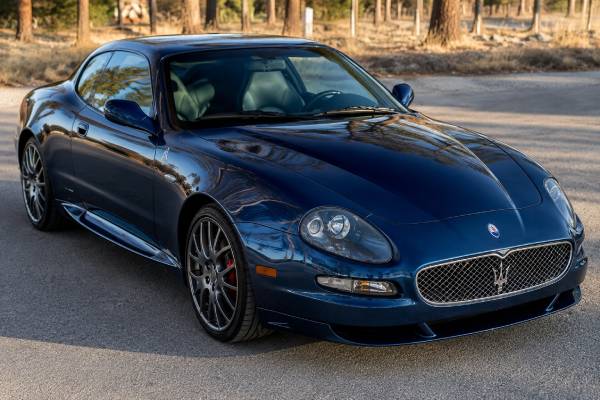
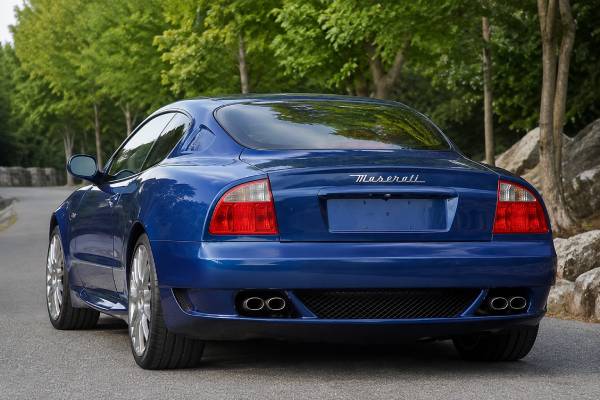
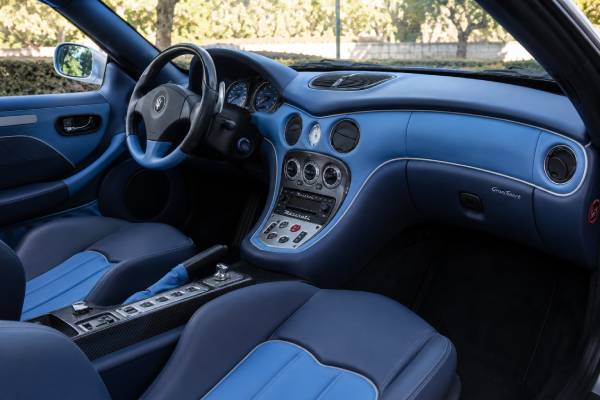
The 2006–2007 Maserati GranSport Limited Edition is a generously equipped version of the M138 GranSport coupé, most often associated with North American cars. Its identity rests on a coordinated factory package rather than additional engine power: Saetta emblems with red accents, oval Maserati fender shields, ball-polished 19-inch Trofeo-style wheels, full leather, heated front seats, driver memory, xenon lighting, Skyhook damping, and upgraded audio are the main clues. Beneath those details sits the familiar 400 hp dry-sump V8 and six-speed Cambiocorsa rear transaxle. This distinction is critical when buying one. Many package components could be ordered separately, replaced, or copied, so badges alone do not establish authenticity. A strong Limited Edition should combine credible build documentation with a healthy clutch, correctly calibrated transmission, sound suspension, straight wheels, stable cooling, and fully functioning luxury equipment. The edition makes the GranSport easier to live with, but every added electrical and trim feature also creates another inspection point.
Table of Contents
- What the Limited Edition Actually Was
- The 400 hp Hardware Beneath the Package
- Market Equipment and Correct Identification
- Saetta Badges, Leather, and Polished Wheels
- How the Option Bundle Affects Daily Use
- Cambiocorsa, Skyhook, and Aging Equipment
- Verification and Purchase Strategy
What the Limited Edition Actually Was
The Limited Edition was an equipment-focused GranSport, not a separate performance model. It preserved the standard coupé’s 400 hp engine, transaxle chassis, bodywork, and performance while grouping luxury, appearance, and convenience features into a recognizable late-run specification.
That position makes it easy to misunderstand. The name sounds like a numbered collector series, yet a reliable universal production total is not widely published. Surviving examples are commonly seen in the United States, and the package is strongly linked with 2006 cars, although titling, registration, and market-year practices can extend coverage into 2007. A seller who presents an exact build count should be able to show factory or importer documentation.
The GranSport itself was the sharper development of Maserati’s M138 Coupé. Introduced in 2004, it raised output to 400 hp, improved Cambiocorsa control logic, lowered the suspension, added 19-inch wheels, and revised the body for better high-speed stability. It remained a four-seat grand tourer rather than a stripped sports car. The Limited Edition reinforced that dual role by adding comfort equipment without removing the GranSport’s more focused hardware.
It should not be confused with the MC Victory. The MC Victory celebrated competition success with numbered production, distinctive aerodynamic parts, more direct steering, carbon racing seats, blue-weave carbon trim, and Italian tricolor fender details. The Limited Edition’s fender emblems, polished wheels, leather, heated seats, xenon lamps, and audio system serve a different buyer: someone who wants a complete road-going specification rather than the strongest motorsport connection.
The package is interesting today because it represents how Maserati positioned the GranSport near the end of its life. Later luxury-performance cars often use turbocharging, dual-clutch gearboxes, electric steering, and complex drive modes. This car has a naturally aspirated V8, hydraulic steering, steel brakes, and a single-clutch transmission that rewards deliberate technique. Its luxury features sit on an unusually mechanical foundation.
Current desirability depends on condition and evidence. The special badges are small, the equipment was not mechanically transformative, and numerous standard cars were ordered with overlapping options. A Limited Edition with incomplete records, repainted emblems, ordinary wheels, or substituted interior trim cannot rely on the name alone. Conversely, a documented car with its package intact can be a compelling and usable special specification without the cost or scarcity of MC Victory components.
The 400 hp Hardware Beneath the Package
Every genuine Limited Edition uses the normal GranSport powertrain: a 4,244 cc naturally aspirated V8 driving a six-speed electrohydraulic manual gearbox mounted with the differential at the rear. No factory power increase was part of the package.
| Category | Specification |
|---|---|
| Chassis | Steel monocoque with front and rear subframes |
| Body style | Two-door, four-seat coupé |
| Engine | M138P 90-degree V8, aluminum block and heads |
| Displacement | 4,244 cc |
| Valve gear | 32 valves, double overhead camshafts per bank |
| Bore × stroke | 92.0 × 79.8 mm |
| Compression ratio | 11.1:1 |
| Induction | Naturally aspirated electronic fuel injection |
| Lubrication | Dry sump |
| Power | 400 hp at 7,000 rpm |
| Torque | 452 Nm at 4,500 rpm |
| Rev limit range | Up to 7,600 rpm |
| Transmission | Six-speed Cambiocorsa automated manual |
| Drive | Rear-wheel drive with limited-slip differential |
| Suspension | Double wishbones; Skyhook adaptive damping in the Limited Edition package |
| Steering | Hydraulically assisted rack and pinion |
| Brakes | Four-piston Brembo calipers with ventilated cross-drilled steel discs |
| Disc dimensions | 330 × 32 mm front; 310 × 28 mm rear |
| Factory tire sizes | 235/35 ZR19 front; 265/30 ZR19 rear |
The rear transaxle improves mass distribution by moving the gearbox and differential away from the front-mounted engine. A torque tube connects the two. This arrangement gives the GranSport a more neutral cornering attitude than a conventional front-engine car with both engine and gearbox ahead of the cabin.
Cambiocorsa contains the gears and clutch of a manual transmission, but hydraulic actuators perform the work. The steering-column paddles request shifts, the control unit coordinates throttle and clutch movement, and an electric pump supplies hydraulic pressure. The system can shift quickly at high engine speed, yet it still slips a friction clutch when leaving a stop. Long periods of creeping, reversing uphill, or holding the car with throttle create wear.
Sport mode changes several systems together. It accelerates shift commands, firms Skyhook response, opens the exhaust bypass more readily, and permits a more energetic stability-control threshold. The best shift quality usually occurs when the driver uses a clear throttle input rather than asking the car to crawl and then suddenly accelerate.
| Measure | Factory figure |
|---|---|
| Length | 4,523 mm |
| Width | 1,822 mm |
| Height | 1,295 mm |
| Wheelbase | 2,660 mm |
| Dry weight | Approximately 1,580 kg |
| Kerb weight | Approximately 1,680 kg |
| Fuel tank | 88 liters |
| Luggage compartment | 315 liters |
| Claimed 0–100 km/h | 4.85 seconds |
| Claimed 0–200 km/h | 17.4 seconds |
| Claimed top speed | 290 km/h |
Period test results can vary with clutch condition, shift strategy, tire age, surface, and timing method. A Limited Edition should not be faster merely because it has a special equipment list. Any claimed engine tune, altered intake, or nonstandard exhaust needs documentation and should be evaluated as a modification.
Market Equipment and Correct Identification
Authentication requires the whole option group to make sense together. The most frequently documented Limited Edition features are Saetta branding, oval fender shields, full leather, polished Trofeo-style wheels, Skyhook, xenon headlamps with washers, heated front seats, driver-seat memory, a CD changer, and the Auditorium 200 audio system.
| Feature | What to inspect |
|---|---|
| Saetta emblem | Trident motif with red accents, correct placement and consistent aging |
| Fender shields | Oval Maserati emblems on both front wings, aligned and properly mounted |
| Wheels | 19-inch Trofeo design with ball-polished finish and matching castings |
| Interior | Full-leather surfaces, factory stitching, correct grain and color consistency |
| Front seats | Heating on both sides and working memory for the driver |
| Lighting | Xenon units, self-leveling behavior where applicable, and working washers |
| Audio | Auditorium 200 components and CD changer, or records of any replacement |
| Damping | Functional Skyhook system with no warning light or stored control faults |
Red brake calipers are often associated with surviving examples, but color alone is weak proof. Calipers are easily refinished, and Maserati offered broad personalization. The same applies to polished wheels and fender shields. A standard GranSport can be made to resemble a Limited Edition with readily visible parts.
Begin with the VIN. Obtain factory build information, the original window sticker or invoice where possible, early dealer records, and dated photographs. Match exterior paint, leather color, option descriptions, wheel type, and electronic equipment. The strongest file shows the car carrying the same specification from first delivery through later ownership.
Examine mounting details. Added fender emblems may sit too high, too low, or at unequal angles. Fresh adhesive or paint disturbance can reveal later installation. Replacement Saetta badges may have different red tone, edge quality, or weathering from surrounding trim. None of these signs proves fraud by itself, because accident repair and age can require legitimate replacement, but the history should explain the change.
Electronic equipment presents another challenge. Period navigation and audio systems are dated, so many cars now have aftermarket head units, amplifiers, speakers, cameras, or Bluetooth adapters. A reversible installation with labeled wiring and retained original components is preferable. Cut harnesses, improvised power feeds, and missing amplifier hardware can create faults and make restoration expensive.
A precise worldwide production number should not be assumed. Maserati’s official heritage total of 2,640 GranSport coupés covers the broader model, while Limited Edition accounting is not consistently separated in public records. Treat the car as a scarce specification whose authenticity can be documented, not automatically as a numbered series.
Saetta Badges, Leather, and Polished Wheels
The Limited Edition’s design value comes from making the GranSport look more complete and luxurious without changing its Giugiaro proportions. Its identifying details are subtle enough that condition and correctness matter more than visual drama.
The M138 body began as an Italdesign grand tourer with a long hood, compact cabin, and short tail. GranSport revisions added a deeper front bumper, a larger grille opening, sculpted side skirts, and a small rear lip. Underbody and exterior changes reduced lift while keeping a clean silhouette. The Limited Edition leaves those aerodynamic components intact and adds polished wheel surfaces and small emblems rather than unique bumpers.
The Saetta motif is the most specific emblem. “Saetta” means lightning bolt, and the design combines the Trident with red accents. On a well-preserved car, it should look integrated with the factory presentation, not like an oversized commemorative plaque. Check the finish under bright light, compare both sides where applicable, and confirm that repainting has not buried edges or changed the surrounding panel texture.
Oval fender shields give the car a more formal Maserati identity. They are visually different from the Italian tricolor details used on the MC Victory. This distinction helps prevent two late GranSport editions from being confused or combined during restoration.
Ball-polished Trofeo wheels create the strongest exterior effect. Their reflective metal surface is brighter and deeper than conventional silver paint. Brake dust, road salt, harsh cleaners, curb impacts, and moisture under the protective layer can damage them. An incorrect refurbishment may leave a chrome-like look, rounded spoke edges, visible sanding marks, or a clear coat unlike the original treatment.
The cabin’s full leather adds richness but expands the number of surfaces vulnerable to heat and ultraviolet exposure. Inspect seat bolsters, dashboard edges, door caps, console pieces, rear trim, and any leather-covered headlining or pillars fitted to the individual car. Shrinkage can pull seams, lift edges, and distort vents. Heavy recoloring may hide cracks while leaving an unnatural gloss.
Heated seats and driver memory improve comfort, but they should not be treated as minor extras during inspection. A nonworking heater can involve an element buried inside the upholstery, while memory faults can come from switches, motors, position sensing, wiring, or control modules. Run every movement through its full travel and confirm that saved positions return accurately.
Xenon lamps produce stronger night lighting than basic halogen units, but aged lenses, failed ballasts, damaged level sensors, and leaking washer equipment can create costs. Both lamps should ignite promptly, match in color, remain stable, and aim correctly. Headlamp washers should extend and retract without emptying fluid into the bumper.
How the Option Bundle Affects Daily Use
The Limited Edition is one of the more practical GranSport specifications because its added comfort features support touring. It still behaves like a compact Italian performance coupé, with firm low-speed manners and a gearbox that demands participation.
The front seats hold the driver securely without the fixed shape of the MC Victory’s carbon shells. Heating makes cold-weather use easier, and memory is valuable when more than one person drives the car. Rear seats remain best for children, smaller adults on short trips, or luggage, but their presence gives the GranSport flexibility that two-seat exotics lack.
Visibility is reasonable for the era. The hood’s edges are easy to judge once familiar, the pillars are not excessively thick, and the car is shorter than many modern grand tourers. Parking sensors, if fitted, help protect bumpers that can be difficult to source. Never assume they work because the system beeps at startup; test each sensor near a controlled obstacle.
In traffic, Cambiocorsa is the main adjustment. The car should be allowed to move in clear increments rather than inch forward every few seconds. Automatic mode reduces paddle use but cannot remove clutch slip. Drivers who learn to create space, use the brake on inclines, and avoid prolonged reverse maneuvers can materially improve clutch life.
On open roads, the transmission makes more sense. Pulling a paddle requests a direct mechanical shift, and the system blips the throttle on downshifts. Sport mode makes the process faster and brings more exhaust sound. A slight easing of the accelerator can smooth gentle upshifts, while firm acceleration works best with committed inputs.
The V8 supplies linear response at every engine speed. There is no turbo lag, and power builds with a clean, increasingly urgent note toward 7,000 rpm. The car is quick without feeling electronically filtered. Any stumble, flashing warning lamp, uneven exhaust beat, or reluctance near the top of the rev range warrants diagnosis.
Hydraulic steering gives useful feedback through the wheel. The rear transaxle helps the car change direction without the heavy-nose sensation common to some front-engine GTs. Correctly matched tires and accurate alignment are essential; old rubber or bent polished wheels can make the steering nervous and disguise the chassis balance.
Skyhook aims to combine control and comfort. In its normal setting, a healthy car should absorb ordinary road movement without floating. Sport mode tightens response but should not make the body rattle or skip across bumps. Harshness often comes from aged tires, worn bushings, incorrect pressures, damaged wheels, or failed dampers rather than the intended calibration.
The upgraded audio is period luxury rather than a modern infotainment experience. Owners who value originality may preserve it and add a hidden streaming interface. Those who prioritize navigation and phone integration can use a reversible head unit. Either approach is better than a visually elaborate installation that cuts the factory harness or overloads old circuits.
Cambiocorsa, Skyhook, and Aging Equipment
Mechanical reliability depends less on the Limited Edition badge than on how the underlying GranSport was used and serviced. The package adds more equipment to test, while the largest bills still tend to involve clutch and hydraulics, suspension, cooling, brakes, electrical faults, or neglected age-based maintenance.
Clutch and transmission checks
A diagnostic clutch-wear figure is useful only when interpreted with the setup data. The workshop should review clutch position, point of initial slip, actuator operation, hydraulic pressure, pump cycling, shift counts, selected-gear errors, and stored faults. A recently installed clutch that was calibrated poorly may drive worse than an older, correctly adjusted one.
Watch for delayed first or reverse engagement, shudder, a flashing gear display, spontaneous neutral, repeated pump running, or behavior that deteriorates when hot. Test the car from cold through a long drive and then perform several parking maneuvers. Hydraulic faults sometimes appear only after underbody heat builds.
Engine and cooling system
The dry-sump V8 is durable when fluids, ignition parts, and cooling components receive timely care. Oil level must be checked using the correct warm procedure; a cold reading can encourage overfilling. Inspect cam-cover areas, front covers, dry-sump hoses, and lower engine surfaces for leakage.
Cooling performance must remain stable in traffic with the air conditioning on. Examine radiator condition, expansion tank, caps, hoses, fans, thermostat behavior, and water-pump area. Coolant smell, dried residue, fluctuating temperature, or frequent topping up needs a pressure test and diagnosis.
Scan for current and pending engine faults. Misfires may come from plugs, coils, injectors, vacuum leakage, poor voltage, or mechanical issues. A dashboard with no warning light is not enough if readiness monitors were recently reset.
Suspension, wheels, and brakes
Skyhook dampers, acceleration sensors, wiring, mounts, and the control unit all need to work together. A warning lamp may reflect an electrical fault rather than failed dampers, but guessing is expensive. Inspect fault codes and live data, then check each damper for leakage and each corner for abnormal movement.
Control-arm bushings, ball joints, tie rods, anti-roll-bar links, and wheel bearings wear with age. Listen for knocks and inspect under load. Uneven tire wear can result from loose joints, wrong alignment, or a bent wheel. Because the polished wheels are edition-defining, verify structural condition before paying for cosmetic refinishing.
Steel brake discs are less costly than carbon-ceramic hardware but still require measurement. Look for deep lips, heat checking, cracks around drilled holes, corroded inner faces, and vibration. Confirm that red calipers, where present, were refinished safely and that paint has not contaminated seals or hardware.
Electrical and cabin equipment
Battery condition and charging voltage affect every module. Weak voltage can trigger gearbox, suspension, airbag, and stability warnings at once. Load-test the battery, inspect grounds, verify alternator output, and check whether aftermarket audio work introduced parasitic drain.
Test seat heaters, memory, climate control, xenon lamps, washers, mirrors, windows, locks, alarm, audio, changer, parking aids, and every switch. Sticky soft-touch coatings are common and should be refinished with proper legends and texture. Cheap chemical stripping can damage icons and leave the cabin inconsistent.
| Record | What it should show |
|---|---|
| Cambiocorsa invoice | Parts used, clutch setup, calibration, and diagnostic results |
| Annual services | Oil, filters, fluid age, inspections, and mileage continuity |
| Cooling work | Leak source, pressure test, replaced components, correct coolant |
| Wheel repair | Structural check and correct ball-polished refinishing process |
| Electrical repairs | Root-cause diagnosis rather than repeated battery replacement |
Verification and Purchase Strategy
The best Limited Edition purchase is a complete, documented car that passes a Maserati-specialist inspection and hot road test. Prioritize authenticity, system function, and recent maintenance over unusually low mileage.
Ask for the VIN and records before traveling. Request photographs of the Saetta logos, fender shields, wheel faces and barrels, leather surfaces, headlamps, option labels, instrument cluster, engine bay, underside, and diagnostic reports. Confirm whether original audio parts and wheels accompany any modifications.
A useful pre-purchase process is:
- Match the specification. Compare build information, invoice, paint and trim codes, and early records with the equipment now on the car.
- Inspect special details. Check badges, shields, polished wheels, full leather, heated seats, memory, xenon washers, Skyhook, and audio equipment.
- Review mileage evidence. Align odometer readings with services, inspections, title history, diagnostic data, and physical wear.
- Perform a complete scan. Record engine, transmission, suspension, ABS, stability, airbag, body, and climate faults before clearing anything.
- Measure consumables. Assess clutch data, tire dates, brake thickness, wheel runout, battery health, and fluid condition.
- Road-test from cold to hot. Include traffic, inclines, reverse, every gear, both transmission modes, Sport mode, rough pavement, and firm braking.
- Inspect underneath. Look for leaks, corrosion, crash repair, damaged undertrays, loose joints, exhaust repairs, and hydraulic seepage.
Do not accept “they all do that” as an explanation for warning lights, severe clutch shudder, overheating, steering vibration, or repeated neutral selection. GranSports have recognizable operating traits, but faults remain faults. A healthy car can engage cleanly, track accurately, brake straight, and complete a heat-soaked drive without drama.
A low odometer is not automatically desirable. Long storage can leave old tires, stale fluids, hardened seals, sticking brakes, weak batteries, and dry leather. Regular mileage with careful servicing often supports better function. The pattern of use matters: repeated urban crawling can wear a clutch faster than longer touring mileage.
The Limited Edition suits a buyer who wants the GranSport’s compact proportions and mechanical feedback with a fuller road-car specification. Its collector case is strongest when every feature is present and documented, but its real appeal remains the driving experience: a balanced rear-transaxle chassis, natural steering, practical rear seats, and a V8 that becomes more vivid as the revs rise. Buy the evidence and condition first; let rarity be the bonus.
References
- GranSport, GranSport Spyder – Gran Turismo models | Maserati 2026
- gransport spyder · coupé 2006 (Brochure)
- Maserati GranSport – Yaroslav Bozhdynsky’s Personal Website 2025
- 2006 Maserati GranSport Limited Edition for sale on BaT Auctions – closed on March 25, 2020 (Lot #29,423) | Bring a Trailer 2020
Disclaimer
This article is for informational purposes and is not a substitute for professional diagnosis, inspection, or repair. Specifications, torque values, service intervals, and procedures may vary by VIN, market, and installed equipment; verify all work against the official service documentation for the individual car.
Please share this guide on Facebook, X/Twitter, or another enthusiast platform to support our work.