
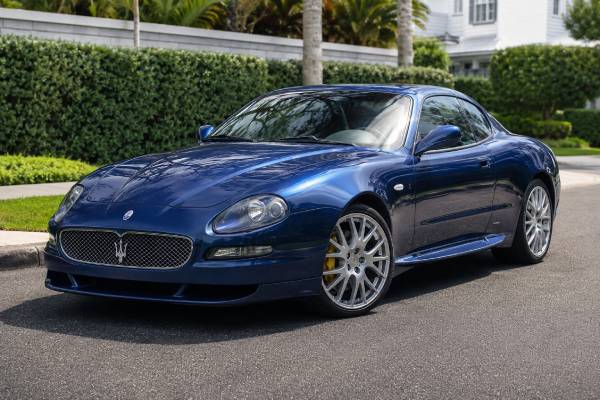
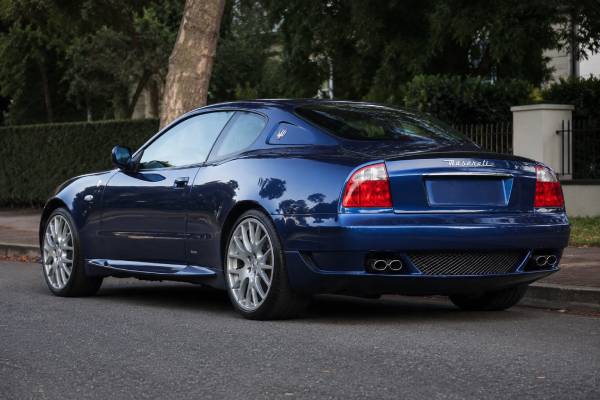
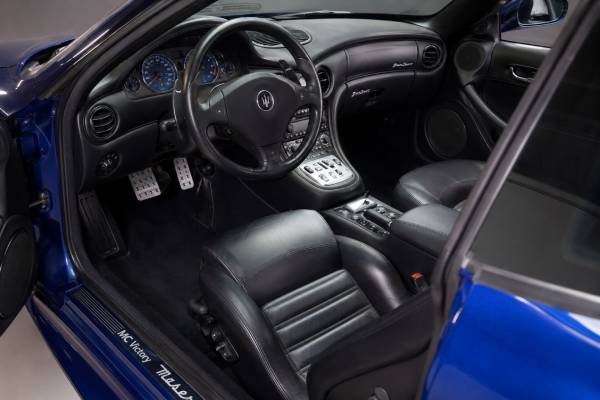
The 2006 Maserati GranSport MC Victory is the most focused factory version of the M138 GranSport coupé and one of the clearest road-going links to Maserati’s successful MC12 racing program. Built as a numbered limited edition after Maserati won the 2005 FIA GT Manufacturers’ Cup, it combines the standard GranSport’s 400 hp naturally aspirated V8 and rear-mounted Cambiocorsa transaxle with revised aerodynamics, sharper steering, carbon-fiber racing seats, blue-tinted carbon trim, and model-specific identification details. It is not a higher-output engine special, so its appeal rests on rarity, specification, condition, and authenticity rather than a dramatic straight-line advantage over a normal GranSport. Today, the MC Victory is increasingly treated as a modern collectible, but it remains a car that rewards regular, informed use. Buyers should focus on clutch condition, service records, sticky interior finishes, suspension health, and the completeness of its expensive edition-specific parts.
Table of Contents
- MC Victory in Maserati History
- V8, Transaxle, and Core Specifications
- Production Numbers and Authenticity Details
- MC12-Inspired Design and Engineering
- How the MC Victory Drives
- Maintenance, Faults, and Ownership Costs
- Buying an MC Victory Wisely
MC Victory in Maserati History
The MC Victory is best understood as a factory-developed handling and appearance flagship, not as a separate high-power model. Maserati introduced it in 2006 to celebrate the MC12’s 2005 FIA GT success and limited production to 180 uniquely numbered cars, making it far rarer than the regular GranSport.
The base GranSport had already transformed the M138 Coupé into a more aggressive grand tourer. It gained 400 hp, faster Cambiocorsa logic, 19-inch wheels, a 10 mm lower suspension setting, revised bumpers and underbody airflow, more supportive seats, and a louder valved exhaust. The MC Victory then pushed that idea toward the brand’s competition identity without removing the road car’s air conditioning, cabin trim, rear seats, or long-distance ability.
Its historical importance comes from timing. Maserati was rebuilding its road-car reputation while simultaneously returning to international GT racing. The MC12 became the visible symbol of that effort, and the MC Victory translated some of its visual and dynamic cues into a car that customers could drive every day. It arrived near the end of M138 production, before the larger Pininfarina-designed GranTurismo changed Maserati’s coupé character toward greater refinement.
The result occupies an unusual place in the market. It is neither a stripped homologation car nor a simple color-and-badge package. The steering and aerodynamic changes are meaningful, while the carbon seats and model-specific trim materially alter the cockpit. Yet the engine, transmission, brakes, and basic steel structure remain closely related to the standard GranSport. That balance makes the MC Victory engaging on the road and usable enough for touring, but it also means condition matters more than the badge alone.
Collectors care about four qualities in particular:
- A documented connection to Maserati’s MC12-era racing success.
- A very small, numbered production run.
- Distinctive factory hardware that is difficult and costly to replace.
- The last-generation feel of a compact, naturally aspirated Maserati with a single-clutch paddle gearbox.
Values therefore tend to separate sharply between complete, correctly presented cars and examples that have lost original carbon pieces, seats, badges, plaques, wheels, or documentation. The most desirable car is not automatically the lowest-mileage one. A well-maintained example that has been exercised, serviced, and stored correctly is often a safer ownership proposition than a static display car with old fluids, hardened seals, and an untested hydraulic transmission system.
V8, Transaxle, and Core Specifications
Mechanically, the MC Victory uses the GranSport’s 4,244 cc dry-sump V8, six-speed electrohydraulic Cambiocorsa transmission, rear transaxle, double-wishbone suspension, and Brembo steel brakes. Factory output remains 400 hp at 7,000 rpm and 452 Nm at 4,500 rpm, so performance is broadly similar to the regular coupé.
| Item | Specification |
|---|---|
| Engine | 4,244 cc 90-degree V8, aluminum construction, naturally aspirated |
| Valve gear | DOHC per bank, 32 valves, variable intake timing |
| Lubrication | Dry-sump system |
| Power | 400 hp at 7,000 rpm |
| Torque | 452 Nm at 4,500 rpm |
| Transmission | Six-speed Cambiocorsa electrohydraulic automated manual |
| Drivetrain | Rear-wheel drive, rear-mounted transaxle and limited-slip differential |
| Front suspension | Independent double wishbones with coil springs and anti-roll bar |
| Rear suspension | Independent double wishbones with coil springs and anti-roll bar |
| Brakes | Brembo four-piston calipers; 330 mm front and 310 mm rear ventilated, cross-drilled discs |
| Steering | Power-assisted rack and pinion, MC Victory-specific calibration |
| Wheels | 19-inch Trofeo-style alloy wheels |
| Tires | 235/35 ZR19 front, 265/30 ZR19 rear |
| Wheelbase | 2,660 mm |
| Length | 4,523 mm |
| Width | 1,822 mm |
| Height | About 1,295 mm |
| Fuel capacity | 88 liters |
| Claimed top speed | 290 km/h |
| Claimed 0–100 km/h | About 4.85 seconds |
The V8 is part of the Ferrari-Maserati F136 family, but the MC Victory’s engine should not be described as an MC12 derivative. It is a compact road-car unit with an 11.1:1 compression ratio, a 92 mm bore, a 79.8 mm stroke, and a 7,600 rpm maximum permitted speed. Its dry-sump lubrication stores oil in a separate reservoir, helping maintain oil pressure during sustained cornering and allowing the engine to sit lower in the chassis.
The transaxle layout places the gearbox and differential at the rear, connected to the front engine by a rigid torque tube. This packaging gives the GranSport a rearward weight bias and helps it rotate progressively rather than behaving like a nose-heavy front-engine GT. The Cambiocorsa unit is a conventional manual gearbox whose clutch and selector are operated hydraulically. There is no torque converter and no dual clutch. Smoothness therefore depends on software, clutch setup, throttle input, and the driver easing the accelerator during low-speed upshifts.
Maserati’s MSP stability system combines anti-lock braking, traction control, engine-drag control, and brake-force distribution. Skyhook adaptive damping appeared on many cars, although equipment can vary by market. The MC Victory’s greater steering precision and added aerodynamic load are its most important dynamic differences from a standard GranSport; the brakes remain durable steel units rather than costly carbon ceramics.
Published weight figures vary because sources mix dry weight, kerb weight, and market equipment. Use a vehicle’s registration and factory data sheet when exact legal weight matters. The useful comparison is that the MC Victory retains the substantial structure and equipment of the GranSport rather than becoming a dramatically lighter track special.
Production Numbers and Authenticity Details
Authenticity is central to MC Victory value because its limited-edition components are more important than mileage alone. Maserati announced 180 uniquely numbered cars, and a genuine example should carry a matching factory identity, correct plaque, and the special exterior and interior hardware associated with the edition.
The cars were offered from May 2006 after their Geneva debut. Blu Victory is the color most closely associated with the model, although surviving cars appear in other factory shades. Buyers should not assume that every legitimate MC Victory must be blue; instead, they should verify the original build specification through Maserati documentation, the supplying dealer, or a recognized historical certification process.
Key factory identifiers include:
- A numbered plaque on the center tunnel.
- Blue-weave carbon-fiber front aerodynamic elements.
- A model-specific rear spoiler or “nolder” in matching blue carbon.
- Recessed Italian tricolor shields in the front fenders.
- Carbon-shell racing seats with leather and Alcantara trim.
- Blue-tinted carbon trim throughout the cockpit.
- Alcantara on the upper dashboard, door areas, steering wheel sections, and seat centers.
- Trofeo-style 19-inch wheels and edition-specific presentation details.
The plaque deserves careful inspection. Its number should be clearly engraved and consistent with the car’s history. A plaque alone does not prove identity, because trim can be transferred between cars. Confirm the VIN, build data, service-book information, original sales invoice where available, and any factory correspondence. Photographs from early ownership can also establish whether the car has always carried its current paint, interior, wheels, and aerodynamic pieces.
What may vary legitimately
Exterior color, leather color, stitching, market equipment, infotainment specification, and small regulatory details can differ. Cars delivered to different countries may have distinct lighting, emissions hardware, speedometer markings, alarm systems, and registration plates. These variations should be documented rather than “corrected” to match another example seen online.
What commonly goes missing
The original racing seats may be replaced for comfort, carbon pieces can be damaged by low curbs, wheels may be refinished incorrectly, and sticky interior controls are sometimes replaced with generic parts. Owners also fit aftermarket exhausts, suspension components, modern audio units, or altered steering wheels. Sensible upgrades can improve use, but every removed factory part should stay with the car. A complete set of original components materially protects value.
Because production was small, reproduction trim may not match the original weave, tint, gloss, shape, or fit. A repair that looks acceptable in photographs can become obvious in direct light. Specialist inspection should compare both sides of the car, examine attachment points, and look for repairs beneath the carbon surface.
MC12-Inspired Design and Engineering
The MC Victory’s special character comes from the way its aerodynamic and interior changes echo the MC12 without pretending to be a road-going race car. The most functional alteration is the revised front splitter, which projects farther and adds lateral profiles to increase front load and high-speed stability.
The M138 body began as Giorgetto Giugiaro’s elegant Coupé shape. The GranSport treatment added a deeper front bumper, larger grille, lower side skirts, rear aerodynamic work, and underbody changes that reduced lift and helped lower the drag coefficient to roughly 0.33. The MC Victory’s blue-carbon splitter and rear element sharpen that package visually and dynamically. They also create an ownership risk: the low front edge is vulnerable to ramps, parking blocks, steep driveways, and careless lifting.
The Italian flags recessed into the front wings are direct visual references to the MC12. They should sit cleanly in the bodywork rather than appearing as surface stickers. Paintwork around them deserves close examination because improper removal or accident repair can disturb the recesses.
Inside, the carbon-shell seats are the defining feature. They lower visual mass, hold the torso more securely, and give the cabin a more serious driving position than the standard GranSport’s already supportive chairs. Fit is personal. A tall or broad driver should spend time in the exact car, because seat shell shape, padding, and adjustment range matter more than a brief test drive suggests.
Blue-tinted carbon appears across the console and other trim, creating a subtle link with Blu Victory paint and the MC12’s competition theme. Maserati mixed it with leather and Alcantara rather than leaving a bare race-car cabin. This keeps road comfort, but the materials age differently. Alcantara can flatten or become shiny, leather bolsters can crease, carbon clearcoat can haze, and soft-touch plastics can turn tacky.
The exhaust is another essential part of the experience. The GranSport uses bypass valves to produce a deeper, freer note under load and in Sport mode. It is loud enough to feel special but not as raw as a straight-through track system. Original exhaust operation should be checked from cold start through full warm-up, because seized valves, vacuum faults, or aftermarket modifications can alter both sound and drivability.
The engineering remains deliberately analog by current standards. Hydraulic steering, a naturally aspirated engine, steel brakes, a single-clutch transaxle, and relatively modest electronic intervention put the driver close to the mechanism. There is no launch-control routine to mask poor technique, no turbo torque plateau, and no adaptive active-aero system. The car’s pace comes from revs, balance, and commitment.
How the MC Victory Drives
The MC Victory feels fast because it combines immediate throttle response, a vocal V8, compact dimensions, and direct steering rather than relying on overwhelming torque. Its best environment is a flowing road where the engine can stay above the midrange and the chassis can settle into long, precise arcs.
At low speed, the Cambiocorsa transmission requires adaptation. Pulling away involves a computer-controlled clutch, so creeping in traffic creates heat and wear. The driver should leave a gap, move decisively, and avoid holding the car on the throttle on an incline. Upshifts are smoother when the accelerator is eased slightly as the paddle is pulled. In Sport mode, shifts become quicker and firmer, the dampers may stiffen on Skyhook-equipped cars, and the exhaust becomes more assertive.
Above about 4,000 rpm, the engine changes character. It pulls cleanly to 7,000 rpm with a hard-edged induction and exhaust note, yet its delivery remains linear. The 452 Nm torque peak is healthy rather than explosive, so choosing the right gear is part of the appeal. A modern turbocharged car may feel stronger from low rpm, but the MC Victory rewards the driver with clearer buildup and better throttle modulation.
Steering is a highlight. The MC Victory calibration is more direct than the normal GranSport’s and communicates front-tire load through the rim. The revised splitter also helps the nose feel planted at speed. On worn tires, poor alignment, or tired suspension joints, that precision disappears quickly, which is why a vague front end should be treated as a condition warning rather than accepted as normal.
The transaxle layout gives the car balanced cornering behavior. Initial turn-in is alert, the middle of the corner feels stable, and power can progressively tighten or widen the line. MSP provides a useful safety net, but old tires can overwhelm the chassis before the electronics can restore grip. Correct sizes, matching models, recent date codes, and proper pressures are essential.
Ride quality depends on road surface and damper condition. The 19-inch wheels and short tire sidewalls transmit sharp edges, while Sport mode can make broken pavement tiring. In normal damping, the GranSport remains a genuine GT and can cover long distances comfortably. Cabin noise is higher than in the later GranTurismo, rear-seat space is limited, and the turning circle is not small, but outward visibility and vehicle width remain manageable.
The steel Brembo brakes offer progressive feel and are easier to service than carbon-ceramic systems. They should pull the car down squarely without steering vibration or a long pedal. Blue or cracked discs, mismatched pads, fluid overdue for replacement, or a pulsing pedal indicate neglect or hard use.
Maintenance, Faults, and Ownership Costs
The MC Victory can be dependable when maintained by an M138 specialist, but deferred service quickly becomes expensive. The largest risks are the Cambiocorsa clutch and hydraulics, age-related cooling and suspension faults, electrical problems, interior deterioration, and damage to edition-specific carbon parts.
Cambiocorsa clutch and hydraulics
Clutch life varies enormously. Frequent reversing, hill starts, parking maneuvers, and urban creeping can shorten it, while open-road use may produce much better longevity. A diagnostic scan should report clutch wear, clutch position, PIS or “kiss point” calibration, stored transmission faults, and pump operation. The percentage shown by a scan tool is useful only when the system is correctly calibrated; it is not a substitute for observing engagement quality and checking records.
Listen for excessive hydraulic-pump cycling, delayed gear selection, neutral warnings, harsh engagement, and refusal to select reverse when hot. Repairs can involve the clutch, release bearing, position sensors, actuator, pump, accumulator, wiring, or calibration. A cheap car with an unresolved gearbox warning can consume the entire purchase-price saving.
Engine, fluids, and cooling
The V8 is robust when supplied with clean oil and allowed to warm properly. Check for oil leaks, coolant leaks, noisy accessory bearings, degraded hoses, weak engine mounts, misfires, and warning lights. A cold start should be prompt, oil pressure should establish normally, and the engine should idle evenly after its initial flare.
The dry-sump system requires correct checking procedure and oil specification. Overfilling is not harmless. Service should include oil and filter changes on time rather than merely by mileage, because many cars cover little annual distance. Brake fluid, coolant, transmission oil, differential oil, power-steering fluid, and air-conditioning condition also matter on a two-decade-old car.
Suspension, brakes, and tires
Inspect ball joints, control-arm bushings, tie rods, anti-roll-bar links, wheel bearings, dampers, and Skyhook electronics where fitted. Knocks, uneven tire wear, steering wander, or a dashboard suspension warning need diagnosis. Four-wheel alignment should be done by a shop familiar with Maserati ride heights and adjustment points.
Brake discs and pads are conventional but not inexpensive. Check disc thickness and condition rather than judging through wheel spokes. Tires age out before they wear out on low-mileage collectors’ cars. Replace mismatched or old tires even if the tread looks deep.
Body, carbon, and cabin
The front splitter is vulnerable and can be costly to restore correctly. Look beneath it, not just at the visible face. Inspect the rear carbon element, seat shells, console trim, wheel finish, fender flags, and plaque. Sticky buttons and vents are common; professional refinishing is preferable to abrasive cleaning that removes legends. Test the windows, mirrors, locks, alarm, climate control, seat functions, radio, instrument display, and every warning lamp.
Parts availability is mixed. Shared mechanical components can often be sourced through specialists, but MC Victory trim may require repair rather than replacement. Keeping the car on a battery maintainer, driving it regularly, and addressing minor faults early are practical ways to reduce cascading electrical and hydraulic issues.
Buying an MC Victory Wisely
Buy the best documented, most complete MC Victory you can verify, even when it costs more than an apparently similar car. A correct numbered example with healthy mechanicals and intact carbon is usually cheaper to own than a bargain car assembled from missing, repainted, or modified parts.
Begin with identity. Match the VIN to the registration, service book, plaque, invoices, and factory specification. Confirm that the car is truly an MC Victory rather than a standard GranSport fitted with selected parts. Ask for photographs of the VIN stamp, labels, plaque, fender flags, seat shells, splitter underside, rear spoiler, wheels, tool kit, books, keys, and any removed original equipment.
Then commission a pre-purchase inspection by a technician who can interrogate the Maserati diagnostic system. A general exotic-car inspection is not enough if it cannot measure clutch data, interpret Cambiocorsa faults, assess Skyhook operation, and identify correct edition trim.
| Area | What to verify | Why it matters |
|---|---|---|
| Identity | VIN, numbered plaque, build specification, consistent history | Protects against replicas or mixed parts |
| Clutch | Diagnostic wear data, PIS setup, hot engagement, invoices | Major cost and drivability factor |
| Hydraulics | Pump cycling, stored faults, shift quality, leaks | Can cause intermittent no-shift failures |
| Carbon parts | Splitter, rear spoiler, seat shells, interior weave and finish | Edition-specific and difficult to replace |
| Chassis | Alignment, ball joints, dampers, bushings, tire wear | Determines steering precision and safety |
| Cooling and fluids | Leak-free system, correct levels, dated service records | Age matters more than annual mileage |
| Cabin electronics | All switches, displays, climate control, locks, windows | Multiple small faults become costly |
A proper road test should start from cold. Watch the startup warning-light sequence, idle quality, exhaust-valve behavior, and transmission engagement. Drive in both normal and Sport modes. Repeat reverse and first-gear selection after the car is fully hot. Brake firmly, check straight-line stability, listen for suspension knocks, and confirm that the engine pulls cleanly to high rpm without misfire or warning messages.
Budget beyond the purchase price. Set aside funds for an immediate baseline service unless documentation proves it was recently completed. Include tires by age, brake condition, battery, sticky-switch refinishing, wheel restoration, alignment, and small trim items. Insurance should reflect agreed value and the scarcity of model-specific carbon.
The best owner is comfortable with a car that asks for mechanical sympathy. The Cambiocorsa should not be driven like a torque-converter automatic, the engine should be warmed before high rpm, and low aerodynamic pieces demand attention. In return, the MC Victory offers something uncommon: a compact Italian GT with real racing-era context, a naturally aspirated V8, strong steering feel, and enough comfort to use beyond special occasions.
References
- The World Prémière of the Maserati GranSport MC Victory | Maserati | Stellantis Media 2006
- GranSport, GranSport Spyder – Gran Turismo models | Maserati 2026
- gransport spyder · coupé 2006 (Brochure)
- World Preview of the Maserati MC12 Versione Corse | Maserati | Stellantis Media 2006
Disclaimer
This article is for informational purposes and is not a substitute for professional diagnosis, inspection, or repair. Specifications, torque values, service intervals, and procedures can vary by VIN, market, and equipment; verify every job against the official service documentation for the specific vehicle.
Please share this article on Facebook, X/Twitter, or your preferred enthusiast community to support our work.