
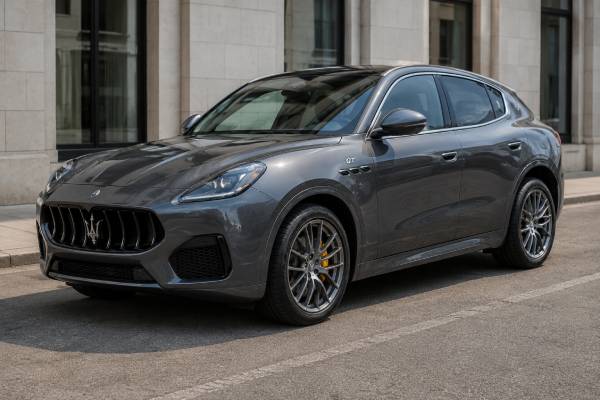
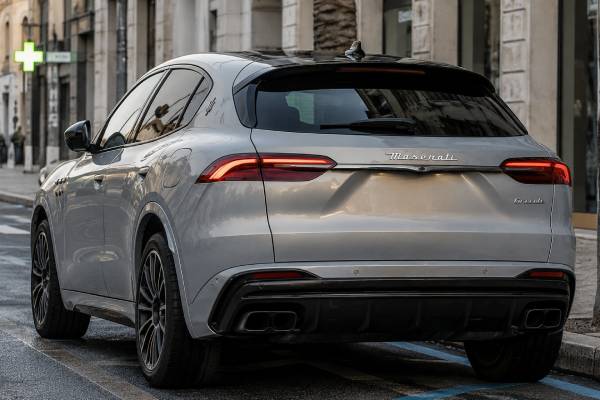
The 2023–2025 Maserati Grecale GT 250 is a market-specific entry version of Maserati’s compact luxury SUV, pairing a 2.0-liter turbocharged four-cylinder engine with a 48-volt mild-hybrid system, an eight-speed automatic transmission, and standard all-wheel drive. Its 250 hp output sits below the better-known 300 hp Grecale GT, but the two versions share the same basic GME T4 powertrain architecture, Giorgio-derived chassis, spacious five-door body, and digital-focused cabin. The result is not a slow or stripped-down Grecale. It is a quieter, tax-conscious specification designed for buyers who want the styling, comfort, and badge without paying for performance they may rarely use.
The 250 hp model is especially relevant in European markets where registration costs, company-car taxation, insurance bands, and emissions rules can make output as important as purchase price. It reaches 100 km/h in 6.3 seconds, develops a strong 450 Nm, and retains the all-weather traction and long-distance ability expected of the Grecale. This guide explains what distinguishes the GT 250, how it drives, what equipment and options matter, which maintenance risks deserve attention, and how to inspect a used example intelligently.
Table of Contents
- The GT 250’s Place in the Grecale Range
- Powertrain, Chassis, and Key Specifications
- Model Years, Equipment, and Options
- Italian Design and Mild-Hybrid Engineering
- Road Manners, Performance, and Efficiency
- Service Needs and Common Ownership Risks
- How to Buy the Right GT 250
The GT 250’s Place in the Grecale Range
The Grecale GT 250 is best understood as a lower-output regional version of the original Grecale GT, not as a separate generation or a fundamentally different vehicle. It uses the same M182 body, the same 2.0-liter mild-hybrid engine family, and the same eight-speed all-wheel-drive layout, but its calibration limits peak power to 250 hp while retaining 450 Nm of torque.
Maserati launched the Grecale in 2022 as its smaller SUV below the Levante. The model entered a highly competitive part of the premium market occupied by the Porsche Macan, BMW X3, Mercedes-Benz GLC, Alfa Romeo Stelvio, Jaguar F-Pace, and several electrified alternatives. Rather than build a purely practical crossover, Maserati aimed to combine useful rear-seat space and luggage capacity with a lower driving position, a long hood, frameless visual details, and handling influenced by the Giorgio platform architecture.
The GT trim originally served as the urban, comfort-oriented Grecale. Above it sat the more richly presented Modena and the far more powerful Trofeo with its Nettuno V6. The GT 250 appeared in selected European markets for the 2023 model year as a fiscally attractive derivative. In Italy, for example, the lower published output could reduce ownership penalties compared with the 300 hp version while preserving most of the torque that drivers feel in ordinary use.
That distinction matters. Horsepower mainly influences how strongly the vehicle continues accelerating at higher engine speeds. Torque shapes the immediate shove available in everyday traffic. Because the GT 250 keeps 450 Nm, it does not feel 50 hp weaker every time the driver touches the accelerator. The difference becomes clearer during sustained acceleration, fast motorway passing, or when the engine is held near the top of its rev range.
The GT 250 also occupies an interesting place in Maserati history. It reflects the brand’s move from low-volume sedans and grand tourers toward higher-volume premium SUVs, while using widespread Stellantis engineering beneath uniquely Maserati calibration, styling, and interior presentation. Some traditionalists question whether a four-cylinder mild-hybrid crossover can deliver authentic Maserati character. Owners often judge it more pragmatically: it provides the design, cabin atmosphere, dealership experience, and road presence of the brand in a vehicle suited to daily use.
Today, the 2023–2025 GT 250 appeals to three main groups:
- Buyers in high-tax markets who specifically need the 250 hp homologation.
- Drivers who value comfort, design, and all-wheel-drive traction over maximum acceleration.
- Used-car shoppers seeking a relatively new Maserati at a lower entry price than the Modena or Trofeo.
It is less compelling for buyers who are indifferent to tax treatment, because the 300 hp GT often offers stronger performance with similar fuel use and nearly identical maintenance needs. The best reason to choose the 250 is therefore not that it is the “cheap” Grecale, but that its exact output and market classification fit the owner’s financial and regulatory circumstances.
Powertrain, Chassis, and Key Specifications
The GT 250 combines a turbocharged 1,995 cc inline-four with a 48-volt belt starter-generator and an electric compressor-assisted mild-hybrid system. It produces 250 hp and 450 Nm, drives all four wheels through a ZF eight-speed automatic, reaches 100 km/h in 6.3 seconds, and has a published top speed of 229 km/h.
| Item | Specification |
|---|---|
| Model code | M182 |
| Engine | GME T4 turbocharged inline-four with 48-volt mild hybrid |
| Displacement | 1,995 cc |
| Maximum power | 250 hp |
| Maximum torque | 450 Nm |
| Transmission | ZF eight-speed automatic |
| Drivetrain | All-wheel drive |
| 0–100 km/h | 6.3 seconds |
| Top speed | 229 km/h |
| WLTP combined consumption | 8.8–9.2 L/100 km |
| WLTP combined CO₂ | 198–208 g/km |
| Body style | Five-door, five-seat luxury SUV |
| Wheelbase | 2,901 mm |
| Approximate length | 4,846 mm |
| Approximate width | 1,948 mm excluding mirrors |
| Fuel tank | 64 liters |
The GME T4 is a direct-injection gasoline engine with variable valve control and turbocharging. Maserati’s mild-hybrid hardware does not propel the vehicle for meaningful distances on electric power. Instead, the 48-volt system recovers energy during deceleration, restarts the engine rapidly, supports accessory loads, and helps the powertrain respond more cleanly at low speed. An electrically driven compressor can improve boost response before exhaust flow fully spins the conventional turbocharger.
This is an important ownership distinction. The GT 250 is not a plug-in hybrid, and there is no charging port. The small 48-volt battery charges itself through regeneration and the belt starter-generator. A driver who expects silent electric commuting will be disappointed, but a driver who wants gasoline convenience with smoother stop-start operation will find the system easier to live with.
The eight-speed automatic is a major part of the vehicle’s character. Its broad ratio spread gives the four-cylinder engine a low first gear for brisk launches and tall upper gears for relaxed motorway travel. Manual control is available through large steering-column-mounted shift paddles on suitably equipped vehicles. Because the paddles stay fixed while the steering wheel turns, they remain easy to locate in fast bends, though some owners find them oversized in tight parking situations.
The all-wheel-drive system is rear-biased in normal driving and can send torque forward when grip requires it. This helps the Grecale feel less nose-led than many front-platform crossovers. The architecture uses independent suspension at all four corners, with double wishbones at the front and a multi-link arrangement at the rear. Steel springs are standard on many GT specifications, while adaptive dampers and air suspension may be available depending on market and option package.
Wheel and tire size affects the way the GT 250 drives more than many buyers expect. Nineteen-inch wheels generally provide the best blend of ride quality, tire cost, and impact resistance. Optional 20- or 21-inch wheels sharpen response and fill the arches visually, but they add unsprung weight, transmit sharper road edges, and make replacement tires more expensive. Staggered performance tires can also limit rotation options.
Braking hardware varies with specification and market. The conventional steel-brake system is entirely appropriate for the GT 250’s performance. What matters on a used car is disc condition, corrosion on vehicles that have sat, even pad wear, and the absence of steering vibration during firm braking. Unlike the Trofeo, the GT 250 does not need exotic brake equipment to deliver repeatable road performance.
Cargo capacity is competitive for the class, and the 2,901 mm wheelbase gives the Grecale unusually useful rear legroom. Published luggage figures can vary by measurement method, spare-wheel arrangement, and market equipment, so buyers should judge the actual vehicle with the load floor in place. The rear seatbacks fold for longer items, but the sloping tail and wide wheel housings mean the space is more lifestyle-oriented than box-shaped.
Model Years, Equipment, and Options
For 2023–2025, the most important task is confirming that a car is genuinely homologated as the 250 hp GT rather than assuming its badge, advertisement, or engine cover proves the specification. The VIN, registration document, certificate of conformity, and factory build data should agree on power output and model designation.
The GT 250 was not offered uniformly worldwide. In North America, the better-known Grecale GT used a roughly 300 hp calibration, while the 250 hp version was aimed at selected European markets. This regional pattern creates several possible complications in the used market:
- Imported cars may have unfamiliar equipment or navigation mapping.
- Warranty coverage may not transfer cleanly across countries.
- Tax authorities may rely on homologated kilowatts rather than the seller’s horsepower description.
- A software-modified 250 may no longer match its legal certification or insurance declaration.
The 2023 model year represents the early production phase. Early cars can be attractive because they often carry generous launch specifications, but they also deserve careful checks for software updates, infotainment behavior, driver-assistance calibration, and completion of recall work. The 2024 and 2025 cars generally benefit from running production improvements and newer software, although exact changes depend on market.
GT trim usually emphasizes a cleaner, less aggressive appearance than Modena. Typical cues include more restrained exterior finishes, smaller standard wheels, and a cabin designed around comfort rather than overt sport styling. However, Maserati’s option structure allows substantial overlap. A well-optioned GT can have larger wheels, premium leather, upgraded audio, driver-assistance systems, a panoramic roof, heated and ventilated seats, and exterior details that make it resemble a higher trim.
Options that add real daily value
The most useful options are those that improve comfort, safety, or resale appeal without making the car unnecessarily fragile.
- Surround-view cameras: Valuable because the Grecale is wide and visibility over the rear corners is limited.
- Adaptive cruise and lane assistance: Helpful for motorway use, provided the systems operate smoothly and have no warning messages.
- Heated steering wheel and seats: Worthwhile in cold climates and usually desirable at resale.
- Premium audio: Adds enjoyment, though every speaker and source should be tested before purchase.
- Panoramic roof: Brightens the cabin but adds weight and potential drain, seal, or rattle issues.
- Adaptive damping or air suspension: Improves breadth of ability, but adds long-term complexity.
- Power tailgate and keyless entry: Convenient, yet both should be checked repeatedly for reliable operation.
Large wheels, very light interior colors, and elaborate exterior carbon-look packages can increase visual appeal without improving the driving experience. A buyer should separate costly options from genuinely useful ones. On a GT 250, the ideal configuration often combines 19- or 20-inch wheels, a practical leather color, cameras, adaptive cruise, and a complete service plan.
Authenticity and software tuning
Because the 250 and 300 hp versions share much of their hardware, some cars may have aftermarket engine software. A tuned GT 250 can feel noticeably faster, but it raises important questions about warranty, emissions compliance, insurance, thermal load, and resale. Sellers sometimes describe a remap as a harmless unlock of factory potential. That claim is too simple. Calibration influences boost pressure, ignition, torque limits, transmission requests, exhaust temperature, and diagnostic behavior.
Before buying, ask for written evidence of any modification and have a Maserati-capable specialist compare software identifiers with factory records. A car returned to stock shortly before sale can still retain clues in flash counters, adaptation values, or service history. For many buyers, an unmodified 250 with clean documentation is worth more than a faster example with uncertain history.
Italian Design and Mild-Hybrid Engineering
The Grecale’s main engineering achievement is that it packages generous cabin space and all-wheel-drive utility in a body that still looks low, long, and distinctly Maserati. The GT 250 shares the same core design as more expensive variants, so its visual appeal does not depend on engine output.
The exterior was developed under Centro Stile Maserati and uses several recurring brand themes: a prominent grille with the Trident at its center, three fender vents, a long hood, a cabin set visually toward the rear, and boomerang-shaped rear-light graphics inspired by historic Maserati forms. The body avoids the upright, squared proportions of many SUVs. Its roofline and rear glass create a more coupe-like stance while preserving five-door practicality.
The underlying platform is related to the Giorgio architecture used by the Alfa Romeo Stelvio and Giulia, but the Grecale has its own wheelbase, body structure, tuning, electronics, and cabin packaging. This lineage helps explain the vehicle’s rear-biased feel and relatively direct steering. It also gives the Grecale a more conventional longitudinal-engine layout than crossovers based on front-wheel-drive platforms.
The mild-hybrid system is packaged around the gasoline engine rather than dominating the vehicle. A 48-volt belt starter-generator replaces a simple alternator, while a compact battery and power electronics manage recovered energy. The design offers several practical benefits:
- Faster, smoother engine restarting during stop-start events.
- Electrical support for the e-booster and vehicle systems.
- Energy recovery during deceleration.
- Reduced engine load under selected conditions.
- Better low-speed response than a basic turbo engine may provide.
It does not, however, transform fuel economy. The Grecale is a wide, all-wheel-drive luxury SUV with substantial mass, performance tires, and a gasoline engine. Official combined consumption around nine liters per 100 km is realistic only under favorable mixed conditions. Short cold trips, urban congestion, high speed, winter tires, and frequent acceleration can push real-world use considerably higher.
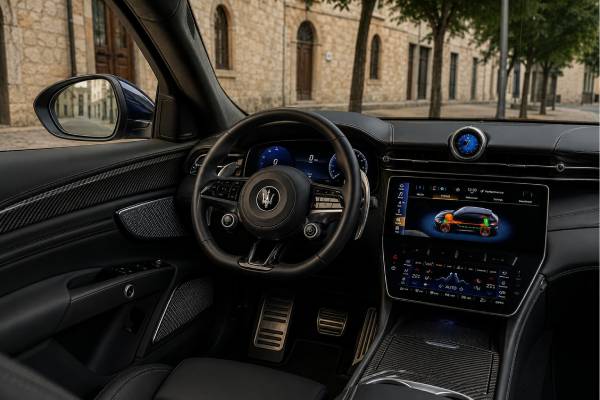
Inside, the Grecale marked a major digital step for Maserati. The dashboard uses a configurable instrument display, a central infotainment screen, a second lower touchscreen for climate and vehicle functions, and a digital version of the traditional dashboard clock. This layout looks modern and reduces physical controls, but it also makes software condition central to ownership quality. A delayed screen, intermittent camera, or failed lower display affects basic functions more than a minor infotainment fault would in an older car.
The push-button transmission selector clears the center console and gives the cabin a distinctive appearance. It takes acclimatization because gear selection is separated from the shift paddles, and quick multi-point maneuvers can feel less intuitive than using a conventional lever. The system should respond immediately and display the selected gear consistently.
Material quality varies by surface and option. The main touchpoints, leather, trim, metal paddles, and screen integration create a convincing premium atmosphere. Lower areas can reveal harder plastics than buyers expect at the original price. Condition matters greatly: scratched piano-black trim, creased pale leather, damaged wheel rims, and worn steering-wheel surfaces can make a young vehicle feel older than its mileage.
Aerodynamic management is subtle rather than theatrical. The front openings feed cooling systems, the underbody is smoothed where practical, and the roof spoiler manages airflow at the rear. The GT 250 does not need the Trofeo’s more aggressive cooling and performance details, which helps preserve its understated character. Buyers who prefer visual drama can find factory appearance packages, but the cleaner standard design often ages better.
Road Manners, Performance, and Efficiency
The GT 250 feels strongest in the middle of its rev range, where 450 Nm and the eight-speed transmission make it responsive without requiring constant high-rpm use. It is fast enough for everyday driving, but drivers who regularly exploit unrestricted motorways or enjoy hard acceleration will notice the advantage of the 300 and 330 hp versions.
From rest, the powertrain delivers a smooth initial response when the engine, transmission, and 48-volt system are fully awake. The official 6.3-second sprint to 100 km/h is credible for a vehicle of this size and places it well above ordinary family SUVs. It does not produce the explosive launch of the Trofeo, nor should it. Its performance is better described as effortless than dramatic.
Throttle behavior changes with the drive mode. Comfort-oriented settings soften initial response and encourage early upshifts. Sportier settings hold gears longer, increase engine braking, sharpen accelerator mapping, and may alter damping and steering effort when the relevant hardware is fitted. The GT 250’s best road character often appears in an intermediate setting: enough response to avoid hesitation, but without keeping the engine unnecessarily busy.
The four-cylinder engine is smooth for its type but cannot imitate the sound or texture of the Nettuno V6. At low and medium speed it is subdued, which suits the GT mission. Under full acceleration it becomes more audible and less cultured. Buyers should decide whether they prefer this restraint or consider the lack of a richer engine note a central compromise.
The eight-speed automatic generally shifts cleanly and keeps the engine near its torque band. Low-speed calibration can occasionally feel busy as the system coordinates stop-start, creep, turbo response, and all-wheel drive. A test drive should include gentle parking maneuvers, a cold start, light urban acceleration, and repeated transitions between braking and throttle. Harsh engagement, pronounced shudder, or persistent hesitation warrants diagnosis rather than being dismissed as normal hybrid behavior.
Steering is quick and accurate, with a more alert response than many luxury SUVs. Feedback is filtered, but the front end goes where it is placed and the long wheelbase contributes to stability. The chassis feels rear-biased when power is applied through a bend, although electronic systems and all-wheel drive keep the vehicle secure. The GT 250 is not as agile as a sports sedan, yet it carries speed confidently and feels smaller than its exterior width once the road opens.
Ride quality depends heavily on wheels and suspension. On 19-inch tires with the standard setup, the Grecale can absorb ordinary road imperfections well while maintaining body control. Larger wheels introduce sharper impacts and more tire noise. Air suspension can broaden the range between comfort and control, but it should not be assumed to make every surface soft; low-profile tires still transmit broken edges.
Braking performance is strong for road use. Pedal feel should be progressive, and the car should stop without vibration or pulling. Regenerative energy recovery is mild enough that the brake pedal generally feels conventional. During a used-car test, perform several moderate stops after the brakes warm. A car that has spent long periods parked may show temporary surface corrosion, but deep scoring, a lip at the disc edge, or recurring vibration indicates expense.
Visibility forward is good, helped by the seating position and dashboard shape. Rear three-quarter visibility is less impressive because of the body’s styling, making cameras and parking sensors important. The turning circle and width require care in old European streets and narrow garages.
Fuel economy is acceptable rather than exceptional. A careful driver on mixed roads may approach the official 8.8–9.2 L/100 km range. Urban use can move into double figures, while steady extra-urban travel may improve it. Premium gasoline requirements should be confirmed for the market and manual. The mild-hybrid badge should not be used to budget diesel-like consumption.
Service Needs and Common Ownership Risks
A GT 250 can be a dependable daily Maserati when it receives correct scheduled service, software updates, battery care, and prompt attention to warning messages. The main ownership risks are not limited to the engine; electronics, 12-volt and 48-volt power management, cooling, suspension options, tires, and incomplete campaign work all deserve equal attention.
Engine and mild-hybrid system
The 2.0-liter turbo engine relies on clean oil, correct viscosity, proper warm-up, and an intact cooling system. Long oil intervals may satisfy a schedule but are not ideal for every use pattern, especially repeated short trips, high ambient temperatures, or hard driving. Owners should follow the market-specific service schedule and consider more frequent oil changes when usage is severe, without substituting informal advice for official requirements.
Watch for:
- Oil leaks or residue around the cam cover, turbo plumbing, and lower engine area.
- Coolant odor, staining, or unexplained level loss.
- Rough cold starts, misfires, or an unstable idle.
- Whistling, boost leaks, or reduced-power warnings.
- Excessive belt noise from the front accessory and starter-generator drive.
- Warning messages related to the 48-volt system or stop-start function.
A weak 12-volt battery can create a surprising number of electronic symptoms even though the vehicle also has a 48-volt system. Low-voltage events may trigger warning lights, disable driver-assistance functions, or cause screens to reboot. Before replacing modules, a technician should test battery health, charging behavior, grounds, and stored fault history.
Transmission and driveline
The ZF eight-speed automatic is widely used and generally robust, but its operation depends on software, fluid condition, mounts, and driveline calibration. A healthy vehicle should engage Drive and Reverse promptly, shift cleanly under light and heavy throttle, and cruise without vibration. Clunks, flare between gears, or shudder under load require investigation.
Although some service literature may describe transmission fluid as long-life, buyers planning extended ownership should discuss preventive fluid service with a qualified Maserati or ZF specialist. The correct procedure, fluid, temperature, and fill level matter. Random flushing at a general workshop can create more harm than benefit.
All-wheel-drive components, driveshaft joints, and differentials should be checked for leaks and noise. Tire circumference must remain closely matched across axles. Mixing brands, models, or significantly different tread depths can place unnecessary strain on the system and alter handling.
Electronics, displays, and driver assistance
Every screen and control should be tested. Confirm fast startup, stable Bluetooth and phone integration, clear camera images, responsive climate controls, working seat functions, and correct operation of the digital clock display. Driver-assistance systems should initialize without persistent warnings. A dirty camera or radar area can cause temporary faults, but recurring messages may involve calibration, sensor damage, or software.
Check that all applicable recalls and service campaigns have been completed by VIN. Grecale recalls have included safety and compliance matters affecting selected model years, and the remedy status matters more than a general statement that “all Grecales do it.” Obtain printed confirmation from an authorized source.
Suspension, brakes, wheels, and body
Standard steel suspension limits complexity, while adaptive dampers and air springs improve versatility at added cost. On air-equipped cars, verify that the vehicle rises and lowers evenly, does not lean after sitting, and shows no suspension warnings. Listen for knocks over broken surfaces and inspect bushings, links, and dampers for leakage.
Large wheels are vulnerable to bends and cosmetic damage. Inspect the inner rim barrels, not just the visible faces. Uneven tire wear can indicate alignment issues, worn suspension, or repeated curb impacts. Replacement tires should match the correct load rating, speed rating, size, and approved specification where required.
Body and paint inspection is important because complex metallic finishes and sensor-equipped bumpers are expensive to repair properly. Check panel gaps, paint depth, lamp dates, radar alignment, and overspray around seals. A minor bumper repair may be acceptable if documented and calibrated; hidden structural work is not.
How to Buy the Right GT 250
The best GT 250 is an unmodified, correctly homologated example with full digital and paper service records, current software, completed recalls, matched premium tires, and equipment that suits daily use. Mileage matters less than evidence of careful ownership, correct servicing, and regular use.
Start with documentation before inspecting the vehicle. Ask for the VIN, registration record, certificate of conformity, factory option list, service invoices, warranty history, and recall status. Confirm the listed output in kilowatts corresponds to the 250 hp version. Do not rely on a GT badge or online advertisement, because sellers often copy specifications from the 300 hp model.
| Area | What to verify | Why it matters |
|---|---|---|
| Identity | VIN, homologated power, market, option list | Confirms it is a genuine GT 250 |
| Service history | Dates, mileage, fluids, campaigns, invoices | Protects against skipped maintenance |
| Cold start | Idle quality, warning lights, belt and turbo noise | Reveals faults hidden by a warmed engine |
| Electronics | Both center screens, cameras, ADAS, phone, keys | Module and display faults can be costly |
| Transmission | Cold and warm shifts, reverse engagement, shudder | Separates normal calibration from faults |
| Tires and wheels | Matching set, tread depth, inner rim damage | Affects AWD, ride, and immediate cost |
| Suspension | Noise, alignment, damper or air-system behavior | Wear can be expensive and safety-related |
| Body | Paint depth, panel fit, sensor calibration evidence | Identifies repaired accident damage |
Always arrange a diagnostic scan with Maserati-capable equipment. Generic readers may show basic emissions codes but miss manufacturer-specific faults, module histories, software status, and network errors. The scan should cover all control units, not only the engine. Ask the technician to note stored and pending faults before clearing anything.
A cold test drive is essential. Drive in stop-start traffic, on rough surfaces, at motorway speed, and through several moderate corners. Use every drive mode. Test full-throttle acceleration only after the fluids are warm and road conditions are safe. Confirm straight tracking, stable braking, smooth gear changes, and the absence of vibration under load.
Budget beyond the purchase price. Allow for annual servicing, premium tires, wheel refurbishment, brake wear, insurance, tax, and an extended warranty where available. A cheaper example needing four tires, brake discs, software diagnosis, and cosmetic repair can quickly cost more than a better car.
The GT 250 makes the most sense when its lower homologated output produces a measurable tax or insurance advantage. Compare the total annual cost with a 300 hp GT and 330 hp Modena in the same country. If the difference is small, the higher-output version may offer better resale demand. If the difference is substantial, the 250’s retained 450 Nm makes it a rational compromise.
Choose smaller wheels unless appearance is a priority, favor a complete driver-assistance and camera package, and treat air suspension as a benefit only when its condition and warranty are clear. Avoid undocumented tuning. A factory-standard car is easier to insure, diagnose, and sell.
Ultimately, the Grecale GT 250 succeeds as a refined daily SUV with enough speed, a distinctive cabin, and a more engaging chassis than many comfort-led rivals. It does not deliver the sound or urgency of a V6 Maserati, and its mild-hybrid system does not make it exceptionally economical. Its appeal lies in balance: useful space, strong midrange torque, all-weather ability, Italian design, and a market-specific power rating that can make ownership financially sensible.
References
- Grecale GT 250 2023 (Official Model Page)
- Maserati Owner Documentation 2026 (Owner’s Manual Portal)
- Maintenance Plans | Maserati US 2026 (Maintenance Information)
- Vehicle Detail Search – 2023 MASERATI GRECALE | NHTSA 2026 (Recall Database)
Disclaimer
This article is for informational purposes and is not a substitute for professional diagnosis, inspection, maintenance, or repair. Specifications, torque values, service intervals, procedures, recall applicability, and equipment vary by VIN, market, production date, and vehicle configuration. Verify all work and technical data against the official service documentation for the exact vehicle.
Please share this article on Facebook, X/Twitter, or another platform if it helped you. Your support helps us produce more detailed vehicle guides.