
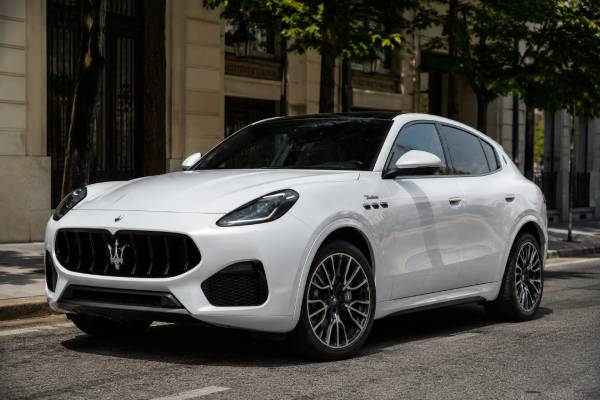
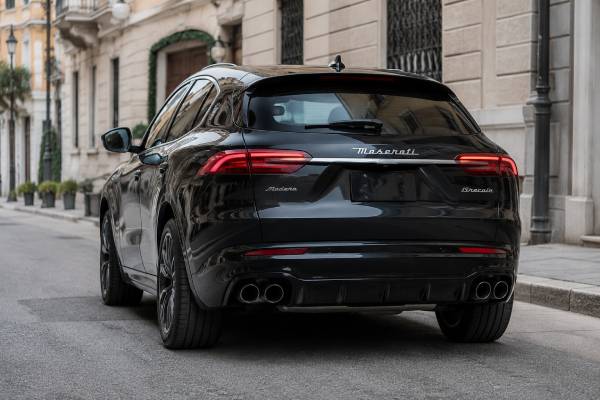
The Maserati Grecale Modena 250 is a regional version that combines the richer, sportier Modena trim with a 250 hp calibration of the 2.0-liter GME T4 mild-hybrid powertrain. It produces 450 Nm, uses an eight-speed automatic and all-wheel drive, reaches 100 km/h in 6.3 seconds, and has a 229 km/h top speed. The important point is that this is not a basic GT wearing Modena badges. It retains Modena-specific styling, materials, wheel choices, and equipment while reducing homologated power for markets where taxation and company-car costs make 250 hp especially attractive.
The standard Modena is normally associated with 330 hp and stronger high-rpm performance, while the Modena 250 prioritizes ownership economics without giving up the trim’s visual identity. Because it keeps the same 450 Nm torque figure, it remains responsive in ordinary traffic and feels more capable than the peak-power number may suggest. It is still a gasoline SUV with mild electrical assistance, not a plug-in hybrid and not an economy car. This guide examines the model’s market role, verified performance, equipment differences, engineering, road behavior, maintenance requirements, and the documentation checks needed to confirm that a used vehicle is a genuine Modena 250.
Table of Contents
- Why Maserati Created the Modena 250
- 250 hp Powertrain and Vehicle Specifications
- Regional Production, Equipment, and Authenticity
- Modena Style with Lower-Output Engineering
- Driving Character, Efficiency, and Comfort
- Maintenance, Electronics, and Age-Related Risks
- Smart Buying for a Modena 250
Why Maserati Created the Modena 250
The Modena 250 exists to deliver the desirable Modena specification while keeping homologated output within a financially favorable regional band. It is aimed mainly at buyers who care about annual tax, fleet policy, insurance, or company-car treatment as much as outright acceleration.
The original Grecale range launched in 2022 with a 300 hp GT, a 330 hp Modena, and a 530 hp Trofeo. Maserati later broadened selected European offerings with 250 hp derivatives. Italy is the most visible market because 184 kW places the model just below a significant power-based tax threshold, making the difference between 250 and 300 or 330 hp meaningful over several years of ownership.
The assignment period begins in 2024, although first registrations, public offers, and model-year labels can vary. Some cars may be described as 2024, MY25, or later depending on production and dealer timing. By the current advertised 2027 range, the Modena 250 remains an official Italian-market configuration with the same headline figures of 250 hp, 6.3 seconds, and 229 km/h.
This version should not be confused with the Grecale GT 250. Both use the same basic 1,995 cc mild-hybrid architecture and performance calibration, but the trim content differs. Modena normally includes a more assertive exterior theme, larger wheels, upgraded cabin materials, and additional equipment. In effect, the buyer pays for style and specification rather than extra engine output.
The model suits a particular customer:
- Someone who wants a Modena interior and exterior but does not need 330 hp.
- An Italian or regional buyer minimizing power-based taxes.
- A company-car user whose policy limits output or running cost.
- A driver who values 450 Nm midrange response more than maximum-speed acceleration.
It is less convincing where the tax or insurance saving is small. In that case, a 300 hp Grecale or 330 hp Modena may deliver better value and wider resale demand. The correct comparison is total ownership cost, not list price alone.
The Modena 250 also illustrates how modern manufacturers adapt one powertrain family to multiple regulatory environments. Hardware commonality helps service and parts supply, while software, homologation, and model designation create a legally distinct vehicle. That is why aftermarket remapping can undermine the very reason for choosing this model.
250 hp Powertrain and Vehicle Specifications
The Modena 250 uses a 1,995 cc turbocharged four-cylinder gasoline engine with 48-volt mild-hybrid assistance. It produces 250 hp and 450 Nm, drives all four wheels through a ZF eight-speed automatic, and accelerates from 0–100 km/h in 6.3 seconds.
| Item | Specification |
|---|---|
| Model code | M182 |
| Engine family | GME T4 turbocharged inline-four |
| Displacement | 1,995 cc |
| Hybrid type | 48-volt mild hybrid |
| Maximum power | 250 hp / 184 kW |
| Maximum torque | 450 Nm |
| Transmission | Eight-speed automatic |
| Drive | All-wheel drive |
| 0–100 km/h | 6.3 seconds |
| Maximum speed | 229 km/h |
| Wheelbase | 2,901 mm |
| Approximate length | About 4,847–4,873 mm, model-year dependent |
| Fuel tank | 64 liters |
| Seating | Five |
| Body | Five-door luxury SUV |
The GME T4 combines direct injection, turbocharging, variable valve control, and an electrically driven compressor. The 48-volt belt starter-generator recovers energy during deceleration and restarts the engine quickly. A compact battery supplies the e-booster and electrical loads. There is no charging socket and no meaningful electric-only mode.
The 250 hp calibration preserves 450 Nm, which explains why low- and mid-speed response remains strong. The power reduction is most noticeable when the driver holds full throttle at higher revs or accelerates beyond normal motorway speeds. In traffic, the transmission can use the same broad torque to move the vehicle without frequent downshifts.
The eight-speed automatic uses a torque converter, providing smooth creep and relaxed shifts. Fixed column-mounted paddles allow manual control. Depending on drive mode, the gearbox can prioritize economy, hold gears longer, or provide stronger engine braking.
All-wheel drive is standard. Normal calibration retains a rear-oriented feel, then transfers more torque forward as grip changes. The system improves wet and winter traction but does not remove the need for suitable tires. All four tires must remain closely matched in size and rolling circumference.
Suspension uses front double wishbones and a rear multi-link design. Modena equipment may include adaptive dampers or optional air suspension depending on market and model year. Larger wheels are common, often 20 or 21 inches. They enhance stance but increase tire cost and impact harshness.
Official fuel-consumption figures vary with equipment and homologation update. The closely related 250 hp Grecale has published combined figures around 8.8–9.3 L/100 km. Real use can exceed 10 L/100 km in short-trip or urban driving. Mild hybrid should be understood as a response and emissions aid, not a promise of diesel-like economy.
The 64-liter fuel tank provides reasonable touring range, but premium gasoline requirements and actual consumption should be included in the budget. The exact fuel grade must be confirmed in the owner documentation for the VIN and market.
Regional Production, Equipment, and Authenticity
The most important buying task is proving that the vehicle is an original Modena 250 with 184 kW homologation. Badges, advertisements, and visual trim are not enough because Grecale variants share body panels and many components.
Start with the certificate of conformity, registration document, and VIN-linked factory build data. Confirm:
- Model designation as Grecale Modena 250.
- Homologated maximum power of 184 kW.
- Original sales market.
- Production and model year.
- Engine and emissions code.
- Factory wheel, interior, suspension, and assistance packages.
The 184 kW figure matters because it is the legal basis for tax and insurance treatment in relevant markets. A software tune that raises output may create compliance, warranty, and insurance problems even if the registration remains unchanged.
What Modena trim usually adds
Modena specification generally provides a more dynamic presentation than GT. Typical features can include:
- Gloss-black grille and window details.
- Modena badging near the fender vents.
- Larger or sportier wheel designs.
- Upgraded leather, stitching, or trim inserts.
- More supportive front seats.
- Additional comfort and driver-assistance equipment.
- Darker exterior accents and sport-oriented interior themes.
Exact standard content changes by model year. A buyer should not assume every Modena includes air suspension, premium audio, panoramic glass, or a full assistance package. These may be optional.
For the advertised 2027 update, current Italian material shows revised front styling, new wheel choices, an updated flat-profile steering wheel, improved digital-clock hardware, metallic PRND controls, revised interface graphics, and a low-speed paddle-based parking logic. These details help identify a facelifted car but do not change the core 250 hp performance figures.
Imports and market differences
A Modena 250 is likely to appear outside its original market through private import. That can produce an attractive purchase, but buyers must verify warranty validity, connected services, navigation, radio, lighting approval, emissions documentation, and tax recognition. A dealer may be able to service the mechanical hardware while declining responsibility for market-specific software or warranty claims.
Check that both keys work and that ownership can be transferred in the Maserati app or connected platform. Confirm the language and region settings of the infotainment system. Imported cars should have complete customs and registration documentation.
Modena Style with Lower-Output Engineering
The Modena 250’s appeal comes from pairing the Grecale’s sportier trim with a restrained engine calibration. Visually and inside the cabin, it can look nearly identical to a 330 hp Modena; the difference is primarily homologation and software-controlled output.
The Grecale body was developed under Centro Stile Maserati with a low grille, long hood, rearward visual cabin, three fender vents, and boomerang-inspired rear lamps. The 2,901 mm wheelbase provides generous rear space, while the tapered roof and tail preserve a lower, more athletic shape than a boxy SUV.
Modena’s dark accents emphasize the body’s width and technical details. Larger wheels fill the arches and create a firmer stance. The effect is attractive, but a 250 hp buyer should consider whether 21-inch wheels undermine the model’s rational ownership goal. Twenty-inch wheels normally provide better ride quality, lower tire cost, and greater resistance to pothole damage.
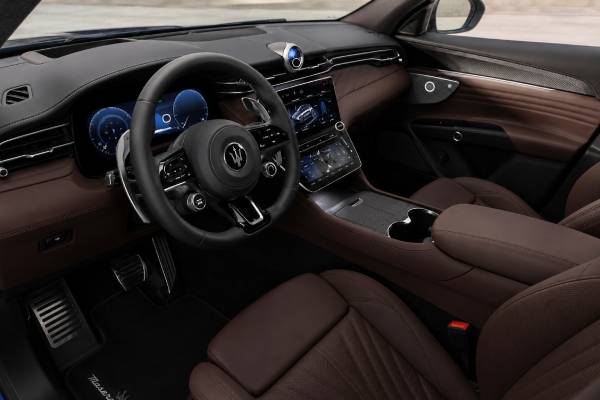
The interior uses a digital instrument panel, a large central infotainment display, a lower comfort and climate screen, and a digital interpretation of the traditional Maserati clock. The push-button gear selector clears the console, while fixed metal shift paddles preserve a performance feel.
This screen-led design makes software condition part of vehicle quality. Climate control, camera views, media, navigation, and vehicle settings rely on stable displays. A slow lower screen or intermittent rear camera affects daily function, not just entertainment.
The mild-hybrid hardware is compact and largely hidden. Its main engineering tasks are to recover deceleration energy, support the electric compressor, restart the gasoline engine, and reduce accessory load. It does not add a large traction motor or heavy plug-in battery, so packaging and luggage space remain close to other four-cylinder Grecales.
The lower-output calibration may reduce sustained thermal and mechanical demand compared with the 330 hp engine, but it does not make servicing unimportant. The same turbocharger, direct injection, 48-volt system, cooling circuits, and control modules still require correct fluids and diagnosis.
One distinctive ownership issue is the temptation to remap. Since related versions produce more power, sellers may claim that a tune simply restores factory output. That ignores homologation, emissions, torque-management, warranty, and tax consequences. The Modena 250 is most valuable when it remains verifiably standard.
Driving Character, Efficiency, and Comfort
The Modena 250 feels responsive and secure rather than genuinely high-performance. Strong 450 Nm torque gives it easy urban pace and confident overtaking, while the 6.3-second acceleration time is sufficient for almost every daily situation.
From rest, all-wheel drive and the torque converter provide clean traction. The vehicle does not feel slow, especially before motorway speeds. Compared with the 330 hp Modena, it loses urgency as revs rise and requires more time for high-speed passing. Drivers who rarely use full throttle may find the difference smaller than expected.
The drive modes alter throttle mapping, gearbox behavior, steering effort, damping, and ride height where fitted. A comfort-oriented mode encourages early upshifts and smooth responses. Sport holds gears longer and sharpens the pedal, which can make the 250 feel more energetic without changing actual output.
Low-speed behavior should be smooth. The engine may stop at traffic lights and restart as the brake is released. A slight transition is normal, but repeated jerking, delay, or hybrid warnings are not. Test the vehicle in traffic rather than only on an open road.
The four-cylinder engine is subdued during gentle use. Under full load it becomes more audible but does not provide the rich tone associated with Maserati V6 models. The Modena cabin and exhaust presentation can add character, but buyers should decide whether styling is enough to offset the modest soundtrack.
Steering is quick and accurate. The longitudinal platform and rear-oriented AWD calibration help the vehicle feel balanced rather than nose-heavy. Body control is good, and 250 hp is unlikely to overwhelm the chassis on dry roads. This makes the model approachable in poor weather and easy to drive briskly without constant intervention.
Ride quality depends on wheel size. A Modena 250 on 20-inch wheels can combine controlled handling with reasonable comfort. On 21-inch wheels, broken surfaces and potholes become more pronounced. Air suspension broadens the range but adds complexity and does not eliminate tire harshness.
Brakes are conventional steel units and well matched to the performance level. The pedal should feel progressive, with no vibration or pulling. Mild regeneration does not dominate pedal feel. Low-mileage cars that sit outdoors may still develop disc corrosion.
Motorway cruising is relaxed. The eight-speed uses tall ratios, the wheelbase gives stability, and the cabin offers useful rear room. Cameras and parking sensors are valuable in town because the vehicle is wide and rear-corner visibility is limited.
Fuel economy will not match a full hybrid. A careful driver may approach official high-single-digit figures on mixed routes. Short trips, cold weather, city congestion, large wheels, and high speed can move consumption into double digits. The model’s financial advantage comes mainly from output classification, not fuel savings.
Maintenance, Electronics, and Age-Related Risks
A Modena 250 should be maintained like any modern turbocharged Maserati: with exact fluids, reliable battery support, current software, matched tires, and prompt diagnosis of warnings. Its lower power does not simplify the electronics or 48-volt network.
Engine and cooling checks
Follow the official oil specification and interval for the VIN. Repeated short trips, heat, and urban use can justify discussion of more frequent oil changes with a qualified specialist. Inspect for leaks around the upper engine, turbo lines, intake hoses, and lower covers.
Cold start should be clean and stable. Persistent misfire, smoke, ticking, boost loss, or reduced-power messages require diagnosis. Coolant level should remain stable, and the engine should hold normal temperature in traffic and after hard acceleration.
The belt starter-generator drive should operate without squeal or abnormal vibration. Any 48-volt warning deserves trained inspection. Technicians must follow hybrid safety procedures even though the system is mild hybrid rather than high-voltage plug-in hardware.
Battery, software, and cameras
The 12-volt battery remains essential. Weak voltage can cause multiple warnings, screen reboots, keyless-entry faults, driver-assistance errors, and disabled stop-start. Test state of health, charging, and parasitic drain before replacing expensive modules.
Operate both center screens, the instrument panel, digital clock, all cameras, phone pairing, climate zones, seat functions, roof, tailgate, keys, and assistance systems. Confirm recall and campaign status by VIN. Grecale model years have been included in rearview-camera software and headlamp-compliance actions in some markets.
Over-the-air updates may complete some remedies, but a buyer should obtain written confirmation. An empty warning display does not prove every campaign is closed.
Transmission, AWD, and suspension
The eight-speed automatic should engage Drive and Reverse promptly and shift cleanly at light and heavy throttle. Delayed engagement, flare, repeated clunks, or shudder need investigation. For long-term ownership, discuss preventive fluid service with a Maserati or ZF specialist.
Check AWD components and differentials for leaks or noise. Fit four compatible tires with similar tread depth. Mixed tires can alter handling and stress the driveline.
Listen for suspension knocks and inspect dampers, links, and bushings. Air-suspension cars should stay level after sitting and change height without frequent compressor use. Large wheels must be checked on their inner faces for bends or cracks.
Body and interior wear
Modena trim can be expensive to restore. Inspect gloss-black finishes, special paint, leather bolsters, carbon or wood trim, and wheel faces. Check panoramic-roof drains and headliner edges for water marks. Paint repairs near cameras or radar should include calibration evidence.
Smart Buying for a Modena 250
A good Modena 250 is valuable because it is exactly what its documents claim: a factory 184 kW vehicle with complete service history, no undocumented tune, current software, and a specification that preserves the tax advantage. Authenticity matters more here than on most Grecale variants.
Before viewing the car, request the VIN, registration, certificate of conformity, build sheet, service invoices, warranty history, and campaign status. Confirm the 250 hp designation and original market. Ask directly about ECU tuning, tuning boxes, exhaust changes, suspension coding, and wheel substitutions.
Inspect the vehicle cold. Check battery behavior, idle, exhaust smoke, warning lights, screen startup, suspension stance, tire dates, and fluid levels. A warmed car can hide weak-start and misfire symptoms.
During the test drive, include slow parking maneuvers, stop-start traffic, rough roads, motorway speed, firm braking, and full acceleration after warm-up. Test every drive mode. The vehicle should shift smoothly, track straight, maintain temperature, and show no persistent warnings.
| Question | Best answer | Risky answer |
|---|---|---|
| Is it factory 250 hp? | 184 kW shown in all official records | Seller relies only on badges |
| Has it been tuned? | Factory software confirmed | “Returned to stock” with no evidence |
| Are taxes favorable? | Verified for the owner’s location | Assumed from an online listing |
| Are tires correct? | Matched premium set with even wear | Mixed brands or large tread differences |
| Are electronics stable? | All systems work and recalls are closed | Intermittent camera or screen faults |
| Is suspension healthy? | Quiet, level, and warning-free | Knocks, leaning, or compressor overuse |
Arrange a full diagnostic scan covering all modules. Ask for stored, pending, and historical faults before codes are cleared. Verify software identifiers where possible. A generic engine-code reader cannot confirm the condition of cameras, hybrid control, suspension, or body modules.
Compare total cost with the standard 300 hp Grecale and 330 hp Modena. Include annual tax, insurance, fuel, depreciation, purchase price, and expected resale. The Modena 250 is compelling when the legal output band saves meaningful money. Without that benefit, the 330 hp version may be easier to sell and more satisfying at high speed.
Choose equipment carefully. Twenty-inch wheels, surround cameras, adaptive cruise, climate-appropriate seats, and a complete service plan usually add more daily value than the largest wheels or delicate trim. Air suspension is worthwhile only with clear condition and warranty support.
An extended warranty should cover electronics, hybrid components, infotainment, AWD, and air suspension, not only internal engine failure. Read exclusions and servicing rules. Maintain a reserve for tires, brakes, batteries, and diagnostic labor.
The Modena 250 is a rationally engineered niche Maserati. It keeps the look and cabin experience of the Modena, preserves strong torque, and reduces power-based ownership costs in the markets for which it was designed. Its success depends on buying the correct, unmodified car and preserving its legal specification. For the right owner, that makes it more intelligent than simply choosing the highest available output.
References
- Maserati Grecale Modena – Versione 2027 2026 (Official Model Page)
- Maserati Grecale, SUV di Lusso, Versioni e Specifiche 2027 | Maserati IT 2026 (Official Range Page)
- Configuratore Auto Maserati: Prezzi e Modelli in Vendita 2026 (Official Configurator)
- Maserati Owner Documentation 2026 (Owner’s Manual Portal)
- Vehicle Detail Search – 2023 MASERATI GRECALE | NHTSA 2026 (Recall Database)
Disclaimer
This article is for informational purposes and is not a substitute for professional diagnosis, inspection, maintenance, repair, tax, or legal advice. Specifications, torque values, intervals, procedures, taxes, recalls, and equipment vary by VIN, market, production date, and configuration. Verify all technical data against official service documentation and confirm local tax treatment with the appropriate authority.
Please share this article on Facebook, X/Twitter, or another platform if it was useful. Sharing supports our work on detailed vehicle guides.