

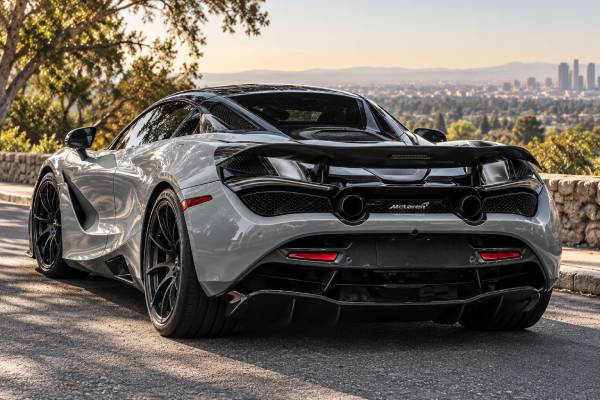
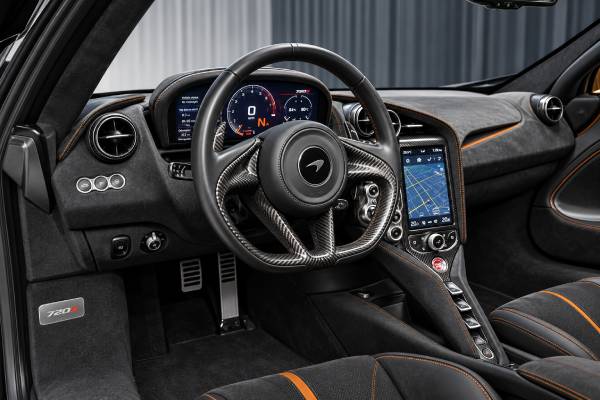
The 2019 McLaren 720S MSO Apex Collection is a track-themed, 15-car special edition built around the 720S Coupé rather than a separate higher-output model. Its defining idea is unusually specific: each car belongs to one of five national themes and carries the measured apex speed achieved by a McLaren professional driver at a famous corner in that country. Underneath the MSO treatment is the familiar 4.0-liter twin-turbo M840T V8, seven-speed Seamless Shift Gearbox, rear-wheel drive, carbon-fiber Monocage II and Proactive Chassis Control II system. What changes is the specification around that hardware. The Apex cars received the 720S Track Pack as standard, plus bespoke carbon-fiber details, racing-oriented cabin equipment and a numbered MSO identity. For a buyer today, that makes originality and documentation at least as important as mileage. This guide explains what the Apex Collection is, what its specifications mean, how the track-focused equipment affects use, and what to inspect before buying one.
Table of Contents
- What Makes the MSO Apex Collection Different
- 720S MSO Apex Collection Technical Specifications
- Track Pack Engineering and Circuit Hardware
- Performance, Handling, and Road Use
- Maintenance and Preservation Priorities
- Buying and Authenticating an Apex Collection Car
- Ownership Perspective and Long-Term Appeal
What Makes the MSO Apex Collection Different
The Apex Collection is best understood as a factory-authorized MSO specification built around the 720S Performance and Track Pack, with its identity tied to five European Grand Prix circuits. McLaren produced 15 cars in total, and the sill inscription on each one links the car to a country, a circuit corner and a measured apex speed.
The five themes were not simply paint-and-badge packages. McLaren used the speed achieved by one of its professional performance drivers as the centerpiece of each version:
- Apex Great Britain — 110 mph: Abbey at Silverstone. Four cars were allocated to this theme, two right-hand drive and two left-hand drive.
- Apex Germany — 85 mph: the Mobil 1 corner at Hockenheim. Three cars, one right-hand drive and two left-hand drive.
- Apex France — 104 mph: Signes at Circuit Paul Ricard. Three cars, one right-hand drive and two left-hand drive.
- Apex Belgium — 103 mph: the Eau Rouge section at Spa-Francorchamps. Three cars, one right-hand drive and two left-hand drive.
- Apex Italy — 90 mph: the Ascari chicane at Monza. Three cars, one right-hand drive and two left-hand drive.
That distribution matters when assessing rarity. “One of 15” describes the collection, but an individual car also belongs to a much smaller theme and steering-position subset. A Great Britain right-hand-drive car, for example, is not interchangeable with a France left-hand-drive car from a provenance standpoint.
The exterior specification reinforces the circuit theme without changing the core body shape. Visible-carbon elements include the hood and rear-fender air intakes, mirror casings and active rear spoiler, while ultra-light forged 10-spoke wheels and the sports exhaust come with the standard Track Pack. The extended carbon-fiber door sills carry the defining apex-speed inscription, and an MSO Apex logo appears at the rear fender.
Inside, the intent is even clearer. Carbon-fiber racing seats, a titanium harness bar and provision for six-point harnesses move the car toward closed-course use. McLaren Track Telemetry records data and, in the three-camera configuration specified for the Apex cars, video that can be reviewed after a session. MSO also added extended shift paddles, a bespoke steering wheel with a contrasting 12 o’clock marker, a special accelerator pedal, key treatment and a dedication plaque.
The important point is that the M840T engine was not given a higher factory power rating for this edition. Its distinction comes from specification, rarity and track context, not a different 720S powertrain calibration.
720S MSO Apex Collection Technical Specifications
The Apex Collection is a gasoline-only, mid-engined ICE supercar using the same 3,994 cc M840T architecture and seven-speed dual-clutch driveline as the 720S Coupé. The figures below separate confirmed 720S platform data from Apex-specific equipment so that a rare-edition detail is not mistaken for a mechanical change.
| Specification | Value |
|---|---|
| Engine family | M840T |
| Fuel type | Gasoline/petrol |
| Layout | Longitudinal mid-mounted 90-degree V8 |
| Displacement | 4.0 L (3,994 cc) |
| Induction | Twin electrically actuated twin-scroll turbochargers |
| Lubrication | Dry sump |
| Maximum power | 720 PS (710 bhp / 530 kW) at 7,500 rpm |
| Maximum torque | 770 Nm (568 lb-ft) at about 5,500 rpm |
| Transmission | 7-speed Seamless Shift Gearbox (SSG) plus reverse |
| Driven wheels | Rear-wheel drive |
| Measure | Value |
|---|---|
| 0–100 km/h (0–62 mph) | 2.9 seconds |
| 0–200 km/h (0–124 mph) | 7.8 seconds |
| Quarter mile (0–400 m) | 10.3 seconds |
| Top speed | 341 km/h (212 mph) |
| 100–0 km/h braking distance | 30 m (98 ft) |
| 200–0 km/h braking distance | 118 m (387 ft) |
| Specification | Value |
|---|---|
| Body structure | Carbon-fiber Monocage II |
| Suspension | Double wishbones with adaptive dampers |
| Chassis control | Proactive Chassis Control II |
| Differential | Open differential with Brake Steer |
| Front brakes | Carbon-ceramic discs with 6-piston aluminum calipers |
| Rear brakes | Carbon-ceramic discs with 4-piston aluminum calipers |
| Aerodynamics | Active rear wing/airbrake |
| Apex equipment | Track Pack standard, including ultra-light forged wheels and sports exhaust |
| Published Track Pack weight saving | 24 kg versus the equivalent non-Track-Pack configuration |
| Specification | Value |
|---|---|
| Body style | 2-door, 2-seat coupé |
| Length | 4,544 mm (178.9 in) |
| Width excluding mirrors | 1,930 mm (76.0 in) |
| Height | 1,196 mm (47.1 in) |
| Wheelbase | 2,670 mm (105.1 in) |
| Lightest published dry weight, standard 720S | 1,283 kg (2,828 lb) |
| DIN kerb weight, standard 720S | 1,419 kg (3,128 lb) |
| Front luggage capacity | 150 L |
| Rear luggage capacity | 210 L |
| Specification | Value or condition |
|---|---|
| Fuel-tank capacity | 72 L (19.0 US gal) |
| Archived McLaren EU WLTP combined consumption | 12.2 L/100 km |
| Archived McLaren EU WLTP CO₂ | 276 g/km |
| Common front tire size | 245/35 ZR19 |
| Common rear tire size | 305/30 ZR20 |
| Reference cold pressure listed by Michelin for 720S fitment | 2.2 bar (32 psi) front and rear; verify the vehicle placard for the exact tire package |
Fuel-economy and emissions certification can differ by market and model-year test procedure. The archived McLaren figure is useful as a reference, but registration documents and the vehicle’s market-specific handbook take priority for an individual 2019 car.
Track Pack Engineering and Circuit Hardware
The Track Pack is the engineering feature that most clearly separates the Apex Collection from a normal road-biased 720S order. It does not transform the engine, but it reduces mass, adds driver-analysis hardware and changes the cabin around repeated circuit use.
The 720S already begins with an unusually stiff carbon-fiber central structure. That lets the suspension do its work without relying on a heavy steel or aluminum body shell for basic rigidity. Proactive Chassis Control II then uses hydraulic interconnection between dampers rather than a conventional anti-roll-bar layout to manage body motion. In practical terms, the car can stay relatively compliant over a broken road while still resisting roll when cornering hard.
The Apex specification builds on that foundation. The forged 10-spoke wheels reduce rotating and unsprung mass relative to heavier wheel designs, helping the suspension control each wheel more precisely. The sports exhaust changes sound and reduces some weight. Visible carbon-fiber exterior pieces are partly aesthetic, but the Track Pack as a package was described with a 24 kg saving.
The titanium harness bar deserves more respect than its visual drama suggests. A six-point harness can hold a driver more securely in a racing seat, reducing the effort required to brace against lateral forces. That can make steering inputs more consistent on track. It is not, however, a casual substitute for the normal road restraint system. Harness use, seat compatibility, helmet choice and local track rules should be treated as a complete safety system.
McLaren Track Telemetry is similarly more than a novelty. It can record lap and sector information and synchronize it with camera footage. The useful way to employ it is not to chase a headline speed on a first lap, but to compare braking points, consistency and line choice after the session. The sill’s engraved apex number is a reference to a professional driver’s result under specific conditions, not a target that proves anything about an owner’s skill.
That distinction is particularly important with the Apex Collection because its theme can encourage comparison. Tire age, tire compound, temperature, surface condition, fuel load and driver experience all change achievable corner speed. A collector who preserves the original Track Pack equipment while using the car intelligently is respecting the idea of the edition better than someone who treats the engraved number as a challenge on a public road.
Performance, Handling, and Road Use
The Apex Collection is as fast in a straight line as a standard 720S because its rated output remains 720 PS, but its factory track equipment can make it feel sharper and more purposeful. The most useful way to understand the car is to separate acceleration from the systems that make that speed manageable.
The M840T’s 770 Nm of torque reaches the rear wheels through a seven-speed dual-clutch transmission. The engine’s dry-sump lubrication is significant in a track-focused car because it helps maintain oil control during sustained cornering. Turbocharging gives the 4.0-liter V8 enormous mid-range thrust, while the gearbox keeps the engine close to its useful power band during hard acceleration.
At the chassis level, the hydraulic suspension system and carbon structure are the bigger story. Steering assistance is hydraulic, which gives the 720S a very different texture from many electrically assisted rivals. The open differential sounds simple on paper, but McLaren combines it with Brake Steer: selective braking at an inside rear wheel can help the car rotate and put power down without a conventional mechanical limited-slip differential.
The active rear wing also has more than one job. It changes position for aerodynamic balance and can rise aggressively under heavy braking as an airbrake. Because the system is active, a pre-purchase inspection should confirm normal movement and check for warnings rather than assuming a wing that sits flush at rest is functioning correctly.
On the road, the Apex car is still fundamentally a 720S, so visibility is better than its low body suggests. The thin pillars and glazed areas around the carbon tub help the driver place the car. The practical limitations are more ordinary: very low bodywork, expensive wheels, wide rear tires and limited tolerance for steep ramps or careless parking.
The Track Pack cabin changes the daily-use equation. Carbon racing seats may fit one driver perfectly and another poorly. A harness bar reduces flexibility behind the seats, and a buyer who expects touring comfort should spend time in the exact car rather than assuming every 720S interior is equivalent. The 150-liter front and 210-liter rear luggage spaces are useful by supercar standards, but the special equipment and the desire to preserve bespoke trim may make owners reluctant to use the car casually.
Maintenance and Preservation Priorities
A well-kept Apex Collection should be maintained as a 720S first and preserved as a 15-car MSO edition second. Mechanical service history, battery management, tires, brakes and recall status matter more than cosmetic perfection, but the rare trim pieces deserve separate attention because replacement may be difficult or impossible to reproduce exactly.
Start with scheduled servicing. Use the handbook and McLaren service documentation that correspond to the VIN and market; do not rely on a generic internet interval or fluid chart. Ask for dated invoices, not just stamps, and check whether long gaps correspond to storage. Low mileage is not proof of low wear when fluids, seals, tires and the 12-volt system have aged.
Battery condition matters on cars that spend long periods parked. The 720S contains numerous control modules, and low voltage can create warning messages or operational faults that complicate diagnosis. A compatible maintainer is sensible for storage, but a car that repeatedly needs external power deserves a proper battery and charging-system check.
Tires should be inspected by date code as well as tread depth. The Apex Collection’s forged wheels are valuable original equipment, so look for inner-barrel damage, repairs, refinishing and curb impact. Track use is not automatically a negative on a car sold with telemetry and harness hardware; undocumented abuse is. Heat cycles can age a performance tire long before the tread appears worn.
Carbon-ceramic brakes need an informed inspection. Surface appearance alone does not establish remaining life. Check disc condition, pad thickness, caliper condition and service records, and investigate vibration or unusual noise rather than dismissing it as “normal carbon-ceramic behavior.” Replacement cost can be substantial.
A U.S. safety recall, NHTSA campaign 20V-231, covered certain 720S vehicles produced through February 2020 with an NVH foam pad beneath the fuel tank that could retain moisture and promote corrosion. The remedy involves removing the pad, inspecting the tank and replacing the tank if corrosion is present. Because campaign applicability is VIN-specific, a buyer should verify completion with McLaren or the relevant national recall database rather than assuming a 2019 car has already been addressed.
Finally, protect the edition-specific pieces. Photograph the sill inscriptions, dedication plaque, MSO key shell, steering-wheel marker, throttle pedal, harness bar, seats, wheels and carbon exterior elements during each major service or acquisition inspection. That record helps prove condition and originality later.
Buying and Authenticating an Apex Collection Car
The best Apex Collection purchase is the car whose identity can be traced from factory specification to present condition. With only 15 built, a convincing badge or copied sill graphic is not enough; provenance should be unusually complete.
Begin by establishing exactly which of the five themes the car represents and whether its steering position matches the published allocation. Then compare the physical specification with period documentation. A genuine car should make sense as a complete package: Track Pack hardware, MSO Bespoke sill treatment with the appropriate apex speed, dedication plaque, Apex exterior identification, carbon racing seats, titanium harness bar, extended paddles and other listed MSO details.
A useful inspection sequence is:
- Confirm the VIN and factory build specification. Obtain documentation from an authorized McLaren retailer or credible factory record where possible.
- Match the theme. Verify country, corner and sill speed rather than accepting “Apex Collection” alone.
- Inventory edition-specific components. Record the original wheels, exhaust, carbon exterior parts, seats, harness bar, steering wheel, key and plaque.
- Check mechanical health independently. Diagnostic scans, leak checks, chassis inspection, brake condition and tire age should be assessed by a specialist familiar with the 720S.
- Review paint and carbon carefully. Repaint is not automatically disqualifying, but damage around carbon-fiber panels or the Monocage requires specialist evaluation and documentation.
- Verify recall and campaign completion. Market-specific campaigns may not appear in a seller’s general service summary.
- Read the telemetry story sensibly. Evidence of track use should prompt deeper inspection, not an automatic rejection. These cars were explicitly configured for circuit driving.
Accident history deserves special care. Conventional body shops may be able to repair painted exterior panels while still leaving questions about mounting points, carbon structures or alignment. Ask for repair invoices and pre-repair photographs where any significant work is disclosed. A specialist inspection should include the underside and areas hidden by aerodynamic panels.
Originality also affects replacement decisions. If a cosmetic component is damaged, retaining the original part with the car can be worthwhile even if a correct replacement is installed. The same applies to refinished wheels, keys and factory-supplied accessories. For an ordinary 720S, an equivalent replacement may be enough; for a 15-car MSO series, the chain of provenance carries more weight.
A road test should also confirm that the car behaves like a healthy 720S rather than merely looking correct. With the powertrain warm, shifts should be decisive without persistent warnings, the hydraulic steering should remain consistent, and the adaptive chassis modes should change the car’s responses without producing fault messages. Exercise the nose-lift system if fitted, parking sensors and cameras, air conditioning, infotainment, folding driver display and Track Telemetry. Electrical features that appear secondary can be expensive to diagnose when a rarely driven car has suffered repeated low-voltage episodes.
Look closely at consumables in context. A nearly new set of tires on an otherwise neglected car does not compensate for old brake fluid, overdue servicing or unexplained warning-history entries. Conversely, fresh pads, recently replaced tires and documented track preparation can be evidence of conscientious use. Ask who performed the work, why it was done and whether alignment settings were returned to a road-appropriate specification after circuit events.
Insurance and transport planning also deserve attention before purchase. The front overhang, low ride height and carbon components make careless loading risky, so confirm that any transporter uses suitable ramps and tie-down practices. If the car will be stored, arrange a dry environment, a compatible battery maintainer and periodic condition checks rather than simply parking it for months. A rare MSO car can deteriorate while stationary just as an ordinary performance car can.
Ownership Perspective and Long-Term Appeal
The Apex Collection’s strongest quality is that its story is built around how the 720S corners, not around a superficial anniversary badge. It combines a genuinely rare MSO specification with equipment that encourages owners to learn the car on a circuit.
That does not mean every example should be preserved without use. In fact, the Track Pack, telemetry system, racing seats and harness hardware make the car’s purpose unusually explicit. The sensible ownership approach is controlled use with documentation: warm the car properly, maintain it on schedule, use suitable tires, allow adequate cooling after hard running and record any track preparation or service.
For collectors, the five-theme structure adds a second layer of interest. The 15-car total is already small, but individual allocations are smaller again. That can make completeness especially important. A missing special key, replaced sill, changed steering wheel or absent harness bar may matter more here than on a normal 720S because those details communicate what the car actually is.
For drivers, the edition preserves the 720S’s main engineering strengths: low mass, an exceptionally rigid carbon core, hydraulic steering, a sophisticated interconnected suspension and explosive twin-turbo V8 performance. The Apex treatment does not overwhelm those traits. It focuses them.
The practical buying decision therefore comes down to intended use. Someone seeking the least complicated 720S to drive frequently may prefer a standard car with more conventional seats and less concern about preserving rare trim. Someone who values McLaren’s circuit history, wants factory track equipment and is willing to document originality carefully will find the Apex Collection far more distinctive than its unchanged horsepower figure suggests.
References
- McLaren 720S Supercar – Interior, Specs, HP, 0-60, Engine 2026
- McLaren Owners 2026 (Owner’s Manual)
- Part 573 Safety Recall Report 20V-231 2020 (Recall Database)
- Michelin Car Tires for McLaren 720S | Michelin Canada 2026
- McLaren 720S Coupe MSO Apex Collection, a new LE 2019
- McLaren 720S MSO Apex Collection 2019
Disclaimer
This article is for informational purposes only and is not a substitute for professional diagnosis, inspection, maintenance, or repair. Specifications, torque values, service intervals, procedures, recall applicability, and equipment can vary by VIN and market; verify all work and vehicle-specific data against official McLaren service documentation.
If this guide helped you understand the 720S MSO Apex Collection, please consider sharing it on Facebook, X/Twitter, or your preferred enthusiast community to support our work.