

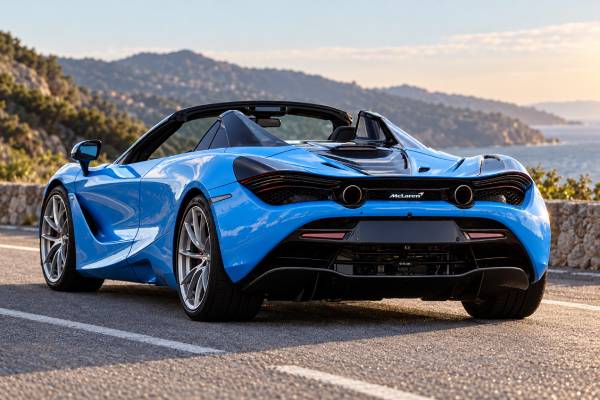
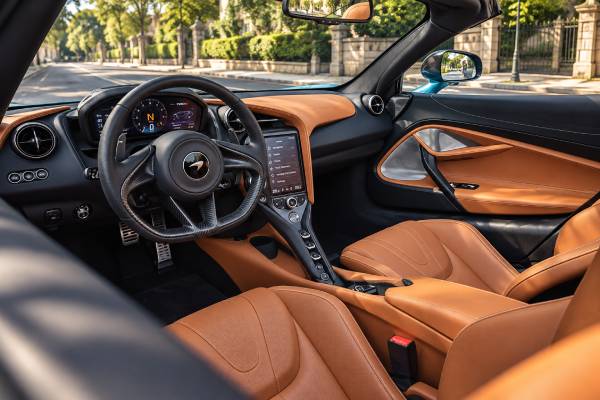
The McLaren 720S Spider turns the 720S into an open-top supercar without adding the heavy reinforcement normally associated with removing a fixed roof. Its Monocage II-S carbon-fiber structure incorporates rollover protection and supports a one-piece retractable hard top that opens or closes in 11 seconds at speeds up to 50 km/h. The result is only 49 kg heavier in McLaren’s lightest dry specification than the Coupé, yet it keeps the same 720 PS (710 bhp), 770 Nm, seven-speed SSG, and 341 km/h roof-up maximum speed. Roof down, McLaren quoted 325 km/h. That combination makes the Spider more than a 720S with a folding panel: its glazing, flying buttresses, rear luggage packaging, aero calibration, and roof mechanism create a distinct ownership experience. Used examples therefore need ordinary 720S scrutiny plus careful checks of roof operation, seals, drains, electrochromic glazing where fitted, and the trim and mechanisms surrounding the retractable top.
Table of Contents
- How McLaren Made the 720S Open Without Losing Its Core
- 720S Spider Technical Data and Specifications
- Open-Air Aerodynamics, Visibility, and Packaging
- Driving the Spider Roof Up and Roof Down
- Roof Care, Storage, and Weather Protection
- A Spider-Specific Pre-Purchase Inspection
- When the Spider Makes Sense as a 720S
How McLaren Made the 720S Open Without Losing Its Core
The defining technical achievement of the 720S Spider is structural: McLaren designed the carbon Monocage II-S around open-roof use, so the car does not require conventional add-on strengthening to compensate for a missing steel roof. That keeps the weight increase small and preserves the suspension’s ability to work from a stiff foundation.
The Spider’s retractable hard top is a single carbon-fiber panel driven electrically rather than hydraulically. It takes 11 seconds to complete an opening or closing cycle and can operate while the car is moving at up to 50 km/h. Those figures matter in ordinary use because the roof can be changed quickly when weather or traffic conditions change, rather than requiring a long stationary stop.
An electrochromic glazed roof was also available. Instead of relying on a manual shade, the glass can change between more transparent and more tinted states. That option creates a brighter cabin with the roof closed while giving the occupants control over glare and heat. On a used car, it is also an additional system to test: the panel should change state as intended, and the buyer should inspect the glass for damage, edge problems, or irregular appearance.
The rear structure differs from the Coupé because it must package the roof and maintain rollover protection. Carbon structural supports are integrated into the Monocage II-S, while glazed flying buttresses preserve sightlines around the rear quarters. Contemporary McLaren material emphasized visibility as a core part of the design, not merely a styling flourish.
The engineering compromise is unusually modest by convertible standards. McLaren lists the Spider at 1,332 kg lightest dry, versus 1,283 kg for the Coupé, a 49 kg difference. DIN weight rises from 1,419 to 1,468 kg by the same amount. The Spider still uses the M840T 4.0-liter twin-turbo V8 and the same chassis-control concept rather than a detuned or softened derivative.
That is why a Spider inspection should not stop at confirming that the roof moves. The roof, buttresses, rear trim, seals, body control, active aero, and carbon structure all interact. A car with evidence of roof misalignment, collision repair near the upper structure, water entry, or repeated warning messages needs specialist investigation before purchase.
720S Spider Technical Data and Specifications
The 720S Spider retains the Coupé’s essential powertrain and braking hardware while adopting the Monocage II-S and convertible-specific packaging. The following figures are published by McLaren unless otherwise identified.
| Engine | M840T 90-degree twin-turbocharged V8 |
|---|---|
| Displacement | 3,994 cc (4.0 L) |
| Maximum power | 720 PS (710 bhp) |
| Maximum torque | 770 Nm |
| Induction and lubrication | Electrically actuated twin-scroll turbochargers; dry sump |
| Transmission | 7-speed Seamless Shift Gearbox plus reverse |
| Driven wheels | Rear |
| 0–100 km/h | 2.9 seconds |
|---|---|
| 0–200 km/h | 7.9 seconds |
| Standing quarter mile | 10.4 seconds |
| Top speed, roof raised | 341 km/h (212 mph) |
| Top speed, roof lowered | 325 km/h (202 mph) |
| 100–0 km/h braking | 30 m |
| 200–0 km/h braking | 118 m |
| Body structure | Carbon-fiber Monocage II-S |
|---|---|
| Roof type | Electrically operated one-piece retractable hard top |
| Roof operating time | 11 seconds |
| Maximum speed during roof operation | 50 km/h (31 mph) |
| Suspension | Double wishbones, adaptive dampers, Proactive Chassis Control II |
| Brakes | Carbon-ceramic; 6-piston front and 4-piston rear calipers |
| Lightest dry weight | 1,332 kg |
|---|---|
| DIN kerb weight | 1,468 kg |
| Fuel tank capacity | 72 L |
| Front luggage capacity | 150 L |
| Rear luggage capacity | 58 L |
| WLTP combined fuel consumption | 12.2 L/100 km |
| WLTP combined CO2 | 276 g/km |
| Front tire size | 245/35ZR19 XL 93(Y) |
|---|---|
| Rear tire size | 305/30ZR20 XL 103(Y) |
| Michelin reference pressure | 2.2 bar (32 psi) front and rear |
The 58-liter rear luggage figure is a major packaging difference from the Coupé’s larger rear capacity. It reflects the space required for the roof system. Buyers planning road trips should therefore judge the Spider by its actual storage layout rather than assuming the open and closed cars carry luggage identically.
Open-Air Aerodynamics, Visibility, and Packaging
Opening the 720S changes the airflow around the cabin, so McLaren altered the rear body and active-aero strategy rather than merely cutting away the Coupé roof. The raised flying buttresses and active rear spoiler are part of a system designed to keep the car stable while limiting turbulence for the occupants.
The glazed buttresses are particularly important. Traditional solid convertible buttresses can create large blind areas behind the driver’s shoulders. McLaren used glazing to preserve rear-quarter visibility, and period material cited a visibility improvement over the previous Super Series Spider. The effect is useful in lane changes and at angled junctions, where seeing through the car’s structure makes a very wide supercar easier to place.
The active rear spoiler is calibrated for both roof states. That matters because the pressure distribution changes when air can enter the cabin. The rear wing remains a functional aerodynamic device rather than a fixed styling element, and its movement should be checked during inspection or service.
With the roof down, the hard top stores behind the occupants. The car still retains the 150-liter front compartment, but rear luggage capacity is only 58 liters. Soft bags make better use of irregular spaces and are less likely to damage trim. Anything carried near the rear deck should be stowed according to the owner’s guidance so it cannot interfere with roof movement.
Wind management is good enough for conversation at moderate road speeds, but open-air comfort always depends on speed, temperature, crosswinds, and occupant preference. The best way to evaluate a used Spider is to drive it in both configurations. Roof-down rattles, buffeting, trim noises, or a seal sound that vanishes with the top closed can help isolate a problem.
Water management deserves equal attention. A retractable roof relies on seals, mating surfaces, channels, and drains that must remain clean and correctly aligned. Dirt or careless detailing can obstruct drainage. A car that lives outside or is frequently washed should be inspected for damp carpet, musty odors, staining around seals, or water traces in storage areas.
The electrochromic glass option changes the roof-up experience again. In its clearer state it brings more light into the cabin; in its darker state it reduces brightness without requiring the panel to be opened. Buyers should not assume every Spider has this feature. Confirm it from the car itself and, where available, the factory specification record.
Driving the Spider Roof Up and Roof Down
The Spider’s dynamic character remains recognizably 720S in either configuration because the modest mass increase does not change the engine, transmission, carbon-ceramic braking system, or Proactive Chassis Control II concept. What changes most is the sensory experience.
With the roof closed, the carbon hard top makes the car feel closer to a fixed-roof supercar than a fabric-roof convertible. The cabin is quieter, weather protection is substantial, and the 341 km/h published top speed matches the Coupé. The 0–100 km/h time is also 2.9 seconds, while 0–200 km/h takes 7.9 seconds, only one tenth slower than McLaren’s published Coupé figure.
Open the roof and exhaust, turbo, road, and surrounding sounds become more prominent. That does not mean the car needs to be driven harder. Because the M840T supplies 770 Nm, small throttle openings already create significant pace. The extra sensation of speed with no roof can make restrained driving more engaging than chasing the upper end of the performance envelope.
McLaren quoted 325 km/h as the roof-down maximum. That number is useful as an engineering reference, not a road-driving target. Public-road use should stay well inside local speed limits and the available sight distance. Roof-down airflow can also move hats, papers, or loose objects, so the cabin should be secured before driving.
The Proactive Chassis Control II suspension remains central to how the Spider deals with imperfect roads. A healthy example should not need to feel brittle simply because it is a 710 bhp supercar. Tire condition, alignment, pressure, and wheel damage can make a large difference, however, and they are easy to overlook on a low-mileage car that still has deep tread.
The retractable roof’s 50 km/h operating allowance is convenient, but it should not encourage repeated operation over rough surfaces or while maneuvering in a tight space. Follow the owner’s procedure, ensure overhead clearance, and let each cycle finish. If the mechanism pauses, warns, or sounds abnormal, stop experimenting and have the fault diagnosed instead of forcing the system.
A useful test route includes urban traffic, uneven pavement, a faster open-road segment, and enough time to bring fluids and tires toward normal operating conditions. Drive first with the roof up, then down if weather permits. Test visibility, air conditioning, window operation, rear-deck behavior, and any electrochromic roof function rather than focusing only on acceleration.
Roof Care, Storage, and Weather Protection
The Spider adds a maintenance category the Coupé does not have: the retractable roof and everything that keeps it aligned, sealed, drained, and electrically healthy. Preventive care is largely about cleanliness, correct storage, and responding early to abnormal behavior.
Keep seals clean using products and procedures appropriate for the materials specified by McLaren. Avoid petroleum products or generic “rubber rejuvenators” unless they are approved for the application. A seal that looks dry does not automatically need a chemical treatment, and the wrong product can attract dirt or attack adjacent finishes.
Drain paths should remain clear. Leaves, grit, detailing residue, and fragments of old protective film can migrate into channels around complex bodywork. Water should leave the car through the intended routes rather than appearing inside trim or luggage spaces. If the cabin smells damp after rain or washing, find the source promptly instead of masking the odor.
Roof alignment is not a do-it-yourself adjustment. Uneven gaps, contact marks, a sudden increase in wind noise, or a latch warning can indicate an issue that needs model-specific diagnosis. The same applies to an electrochromic panel that stays in one state or changes unevenly. Because the roof is a prominent and costly assembly, a documented professional repair is preferable to repeated trial-and-error adjustment.
Electrical health is especially relevant during storage. The roof relies on control modules, motors, sensors, and adequate battery voltage. A weak battery can complicate operation and produce warnings elsewhere in the car. Use the approved battery-maintenance method during extended storage and investigate recurring low-voltage events rather than repeatedly clearing messages.
When storing the Spider, put the roof in the configuration recommended by McLaren and keep the car dry, clean, and ventilated. Do not place objects on the roof panel, rear deck, or mechanism covers. A fitted breathable cover can protect paint indoors, but it should not trap moisture against a wet car.
Tires continue aging while parked. Check the 245/35ZR19 fronts and 305/30ZR20 rears for date, cracking, flat spotting, and inner-edge wear, not just tread depth. If the vehicle has stood for months, inspect beneath it for fluid traces and verify pressures before the first drive. The first journey after storage should be a careful systems check, not an immediate high-load run.
Service records should identify roof-related work separately from routine engine maintenance. Invoices for seals, roof calibration, glass replacement, battery work, or water-leak diagnosis can explain why a car behaves correctly today. Missing records do not prove a defect, but detailed documentation lowers uncertainty on a mechanism unique to the Spider.
Seasonal use also changes what “good condition” looks like. A Spider that spends winter indoors may accumulate very little mileage, so service dates, battery support, tire age, and seal condition can reveal more than the odometer. Cars used year-round should be checked for road-salt residue and debris around lower bodywork and drainage paths. In either case, a clean history should explain how the car was stored and maintained between drives, not simply show that annual mileage was low. That distinction is especially useful when comparing two visually similar examples.
A Spider-Specific Pre-Purchase Inspection
A good 720S Spider inspection combines the usual carbon-supercar checks with a complete test of the retractable roof in both directions. The buyer should see the roof operate from fully closed to fully stowed and back again, preferably more than once under appropriate conditions.
Start with the upper body. Look at panel gaps around the roof, rear deck, buttresses, doors, and windows. Inspect seals for tears, pinching, unusual compression marks, or adhesive repairs. Examine glazed buttresses and any electrochromic roof panel for chips, delamination-like appearance, scratches, or unexplained replacement markings.
Then check the cabin and luggage spaces for evidence of water. Lift accessible mats according to the correct procedure and look for staining, corrosion on exposed hardware, dampness, or odor. Ask whether the car has ever had leak diagnosis and request the invoice if it has. A professionally corrected leak with clear documentation can be preferable to an apparently untouched car that still gets wet.
Operate windows and doors with the roof in both positions, watching for proper glass indexing and clean sealing. Test the infotainment, cameras, climate control, seats, lift system if fitted, driving modes, parking sensors, lights, and active aero. The purpose is to reveal interactions: roof or door warnings can involve sensors and control logic rather than a visibly broken panel.
Inspect beneath the car for splitter, floor, diffuser, and wheel damage. Carbon construction makes structural assessment specialist work, particularly after an accident. A conventional paint-meter walkaround cannot tell the whole story. Any collision history near the rear deck or upper structure deserves extra attention because it may involve roof alignment and body geometry.
Mechanical checks remain essential. Review service dates, tire age, brake condition, fluid history, battery health, and cooling-system evidence. A car that has covered few miles can still need time-based maintenance. If it has been used on track, ask about preparation and post-event service rather than assuming circuit mileage is either harmless or disqualifying.
For U.S.-market cars, check the VIN for applicable recalls, including NHTSA campaign 20V-231 concerning possible fuel-tank corrosion associated with moisture retained by NVH foam on certain vehicles. Market and VIN determine applicability, so verify status through the relevant authority or McLaren network.
Finally, perform a cold-to-warm road test. Listen for roof, buttress, and trim noise over uneven surfaces with the top closed, then repeat part of the route open if conditions allow. Check straight braking, steering, transmission behavior, temperatures, and warning messages. A Spider that feels cohesive in both configurations gives far more confidence than one evaluated only during a five-minute showroom demonstration.
When the Spider Makes Sense as a 720S
The Spider makes sense for an owner who will actually use the open roof and accepts the reduced rear luggage space and additional roof hardware that come with it. Its published performance remains so close to the Coupé that the decision is primarily about experience and ownership priorities, not headline speed.
For touring, the ability to close a hard roof quickly is valuable. The front storage remains generous for a supercar, but the 58-liter rear compartment requires more disciplined packing than the Coupé’s 210-liter rear capacity. If two people travel frequently, test your real luggage rather than relying on liters alone.
For warm-weather driving, the roof gives access to the sounds and surroundings that a closed car filters out. The electrochromic panel, when fitted, broadens the roof-up experience by admitting more or less light. In very hot climates, inspect air-conditioning performance and roof tint operation before purchase rather than assuming they are cosmetic conveniences.
For collectors, low mileage may matter, but complete roof function matters more. A mechanism that has almost never been cycled can still have aged seals, a weak battery history, or unresolved calibration issues. Preserve originality while exercising the systems enough to detect trouble and maintain the car on time.
For drivers who never open a convertible roof, the Coupé’s simpler upper body and larger rear luggage capacity may better match the use case. That is not a performance verdict; both share the 720 PS engine, rear-drive layout, sophisticated suspension, and carbon-fiber core. It is a question of which packaging you will benefit from.
Whichever configuration fits, condition should outrank the novelty of the roof. Verify the VIN, factory options, service history, accident history, recall status, tire age, and specialist inspection findings. Then test the unique Spider equipment as carefully as the engine. The 720S Spider’s appeal comes from making open-air driving feel unusually uncompromised, and a well-kept example should demonstrate that quality before money changes hands.
References
- McLaren 720s Spider – Fast & Comfortable Convertible Supercar | McLaren Automotive 2026 (McLaren Automotive; official Spider engineering and specification data).
- McLaren Owners 2026 (McLaren Automotive; official owner-handbook access and support information).
- McLaren 720S Spider 2019 revealed – Car News | CarsGuide 2018 (CarsGuide; launch data including roof-down top speed, mass difference, and roof operation).
- McLaren 720S Spider Unveiled To Fight Ferrari 488 Spider 2018 (Motor1; period McLaren launch information on Monocage II-S, RHT, visibility, and performance).
- Michelin Car Tires for McLaren 720S | Michelin Canada 2026 (Michelin; 720S-family tire sizes and pressure reference).
- Part 573 Safety Recall Report 20V-231 2020 (National Highway Traffic Safety Administration; recall description and affected-vehicle criteria).
Disclaimer
This article is for general informational purposes and is not professional repair, diagnostic, legal, insurance, or purchasing advice. Specifications, torque values, service intervals, fluids, roof procedures, software, recall applicability, and equipment can vary by VIN, model year, market, and options. Verify all work and operating limits against the correct McLaren service information, owner’s handbook, vehicle labels, and applicable authority for the specific car.
If this guide clarified what makes the 720S Spider different, share it with another owner or shopper comparing open-top McLarens.