


The 2022 McLaren 720S Spider Canada 10th Anniversary MSO 1/10 combines two stories that make sense together: the open-roof engineering of the 720S Spider and a Canadian MSO commission built around McLaren’s first decade of modern sales in the country. Seven Spiders were produced within the 10-car anniversary run, alongside three Coupés. All ten used MSO Bespoke Pure Black, McLaren Orange accents, maple-leaf graphics, Stealth-finish wheels, and a dedicated anniversary plaque, while the Spiders added a glazed electrochromic retractable hard top. Beneath the country-specific finish is the standard 720S Spider powertrain—720 PS (710 bhp), 770 Nm, a seven-speed SSG, and rear-wheel drive—supported by the Monocage II-S carbon structure and Proactive Chassis Control II. For an owner or buyer, the model’s rarity is only half the job. The roof system, bespoke paintwork, Canadian provenance, tires, service history, carbon structure, and active aero all need to remain coherent and documented.
Table of Contents
- The Seven-Spider Side of Canada’s 10-Car Anniversary Run
- Electrochromic Roof Meets Pure Black and McLaren Orange
- Technical Data for the 2022 Anniversary Spider
- What the Spider Hardware Changes on the Road
- Cold Seasons, Storage, Seals, and Bespoke Finish Care
- Provenance and Inspection for a Seven-of-Ten Car
- Using and Preserving a Canadian MSO Spider
The Seven-Spider Side of Canada’s 10-Car Anniversary Run
Seven of the ten Canada 10th Anniversary MSO 1/10 cars were 720S Spiders, making the open-top body style the majority of the programme. The remaining three were Coupés, so a Spider should be described accurately as one of seven Spiders within a ten-car Canadian commission.
The series marked ten years since McLaren Automotive began modern retail operations in Canada. The first Canadian showroom opened in Toronto in 2012, and period delivery coverage identifies the first car sold in the country as a black 2012 12C delivered by McLaren Toronto. Later retail expansion included Vancouver and Montreal.
MSO used that early road-car history as the foundation for the anniversary palette. Pure Black was chosen to echo the first Canadian 12C, while bright McLaren Orange introduced the motorsport side of the story. Contemporary launch material linked the orange treatment to McLaren’s Canadian Can-Am wins beginning in 1967 and its Canadian Formula 1 successes.
The cars were not just a dealer-applied graphics exercise. McLaren Special Operations supplied bespoke paint and trim, a dedicated “Canada 10th Anniversary by MSO – 1 of 10” plaque, custom exterior details, and a richly equipped cabin. Current McLaren Montreal descriptions state that the vehicles carried more than $70,000 in bespoke MSO content.
For the Spider, the electrochromic glazed retractable roof is a particularly important part of the specification. It complements the black-and-orange theme when closed and changes the cabin atmosphere without requiring the roof to be lowered. Because it is both edition-relevant and mechanically complex, it belongs on the authenticity checklist and the condition checklist at the same time.
The Canadian commission also arrived near the end of the 720S model’s life, which gives the 2022 cars a late-production context without making them mechanically separate from other 720S Spiders. They continue to use the M840T 4.0-liter twin-turbo V8 and 720S Spider chassis technology.
A heritage hardcover book celebrating McLaren’s Canadian history was reported as part of the customer handover. For a later owner, that book, the original manuals, keys, charger, cover, specification records, and sale documents help preserve the connection between an individual car and the national programme.
Electrochromic Roof Meets Pure Black and McLaren Orange
The anniversary Spider’s visual identity works because the roof, body, moving aero, wheels, and cabin were specified as a single MSO theme. Authenticity is strongest when all of those elements agree with the paperwork rather than when a car merely has black paint and orange accents.
The exterior base is MSO Bespoke Pure Black. The wheels use a dark Stealth finish, and the specification incorporates the MSO Black Package and Stealth Package. Orange is then placed on functional or visually active areas: the front and side intakes, rear diffuser, brake calipers, and underside of the rear wing.
A custom stripe contains a maple-leaf graphic. The underside of the active rear wing receives its own orange treatment with a contrasting black stripe and maple-leaf motif. That means the car’s Canadian symbolism changes visibility with the aero device itself. A buyer should inspect the wing both stowed and deployed, checking the mechanical movement as well as the condition of its unique finish.
The roof adds another layer. Standard 720S Spider engineering uses a one-piece electrically operated retractable hard top, and the anniversary Spiders were specified with the glazed electrochromic version. The glass can switch between clearer and darker states, allowing light into the cabin when the roof is raised while offering a tint function when desired.
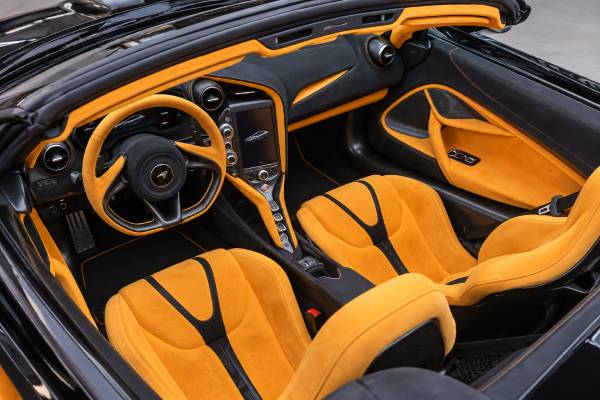
Inside, McLaren Orange Alcantara is paired with bespoke contrast stitching and MSO headrest logos. McLaren Montreal’s documented anniversary Spider lists heated power-adjustable memory seats, an electric steering column, primary and secondary carbon-fiber interior components, Bowers & Wilkins 12-speaker audio, and the anniversary dedication plate.
These details should be photographed before cosmetic work. Protective film, paint correction, roof-glass treatment, wheel refinishing, and interior repairs can all alter or conceal evidence of original finish. A careful custodian keeps before-and-after images and invoices, especially when work involves a maple-leaf graphic, orange paint boundary, plaque, or MSO-embroidered part.
The roof should never be treated as just another color option. Its glass, seals, motors, sensors, latches, drains, and control logic make it one of the most complicated assemblies on the vehicle. The anniversary specification makes correct function more valuable, not less necessary.
Technical Data for the 2022 Anniversary Spider
The Canada 10th Anniversary Spider did not receive a separate higher-output engine calibration. Its performance hardware follows the 720S Spider specification, supplemented by the anniversary programme’s MSO content and Performance Plus equipment.
| Model year | 2022 |
|---|---|
| Total anniversary production | 10 cars |
| Spider allocation | 7 cars |
| Coupé allocation | 3 cars |
| Exterior | MSO Bespoke Pure Black with McLaren Orange accents |
| Roof | Glazed electrochromic retractable hard top |
| Engine | M840T 90-degree twin-turbocharged V8 |
|---|---|
| Displacement | 3,994 cc (4.0 L) |
| Maximum power | 720 PS (710 bhp) |
| Maximum torque | 770 Nm |
| Lubrication | Dry sump |
| Transmission | 7-speed Seamless Shift Gearbox plus reverse |
| Drive | Rear-wheel drive |
| 0–100 km/h | 2.9 seconds |
|---|---|
| 0–200 km/h | 7.9 seconds |
| Standing quarter mile | 10.4 seconds |
| Top speed, roof raised | 341 km/h (212 mph) |
| Top speed, roof lowered | 325 km/h (202 mph) |
| 100–0 km/h braking | 30 m |
| Body structure | Carbon-fiber Monocage II-S |
|---|---|
| Roof cycle | 11 seconds |
| Roof-operation speed | Up to 50 km/h (31 mph) |
| Lightest dry weight | 1,332 kg |
| Fuel tank capacity | 72 L |
| Luggage capacity | 150 L front; 58 L rear |
| Wheels | 10-spoke super-lightweight forged; Stealth finish |
|---|---|
| Packages | MSO Black Package, Stealth Package, Performance Plus Package |
| Interior | McLaren Orange Alcantara with MSO contrast stitching |
| Seats | Electric, heated, memory |
| Audio | Bowers & Wilkins 12-speaker system |
| Chassis feature | Vehicle lift listed on documented example |
The car’s anniversary content changes its rarity and appearance, not the laws of maintenance or tire behavior. Any replacement tire, fluid, component, or procedure should be chosen from the documentation for the specific VIN rather than from a generic special-edition description.
What the Spider Hardware Changes on the Road
The 720S Spider preserves nearly all of the Coupé’s headline performance while adding an electrically retractable roof, and that small performance penalty is central to why the body style works. McLaren quotes the same 2.9-second 0–100 km/h time, with 0–200 km/h in 7.9 seconds.
The Monocage II-S carbon structure is designed around the open-top configuration and incorporates rollover protection. It does not require the kind of heavy supplemental strengthening commonly associated with converting a fixed-roof platform. McLaren’s lightest dry figure is 1,332 kg, only 49 kg above the corresponding Coupé figure.
Roof-up maximum speed is 341 km/h. With the roof lowered, McLaren quoted 325 km/h. Those figures are engineering markers rather than road-use goals; in Canada, public-road driving must reflect legal limits, traffic, surface temperature, and sight distance. The anniversary car’s significance is not an invitation to treat a public highway like a high-speed test facility.
What the roof changes most is sensation. Open-air driving brings more exhaust note, turbo sound, wind, and environmental noise into the cabin. The orange accents and glazed buttresses also become more noticeable from the driver’s seat when the roof is stowed. At ordinary speeds, those differences can make the car feel more eventful without using a large fraction of its power.
The 11-second roof cycle and 50 km/h operating allowance make changing configuration convenient. Still, an owner should use the system on suitable surfaces and let the cycle complete without interruption. If movement hesitates, a latch warning appears, or the mechanism sounds different from normal, repeated cycling is not a diagnostic method. Record the symptom and have the system checked.
The active rear spoiler remains functional with the roof up or down. On this edition, its painted underside adds a preservation concern. The actuator and aerodynamic function need to work, while the orange and maple-leaf treatment must also survive road debris, washing, and any future repair. Mechanical and cosmetic inspection therefore overlap.
Performance Plus equipment and Pirelli Corsa tires were part of the Canadian anniversary specification described at delivery. Such tires reward appropriate temperatures and dry conditions but should not be treated as all-season equipment. In cold weather, grip can fall well before snow appears. Owners who drive into shoulder seasons should choose a tire strategy based on manufacturer approvals, ambient conditions, and intended use.
The best road test uses both roof positions. With the roof raised, listen for wind leaks or trim movement and test the electrochromic glass. With it lowered, listen for unusual rear-deck noises and evaluate buffeting. In both modes, assess steering, braking, transmission response, ride quality, warning status, climate control, and lift operation where fitted.
Cold Seasons, Storage, Seals, and Bespoke Finish Care
A Canadian anniversary Spider needs a storage plan that protects both a complex convertible system and a heavily customized MSO finish. Long periods off the road make battery support, moisture control, roof cleanliness, tire condition, and documentation especially important.
Begin with the storage environment. The car should be put away clean and dry in a ventilated space, not sealed beneath a cover while moisture is trapped in body seams, brakes, or roof channels. Road salt and spring grit should be removed appropriately from the lower body before storage because the splitter, diffuser, fasteners, and wheel areas sit close to the road.
Battery maintenance is critical because roof operation depends on healthy electrical supply as well as motors and sensors. Use McLaren’s approved charging procedure and equipment suitable for the vehicle. A battery that has been allowed to discharge repeatedly can generate warning messages and create confusing symptoms across multiple systems when the car wakes up.
The roof deserves its own seasonal inspection. Clean mating surfaces and seals using methods appropriate to the materials. Check channels and drains for leaves, grit, film fragments, or detailing residue. Do not apply generic seal dressings simply because a rubber surface looks dry; products that are incompatible with surrounding finishes can make matters worse.
The electrochromic glass should be tested before and after a long layup. It should change state as designed, without obvious damage or irregular behavior. Chips or edge damage in a specialized roof panel should be assessed promptly because replacement is not equivalent to swapping ordinary side glass.
Tires can age while the odometer barely changes. Inspect date codes, sidewalls, inner shoulders, tread, and flat spotting before spring use. Correct pressures should be verified cold using the vehicle information and current manufacturer guidance. If the car has remained in one position for months, the first drive should be gentle enough to reveal vibration or flat spotting before speed builds.
Paint and graphics need a different kind of care. Pure Black highlights swirls and chips, while the orange intakes, diffuser details, wing underside, and maple-leaf stripe are difficult to recreate perfectly. Paint-protection film can be sensible, but installation and removal should be entrusted to specialists familiar with carbon-composite exotics and factory graphics.
When film is renewed, photograph the car before removal, during exposed inspection, and after installation. Keep product and installer records. If a graphic or painted MSO component is already damaged, obtain advice before sanding, repainting, or replacing it. The most visually perfect repair is not automatically the best historical repair if it erases original material without documentation.
Avoid short storage “exercise” starts that never bring the car through a proper operating cycle. Follow the owner’s guidance for storage and return-to-service. Before the first seasonal drive, inspect beneath the vehicle for leaks, check fluids as directed, confirm tire condition and pressure, verify the roof and electronics, and allow the drivetrain to warm normally under light load.
Provenance and Inspection for a Seven-of-Ten Car
A genuine anniversary Spider should be verifiable through records, specification, and physical condition. Because only seven Spiders were part of the ten-car run, vague statements such as “rare Canadian edition” are not enough for a serious purchase.
Start with the VIN and the earliest available documents. The original Canadian sales record, build/specification information, invoices, registration history, and McLaren service entries should identify one continuous car. Compare odometer readings by date and ask for explanations where history disappears for long periods.
Then establish that it is a Spider from the anniversary programme, not a normal Pure Black Spider with later orange trim. Confirm the special plaque, MSO Bespoke Pure Black paint, Stealth wheels, black packages, orange intake and diffuser treatment, orange brake calipers, custom stripe and maple leaf, and the decorated active wing. The glazed electrochromic retractable roof is another important Spider-specific element.
Move inside and compare the cabin with available build information. Orange Alcantara, bespoke stitching, MSO headrest embroidery, carbon-fiber components, heated memory seating, electric steering column, Bowers & Wilkins audio, and the dedication plaque are all documented on the Canadian anniversary specification. A current McLaren Montreal example also lists a front-trunk commemorative options plate.
The roof inspection should be deliberate. Cycle it fully open and fully closed under appropriate conditions, then test the electrochromic function. Inspect seals, roof glass, buttress glazing, panel gaps, latch areas, rear-deck surfaces, and the cabin for signs of water entry. Damp carpet, staining, unusual odor, or recurring roof messages deserve diagnosis.
Carbon structure and accident history require specialist eyes. Check the low front splitter, underbody, wheels, rear diffuser, door edges, and upper body for evidence of impact or disassembly. Paint measurements can contribute information on painted surfaces, but they do not substitute for understanding carbon and composite repairs.
A mechanical pre-purchase inspection remains mandatory even when provenance is excellent. Review battery health, brakes, tire age, cooling condition, fluid service, electronic faults, active aero, suspension behavior, doors, windows, lift, cameras, climate control, and transmission operation. A rare badge does not reduce the cost of a neglected 720S.
If the car has moved outside Canada, add import and registration records to the file. Different jurisdictions can have their own requirements for emissions, lighting, taxation, title, and insurance. The previous owner’s successful registration does not guarantee that every later transfer is automatic, so buyers should confirm the current rules independently.
Finally, inventory the handover items. Both keys, manuals, charger, cover, heritage book, original accessories, removed parts, and records of protective-film or paint work can help complete the provenance. Write important items into the purchase agreement so there is no ambiguity after collection.
Using and Preserving a Canadian MSO Spider
The anniversary Spider is most convincingly preserved when it remains mechanically exercised, cosmetically documented, and historically complete. Extremely low mileage can be appealing, but inactivity should never be confused with maintenance.
For an owner who wants to drive the car regularly, plan around conditions. Warm, dry days allow the roof, tires, brakes, and chassis to work as intended. Canadian shoulder seasons can produce cold pavement even under clear skies, so tire temperature and compound suitability matter. Avoid treating a Corsa-equipped supercar as if it has year-round traction merely because the road is free of snow.
For touring, the Spider’s 150-liter front luggage area does most of the work because rear capacity is only 58 liters. Pack soft bags and confirm that nothing can interfere with the roof mechanism or rear trim. The hard top’s quick cycle makes weather changes easy to manage, while the electrochromic panel adds a useful intermediate state when occupants want light without full open-air exposure.
For shows or collection use, preserve the story beyond visible paint. Display material should describe the car accurately as one of seven anniversary Spiders within a ten-car programme, not as “one of ten Spiders.” Keep a copy of the original Canadian commission material with the heritage book and build records so later owners do not have to reconstruct the distinction.
For servicing, choose a McLaren retailer or specialist with experience in the 720S Spider and access to correct procedures. Roof alignment, carbon repair, active-aero work, hydraulic chassis diagnosis, and software issues are not ideal areas for experimentation. Ask the shop to note edition-specific surfaces before placing protective covers, lifting the car, or dismantling panels.
Insurance should reflect the bespoke specification. A generic 720S Spider valuation may not describe the MSO content or the difficulty of reproducing special graphics and trim after a loss. Supply the insurer with photographs, specification records, and any agreed appraisal needed for the policy being considered.
If an original special part is replaced, retain the old component when legally and practically possible, or at least photograph it carefully. Keep the invoice and record why replacement was necessary. This is especially useful for roof glass, painted aero pieces, wheels, interior trim, or plaques whose finish contributes to the edition’s identity.
A buyer should resist two shortcuts: assuming rarity guarantees condition, and assuming a low odometer guarantees preservation. The strongest example is the car whose Canadian provenance, seven-Spider allocation, MSO finish, roof system, service file, and present mechanical state all support one another. That is what allows the 720S Spider’s open-air engineering and the anniversary story to survive as more than a set of decals and a plaque.
References
- McLaren 720S Gets 10-Unit Special Edition Only for Canada 2022 (The Car Guide; original programme announcement, production split, colors, and Canadian theme).
- First of 10 McLaren 720S Canada 10th Anniversary MSO 1/10 Models is Delivered 2022 (The Car Guide; delivery-era specification, historical references, and included heritage book).
- 2022 McLaren 720S Spider Performance — McLaren Montreal 2026 (McLaren Montreal; current anniversary Spider listing and detailed MSO equipment).
- McLaren 720s Spider – Fast & Comfortable Convertible Supercar | McLaren Automotive 2026 (McLaren Automotive; official Spider powertrain, Monocage II-S, performance, weight, and capacity data).
- McLaren Owners 2026 (McLaren Automotive; official owner-handbook access and support information).
- McLaren 720S Spider Unveiled To Fight Ferrari 488 Spider 2018 (Motor1; period McLaren launch information on roof operation, electrochromic glazing, weight, and roof-down speed).
Disclaimer
This article is for general informational purposes and is not professional repair, diagnostic, legal, insurance, valuation, or purchasing advice. Specifications, torque values, service intervals, fluids, roof procedures, software, recall applicability, and equipment can vary by VIN, market, and individual MSO build. Verify all work, operating limits, provenance, and compliance against the correct McLaren service information, owner’s handbook, build documents, vehicle labels, and applicable authorities.
If this guide helped you understand the seven anniversary Spiders, share it with another owner or buyer researching Canada’s MSO 1/10 series.