

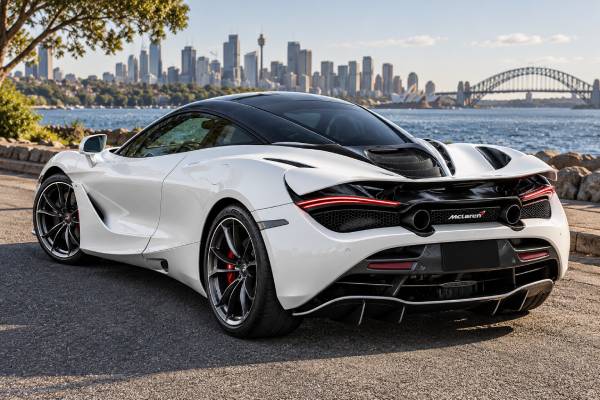

The McLaren 720S turned the second-generation Super Series into a car that could deliver hypercar-level acceleration without giving up the visibility, luggage space, and road manners expected of a usable two-seat supercar. Introduced with McLaren’s carbon-fiber Monocage II, a 3,994 cc twin-turbocharged V8, a seven-speed Seamless Shift Gearbox, and Proactive Chassis Control II, the 720S combined 720 PS (710 bhp) with a lightest dry weight of 1,283 kg. Its numbers remain striking: 0–100 km/h in 2.9 seconds, 0–200 km/h in 7.8 seconds, and a 341 km/h top speed. Yet the engineering story is broader than straight-line speed. The hidden headlamp intakes, active rear wing, hydraulically linked suspension, airy glasshouse, and carbon tub all serve multiple purposes. For a used-car buyer, that sophistication makes condition, service evidence, tire age, hydraulic and electronic function, and recall completion more important than simply finding the lowest odometer reading.
Table of Contents
- Why the 720S Changed the Super Series
- 720S Specifications and Technical Data
- Carbon Structure, Aero, and Proactive Chassis Control II
- Performance Without Sacrificing Road Usability
- Service, Consumables, and Long-Term Care
- What to Inspect Before Buying a Used 720S
- Choosing the Right 720S for the Way You Will Use It
Why the 720S Changed the Super Series
The 720S was not a light facelift of the 650S; it was the first production model of McLaren’s second-generation Super Series. Its new carbon structure, engine, suspension control strategy, aerodynamics, and cabin architecture were developed as an integrated package.
The center of that package is the Monocage II carbon-fiber structure. Earlier McLaren road cars already relied on carbon tubs, but the 720S extended the carbon structure upward around the passenger cell. That helped McLaren combine stiffness and low mass with the unusually thin pillars and broad glass area that define the car from the driver’s seat. The dihedral doors open with part of the roof structure, improving the access aperture while making the door shape a visible expression of the carbon architecture.
The body solves airflow problems in ways that are easy to miss when the car is parked. Instead of placing obvious intake openings on the body sides, McLaren routes air toward the engine through channels around the rear of the doors. The headlamp cavities are also functional air intakes. Their dark eye-socket appearance became one of the car’s signatures, but the shape exists because cooling and aerodynamic requirements were packaged into the front design.
At the rear, an active wing can change position according to the car’s needs. It contributes to aerodynamic balance and can act as an airbrake under heavy deceleration. That multi-function approach is characteristic of the 720S: components are expected to help performance without creating needless mass or visual clutter.
The M840T engine is another major change. It is a 3,994 cc, 90-degree, twin-turbocharged V8 with dry-sump lubrication and electrically actuated twin-scroll turbochargers. Its 720 PS output supplies the model name, while 770 Nm of torque gives the car the midrange force needed for exceptionally rapid acceleration. Power reaches the rear wheels through McLaren’s seven-speed Seamless Shift Gearbox.
For owners and buyers, the importance of this engineering reset is practical. A 720S should be evaluated as a tightly integrated system rather than as an engine attached to an exotic-looking body. A fault in ride-height control, aerodynamics, cooling, door operation, sensors, tires, or battery condition can affect the experience even when the V8 itself appears healthy.
720S Specifications and Technical Data
The core 720S specification is consistent with its mission: high output, low mass, carbon structure, rear-wheel drive, and sophisticated adaptive suspension. The figures below use McLaren’s published 720S data and tire information from Michelin rather than estimates.
| Engine | M840T 90-degree twin-turbocharged V8 |
|---|---|
| Displacement | 3,994 cc (4.0 L) |
| Maximum power | 720 PS (710 bhp) |
| Maximum torque | 770 Nm |
| Lubrication | Dry sump |
| Transmission | 7-speed Seamless Shift Gearbox plus reverse |
| Drive | Rear-wheel drive |
| 0–100 km/h | 2.9 seconds |
|---|---|
| 0–200 km/h | 7.8 seconds |
| Standing quarter mile | 10.3 seconds |
| Maximum speed | 341 km/h (212 mph) |
| 100–0 km/h braking | 30 m |
| 200–0 km/h braking | 118 m |
| Body structure | Carbon-fiber Monocage II |
|---|---|
| Front suspension | Double wishbones with adaptive dampers |
| Rear suspension | Double wishbones with adaptive dampers |
| Chassis control | Proactive Chassis Control II |
| Differential strategy | Open differential with Brake Steer |
| Front brakes | Carbon-ceramic discs, 6-piston calipers |
| Rear brakes | Carbon-ceramic discs, 4-piston calipers |
| Lightest dry weight | 1,283 kg |
|---|---|
| DIN weight | 1,419 kg |
| Fuel capacity | 72 L |
| Front luggage capacity | 150 L |
| Rear luggage capacity | 210 L |
| WLTP combined fuel consumption | 12.2 L/100 km |
| WLTP combined CO2 | 276 g/km |
| Front tire size | 245/35ZR19 XL 93(Y) |
|---|---|
| Rear tire size | 305/30ZR20 XL 103(Y) |
| Michelin reference pressure | 2.2 bar (32 psi) front and rear |
Numbers do not describe optional equipment, market differences, or changes made to an individual car after delivery. Tire fitment in particular should be confirmed against the vehicle label and current McLaren guidance before replacement. A buyer should also distinguish McLaren’s lightest dry figure from weights measured with fluids, fuel, options, and occupants; mixing those standards creates misleading comparisons.
Carbon Structure, Aero, and Proactive Chassis Control II
The 720S chassis is unusual because it seeks both body control and compliance without relying on conventional anti-roll bars. Proactive Chassis Control II links hydraulic elements across the adaptive dampers and uses sensor data to manage wheel and body motion.
That architecture allows the suspension to resist roll when the car is cornering while letting individual wheels respond more freely to a rough road. The driver can select handling modes, but the underlying appeal is not a single aggressive setting. It is the breadth between a controlled, confidence-building road setup and the tighter responses needed for hard driving.
The carbon Monocage II supports that range because a stiff passenger cell gives the suspension a stable foundation. It also contributes to the car’s excellent sightlines. Thin pillars and the glazed upper door areas make the boundaries of the car easier to judge than its low, wide proportions might suggest. In daily use, that matters at junctions, on narrow roads, and when placing the front corners near curbs.
Aerodynamics are similarly integrated. The front intakes, door channels, underbody management, rear wing, and rear bodywork are designed to move cooling air and manage pressure while preserving the clean side profile. The active wing can rise and alter its angle; under braking it can deploy as an airbrake. A used-car inspection should therefore include its full movement rather than treating it as decorative bodywork.
The open differential with Brake Steer is another McLaren-specific choice. Rather than adding the mass of a conventional limited-slip differential, the system can brake an inside rear wheel to influence the car’s line and traction behavior. That places brake condition and correct system operation within the broader handling picture.
None of this means a 720S requires constant intervention from its owner. It does mean that diagnosis should be model-aware. A generic workshop may be comfortable with ordinary fluid and tire work yet lack the equipment, procedures, or experience to interpret chassis warnings, calibrate systems after repairs, or inspect carbon structures correctly. Specialist knowledge has real value before a problem becomes expensive.
Performance Without Sacrificing Road Usability
The 720S is brutally fast, but its usability is what separates the car from a machine that is impressive only during a short full-throttle run. Good outward visibility, two luggage compartments, compliant suspension settings, and progressive controls make ordinary miles realistic.
At maximum acceleration, 0–200 km/h arrives in 7.8 seconds, so the car can consume available road at a rate that demands restraint. The useful road skill is not learning how to access full output everywhere; it is learning to make small, deliberate inputs and to build speed only where visibility, surface, law, and traffic leave a wide margin.
The seven-speed SSG supports that approach. Automatic operation makes low-demand driving straightforward, while the steering-wheel paddles give direct gear selection when desired. Turbocharged torque means there is rarely a need to chase the rev limit just to move quickly. A healthy car should transition between light-load cruising and stronger acceleration without hesitation, warning messages, or driveline harshness that feels abnormal for the mode selected.
Ride quality should also be judged in context. The 720S can be remarkably composed on imperfect pavement, but low-profile tires still transmit sharp impacts and can be damaged by potholes. A car that wanders, vibrates, pulls under braking, or has uneven steering effort deserves inspection rather than being dismissed as “supercar behavior.”
Packaging is more practical than the silhouette suggests. The 150-liter front compartment can hold soft bags, while the 210-liter rear luggage shelf/compartment adds useful capacity behind the cabin. Heat around rear-stowed items should be considered, and luggage must be positioned so it does not interfere with visibility or trim.
Entry and exit become easy with familiarity, but the dihedral doors need overhead and side clearance. Garage dimensions matter. Owners should check where the door rises before committing to a lift, low ceiling, wall cabinet, or parking bay. The nose is low enough that the suspension lift, where fitted, is a meaningful tool rather than a novelty; ramps and sharp driveway transitions still deserve a slow approach.
A road test should include more than a dramatic acceleration burst. Drive through town, make tight turns, use reverse, cycle the lift if equipped, test the climate control, change chassis and powertrain modes, and listen over rough pavement. Then let the car become fully warm and check it again. The quiet parts of the test often expose the problems that a fast demonstration can hide.
Service, Consumables, and Long-Term Care
A 720S is best maintained by schedule, condition, and documented procedure rather than by mileage alone. Low annual use does not stop brake fluid, tires, batteries, seals, or lubricants from aging.
Start with the owner’s handbook for the exact model year and market, then use a McLaren retailer or experienced specialist for service information that depends on VIN, equipment, or updates. Avoid copying a fluid specification, torque value, or interval from a different year simply because the cars look mechanically similar.
Battery health deserves unusual attention on a modern low-use supercar. A weak battery can produce a cascade of warnings and erratic behavior that complicates diagnosis. When the car will sit, use the approved battery-maintenance procedure and keep the charger connection and cable routing clean and secure. If voltage has been low, do not assume every subsequent alert identifies a failed component; restore the electrical baseline and have persistent faults diagnosed properly.
Tires need both tread and age checks. The original-size Michelin reference is 245/35ZR19 front and 305/30ZR20 rear, but brand, specification marking, pressure, load rating, and current fitment guidance must match the car. Look for sidewall cracking, flat spots, puncture repairs, inner-edge wear, and mismatched axle pairs. On a 710 bhp rear-drive car, stale rubber can compromise acceleration, braking, steering, and electronic-control behavior at the same time.
Carbon-ceramic brakes are durable when used appropriately, but damage can be costly. Inspect discs for chips or impact damage, verify pad condition, and investigate vibration rather than assuming it is normal. Cars that have spent time on track deserve closer review of pads, fluid, tires, wheels, and heat-exposed components.
Cooling-system cleanliness is also important. The 720S moves significant air through openings that can collect leaves, grit, and road debris. A specialist can inspect vulnerable cooling surfaces without careless pressure washing or dismantling. Any history of overheating, fluid smell, recurring low-level warning, or stained undertray deserves an explanation.
Exterior care should respect exposed carbon and aerodynamic surfaces. The front splitter, lower corners, diffuser, and underbody can be damaged by steep entries or road debris even when the upper paintwork looks immaculate. Paint-protection film can reduce cosmetic wear, but old film should be inspected for lifting, staining, adhesive issues, and damage concealed beneath it.
Finally, maintain records as carefully as the hardware. Date-stamped invoices, recall evidence, tire receipts, alignment records, battery replacement, and documentation for any body repair make future diagnosis and resale easier. A thick file of specific, chronological evidence is more useful than a seller’s statement that the car was “always serviced.”
Storage environment matters too. A dry, ventilated space protects more than the paint: it reduces condensation around metal hardware, brakes, electrical connectors, and the fuel-system area. Do not park the car wet and immediately seal it under a non-breathable cover. If it will stand for an extended period, follow McLaren’s storage guidance rather than improvising with overinflated tires, disconnected electronics, or aftermarket charging equipment. Before the first drive after storage, inspect beneath the car, check tire condition and pressures, verify fluid levels as directed by the handbook, and make the initial journey long enough for the car to reach normal operating temperature. Repeated brief starts without a meaningful drive are not a substitute for correct storage or scheduled maintenance.
What to Inspect Before Buying a Used 720S
A pre-purchase inspection should test the whole 720S as a system, with special attention to carbon structure, hydraulics, electronics, cooling, brakes, tires, and evidence of accident or track damage. The inspection is most valuable when performed by someone who knows the model and can access appropriate diagnostic information.
Begin with identity and history. Confirm the VIN across the car and paperwork, then trace ownership and service chronologically. Odometer progression should make sense across invoices and inspection records. Missing periods do not automatically prove a problem, but unexplained gaps should change the amount of evidence you require elsewhere.
Inspect the carbon tub and attached structures carefully. Cosmetic paint readings alone cannot establish the condition of a carbon monocoque. Look for signs of impact underneath, poor panel fit, nonstandard fasteners, repaired wheels, disturbed undertrays, and overspray around edges. If there is accident history, obtain repair documentation and have the work evaluated by a qualified McLaren-aware facility.
Operate everything. Doors should open and latch correctly; windows should index as intended; screens, cameras, parking sensors, climate control, seat functions, lights, drive modes, active aero, and vehicle lift should all be tested where fitted. Intermittent behavior matters because electrical issues can disappear by the time the car reaches a workshop.
The recall history deserves a specific check. NHTSA recall 20V-231 covered certain 720S vehicles in the United States because NVH foam beneath the fuel tank could retain moisture and promote tank corrosion, creating a potential fuel leak and fire risk. Applicability depends on the individual vehicle, market, and VIN. Do not infer completion from model year alone; verify the VIN with the relevant authority or McLaren service network and retain proof of remedy.
On the road, start cold if possible. Listen for unusual noises before the seller has warmed the car, then verify smooth shifting, stable temperatures, straight braking, steering consistency, and suspension behavior across several surfaces. Recheck for messages or leaks after the drive. A scan of diagnostic systems can add context, but fault codes should be interpreted rather than counted mechanically; low voltage or a past repair can leave history that needs explanation.
Do not allow low mileage to substitute for condition. A lightly used car may have old tires, a repeatedly discharged battery, stale fluids, sticky seals, or deferred campaigns. Conversely, a higher-mileage example with continuous expert care may present a clearer mechanical story. The inspection exists to reveal which description fits the individual car.
Choosing the Right 720S for the Way You Will Use It
The right 720S is the example whose condition, history, equipment, and prior use fit your plans; color and option desirability should come after mechanical and structural confidence. The model’s basic performance is already so high that a clean standard car needs no special-edition badge to deliver the core experience.
For frequent road use, prioritize fresh tires, reliable climate control, functional lift equipment where needed, clean visibility, and a service relationship you can continue. A car with stone chips but excellent records may be easier to enjoy than an immaculate display car whose age-sensitive maintenance has been postponed.
For occasional track use, examine brake and tire consumables closely and ask whether the car has previous circuit history. Track driving is not automatically abusive when the car has been prepared and serviced properly, but heat cycles and high loads leave evidence. Alignment, wheel condition, brake-fluid management, and post-event inspection matter more than a vague promise that the vehicle was “never raced.”
For a collection, provenance and originality gain weight, yet preservation should not become neglect. Exercise the car according to sensible storage practice, keep the battery supported, maintain fluids by time as well as distance, and document any replacement of original cosmetic components. A static car can still deteriorate.
Options should be checked car by car rather than assumed from an online listing. Carbon-fiber packs, audio equipment, seat types, interior trims, exterior finishes, vehicle lift, and other choices affect usability and replacement cost. Verify factory configuration from supporting documentation whenever possible, especially if a seller describes expensive MSO content.
Running costs should be approached with a reserve rather than a fixed annual prediction. Tires, carbon-ceramic brake components, bodywork, electronics, hydraulic systems, and bespoke trim can produce large individual bills, while insurance and taxes vary sharply by location. Obtain quotes using the actual VIN and intended use before purchase.
Most important, buy enough evidence. The 720S is an advanced supercar whose strengths depend on many systems working together. A documented, correctly repaired, properly serviced example lets the carbon structure, clever suspension, strong brakes, visibility, and 720 PS engine work as McLaren intended. That is a better foundation for ownership than chasing a particular odometer number or assuming the newest-looking advertisement is automatically the safest choice.
A final ownership habit is to record baseline condition. Photograph the underside, wheels, brake discs, exposed carbon, front splitter, and cabin when the car enters your care, then update the record after major service or repair. This makes gradual wear easier to distinguish from sudden damage and gives a future specialist useful context.
References
- McLaren 720S Supercar – Interior, Specs, HP, 0-60, Engine 2026 (McLaren Automotive; official model specifications and engineering overview).
- McLaren Owners 2026 (McLaren Automotive; official owner-handbook access and vehicle support).
- Part 573 Safety Recall Report 20V-231 2020 (National Highway Traffic Safety Administration; fuel-tank corrosion recall scope and remedy description).
- Michelin Car Tires for McLaren 720S | Michelin Canada 2026 (Michelin; 720S tire sizes and pressure reference).
- 2020 McLaren 720S Technical Specs & Features 2020 (McLaren Chicago; technical specification cross-check).
Disclaimer
This article is for general informational purposes and is not professional repair, diagnostic, legal, insurance, or purchasing advice. Specifications, torque values, service intervals, fluids, procedures, software, recall applicability, and equipment can vary by VIN, model year, market, and option content. Verify all work against the correct McLaren service information, owner’s handbook, vehicle labels, and applicable authority before servicing or buying a specific car.
If this guide helped you understand the 720S, share it with another owner or buyer who wants a fact-based starting point.