


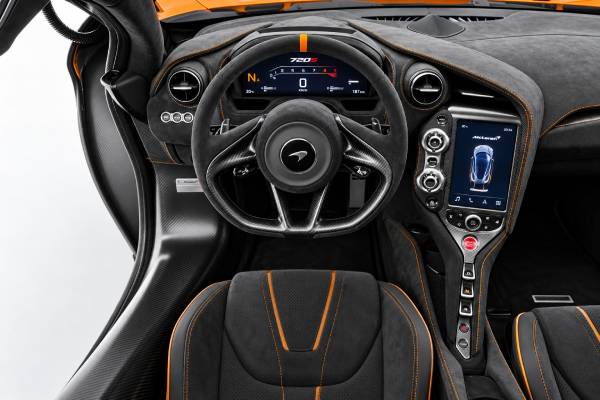
The 2019 McLaren 720S Spa 68 Collection is one of the smallest factory-linked 720S special editions: three Coupés commissioned through McLaren Brussels and finished by McLaren Special Operations to remember Bruce McLaren’s victory at the 1968 Belgian Grand Prix. That race gave the McLaren Formula 1 team its first Grand Prix win, so the edition’s details are tied to a specific event rather than a generic racing theme. All three cars use MSO Bespoke Anniversary Orange, a silver outline of the period Spa-Francorchamps circuit, black Alcantara with orange detailing, commemorative carbon-fiber sills and a numbered “1 of 3” plaque. Mechanically, the Spa 68 remains a 720S, with the M840T 4.0-liter twin-turbo V8 producing 720 PS (710 bhp), a seven-speed dual-clutch transmission and rear-wheel drive. The buying challenge is therefore unusual: mechanical condition must be judged like any 720S, while originality has to be judged at the level of paint, embroidery, plaques, keys and historic MSO specification.
Table of Contents
- Why the Spa 68 Collection Exists
- Bespoke Paint, Cabin, and Commemorative Details
- Spa 68 Mechanical and Technical Specifications
- How the Spa 68 Drives
- Care, Service, and Preservation
- Inspection and Authenticity Checks
- What the Three-Car Production Means for Owners
Why the Spa 68 Collection Exists
The Spa 68 Collection commemorates a very specific milestone: Bruce McLaren winning the Belgian Grand Prix on June 9, 1968 in a McLaren M7A. That result was the Formula 1 team’s first Grand Prix victory, and the three-car 720S commission uses both the color and the old circuit layout to make the connection visible.
The 1968 race took place on the much longer historic Spa-Francorchamps course, not the shorter modern layout. McLaren Brussels commissioned the special run, and MSO created a new shade called MSO Bespoke Anniversary Orange. The color references the vivid orange associated with Bruce McLaren’s period racing cars without turning the road car into a literal replica.
Only three examples were produced. Period reporting said two were already sold when the cars were announced, which underlines how targeted the commission was. This was not a global 50- or 100-car programme distributed through many retailers. Its identity is inseparable from Belgium, the Brussels retailer and the 1968 event.
That context is important when evaluating a car today. A normal 720S can be resprayed orange and fitted with black wheels, but the Spa 68 Collection is defined by a coordinated set of factory/MSO details. The historical meaning also explains why changes that might be harmless on a standard car can have a greater effect on provenance here. Replacing an ordinary trim panel with a later equivalent is one thing; losing a sill inscription that explicitly references the first McLaren F1 victory is another.
The edition is also a useful example of how McLaren Special Operations worked with individual retailers. Rather than changing engine output or creating a different chassis derivative, MSO used color, materials, graphics and numbered identification to turn the 720S into a tightly focused commemorative object. The car’s performance comes from the already extreme 720S platform; the collection’s rarity comes from the commission itself.
Bespoke Paint, Cabin, and Commemorative Details
The easiest way to recognize a correct Spa 68 car is to look for the complete historical theme, not one badge. Anniversary Orange, the old Spa outline, orange interior stitching and the numbered plaque should tell the same story throughout the car.
On the exterior, the defining feature is MSO Bespoke Anniversary Orange. Ahead of each rear wheel is a silver outline of the 1968 Spa-Francorchamps circuit. Matte or satin black wheel treatment and dark roof elements provide contrast, keeping attention on the orange body and silver circuit graphic rather than adding multiple decorative colors.
The cabin repeats the same idea more subtly. Black Alcantara is used across the seats and major interior surfaces, with orange stitching. The historic Spa circuit silhouette is embroidered into the headrests. The exposed-carbon sill carries a dedication to McLaren’s first Formula 1 victory, identifying the Belgian Grand Prix, the June 9, 1968 date and Bruce McLaren as the driver.
A special key is part of the presentation as well, with Anniversary Orange treatment and “Spa 1968” identification. The numbered interior plaque is especially important because it states that the car belongs to the Spa ’68 Collection and is one of three.
For an owner, these are not merely decorative pieces to photograph. They are the edition’s documentary evidence in physical form. When service or repair requires interior disassembly, the workshop should know that trim panels, sill pieces and embroidered components may be unique. Cleaning products should also be selected with Alcantara, painted graphics and exposed carbon in mind. Aggressive polishing or refinishing can erase originality even when it makes a surface look newer.
A high-quality repaint after damage can preserve appearance but still changes a car’s history. Buyers should therefore ask whether Anniversary Orange panels are factory paint, locally refinished or completely resprayed. Paint-depth readings can help, but they should be interpreted by someone familiar with composite body panels and McLaren construction rather than judged by standards intended for steel-bodied cars.
Spa 68 Mechanical and Technical Specifications
The Spa 68 uses the conventional 720S Coupé powertrain: a dry-sump, twin-turbocharged 3,994 cc V8 mounted behind the cabin and driving the rear wheels. No verified factory source identifies a special engine calibration for the three-car collection, so the correct approach is to use standard 720S performance and chassis figures while treating the MSO content as a separate specification layer.
| Item | Specification |
|---|---|
| Engine | M840T 90-degree V8 |
| Displacement | 3,994 cc (4.0 L) |
| Induction system | Twin electrically actuated twin-scroll turbochargers |
| Lubrication | Dry sump |
| Maximum output | 720 PS (710 bhp / 530 kW) at 7,500 rpm |
| Peak torque | 770 Nm (568 lb-ft) at about 5,500 rpm |
| Gearbox | 7-speed Seamless Shift Gearbox (SSG) with reverse |
| Drive layout | Longitudinal mid-engine, rear-wheel drive |
| Test | Factory figure |
|---|---|
| 0–100 km/h (0–62 mph) | 2.9 seconds |
| 0–200 km/h (0–124 mph) | 7.8 seconds |
| 0–400 m (quarter mile) | 10.3 seconds |
| Maximum speed | 341 km/h (212 mph) |
| 100–0 km/h | 30 m (98 ft) |
| 200–0 km/h | 118 m (387 ft) |
| Item | Specification |
|---|---|
| Central structure | Carbon-fiber Monocage II |
| Suspension layout | Double wishbones front and rear |
| Damping and body control | Adaptive dampers with Proactive Chassis Control II |
| Steering | Hydraulically assisted steering |
| Differential strategy | Open differential with Brake Steer |
| Front brake hardware | Carbon-ceramic discs, 6-piston aluminum calipers |
| Rear brake hardware | Carbon-ceramic discs, 4-piston aluminum calipers |
| Rear aero device | Active wing with airbrake function |
| Measurement | Value |
|---|---|
| Configuration | 2-seat, 2-door Coupé |
| Length | 4,544 mm (178.9 in) |
| Width without mirrors | 1,930 mm (76.0 in) |
| Height | 1,196 mm (47.1 in) |
| Wheelbase | 2,670 mm (105.1 in) |
| Lightest published 720S dry weight | 1,283 kg (2,828 lb) |
| Published DIN kerb weight | 1,419 kg (3,128 lb) |
| Front luggage space | 150 L |
| Rear luggage space | 210 L |
| Item | Value |
|---|---|
| Fuel-tank capacity | 72 L (19.0 US gal) |
| Archived EU WLTP combined consumption | 12.2 L/100 km |
| Archived EU WLTP CO₂ figure | 276 g/km |
| Front tire size | 245/35 ZR19 |
| Rear tire size | 305/30 ZR20 |
| Michelin reference cold pressure for 720S fitment | 2.2 bar (32 psi) front and rear; use the vehicle placard for the exact installed tire package |
The 2019 registration market matters for emissions and fuel-consumption documentation. Different test cycles and regional approvals can produce different official numbers, so the car’s own certificate, handbook and VIN-specific documentation should take priority over a generic web specification.
How the Spa 68 Drives
The Spa 68 drives like a well-specified 720S rather than a separate performance derivative, and that is a strength rather than a limitation. Its 710 bhp is already enough to make traction, tire condition and driver judgment more important than another small increase in output.
The carbon Monocage II creates a rigid base for the suspension and also helps visibility. Because the upper structure can use slim pillars and glazed areas, the driver gets a clearer sense of the car’s corners than the dramatic exterior suggests. That matters on narrow roads and becomes even more valuable when placing the car near an apex on a circuit.
Proactive Chassis Control II is central to the 720S character. Instead of relying on conventional anti-roll bars alone, the hydraulically linked damping system manages body movement while allowing individual wheels to respond to bumps. The result is a car that can feel unexpectedly composed on imperfect pavement without losing the body control expected of a supercar.
The hydraulic steering is another defining trait. It communicates load and surface texture in a way that many newer electrically assisted systems filter differently. The open differential with Brake Steer may also surprise buyers accustomed to seeing a mechanical limited-slip differential on a high-output rear-drive car. McLaren uses selective braking to help rotation and traction behavior, integrating it with the broader chassis-control strategy.
The engine changes character with revs. The twin-turbo V8 produces strong torque before peak power, but the 7,500 rpm maximum-power point encourages the driver to use the upper half of the tachometer when conditions permit. The seven-speed SSG responds quickly to paddle commands, while the active rear wing contributes stability and can operate as an airbrake under hard deceleration.
None of those abilities make public-road speed harmless. The Spa 68’s historical connection to racing can tempt owners to treat the car as a moving tribute, but the safest way to explore its limits is a properly managed circuit day with current tires, suitable brake condition and a pre-event inspection.
A second part of the experience is thermal management. The 720S routes cooling air through openings that are visually integrated into the headlamp areas and side bodywork, so blocked ducts, damaged mesh or poorly fitted protective film should not be dismissed as cosmetic concerns. After sustained hard use, the car benefits from a calm cool-down period rather than being shut off immediately after a sequence of full-load laps. Owners who use the car on circuit should also keep a record of brake-fluid changes, tire replacements and alignment work so future servicing is based on actual use rather than odometer distance alone.
The driving modes also deserve deliberate exploration. Comfort, Sport and Track settings alter the responses of the chassis and powertrain, but they do not change the basic physics of cold tires, wet pavement or limited sight lines. A fresh owner should learn the car in progressively faster steps. The 720S can build speed with very little drama, and the absence of obvious body roll can make an unfamiliar road feel slower than it really is. The best use of the chassis is precision, not theatrics.
Cabin ergonomics are another practical strength. The folding driver display can show a reduced information view during focused driving, and the low cowl improves sight lines. At the same time, the car is still wide, the doors need vertical clearance, and the front splitter sits low. Parking garages, steep ramps and transport trailers should be considered before they become expensive surprises.
Care, Service, and Preservation
The maintenance objective is twofold: keep the 720S mechanical systems healthy and avoid degrading the irreplaceable Spa 68 details. A car can be mechanically excellent but lose collector integrity through careless cosmetic work, or look perfect while suffering from deferred service and age-related problems.
Service history should be continuous and specific. Ask for invoices showing what fluids, filters and components were changed, not just a service-book stamp. An ultra-low-mileage car may still need time-based maintenance, and long storage can be hard on batteries, seals, tires and fuel systems.
Battery support is particularly sensible for a collector car that may sit for weeks. Repeated low voltage can produce confusing electronic symptoms. A compatible conditioner helps during storage, but if the battery will not hold charge or warning messages return after proper charging, the cause should be diagnosed rather than masked.
Tire age deserves the same attention. The rear tires handle 770 Nm through one driven axle, and a tire can have deep tread while its compound has hardened with time. Read the date codes, inspect inner shoulders and look for signs that the black wheels have been repaired or refinished. If the car has spent time on track, ask about heat cycles and alignment rather than judging tread alone.
Carbon-ceramic brakes are durable under the right conditions but expensive to replace. A specialist should evaluate disc condition and wear, pad thickness and calipers. Avoid assuming squeal proves a problem, but do not dismiss vibration, cracking, impact damage or warning messages as normal.
For the body, use paint-safe washing methods and avoid aggressive machine polishing around the silver Spa graphics or edges of special paintwork. Alcantara should be cleaned with products suitable for the material, and embroidered headrests should not be repeatedly saturated. Photograph special trim periodically so there is a condition record.
U.S.-market 720S buyers should also be aware of NHTSA recall 20V-231, which involved certain cars equipped with an NVH foam pad under the fuel tank. Moisture retention could lead to tank corrosion and a possible fuel leak. Applicability and completion are determined by VIN, so verify the exact car rather than relying on model-year assumptions.
Inspection and Authenticity Checks
A Spa 68 purchase should start with proof that the car is one of the three commissioned examples, then move to a normal 720S mechanical inspection. The order matters because a beautifully presented orange 720S is not automatically a Spa 68 Collection car.
First, compare the VIN, build sheet and sales history with McLaren or an authorized retailer record where available. Then inspect the features that would be difficult to reproduce convincingly as a set: Anniversary Orange paint specification, silver period-Spa outline, embroidered headrests, commemorative sill inscription, Spa-themed key and the metal “1 of 3” dedication plaque.
Do not rely on photographs alone. Check whether the plaque is original to the car, whether the carbon sill shows replacement or refinishing, and whether the key is included. If a special component was replaced under warranty or after damage, ask for the invoice and keep the removed original part if it still exists.
The mechanical inspection should include:
- diagnostic scan and warning-history review;
- engine and transmission leak inspection;
- condition of radiators, cooling ducts and underbody panels;
- operation of active aerodynamics and vehicle lift where fitted;
- tire dates, wheel condition and alignment clues;
- carbon-ceramic brake assessment;
- evidence of accident or underside impact;
- climate-control, infotainment, camera and parking-system operation;
- battery and charging-system health.
Panel gaps on a carbon-bodied supercar should be judged by someone familiar with the model. Likewise, paint-depth numbers on composite panels need knowledgeable interpretation. The goal is not to reject any repair automatically; it is to understand exactly what happened, who repaired it and whether structural areas were involved.
A road test should be long enough for the car to reach proper operating temperature. Gear changes, steering effort and damper behavior should remain consistent. Listen for new rattles, check that warning lights clear normally, and confirm that the active wing and lift system behave as intended.
Paperwork can reveal as much as the physical inspection. Look for the original sales invoice, factory/MSO specification, owner’s manuals, service booklet, battery charger, keys and any correspondence that identifies the Spa 68 commission. If the car moved between countries, verify that import, tax and registration documents align with the VIN and that later modifications required by a new market are documented.
Also ask whether paint-protection film was installed when new and whether it has ever been replaced. Old film can yellow, lift at edges or damage fragile graphics during removal if handled badly. A specialist familiar with collectible paintwork should remove aged film slowly and record what was found underneath. The same caution applies to ceramic coatings and paint correction: preservation should take priority over chasing a flawless gloss score.
Finally, establish a baseline after purchase even when the seller presents extensive records. A fresh specialist inspection, current diagnostic report, tire-date check and fluid-status review give the new owner a starting point. On a three-car edition, that baseline becomes part of the provenance for the next custodian as well.
What the Three-Car Production Means for Owners
With only three cars in the collection, provenance carries unusually high weight. There may be very few public transactions from which to infer value, so condition, completeness and documentation become more useful than broad market averages.
The historic connection is also unusually direct. The edition does not celebrate a vague “racing heritage”; it identifies the team’s first Formula 1 victory, the driver, the date and the circuit. The old Spa outline is therefore part of the car’s identity in the same way a chassis number or build plaque is. Keeping those details intact preserves the reason the car exists.
For a buyer who intends to drive frequently, rarity can be a practical disadvantage. Cosmetic damage to an ordinary 720S panel can often be repaired without worrying about recreating a one-of-three graphic or bespoke trim treatment. On the Spa 68, the cost of repair is only part of the issue; maintaining documented authenticity matters too.
For a collector who enjoys using cars, however, the mechanical familiarity of the standard 720S platform is helpful. The special edition does not depend on an experimental powertrain or unique transmission. An experienced McLaren specialist already understands the major mechanical systems, while the owner can concentrate preservation effort on the bespoke surfaces and records.
Insurance valuation should be agreed with a provider that understands limited-production MSO cars, because replacement-cost logic for a normal 720S may not reflect a one-of-three commission. Secure storage, careful transport and an inventory of special components are practical ownership tasks, not collector-pageantry.
The most defensible example is therefore not necessarily the one with the fewest kilometers. A slightly used car with uninterrupted servicing, original special components, clear paint history and complete factory documentation can tell a more convincing story than a static display car with gaps in maintenance. The Spa 68 Collection is rare enough that every individual car effectively has its own history; buyers should evaluate that history rather than shopping by mileage alone.
References
- McLaren 720S Supercar – Interior, Specs, HP, 0-60, Engine 2026
- McLaren Owners 2026 (Owner’s Manual)
- Part 573 Safety Recall Report 20V-231 2020 (Recall Database)
- Michelin Car Tires for McLaren 720S | Michelin Canada 2026
- McLaren 720S Spa ’68 Collection 2018
- McLaren 720S Spa 68 Collection Honors Founder’s Grand Prix Victory 2018
Disclaimer
This article is for informational purposes only and does not replace professional diagnosis, inspection, maintenance, or repair. Specifications, torque values, service intervals, procedures, campaign applicability, and equipment can differ by VIN and market. Confirm vehicle-specific information in official McLaren service documentation before carrying out work or making a purchase decision.
If you found this Spa 68 guide useful, please share it on Facebook, X/Twitter, or an enthusiast community to help support our work.