
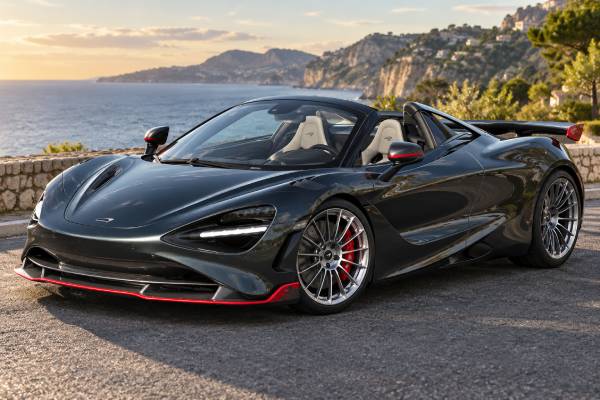
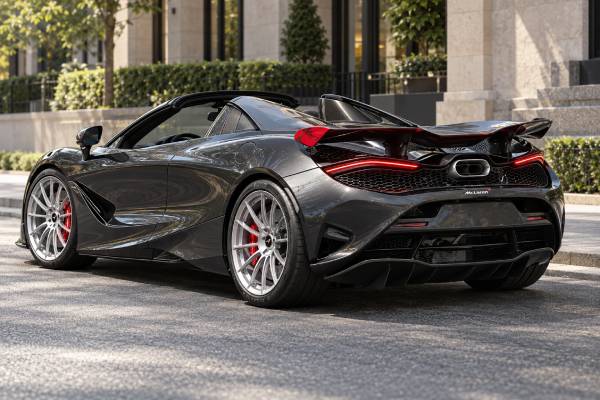
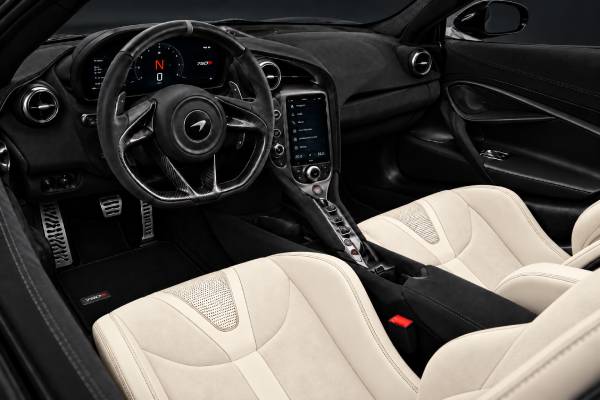
The McLaren 750S Spider JC96 is more than the open-roof version of a Japan-only commemorative model. It marks the first time McLaren offered the MSO High Downforce Kit on a 750S Spider, combining the retractable-hard-top body with an aerodynamic package developed to raise downforce by 10 percent. JC96 itself celebrates the #61 McLaren F1 GTR that won the 1996 All-Japan Grand Touring Championship drivers’ title, and McLaren limited the programme to 61 cars across Coupé and Spider combined. Every JC96 carries hand-painted race-inspired details, a Full Alcantara interior with gold-finish controls, and Delta 15-spoke forged wheels; a much smaller subset received the complete hand-painted Tribute Livery. For a Spider buyer, however, the roof mechanism, rear luggage packaging, extra body mass, and HDK condition deserve as much attention as the graphics. The right inspection therefore has to verify both sides of the car’s identity: a genuine JC96 commission and a mechanically healthy 750S Spider whose active aero and retractable roof work exactly as intended.
Table of Contents
- Why the JC96 Spider Matters
- Open-Top Aerodynamics and the HDK
- JC96 Spider Specifications
- Roof, Packaging, and Driving Character
- Japanese Racing Details and Personalisation
- Care for a Rare Open-Top McLaren
- Buying: Provenance, Condition, and Completeness
Why the JC96 Spider Matters
The JC96 Spider’s strongest technical claim is straightforward: it was the first 750S Spider offered with McLaren Special Operations’ High Downforce Kit. That gives the model a place in 750S development history beyond its limited-production Japanese racing theme.
JC96 was created to commemorate McLaren’s 1996 success in the All-Japan Grand Touring Championship. The #61 F1 GTR, driven by John Nielsen and David Brabham, won the drivers’ title in the top GT500 class. McLaren used the competition number as the modern production total, announcing 61 JC96 cars available only in Japan and split between Coupé and Spider according to customer orders rather than a publicly stated body-style quota.
That wording is important when a Spider is advertised. It is accurate to call it part of a 61-car JC96 programme; it is not accurate to invent a Spider-only production number unless the individual car’s documentation or a later McLaren statement proves one. Collectors often turn a total series count into a body-style count by accident, and that can distort both rarity claims and price comparisons.
The Spider also changes the context of the High Downforce Kit. The package first appeared on the 750S Le Mans Coupé. JC96 represented its second application overall, but the first on an open-top 750S. McLaren did not respond by giving the Spider extra power. The same 4.0-litre twin-turbo V8 produces 750 PS, or 740 bhp, and 800 Nm, while the roof can still open or close in 11 seconds at speeds up to 50 km/h.
This makes the JC96 Spider a layered special. Its racing history comes from the F1 GTR, its rarity comes from the Japan-only 61-car programme, its individuality comes from MSO paint and trim, and its engineering significance comes from pairing the HDK with the retractable-hard-top platform. A buyer should identify which of those layers the seller is charging for and then verify each one independently.
Open-Top Aerodynamics and the HDK
The HDK changes the JC96 Spider in a way that can be felt and inspected: McLaren says the package raises downforce by 10 percent through coordinated front and rear components. The key is not simply a larger rear spoiler, but the balance between the enlarged front splitter, underbody treatment, and raised Active Rear Spoiler.
The front bumper is revised to accept a larger dual-element carbon-fibre splitter. A louvred under-wing panel manages airflow below the car, while the rear wing sits higher to increase its aerodynamic contribution. Because front and rear changes are engineered together, the package is intended to preserve the car’s balance as overall load rises with speed.
On an open-top supercar, this is particularly interesting. Removing a fixed roof changes airflow around the upper body when the roof is retracted, yet the 750S Spider’s carbon-fibre Monocage II was engineered from the outset to support both body styles. The HDK does not turn the Spider into a closed-roof race car, and McLaren does not claim that the roof position creates a new performance rating. Instead, it gives Spider customers the same 10-percent downforce increase attributed to the kit while retaining the retractable roof’s normal operation.
For road driving, the most immediate consequence may be physical clearance. The carbon front splitter is vulnerable to steep parking ramps, aggressive speed humps, trailer transitions, and careless curb approaches. The nose-lift system is useful, but it cannot protect a splitter from every angle or from a driver who activates it too late. Buyers should inspect the entire underside, including attachment points, because abrasion can be invisible when the car is viewed only at standing height.
The rear deserves an operational test rather than a glance. The Active Rear Spoiler is part of the 750S’s braking and aerodynamic strategy, so it should move through its expected positions cleanly without warning messages, grinding, hesitation, or uneven gaps. On an HDK car, damaged mounts or a poorly aligned replacement element can undermine both originality and function.
Track use adds another layer. Downforce helps most at speed, whereas tire condition and temperature dominate slower corners. Owners should resist interpreting “10 percent more downforce” as a blanket 10-percent improvement in grip or lap time. Alignment, tire choice, brake condition, surface temperature, and driver consistency can have larger effects. The HDK is best understood as an aerodynamic stability package whose benefits grow with speed.
If a JC96 Spider has no HDK, that does not automatically make it inauthentic. McLaren describes HDK as available for the JC96 and emphasizes its first Spider application, so the individual build sheet remains the authority on how a particular car was ordered. A buyer should verify the factory configuration instead of assuming every example is identical.
JC96 Spider Specifications
Mechanically, the JC96 Spider uses the standard 750S Spider’s mid-mounted M840T V8, seven-speed dual-clutch transmission, rear-wheel drive, carbon structure, and Proactive Chassis Control III. The edition’s performance identity therefore comes from low mass, short gearing, hydraulic chassis systems, and available HDK aero rather than from a higher-output engine calibration.
| Specification | Value |
|---|---|
| Engine | M840T 90° V8, 3,994 cc (4.0 L) |
| Induction | Twin electrically actuated twin-scroll turbochargers |
| Lubrication | Dry sump |
| Valvetrain | DOHC, 32 valves, variable valve timing |
| Maximum power | 750 PS (740 bhp / 552 kW) at 7,500 rpm |
| Maximum torque | 800 Nm (590 lb-ft) at 5,500 rpm |
| Maximum engine speed | 8,500 rpm |
| Driven wheels | Rear |
| Specification | Value |
|---|---|
| Transmission | 7-speed Seamless Shift Gearbox with reverse |
| Differential | Open differential with Brake Steer |
| Steering | Electro-hydraulic power assistance |
| Suspension | Double wishbone, adaptive dampers |
| Chassis control | Proactive Chassis Control III |
| Roof | Electrically operated retractable hard top |
| Roof cycle | 11 seconds, operable up to 50 km/h (31 mph) |
| JC96 aero | MSO High Downforce Kit available; 10% claimed downforce increase |
| Measure | Value |
|---|---|
| 0–100 km/h (0–62 mph) | 2.8 seconds |
| 0–60 mph | 2.7 seconds |
| 0–200 km/h (0–124 mph) | 7.3 seconds |
| Quarter mile | 10.3 seconds |
| Top speed | 332 km/h (206 mph) |
| 100–0 km/h braking | 30 m (98 ft) |
| 200–0 km/h braking | 113 m (371 ft) |
| Specification | Value |
|---|---|
| Front brakes | 390 mm carbon-ceramic discs, 6-piston forged aluminium calipers |
| Rear brakes | 380 mm carbon-ceramic discs, 4-piston aluminium calipers |
| Wheel design | JC96 Delta 15-spoke ultra-lightweight forged alloy |
| Front wheel size | 19 × 9.0J |
| Rear wheel size | 20 × 11.0J |
| Front tires | 245/35 R19 93Y XL |
| Rear tires | 305/30 R20 103Y XL |
| Specification | Value |
|---|---|
| Body style | Two-seat Spider |
| Structure | Carbon-fibre Monocage II |
| Length | 4,569 mm (179.9 in) |
| Width without mirrors | 1,930 mm (76.0 in) |
| Width with mirrors | 2,161 mm (85.1 in) |
| Height | 1,196 mm (47.1 in) |
| Wheelbase | 2,670 mm (105.1 in) |
| Lightest dry weight | 1,326 kg (2,923 lb) for the base 750S Spider specification |
| DIN weight | 1,438 kg (3,170 lb) for the base 750S Spider specification |
| Luggage capacity | 150 L front, 58 L rear |
| Specification | Value |
|---|---|
| Fuel capacity | 72 L (19.0 US gal) |
| EU WLTP combined fuel use | 12.2 L/100 km |
| EU WLTP combined CO₂ | 276 g/km |
| Published exhaust configuration | Centre-exit exhaust layout |
The 1,326 kg dry figure and 1,438 kg DIN figure are the official baseline numbers for the 750S Spider, not a guaranteed scale result for every JC96. HDK hardware, paint, seat choice, audio, carbon options, and other market equipment can alter an individual car. Use the published figures to understand the platform, not to settle a dispute about the exact mass of a specific chassis.
Roof, Packaging, and Driving Character
The Spider’s carbon structure allows it to retain the steering precision and hydraulic suspension character that define the 750S while adding an 11-second retractable hard top. The practical tradeoff is about 49 kg more published dry mass than the Coupé and substantially less rear luggage volume.
The roof can operate at up to 50 km/h, which makes it genuinely usable when weather changes in traffic. Even so, owners should treat the mechanism as precision hardware rather than as a party trick. The safest habit is to use it on a relatively smooth, level surface, keep loose items away from the storage area, and stop if the motion becomes asymmetrical or the car reports a roof fault.
With the roof down, the car’s exhaust, turbo, and intake sounds become much more prominent. That sensory gain is central to the Spider’s appeal and may matter more to an owner than the small performance difference from the Coupé. McLaren quotes the same 2.8-second 0–100 km/h time and 332 km/h top speed, while 0–200 km/h takes 7.3 seconds rather than the Coupé’s 7.2.
Storage is the less glamorous consequence. The front compartment remains a useful 150 litres, but rear luggage space is only 58 litres versus 210 litres in the Coupé. For touring, that means soft bags and careful packing work far better than rigid cases. On a JC96 with valuable Alcantara and special paint, it is also wise to avoid stuffing items against trim panels simply because the luggage area is small.
Chassis behavior remains unusually communicative because McLaren retains electro-hydraulic steering and Proactive Chassis Control III rather than switching to a more conventional electric steering and anti-roll-bar arrangement. On real roads, that gives the Spider a dual personality: body control can be firm and accurate when asked, yet the suspension has enough compliance for long distances.
The HDK adds another dimension at higher speeds. The driver may notice greater confidence on a fast circuit, but the kit does not eliminate the need to respect wind, tire temperature, surface changes, or the different acoustic environment with the roof lowered. A fast open-top car can make speed feel dramatic while still accumulating it deceptively quickly.
Japanese Racing Details and Personalisation
JC96 is intentionally customizable, so authenticity should not be judged by searching for one fixed paint-and-trim recipe. The common identity comes from the edition’s hand-painted tiger-stripe-inspired details, Full Alcantara environment, gold-finish switches and pedals, and Delta wheels, with additional MSO choices layered on top.
The tiger-stripe theme refers back to the 1996 JGTC F1 GTRs rather than merely copying a modern McLaren race livery. On many cars, it appears as selected painted accents. Only a much smaller group received the full-vehicle JC96 Tribute Livery. Contemporary reporting at launch put that number at four cars across the entire 61-car programme.
That difference should be written clearly on sales listings. “One of 61 JC96” describes the edition. “One of four Tribute Livery” describes a specific factory paint commission and requires stronger documentation. A Spider painted later to resemble the full tribute scheme does not become one of those four, no matter how accurate the reproduction looks.
Customers could select from the regular 750S color range and MSO palette, choose caliper colors, specify visual carbon on aerodynamic components, and select among four finishes for the Delta wheels. The breadth of combinations means two genuine JC96 Spiders may appear unrelated in photographs. The build record should settle what the car was when delivered.
The cabin’s gold-finish switches and pedals are small but useful authentication clues because they are less likely than wheels or exterior film to be changed casually. Inspect them for unusual wear, replacement parts, or mismatched finishes. Full Alcantara should also be examined under neutral light; cleaning products can darken or stiffen the material, while body oils can polish high-contact areas.
Protection work should be documented. High-quality paint-protection film can make sense on a hand-finished special, especially on the splitter, nose, mirrors, doors, and rear arches. But poor film can lift paint edges or hide repaired panels. A buyer should know when it was installed, whether panels were removed, and whether the installer cut film on the car. Preservation is valuable only when the preservation work itself has been carried out correctly.
Care for a Rare Open-Top McLaren
The best JC96 Spider maintenance plan combines normal 750S mechanical service with deliberate care of the roof, seals, aero hardware, Alcantara, and special paint. Low annual mileage does not reduce the importance of time-based inspections.
Exercise the roof periodically in suitable conditions and observe the entire cycle. Both sides should move smoothly, latches should engage without repeated attempts, and the instrument display should confirm completion. Keep drain paths and seal areas clean using methods approved for the materials, and investigate water ingress quickly. Moisture that reaches trim or electronics is more expensive to ignore than to diagnose early.
Door and roof sealing deserve extra attention on any Spider used in heavy rain or washed frequently. Look for damp carpeting, musty odor, water marks, or condensation that lingers after the car is dry. A leak is not merely a comfort issue when control modules, connectors, or premium interior materials are nearby.
Use a compatible battery maintainer during storage. Roof motors, pumps, latches, active aero, suspension electronics, and control units all depend on stable voltage. Low battery state can produce confusing warning cascades, and repeated deep discharge shortens battery life. Before assuming several systems have failed at once, battery condition and charging history should be part of the diagnosis.
Tires should be judged by age and condition as well as tread depth. A collector car can retain deep tread long after rubber has aged. Check manufacturing dates, sidewalls, inner shoulders, puncture repairs, and correct axle specifications. If a previous owner used track-oriented tires, ask how the car was stored and used because repeated heat cycles can reduce performance before tread disappears.
Carbon-ceramic brakes are durable in the right use but expensive when damaged. Inspect disc surfaces and edges for chips, abnormal markings, or impact damage, and assess pad condition. Track debris can harm a disc even on a low-mileage car. Brake-fluid age and pedal feel matter too; rarity does not exempt the car from normal fluid maintenance.
The HDK splitter needs an underside inspection at every meaningful service, especially after unfamiliar roads or circuit days. Examine carbon weave, clear coat, leading edges, mounting hardware, and the areas where load is transferred into the bumper structure. At the rear, verify Active Rear Spoiler operation and look for contact marks that could indicate alignment problems.
Finally, keep service records in a form the next owner can understand. Date, mileage, retailer or specialist, work performed, parts fitted, software updates, tire changes, alignment data, and photos of significant preservation work create a history that supports the car’s future value better than a folder containing only annual stamps.
Buying: Provenance, Condition, and Completeness
A proper JC96 Spider pre-purchase inspection should verify edition provenance first, then evaluate the expensive Spider and HDK systems, and finally assess normal 750S mechanical condition. A beautiful exterior is not enough to establish any of those three.
Start by matching the VIN across the chassis, registration, service invoices, and original order paperwork. Because JC96 was Japan-only, trace the supplying retailer and Japanese registration history where possible. If the car has been exported, obtain import and compliance records rather than accepting a vague statement that it was “brought over legally.” Registration rules differ by country and can change the usability of an otherwise excellent car.
Confirm the original specification line by line. Look for the Delta wheels and recorded finish, JC96 paint details, Full Alcantara environment, gold controls and pedals, chosen carbon options, brake-caliper finish, and any HDK equipment. If the car is represented as one of the four full Tribute Livery commissions, require direct factory or original-order evidence for that claim.
Operate the roof several times after checking battery voltage and environmental conditions. Listen for hesitation, binding, unusual pump noise, or trim contact. Inspect seals, drain areas, the roof panel, rear deck, hinges, and the small gaps where paint can chip. Check rear luggage trim because roof-system work or water ingress may leave evidence there.
Use diagnostic equipment appropriate to McLaren to review current and stored faults. Test the gearbox from cold through normal operating temperature, confirm clean shifts at light and heavy throttle, and verify all chassis modes. Inspect cooling hoses and connections, underbody panels, suspension hardware, hydraulic circuits, turbo plumbing, and evidence of fluid seepage.
Accident history demands specialist attention. The Monocage II is carbon fibre, while other structures and body panels use different materials. Paint-depth readings can help on painted metallic panels but cannot replace correct carbon inspection. Misaligned doors, inconsistent fasteners, disturbed seam materials, or unexplained replacement aero pieces should lead to deeper investigation.
Assess the complete collector package, not just the car. Two keys, handbooks, battery charger, original tools or accessories, delivery material, MSO paperwork, spare parts, and removed factory components can all matter. If a seller has changed wheels or installed a different exhaust, confirm that the original pieces remain available and correctly identified.
Most importantly, buy according to intended use. A pristine full-livery Spider may reward preservation-minded ownership, while a standard-color JC96 with protective film and documented use may be more satisfying for regular driving. The model’s significance does not depend on keeping it motionless. It depends on maintaining its provenance, respecting the mechanical systems, and ensuring that every change is reversible and honestly recorded.
References
- McLaren 750S | JC96 — McLaren Automotive, 2025.
- McLaren 750S JC96 celebrates the F1’s racing success in Japan — evo, 2025.
- McLaren 750s Spider — McLaren Automotive, current Spider specifications.
- Discover McLaren 750S & 750S Spider — McLaren Automotive, model overview.
- McLaren Ownership – Owner’s Handbooks | McLaren Automotive — McLaren Automotive, ownership information.
- Check for Recalls: Vehicle, Car Seat, Tire, Equipment | NHTSA — National Highway Traffic Safety Administration, recall lookup.
Disclaimer
This article is for general informational purposes and does not replace the owner’s handbook, McLaren workshop procedures, market-specific compliance information, or a professional inspection. Specifications and equipment can differ by VIN, model year, market, and MSO order; campaigns and software actions can also have narrow VIN ranges. Verify any car using its original build record, current official service information, and an authorized McLaren retailer or qualified specialist. Use factory procedures, specified fluids, torque values, lifting points, and safety instructions for maintenance and repair.
Share this guide with another JC96 Spider owner or buyer if it helps them separate the edition’s verified engineering and provenance from unsupported rarity claims.