
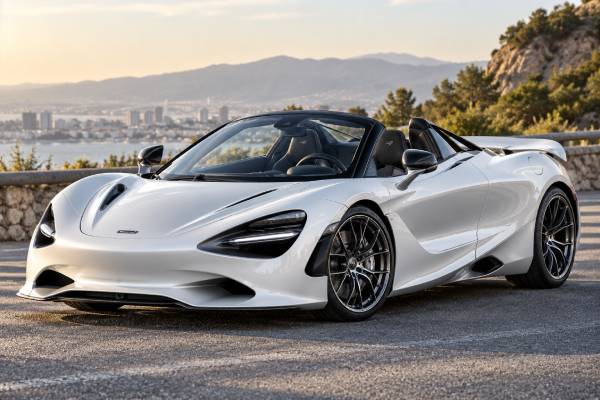
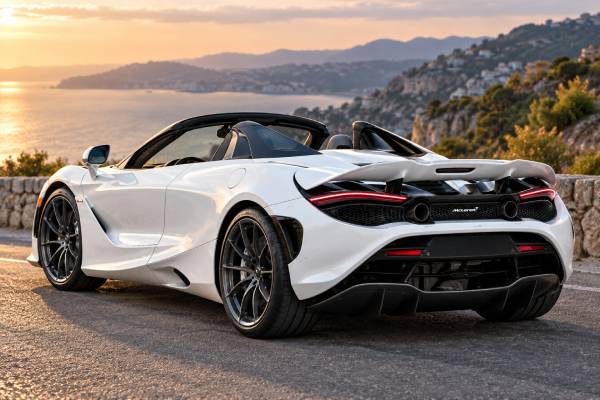
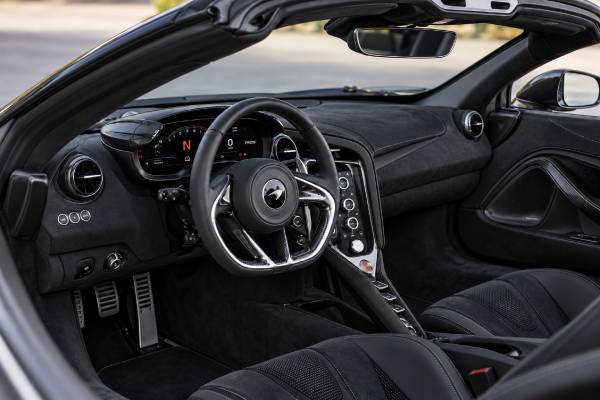
The McLaren 750S Spider combines the 740 bhp, rear-wheel-drive performance of the 750S with an electrically folding hard top that opens or closes in 11 seconds at speeds up to 50 km/h. It launched alongside the Coupé in 2023 and keeps the same carbon-fibre Monocage II, M840T twin-turbo V8, seven-speed Seamless Shift Gearbox, Proactive Chassis Control III, and electro-hydraulic steering. The engineering compromise is smaller than the visual transformation suggests: McLaren lists a 1,326 kg lightest dry weight, only 49 kg above the Coupé baseline, and quotes the same 2.8-second 0–100 km/h time and 332 km/h top speed. The practical differences matter more in ownership. Rear luggage capacity drops to 58 litres, the roof mechanism and seals add inspection points, and water management becomes part of long-term care. For buyers, the Spider should therefore be evaluated as both a 750S and a convertible: drivetrain, brakes, hydraulics, software, roof operation, drainage, weather sealing, and body condition all deserve independent checks.
Table of Contents
- The Spider Engineering Brief
- Roof System, Structure, and Packaging
- 750S Spider Specifications
- How the Spider Drives
- Roof and Convertible Maintenance
- Mechanical Service and Campaign Checks
- Pre-Purchase Inspection and Specification Choice
The Spider Engineering Brief
The 750S Spider was engineered as an open-top version of the same performance platform rather than as a softer grand-touring derivative. It uses the same 750 PS V8, short final drive, carbon structure, hydraulic suspension, active rear aero, and carbon-ceramic brakes as the Coupé, while adding the Retractable Hard Top and its operating hardware.
McLaren launched Coupé and Spider together, which matters because the open car was considered during the 750S development programme instead of being a later conversion. The Monocage II carbon-fibre structure is central to that strategy. Its stiffness allows the Spider to avoid the extensive steel reinforcement that would make a conventional aluminium convertible much heavier.
The published weight difference is 49 kg when comparing the lightest dry figures: 1,326 kg for the Spider and 1,277 kg for the Coupé. DIN figures show the same gap, at 1,438 kg versus 1,389 kg. Those numbers explain why the performance penalty is small. McLaren quotes identical 0–100 km/h acceleration at 2.8 seconds and the same 332 km/h top speed. The Spider takes 7.3 seconds to reach 200 km/h, one tenth slower than the Coupé, and covers the quarter mile in 10.3 seconds rather than 10.1.
The powertrain revisions that define the 750S apply here too. The M840T develops 750 PS, or 740 bhp, and 800 Nm. Compared with the preceding 720S generation, the 750S received more power and torque, a 15-percent shorter final-drive ratio, a wider front track, quicker steering, new twin-valve dampers, and a broader programme of weight reduction.
For a Spider buyer, the conclusion is simple: choose this body style for the roof-down experience rather than because it is materially easier or slower to drive. The basic performance envelope remains supercar-level. The extra systems simply mean that ownership quality depends on keeping the roof, seals, drainage, battery, and electronics as healthy as the engine and chassis.
Roof System, Structure, and Packaging
The Retractable Hard Top is the Spider’s defining mechanism, and McLaren designed it to complete a full open-or-close cycle in 11 seconds while the car is moving at up to 50 km/h. That makes the roof useful in real traffic, but it should still be treated as a precisely aligned electromechanical system.
The hard panel gives the car a coupe-like silhouette when raised and better weather isolation than a traditional fabric top. When lowered, the roof stores behind the cabin and changes the available rear luggage volume. The Spider retains 150 litres in the front luggage compartment but offers only 58 litres at the rear, compared with 210 litres in the Coupé. For touring, soft bags that conform to the available spaces are far more practical than rigid suitcases.
Roof operation should be smooth from beginning to end. The panel should unlatch without repeated attempts, travel evenly, stow without contacting trim, and lock securely in the final position. Warning messages, asymmetric motion, unusual pump or motor noise, repeated stopping, or the need to press the switch multiple times are reasons for diagnosis rather than quirks to accept.
Weather sealing is equally important. Examine the roof perimeter, header area, side-window interfaces, rear deck, and drainage paths for dirt, damaged rubber, compression marks, or previous adjustment. After rain or a careful leak test, inspect carpets and hidden edges for moisture. A musty smell, fogging that persists, or water marks around trim can reveal a problem even when the visible cabin seems dry.
The carbon-fibre passenger structure means the absence of a fixed roof does not create the flex typical of older convertibles. Even so, body alignment can influence roof behavior. A Spider with accident damage, poorly repaired rear bodywork, or disturbed door geometry deserves extra scrutiny because small alignment errors can show up as wind noise, sealing issues, or uneven roof movement.
An electrochromic glazed roof panel was offered in some specifications and markets. If fitted, it should be checked for consistent tint operation and clarity. As with any expensive option, verify the individual car’s build sheet before assuming a roof feature is standard just because another 750S Spider has it.
The roof also changes how the car should be stored. Keep the mechanism and seal areas clean, avoid placing objects where they can interfere with moving panels, and use a compatible battery maintainer during long periods off the road. A weak electrical supply is a poor foundation for diagnosing any modern convertible mechanism.
750S Spider Specifications
The 750S Spider is a conventional petrol-powered supercar with a mid-mounted 4.0-litre V8, rear-wheel drive, and no hybrid assistance. The key numbers are nearly identical to the Coupé, but body weight, 0–200 km/h performance, quarter-mile time, roof hardware, and luggage capacity are Spider-specific.
| Specification | Value |
|---|---|
| Engine code | M840T |
| Configuration | 90° V8, longitudinal mid-engine |
| Displacement | 3,994 cc (4.0 L) |
| Induction | Twin electrically actuated twin-scroll turbochargers |
| Lubrication | Dry sump |
| Valvetrain | DOHC, 32 valves, variable valve timing |
| Maximum power | 750 PS (740 bhp / 552 kW) at 7,500 rpm |
| Maximum torque | 800 Nm (590 lb-ft) at 5,500 rpm |
| Maximum engine speed | 8,500 rpm |
| Specification | Value |
|---|---|
| Transmission | 7-speed Seamless Shift Gearbox with reverse |
| Final drive | Shorter 750S ratio, 15% shorter than 720S |
| Drive | Rear-wheel drive |
| Differential | Open differential with Brake Steer |
| Steering | Electro-hydraulic power-assisted steering |
| Suspension | Double wishbone, adaptive twin-valve dampers |
| Chassis system | Proactive Chassis Control III |
| Roof | Retractable hard top, 11-second cycle up to 50 km/h |
| Measure | Value |
|---|---|
| 0–100 km/h (0–62 mph) | 2.8 seconds |
| 0–60 mph | 2.7 seconds |
| 0–200 km/h (0–124 mph) | 7.3 seconds |
| Quarter mile | 10.3 seconds |
| Top speed | 332 km/h (206 mph) |
| 100–0 km/h braking | 30 m (98 ft) |
| 200–0 km/h braking | 113 m (371 ft) |
| Specification | Value |
|---|---|
| Front brakes | 390 mm carbon-ceramic discs, 6-piston forged aluminium calipers |
| Rear brakes | 380 mm carbon-ceramic discs, 4-piston forged aluminium calipers |
| Front wheels | 19 × 9.0J |
| Rear wheels | 20 × 11.0J |
| Front tires | 245/35 R19 93Y XL |
| Rear tires | 305/30 R20 103Y XL |
| Standard road-tire family | Pirelli P Zero |
| Specification | Value |
|---|---|
| Length | 4,569 mm (179.9 in) |
| Width without mirrors | 1,930 mm (76.0 in) |
| Width with mirrors | 2,161 mm (85.1 in) |
| Height | 1,196 mm (47.1 in) |
| Wheelbase | 2,670 mm (105.1 in) |
| Front / rear track | 1,680 / 1,629 mm (66.1 / 64.1 in) |
| Lightest dry weight | 1,326 kg (2,923 lb) |
| DIN weight | 1,438 kg (3,170 lb) |
| Luggage capacity | 150 L front, 58 L rear |
| Specification | Value |
|---|---|
| Fuel type | Petrol/gasoline |
| Fuel-tank capacity | 72 L (15.8 UK gal / 19.0 US gal) |
| EU WLTP combined consumption | 12.2 L/100 km |
| EU WLTP combined CO₂ | 276 g/km |
| Exhaust layout | Centre-exit sports exhaust |
The official mass values are minimum factory reference figures rather than guaranteed measured weights for every specification. Seats, audio, carbon options, paint, roof glazing, protection film, and market equipment can change the actual figure. Likewise, acceleration claims assume suitable conditions, tires, and launch procedure.
How the Spider Drives
The Spider preserves the 750S’s core handling character, with only a small performance penalty for the roof system. In normal use, the larger difference is sensory: lowering the roof makes the V8, turbocharger sounds, exhaust, wind, and road environment much more immediate.
The 15-percent shorter final-drive ratio gives the car an urgent feel even when road speeds are moderate. The engine reaches its stronger rev range quickly, and the seven-speed gearbox can deliver rapid shifts from the steering-column paddles. Automatic mode is useful in traffic, but manual control suits the car’s precise throttle response and lets the driver avoid unnecessary shifts on a winding road.
The electro-hydraulic steering remains a standout feature. Weight builds naturally as the front tires load, and the rack communicates surface changes that many fully electric systems filter out. The wider front track and quicker steering response introduced with the 750S make the car feel eager to turn without requiring an artificial heavy steering setting.
Proactive Chassis Control III gives the Spider a broad ride envelope. On a broken road, the hydraulically linked suspension can absorb movement without letting the body become loose. In Sport or Track settings, damping and powertrain response tighten for faster driving. The open roof does not mean the car needs exaggerated stiffness to compensate for a weak structure because the carbon tub carries the structural load.
With the roof lowered, wind management is good for a car of this performance but not silent. Conversations, phone calls, and audio quality all become speed-dependent. That is part of the experience, yet it can also mask subtle noises. When diagnosing suspension, wheel-bearing, trim, or drivetrain sounds, test the car with the roof raised as well as lowered.
The same point applies to track days. The Spider is capable of serious circuit use, but helmet compatibility, roof rules, rollover requirements, and local organizer policies should be checked before booking. Prepare tires, brakes, fluids, and wheel fasteners exactly as for the Coupé, then inspect the roof area and rear deck for debris after the session.
The front lift system is valuable on road because the nose and splitter sit low. Use it before the obstacle rather than while already climbing a sharp ramp. Repeated underside impact is easy to miss from the driver’s seat and can become an expensive cosmetic or aerodynamic repair.
Roof and Convertible Maintenance
Spider-specific maintenance is mainly about keeping the roof mechanism clean, correctly powered, properly aligned, and dry. A roof that works perfectly during an annual service can still become troublesome if seals are neglected, drains clog, or the battery repeatedly falls to low voltage.
Exercise the roof periodically when conditions are appropriate. Watch both sides of the cycle rather than pressing the switch and looking away. The mechanism should not shudder, pause unexpectedly, or require assistance. If operation becomes slower, investigate battery health and stored faults before assuming the mechanical roof hardware itself has failed.
Keep seals clean using products compatible with the rubber and surrounding finishes. Dirt trapped on a seal can create wind noise or a small water path, while aggressive chemicals can dry or swell the material. Do not add generic silicone products simply because they are sold for convertible roofs; use the guidance appropriate to the 750S materials.
Drainage should be checked whenever leaves, dust, or detailing residue can accumulate. A blocked path may not show itself until heavy rain or washing sends water somewhere it was never meant to go. Inspect hidden carpet edges and storage areas periodically, especially if the car lives outdoors or is washed frequently.
Painted roof panels and black trim can show fine scratches from careless washing. Hand washing with clean media, good lubrication, and separate tools for dirty lower panels reduces the chance of dragging contamination across the roof. If the car has an electrochromic glass roof, avoid cleaners that are not suitable for its coatings.
Do not store loose objects in areas that interact with roof movement. A small item left where the mechanism stows can damage trim, interfere with travel, or create a fault that becomes much more expensive than the object itself. The rear compartment is limited, so use correctly sized soft luggage rather than forcing hard cases into marginal spaces.
Water ingress should be addressed early. A few drops after pressure washing may seem minor, but persistent moisture can affect leather, Alcantara, carpet backing, adhesives, connectors, and electronic modules. Record any seal adjustment or roof repair because future buyers will want to understand what was corrected and why.
Mechanical Service and Campaign Checks
Beyond the roof, the 750S Spider needs the same disciplined mechanical care as the Coupé: correct time-based service, stable battery voltage, healthy hydraulic systems, fresh tires, sound carbon-ceramic brakes, and current software. Low mileage is not a substitute for maintenance.
Follow the owner’s handbook and current McLaren service information for the exact VIN. Engine oil, filters, brake fluid, coolant-related checks, and other service operations should use the specified fluids and procedures. Do not assume the interval for a previous McLaren or a different market is automatically correct.
Battery condition is especially important in the Spider because low voltage can affect not only infotainment and chassis modules but also the roof system. Use a compatible maintainer during storage, keep connections clean, and replace a failing battery before it generates a catalogue of secondary faults.
Inspect the suspension and steering hydraulics for leaks, damaged lines, unusual noises, or changes in assistance. The car should ride consistently across its modes and return cleanly to center after steering inputs. Any sudden change in steering effort deserves diagnosis rather than adaptation by the driver.
Carbon-ceramic brakes should be inspected for physical damage and condition, not simply assumed healthy because the car has low mileage. Track debris, incorrect wheel handling, and impact can damage a disc. Check pads, calipers, fluid, and pedal behavior at the same time.
Tire age is one of the most common low-mileage-car risks. Verify date codes, correct sizes, sidewall condition, puncture history, and inner-shoulder wear. A 740 bhp rear-wheel-drive car deserves fresh rubber even if an old set still shows plenty of tread.
Software and campaigns should be checked by VIN through an authorized retailer. McLaren has issued technical actions affecting particular 750S model years and configurations, including HVAC-control updates and later platform software. Some Spider-specific service campaigns have also covered narrowly defined cars or systems. The presence of a bulletin online does not prove an individual vehicle is affected, so obtain a VIN-specific status report.
Official recall databases should be checked in the market where the car is registered. A recall that applies to one production window or country may not cover another. Keep completion documentation with the service file; it reassures a future buyer and prevents the same question from resurfacing years later.
Pre-Purchase Inspection and Specification Choice
A 750S Spider purchase should be based on condition, provenance, roof health, and the suitability of its options rather than mileage or color alone. The best example is the one whose history makes sense and whose expensive systems can be demonstrated to work correctly.
Start with the VIN and factory specification. Match registration, service invoices, warranty records, and build-sheet information. Confirm the exact roof type, seat option, wheels, carbon packages, audio, lift system, exterior color, and any MSO work. On a highly personalized McLaren, original configuration can materially affect value.
Inspect the roof before the engine is fully warm so you can see how it behaves under the car’s initial battery and hydraulic conditions. Cycle it more than once if appropriate, test windows and seals, and look inside the rear storage and roof areas for moisture or disturbed trim. Check the hard panel for chips along its edges and make sure gaps are consistent when closed.
Examine the body in neutral light and inspect underneath on a lift. The front splitter, floor, jacking points, diffuser, wheel barrels, and lower body edges can show evidence of curb, ramp, or track contact. Paint-protection film can be valuable, but it can also conceal repairs or leave cut marks, so inspect its edges carefully.
A specialist should review the carbon structure if accident damage is suspected. Paint-depth tools alone are not enough for composite material. Inconsistent fasteners, poorly aligned doors, unusual seal adjustment, or a roof that suddenly became noisy after body repair can justify a deeper structural check.
Drive the car from cold to normal operating temperature. Test gearbox behavior in both automatic and manual modes, steering assistance, chassis settings, front lift, brakes, climate control, cameras, infotainment, and active rear aero. Read stored diagnostic faults rather than relying on the absence of dashboard warnings during a brief drive.
Convert consumable condition into a realistic budget. Four correct tires, carbon-ceramic brake work, damaged forged wheels, roof repairs, or cosmetic carbon pieces can each represent a significant expense. A lower asking price is only attractive if the deferred work is understood before purchase.
Specification should reflect use. Touring owners benefit from comfortable seats, lift, cameras, road tires, and a roof they will actually operate. Track-oriented owners may prefer lighter seats and more aggressive tires, but should still retain original parts and document changes. Collectors may value rare MSO paint and exposed carbon, yet uninterrupted service and original condition remain more important than an unusual color name.
Finally, plan ownership rather than just acquisition. Budget insurance, annual service, tire aging, battery care, detailing, secure storage, and unexpected repairs. Use the roof regularly enough to keep it exercised, drive the car long enough to reach proper temperatures, and record every intervention. The 750S Spider makes sense when its open-air character is enjoyed without pretending the additional mechanism requires no maintenance.
References
- McLaren 750s Spider — McLaren Automotive, current model specifications.
- Discover McLaren 750S & 750S Spider — McLaren Automotive, current model overview.
- McLaren Ownership – Owner’s Handbooks | McLaren Automotive — McLaren Automotive, ownership information.
- RESTRICTED — McLaren Automotive / NHTSA, 2024, Spider door-sensor service campaign.
- RESTRICTED — McLaren Automotive / NHTSA, 2025, platform software campaign.
- Check for Recalls: Vehicle, Car Seat, Tire, Equipment | NHTSA — National Highway Traffic Safety Administration, recall lookup.
Disclaimer
This article provides general information and does not replace McLaren’s owner’s handbook, current workshop instructions, VIN-specific campaign information, local legal requirements, or a professional inspection. Specifications, equipment, software, and service actions can vary by model year, market, VIN, and MSO order. Verify any vehicle using original build documentation and current official records, and use factory procedures, fluids, torque values, lifting points, and safety instructions for maintenance or repair.
If this guide clarified what to inspect and maintain on a 750S Spider, share it with another owner or prospective buyer who may find the same details useful.