
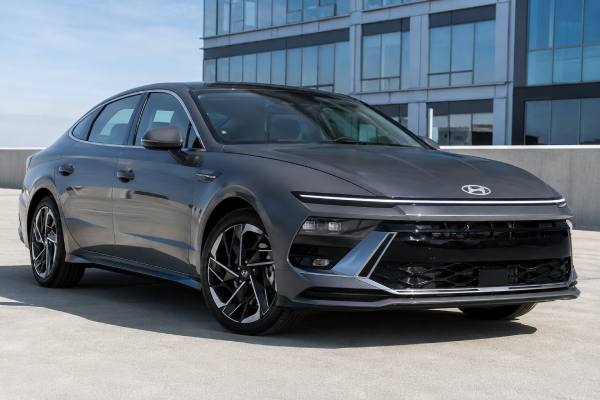
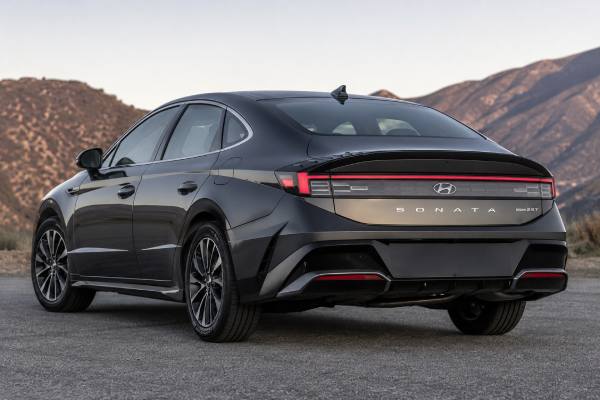
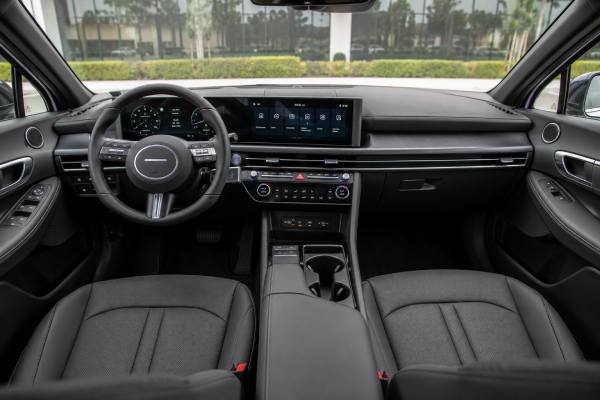
The facelifted Hyundai SONATA Hybrid DN8 is the fuel-efficient version of Hyundai’s midsize sedan, combining a 2.0-liter direct-injection gasoline engine, an electric motor, a small lithium-ion battery, and a conventional 6-speed automatic transmission. In U.S.-market form, it delivers 192 hp combined, front-wheel drive, strong highway economy, and a much more modern cabin than the pre-facelift DN8.
For buyers, the main appeal is not outright performance. It is the blend of long-distance comfort, high fuel economy, generous equipment, a large-sedan feel, and Hyundai’s hybrid-system warranty coverage. The most important checks are software campaign completion, service records, brake condition, tire wear, and hybrid-system health on used examples.
Final Verdict
The 2024–present Hyundai SONATA Hybrid DN8 is a strong choice for drivers who want a comfortable, efficient midsize sedan with modern screens, good standard safety equipment, and a more natural transmission feel than many eCVT hybrids. It suits commuters, highway drivers, rideshare users, and families who value fuel economy without moving into an SUV. Its main tradeoff is that it is not as sporty as it looks, and Toyota’s Camry Hybrid still has the stronger long-term hybrid reputation. Buy one only with documented maintenance, completed software recalls, and a clean hybrid-system scan.
| Pros | Cons |
|---|---|
| 192 hp hybrid system feels adequate for daily driving | Not quick enough to satisfy performance-focused drivers |
| Excellent highway economy for a roomy midsize sedan | Cold weather and short trips can reduce real-world mpg |
| 6-speed automatic gives more familiar shift behavior | Hybrid transitions can still be noticeable under load |
| Limited Hybrid includes premium safety and parking tech | Top trim adds weight and higher tire/brake costs |
| Strong hybrid warranty coverage supports used confidence | VIN recall checks are essential on 2024–present cars |
Table of Contents
- DN8 Facelift Sonata Hybrid Overview
- 2.0L Hybrid Specifications and Data
- Trims, Safety and Driver Assistance
- Reliability, Issues and Service Actions
- Maintenance and Buyer’s Guide
- Driving, Performance and Efficiency
- How the Sonata Hybrid Compares to Rivals
DN8 Facelift Sonata Hybrid Overview
The facelifted DN8 SONATA Hybrid is best understood as a comfort-first hybrid sedan with strong efficiency and generous equipment, not as a sporty alternative to the N Line. The 2024 update brought the dramatic “Seamless Horizon” front lighting theme, a cleaner rear design, a redesigned dashboard, and Hyundai’s wide digital display layout.
This article focuses on the U.S.-market 2024–present SONATA Hybrid with the 2.0L GDI hybrid system rated at 192 hp combined. Earlier DN8 hybrids from 2020–2023 are closely related mechanically, but the facelifted cars have different styling, interior layout, equipment packaging, and some safety-test relevance.
Mechanically, Hyundai kept a familiar layout. The gasoline engine is a naturally aspirated 2.0-liter GDI four-cylinder tuned for efficiency, paired with a permanent-magnet synchronous electric motor and a compact lithium-ion battery. Unlike many hybrid rivals that use an eCVT, the SONATA Hybrid uses a 6-speed automatic transmission. That gives it more conventional shifts and a familiar driving feel, especially on the highway.
All U.S.-market facelift DN8 Hybrid models are front-wheel drive. There is no AWD hybrid version in this generation, which matters if the buyer is comparing it with the Toyota Camry Hybrid AWD. Hyundai offers AWD on some gasoline SONATA trims, but not on the 192 hp hybrid.
The sedan format is still one of the SONATA Hybrid’s biggest advantages. It has a long 2,840 mm wheelbase, a quiet cabin, easy front-seat space, and useful rear-seat room. The trunk is lower and easier to load than many crossovers, although the hybrid packaging and sloping roofline mean rear headroom and cargo practicality are not quite as flexible as an SUV.
The strongest ownership case is simple: the SONATA Hybrid delivers near-premium features and high fuel economy at a lower price than many similarly equipped competitors. The Limited Hybrid is especially well equipped, with features such as a panoramic sunroof, leather seating surfaces, surround-view camera, blind-spot camera display, head-up display, Bose audio, and Remote Smart Parking Assist depending on model year.
The main caution is that this is still a relatively new facelift cycle. Early ownership data is thinner than for older Toyota hybrids, so used buyers should pay close attention to warranty status, software recalls, service history, and signs of collision repair that could affect ADAS calibration.
2.0L Hybrid Specifications and Data
The facelifted SONATA Hybrid uses a 2.0L GDI gasoline engine, a 39 kW electric motor, a lithium-ion battery, and a 6-speed automatic transmission. Its most important technical traits are the 192 hp combined output, front-wheel-drive layout, 13.2-gallon fuel tank, low-drag hybrid body, and 17-inch wheel package on most 2024–2025 hybrid trims.
| Item | Specification |
|---|---|
| Engine | 2.0L GDI DOHC 16-valve inline-4 |
| Displacement | 1,999 cc |
| Bore × stroke | 81.0 × 97.0 mm |
| Compression ratio | 14.0:1 |
| Gasoline engine output | 150 hp at 6,000 rpm |
| Gasoline engine torque | 188 Nm (139 lb-ft) at 5,000 rpm |
| Electric motor | Permanent-magnet synchronous motor |
| Motor output | 39 kW (51 hp) |
| Motor torque | 205 Nm (151 lb-ft) |
| Battery | Lithium-ion, 270 V maximum, 1.62 kWh |
| Combined system output | 192 hp |
| Item | Specification |
|---|---|
| Transmission | 6-speed electronic automatic with SHIFTRONIC |
| Drive type | Front-wheel drive |
| Final drive ratio | 3.510:1 |
| Front suspension | MacPherson strut with stabilizer bar |
| Rear suspension | Multi-link with stabilizer bar |
| Front brakes | Ventilated discs, 305 mm (12.0 in) |
| Rear brakes | Solid discs, 284 mm (11.2 in) |
| Steering | Column-mounted motor-driven rack-and-pinion |
| Turning diameter | 10.9 m (35.9 ft) |
| Item | Specification |
|---|---|
| Body style | 4-door midsize sedan, 5 seats |
| Length | 4,910 mm (193.3 in) |
| Width | 1,859 mm (73.2 in), mirrors excluded |
| Height | 1,445 mm (56.9 in) |
| Wheelbase | 2,840 mm (111.8 in) |
| Ground clearance | 135 mm (5.3 in) |
| Passenger volume | 2,956 L (104.4 cu ft) |
| Trunk volume | About 442 L (15.6 cu ft) |
| Curb weight | 1,560–1,672 kg (3,439–3,687 lb) |
| Fuel tank | 50 L (13.2 US gal) |
| Towing | Not recommended |
| Item | Specification or practical note |
|---|---|
| 2024–2025 EPA economy | 5.3 / 4.6 / 5.0 L/100 km city/highway/combined |
| 2024–2025 EPA economy | 44 / 51 / 47 mpg US, or 53 / 61 / 56 mpg UK |
| 2026 Blue Hybrid economy | Up to 47 / 56 / 51 mpg US |
| Hybrid drag coefficient | Cd 0.24 |
| Common hybrid tire size | 215/55R17 on 2024–2025 SEL and Limited Hybrid |
| Engine oil capacity | Hyundai specification table: 5.5 US qt |
| Engine coolant capacity | Hyundai specification table: 3.0 US qt |
| Wheel-nut torque | 107–127 Nm (79–94 lb-ft) |
Trims, Safety and Driver Assistance
For 2024 and 2025, the U.S. SONATA Hybrid lineup is centered on SEL Hybrid and Limited Hybrid trims. For 2026, Hyundai adds a more efficiency-focused Blue Hybrid trim, giving buyers a lower-cost hybrid entry point and a higher EPA rating when equipped for maximum economy.
Trims and option differences
The SEL Hybrid is the value trim. It has the same 192 hp hybrid system, front-wheel drive, 6-speed automatic, 17-inch alloy wheels in 2024–2025 form, dual 12.3-inch display layout on the facelifted cabin, heated front seats, wireless smartphone integration, dual-zone climate control, and Hyundai’s core SmartSense driver-assistance features.
The Limited Hybrid is the premium version. It is the trim to seek if the buyer wants the most complete driver-assistance and convenience package. Typical Limited Hybrid identifiers include leather seating surfaces, panoramic sunroof, ventilated front seats, head-up display, Bose premium audio, surround-view camera, Blind-Spot View Monitor, Remote Smart Parking Assist, parking collision-avoidance features, and memory settings.
Quick identifiers:
- SEL Hybrid: 17-inch wheels, hybrid badging, simpler parking-camera package, no blind-spot camera display.
- Limited Hybrid: panoramic roof, leather interior, head-up display, Bose audio, surround-view monitor, Blind-Spot View Monitor.
- 2026 Blue Hybrid: economy-focused hybrid trim, likely easiest to identify by its lower wheel/tire package and higher EPA fuel-economy rating.
Mechanically, the trims are very similar. Buyers should not expect a different engine, gearbox, suspension architecture, or AWD option by trim. The main differences are equipment, wheel package, cabin materials, driver-assistance hardware, and curb weight.
Safety ratings
The 2024 Hyundai Sonata sedan earned an IIHS Top Safety Pick designation. IIHS rates the 2024 Sonata Good in small-overlap front, Good in the original moderate-overlap front test, Poor in the updated moderate-overlap front test, Good in the updated side test, Good for headlights, Acceptable for vehicle-to-vehicle front crash prevention, and Good for pedestrian front crash prevention.
That mixed moderate-overlap result matters. The car performs well in many major crashworthiness areas, but the updated rear-passenger-focused moderate-overlap test is tougher than older tests. Family buyers who often carry rear-seat passengers should understand that distinction rather than only looking at the award label.
Airbags, child seats and ADAS
The restraint package includes front airbags, driver knee airbag, side-impact airbags, side curtain airbags, seatbelt pretensioners, load limiters, and rear child-seat anchors. The rear seat has two full LATCH/ISOFIX-style lower-anchor positions and a center tether anchor.
Standard or widely available safety systems include forward collision avoidance with pedestrian, cyclist, and junction-turning detection; blind-spot collision warning; rear cross-traffic collision avoidance; lane keeping assist; lane following assist; driver attention warning; high-beam assist; stability control; traction control; ABS; brake assist; and tire-pressure monitoring.
ADAS calibration is important. If the windshield, front bumper, grille area, camera bracket, radar sensor, suspension, or alignment is repaired after a collision, the camera and radar systems may need proper calibration. A cheap windshield replacement or uncalibrated front-end repair can create warning lights, false alerts, poor lane-centering behavior, or disabled safety systems.
Reliability, Issues and Service Actions
The facelifted 2024–present SONATA Hybrid is too new for a full high-mileage reliability record, but its early ownership profile is clear enough to set inspection priorities. The biggest current concerns are software campaign completion, hybrid-system diagnostics, brake condition, 12 V battery health, and evidence of correct maintenance.
| Area | Prevalence | Severity | Symptoms | Likely remedy |
|---|---|---|---|---|
| Brake-light software campaign | Known service action | Medium | Recall open by VIN | Dealer or OTA software update |
| 12 V battery weakness | Occasional | Low to medium | No-start, warning messages, low-voltage faults | Test, charge, update, or replace battery |
| Brake rotor corrosion | Occasional in salt climates | Low to medium | Pulsation, scraping, rust lips | Clean, service, resurface, or replace brakes |
| ADAS sensor misalignment | Occasional after repairs | Medium | Camera/radar warnings, poor lane support | Inspect repair quality and calibrate sensors |
| GDI intake deposits | Long-term occasional | Medium | Rough idle, misfire, reduced response | Diagnosis and intake cleaning if confirmed |
| Hybrid battery degradation | Rare early | High | Reduced assist, warning lights, poor mpg | Dealer scan and warranty evaluation |
The important 2024 service action is Hyundai Recall 267, which addresses rear brake-light software. On affected 2024 Sonata vehicles, the brake lights could flash during certain braking situations because of incorrect software logic. The remedy is a no-charge software update, and buyers should ask for proof that it has been completed.
For 2025–2026 cars, use both Hyundai’s recall system and an official VIN check before purchase. Software campaigns can change during a vehicle’s production run, and a clean general model search is not enough. A specific VIN check is the only useful answer for a specific car.
Because this is a non-plug-in hybrid, there is no charge port, onboard AC charger, or household charging equipment to inspect. Instead, focus on the high-voltage battery, hybrid power control unit, traction motor, DC–DC converter, cooling loops, contactors, and wiring condition. A dealer-level scan should show whether hybrid-control modules have stored faults and whether the battery is behaving normally.
The gasoline engine uses direct injection, so long-term carbon buildup is a reasonable inspection item, especially on cars that do repeated short trips and rarely reach full operating temperature. It is not a reason to avoid the car, but rough idle, cold-start misfires, or persistent fuel-trim faults should be diagnosed before purchase.
Timing-chain issues are not expected as a routine service item. There is no scheduled timing-belt replacement because this engine uses a chain. The practical check is to listen for abnormal cold-start chain rattle, inspect for timing-correlation fault codes, and repair chain guides, tensioners, or chain components only when symptoms or measurements justify it.
Pre-purchase documents to request:
- Complete oil-change and inspection history.
- Recall and campaign completion printout.
- Hybrid-system diagnostic scan.
- 12 V battery test result.
- Evidence of proper tire size and even tire wear.
- Collision-repair records, especially front-end or windshield work.
- Dealer confirmation that ADAS functions operate without stored faults.
Maintenance and Buyer’s Guide
The safest maintenance approach is to follow Hyundai’s VIN-specific schedule, then shorten intervals for severe use such as short trips, winter salt, heavy city driving, extreme heat, dusty roads, rideshare work, or long idling. Hybrids are efficient, but the gasoline engine still needs clean oil, correct coolant, healthy ignition parts, and proper brake service.
| Interval | Service items |
|---|---|
| Every 8,000 mi / 12 months | Engine oil and filter, tire rotation, brake inspection, fluid checks, multi-point inspection |
| Every 16,000 mi / 24 months | Cabin air filter, brake lines and hoses, suspension, steering, cooling hoses |
| Every 32,000 mi / 48 months | Engine air filter, fuel and vapor hoses, belts, alignment check, battery test |
| Every 2–3 years | Brake fluid test or replacement, especially in humid climates |
| 60,000–90,000 mi | Consider automatic-transaxle fluid service for severe use; inspect mounts and axles |
| 96,000–105,000 mi | Spark plugs, coolant service if due, deeper hybrid-system and GDI inspection |
| Annually after year 3 | 12 V battery load test, charging-system check, software update check |
Use the oil viscosity, oil specification, and exact drain-and-refill quantity shown in the owner’s manual and on the oil cap for that VIN. Hyundai’s specification material lists 5.5 US quarts for the hybrid engine, but actual service fill quantity can differ from total system capacity. Do not overfill; hybrids may stop and restart the engine frequently, so oil level and oil quality matter.
The automatic transmission should not be treated like an old “lifetime fluid” unit if the car is used hard. The 6-speed automatic is a major advantage of the SONATA Hybrid’s driving feel, and fresh correct-spec ATF is cheaper than transmission problems. Use Hyundai-approved fluid and the correct service procedure.
Brake maintenance is especially important on hybrids. Regenerative braking reduces friction-brake use, which saves pads but can allow rotors to rust, especially in wet or salty climates. During a test drive, check for brake pulsation, scraping, steering-wheel shake, and uneven rear rotor surfaces. A few firm stops in a safe area can help keep the friction brakes clean, but existing corrosion may still require service.
Buyer inspection checklist:
- Confirm the exact trim from the window sticker or build sheet.
- Check for Recall 267 completion on 2024 cars.
- Scan all hybrid, engine, transmission, brake, ADAS, and body modules.
- Inspect the front bumper, windshield, grille, and camera area for poor repairs.
- Check the trunk floor and rear body seams for water intrusion or crash repair.
- Inspect all four tires for matching size, brand quality, tread depth, and even wear.
- Verify smooth EV-to-engine transitions during gentle acceleration.
- Test adaptive cruise, lane assist, blind-spot alerts, parking cameras, and parking sensors.
- Look for brake rust, wheel vibration, suspension noise, and alignment pull.
- Confirm both key fobs, charging of the 12 V system, and no warning lights.
For most used buyers, the best value is the SEL Hybrid with clean history and remaining warranty. The Limited Hybrid is worth paying extra for if the buyer wants the premium interior and safety-camera hardware, but it must be inspected more carefully because there are more sensors and convenience systems to verify.
Long-term durability outlook is positive if maintenance is documented and software campaigns are complete. The hybrid battery warranty is a major advantage, but it does not replace ordinary maintenance. The best examples will be boring on paper: clean title, no collision history, regular oil changes, matching tires, no warning lights, and a dealer scan showing no unresolved hybrid faults.
Driving, Performance and Efficiency
The SONATA Hybrid drives like a relaxed, efficient midsize sedan. It is smooth, quiet at cruising speeds, and stable on the highway, but it is not tuned to feel sharp or aggressive despite the dramatic facelifted styling.
The 192 hp combined output is enough for daily merging, commuting, and road trips. Independent instrumented testing has placed the facelifted hybrid around the high-7-second range to 60 mph, which feels adequate rather than quick. The car’s strength is steady response, not hard acceleration.
The 6-speed automatic is a key part of the driving character. Compared with many eCVT hybrids, it feels more familiar because the engine speed and road speed are more closely related during acceleration. In normal driving, shifts are smooth, and the hybrid motor fills in low-speed torque. Under harder throttle, the engine becomes more audible, and the system feels less effortless than a stronger Accord Hybrid or the latest Camry Hybrid.
Ride quality is one of the car’s best traits. On the standard hybrid wheel package, it absorbs broken pavement well and feels settled at highway speeds. The steering is light to moderate in weight, accurate enough for daily driving, and more comfort-oriented than communicative. Cornering balance is safe and predictable, with understeer arriving before anything dramatic happens.
Braking feel is good for a hybrid but still has some regen blending. Drivers moving from a conventional gasoline sedan may notice that the pedal response changes slightly as regenerative and friction braking combine. The system is easy to adapt to, and the paddle-adjustable regeneration behavior gives the car a useful efficiency tool, although it is not a one-pedal EV-style setup.
Real-world economy depends heavily on trip length and temperature. In mild weather, a careful driver can approach the official 47 mpg combined rating. On short winter trips, with heater use and frequent engine warm-up, economy can fall into the high-30s or low-40s mpg US. On steady highway trips at moderate speeds, the SONATA Hybrid is at its best because the low-drag body and tall gearing help it hold strong numbers.
Typical real-world expectations:
- City: about 5.0–6.0 L/100 km, or 39–47 mpg US.
- Highway at 100–120 km/h: about 4.6–5.8 L/100 km, or 41–51 mpg US.
- Mixed driving: about 5.0–6.1 L/100 km, or 39–47 mpg US.
- Cold short trips: expect a noticeable drop until the engine and cabin are warm.
There is no plug-in charging performance to discuss because this is a regular hybrid, not a PHEV. The battery recharges through regenerative braking and engine operation. That makes ownership simple: no charger, no charge port, no EV range planning, and no Level 1 or Level 2 charging routine.
Do not buy the SONATA Hybrid for towing. Hyundai lists towing as not recommended for this configuration. It is better used as an efficient commuter, family sedan, and long-distance car.
How the Sonata Hybrid Compares to Rivals
The SONATA Hybrid’s main rivals are the Toyota Camry Hybrid and Honda Accord Hybrid. The Hyundai is usually strongest on equipment value, warranty coverage, conventional-shifting feel, and highway comfort. The Toyota is stronger on hybrid reputation and available AWD. The Honda is stronger on powertrain response and driver engagement.
| Model | Main advantage | Main drawback |
|---|---|---|
| Hyundai SONATA Hybrid | High equipment value, 6-speed automatic feel, strong highway mpg | No AWD hybrid and shorter real-world track record than Toyota |
| Toyota Camry Hybrid | Excellent hybrid reputation, strong economy, available AWD | Popular trims may cost more on the used market |
| Honda Accord Hybrid | More responsive hybrid system and excellent road manners | No AWD and higher trims can become expensive |
| Toyota Prius | Better maximum efficiency and available AWD in some trims | Smaller cabin and less midsize-sedan comfort |
| Hyundai Elantra Hybrid | Lower purchase cost and excellent commuting economy | Less space, comfort, and highway refinement |
Against the Camry Hybrid, the SONATA feels more feature-rich for the money, especially in Limited Hybrid form. Toyota’s advantage is confidence: many buyers trust its hybrid systems, resale value, and AWD availability. If all-weather traction and maximum long-term reputation are top priorities, the Camry is difficult to beat. If equipment, cabin design, and purchase value matter more, the Hyundai makes a strong case.
Against the Accord Hybrid, the SONATA is calmer and more comfort-focused. The Honda’s two-motor hybrid system feels more immediate and polished under acceleration, and the Accord remains one of the best-driving family sedans. The Hyundai counters with a more conventional automatic-transmission feel, strong highway efficiency, and a high-value Limited trim.
Against smaller hybrids such as the Prius or Elantra Hybrid, the SONATA is simply the more comfortable long-distance car. It has a wider cabin, quieter highway manners, and a more traditional sedan seating position. It will not beat a Prius for maximum efficiency, but it is easier to live with if adults regularly use both rows.
The practical recommendation is straightforward. Choose the SONATA Hybrid if you want a well-equipped, efficient midsize sedan with a long warranty and a relaxed personality. Choose the Camry Hybrid if AWD, resale value, and proven hybrid reputation are the priority. Choose the Accord Hybrid if you want the most satisfying powertrain response and sharper road feel.
References
- 2024 Sonata Specifications 2023 (Specifications)
- 2026 Hyundai SONATA Features & Specs 2026 (Specifications)
- 2024 Owner’s Handbook & Warranty Information 2024 (Warranty)
- 2024 Hyundai Sonata 2024 (Safety Rating)
- Recall 267 Information and Implementation Plan | MyHyundai 2024 (Recall)
Disclaimer
This article is for informational purposes only and is not a substitute for professional diagnosis, repair, inspection, or service advice. Specifications, torque values, fluid capacities, maintenance intervals, recall applicability, and procedures can vary by VIN, market, production date, trim, and equipment. Always verify the exact requirements against the official owner’s manual, service information, VIN recall records, and a qualified Hyundai technician.
If this guide helped you, please consider sharing it on Facebook, X/Twitter, or another platform to support our work.