
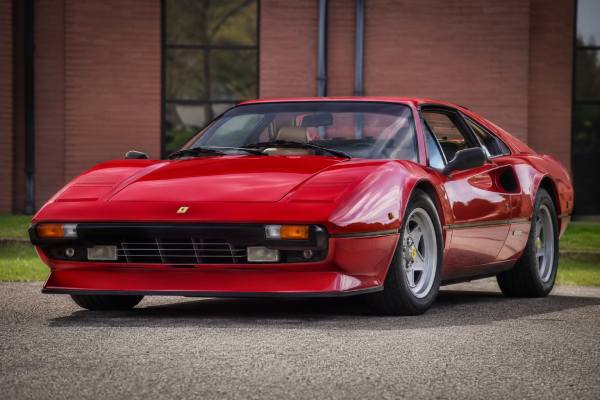
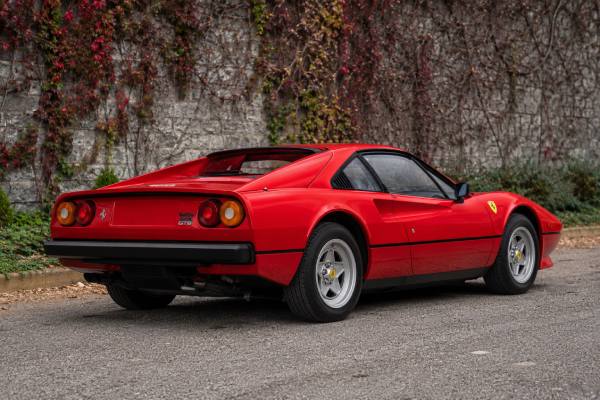
The Ferrari 208 GTB Turbo is the fixed-roof, two-seat, mid-engined Ferrari built from 1982 to 1985 around the F 106 D 000 2.0-litre turbocharged V8. Its chassis type, F 106 DB 100, places it in the 308-family line, but its engine makes it one of the most unusual road Ferraris of the period: a small-displacement V8 designed for the Italian market, where cars over 2.0 litres were heavily taxed.
The 208 GTB Turbo matters because it was Ferrari’s first turbocharged road car. It was not created as a pure homologation special or a global supercar flagship. It was a clever answer to a market problem. Ferrari took the underpowered naturally aspirated 2.0-litre 208 GTB idea and gave it forced induction, raising output to 220 hp and restoring the pace expected from a Pininfarina-styled mid-engined Ferrari. Today, buyers search for it because it combines 308-era looks, rarity, early Ferrari turbo history, and a very specific ownership profile.
Quick Take
The Ferrari 208 GTB Turbo is most appealing as a rare, Italian-market, 308-family coupe with a landmark engine: a 2.0-litre, single-turbo V8 that gave Ferrari its first production-road-car step into turbocharging. Its strongest draw is the mix of classic Pininfarina shape, manual gearbox, low production, and real historical importance; the main caution is that condition, originality, turbo-system health, timing-belt history, corrosion control, and documentation matter more than headline mileage or cosmetic shine.
Table of Contents
- History and Collector Significance
- Engine, Chassis and Key Specs
- Production, Variants and Identification
- Design, Engineering and Turbo Details
- Road Feel, Performance and Character
- Maintenance, Restoration and Known Risks
- Market Values, Buying Guide and Rivals
History and Collector Significance
The 208 GTB Turbo is historically important because it turned Ferrari’s tax-driven 2.0-litre V8 into a credible performance car and introduced turbocharging to Ferrari road production. It sits between the naturally aspirated 208 GTB and the later 328-based GTB Turbo, making it a bridge between the 308 era and Ferrari’s later forced-induction icons.
The story begins with Italian tax rules. In period, cars with engines over 2.0 litres attracted a much heavier tax burden in Italy, so Ferrari created smaller-displacement versions of its V8 models for the domestic market. The 208 GTB looked much like a 308 GTB, but its naturally aspirated 1990.64 cc V8 could not match the urgency of the 3.0-litre cars. It had the right shape and the right badge, but not enough power for buyers who expected Ferrari performance.
The turbo version changed that. Presented in 1982, the 208 GTB Turbo kept the compact 2.0-litre displacement but added a single exhaust-driven KKK turbocharger, Bosch K-Jetronic injection, and Marelli electronic ignition. Output rose to 220 hp at 7000 rpm, which brought the small-displacement car much closer to the performance character people associated with the 308 family.
Its significance is easy to underestimate because the 288 GTO and F40 later became the famous turbocharged Ferraris. The 208 GTB Turbo was less dramatic, less powerful, and sold mainly in Italy. Yet it came first. It proved that forced induction could fit into a Ferrari road car without turning the vehicle into a rough experiment. It also reflected Ferrari’s Formula 1 experience of the early 1980s, when turbocharging had become central to top-level racing.
The car’s place in the model line is narrow but meaningful. It was not a replacement for the 308 GTB in export markets. It was a specialized domestic-market alternative for buyers who wanted the style and chassis balance of a mid-engined Ferrari without crossing the Italian 2.0-litre tax threshold. That makes it both more obscure and more collectible than many casual observers expect.
Today, the 208 GTB Turbo appeals to two overlapping groups. Enthusiasts value it for its early turbo response, compact V8, manual gearbox, and 308-family proportions. Collectors value it for low production, model-code specificity, and its role as the first turbocharged Ferrari road car. It is still less famous than a carbureted 308 GTB, a 308 Quattrovalvole, or a 288 GTO, but it has a more unusual technical identity than most of them.
Engine, Chassis and Key Specs
The 208 GTB Turbo uses a transverse mid-mounted 2.0-litre 90-degree V8 with one turbocharger, a five-speed manual gearbox, rear-wheel drive, and a tubular steel chassis. Its key numbers are modest by modern supercar standards, but they were impressive for a 2.0-litre road car in the early 1980s.
| Item | Specification |
|---|---|
| Model | Ferrari 208 GTB Turbo |
| Chassis type | F 106 DB 100 |
| Engine type | F 106 D 000, 90-degree V8 |
| Displacement | 1990.64 cc |
| Bore x stroke | 66.8 mm x 71 mm |
| Induction | Single KKK exhaust-driven turbocharger |
| Fuel system | Bosch K-Jetronic mechanical fuel injection |
| Maximum power | 220 hp at 7000 rpm |
| Maximum torque | 240 Nm at 4800 rpm |
| Transmission | Five-speed manual |
| Drive | Rear-wheel drive |
| Top speed | 242 km/h |
The engine’s numbers are central to the car’s identity. A 2.0-litre V8 is rare on its own, and the turbocharger gave it a specific output of roughly 110 hp per litre. The compression ratio was reduced compared with the naturally aspirated 208, allowing the engine to accept boost. Maximum boost was around 0.6 bar, with the wastegate controlling pressure once the engine was on load.
The engine is mounted transversely ahead of the rear axle, in the same broad layout as the 308 family. The gearbox sits in unit with the engine, with the final drive and limited-slip differential packaged together. The five-speed manual is a traditional gated Ferrari transmission, and the ratios give the car a period feel rather than a relaxed grand-touring character.
| Area | Ferrari 208 GTB Turbo detail |
|---|---|
| Structure | Tubular steel chassis with separate body panels |
| Wheelbase | 2340 mm |
| Length | 4230 mm |
| Width | 1720 mm |
| Height | 1120 mm |
| Curb weight without options | 1284 kg |
| Suspension | Independent front and rear, wishbones, coil springs, hydraulic dampers, anti-roll bars |
| Steering | Rack and pinion, unassisted |
| Brakes | Ventilated discs on all four wheels, vacuum servo |
| Tyres | 205/55 VR16 front, 225/50 VR16 rear, depending on wheel specification |
The car’s suspension is straightforward and effective: double-wishbone-style independent suspension with coil springs, hydraulic dampers, and anti-roll bars. The steering is manual rack and pinion, which gives the car strong feedback once moving but requires more effort at low speeds than a modern assisted setup.
Performance figures vary slightly by source and test method, but the car’s broad ability is clear. It was capable of around 242 km/h and a standing kilometre in the high-27-second range. In period, that made it far more convincing than the naturally aspirated 208 GTB and close enough to the 308 family to feel like a real Ferrari rather than a tax-special compromise.
Production, Variants and Identification
The 208 GTB Turbo was a low-volume, left-hand-drive, Italian-market coupe, with 437 GTB examples built from 1982 to 1985. Its rarity, chassis type, engine type, and original Italian-market specification are the most important identification points for collectors.
The GTB Turbo was joined by the open-roof 208 GTS Turbo, but the GTB is the fixed-roof berlinetta. Both share the same basic 2.0-litre turbo idea, yet the GTB has the purer coupe structure and cleaner roofline. For buyers, the distinction matters because some market listings loosely group the 208, 208 Turbo, GTB Turbo, GTS Turbo, and later intercooled GTB/GTS Turbo together.
| Model | Period | Main identity | Buyer note |
|---|---|---|---|
| 208 GTB | 1980–1982 | Naturally aspirated 2.0-litre V8 coupe | Rarer in some counts, but much less powerful |
| 208 GTB Turbo | 1982–1985 | Single-turbo 2.0-litre V8 coupe, 220 hp | The first turbocharged Ferrari road car |
| 208 GTS Turbo | 1983–1985 | Single-turbo 2.0-litre V8 targa | Open-roof version with separate production count |
| GTB Turbo / GTS Turbo | 1986–1989 | 328-based, intercooled 2.0-litre turbo models | More powerful and visually updated, but not the same model |
A correct 208 GTB Turbo should be checked by its chassis number, type plate, engine number, body details, and supporting paperwork. The chassis number range often cited for the GTB Turbo is 41357 to 59277. The engine should correspond to the turbocharged 2.0-litre unit, not the naturally aspirated 208 engine and not the later intercooled 328-based unit.
Important identification points include:
- F 106 DB 100 chassis-type identity for the GTB Turbo coupe.
- F 106 D 000 engine identity for the 2.0-litre turbo V8.
- Left-hand-drive configuration.
- 308-family body proportions with turbo-specific exterior details.
- Bosch K-Jetronic injection and single KKK turbocharger.
- Period-correct wheels, interior trim, instruments, badges, and air intake details.
- Factory documentation, service book, owner’s manual, tool kit, jack kit, and import history.
Originality can be more complicated than it first appears. Many cars have crossed borders, and some have been restored, repainted, retrimmed, modified, or federalized depending on where they later lived. A car that looks excellent may still have incorrect engine-bay finishes, aftermarket boost changes, non-original wheels, missing books, or an unclear service history.
Factory colors and interiors follow the general Ferrari pattern of the period, with red over tan often seen, but less common color combinations can be especially interesting when properly documented. The key is proof. A rare color helps value only when it can be tied to the car’s original build or long-term documented history.
For serious buyers, Ferrari Classiche certification or strong specialist documentation can help confirm identity, but certification is not a substitute for inspection. The car still needs a physical review of chassis condition, engine type, gearbox condition, body repairs, stampings, trim, and all hard-to-find turbo-specific components.
Design, Engineering and Turbo Details
The 208 GTB Turbo looks close to a 308, but its cooling, intake, badging, and engine-bay details give it a distinct identity. The design works because Ferrari did not disguise the car’s purpose: it kept the elegant Pininfarina wedge and added just enough visual aggression to signal turbocharging.
The exterior belongs to the classic 308 design family: low nose, pop-up headlights, flying-buttress rear quarters, crisp side intake treatment, and a compact mid-engined stance. The GTB fixed roof gives the car a clean silhouette and better visual tension than the targa version. It is not a large car, and that compactness is part of its appeal today.
Turbo-specific details are important. The 208 GTB Turbo gained additional cooling and intake cues, including NACA-style ducts and a more assertive rear-engine-cover treatment. The red intake plenum with turbo script is one of the most recognizable features in the engine bay. A missing, refinished, or incorrect intake casting is not just cosmetic; it affects the car’s identity and collector appeal.
The engineering choice that defines the car is the single turbocharger. The KKK unit is driven by exhaust gas and uses a wastegate to control boost pressure. Ferrari’s owner literature describes the system as a high-speed centrifugal compressor driven by an exhaust-gas turbine. That sounds simple today, but in an early-1980s road Ferrari it was a significant step.
The car does not have the later sophistication of the 1986-on intercooled GTB/GTS Turbo. The first 208 GTB Turbo is more old-school: one turbo, mechanical injection, relatively low compression, and a clear transition from off-boost softness to boosted acceleration. That is part of its charm, but it also makes setup quality important. A tired fuel system, leaking intake tract, sticky wastegate, or incorrect ignition behavior can make a good car feel flat or unpredictable.
The chassis is familiar Ferrari V8 practice of the period. The tubular steel structure, mid-mounted transverse engine, limited-slip differential, independent suspension, and ventilated disc brakes make it a genuine driver’s car rather than a styling exercise. It was engineered to solve a tax problem, but Ferrari solved it with real performance hardware.
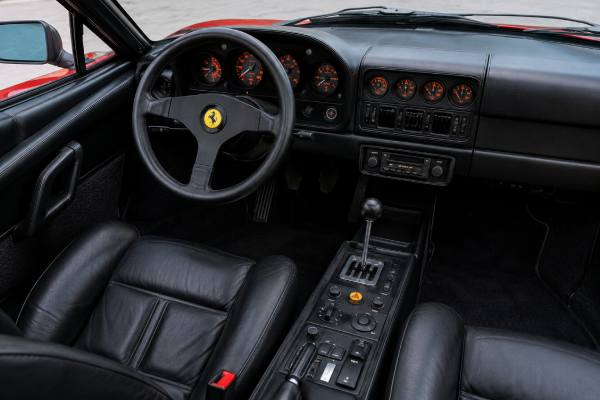
Inside, the cabin is compact and purposeful. The seating position is low, the windscreen is close, the dashboard is simple, and the gear lever sits in the exposed metal gate that defines the era. Ergonomics are not modern. Pedals, steering effort, cabin heat, ventilation, and visibility all feel period-correct. For many owners, that is exactly the point.
Road Feel, Performance and Character
The 208 GTB Turbo drives like a light, compact, manual Ferrari with a noticeable boost threshold rather than like a smooth modern turbo car. Its character is built around contrast: modest torque off boost, a sharp climb in energy as the turbo works, and a classic mid-engined chassis that rewards clean inputs.
At low revs, the 2.0-litre V8 does not feel large or effortless. It needs revs, temperature, and room to work. Below the boost range, it can feel lighter in torque than its 3.0-litre 308 relatives. Once the turbocharger begins to deliver, the car wakes up and becomes much more urgent. The power peak at 7000 rpm encourages a committed driving style.
Throttle response depends heavily on condition. A healthy, properly adjusted car should feel crisp enough for its age, but there will still be a period turbo pause. A poor example may feel hesitant, smoky, over-rich, under-boosted, or inconsistent. That difference matters because buyers sometimes confuse “old turbo character” with problems that need money.
The gearbox is a major part of the experience. The five-speed gated manual rewards patience when cold and precision when warm. Like many transaxle Ferraris of the era, second gear can be reluctant until the oil reaches temperature. A good car improves as it warms; a worn gearbox may remain difficult, noisy, or vague.
Steering feel is one of the strengths. There is no modern filter, and the front end communicates well once the car is rolling. At parking speeds it is heavy, but on a flowing road the steering feels direct and naturally weighted. The chassis is small enough to place accurately, and the coupe body gives a good sense of structure.
Braking performance is period-correct rather than modern-supercar brutal. The ventilated discs and servo assistance are suitable for fast road use when the system is fresh. Old hoses, tired fluid, sticky calipers, aged pads, or poorly set handbrake mechanisms can make the car feel much older than it should. Brake condition is therefore part of the driving experience, not just a maintenance note.
Ride quality is firm but not punishing when the suspension is correctly rebuilt and the tyres are suitable. Wrong tyres can ruin the car. The original tyre sizes and wheel options need careful attention because the car’s steering, gearing, and ride were developed around period rolling diameters and sidewall behavior.
On a mountain road, the 208 GTB Turbo is at its best when driven smoothly: brake in a straight line, let the front settle, feed in throttle, and wait for the turbo to add speed. It is not a car that likes clumsy mid-corner corrections. Its balance is good, but it is still a mid-engined classic with no modern stability control.
On highways, it feels more serious than the engine size suggests. The official top speed of about 242 km/h shows how effective the turbocharging was for the period. In city use, however, it is a warm, low, manual, old Ferrari. Cooling condition, clutch adjustment, fuel-system health, and driver patience all matter.
Maintenance, Restoration and Known Risks
The 208 GTB Turbo is not a simple cheap-to-run 308 substitute; it is a rare turbocharged Ferrari that needs specialist attention and correct parts. The biggest risks are deferred belt service, weak fuel injection, turbocharger and wastegate faults, cooling problems, corrosion, accident repairs, and missing model-specific components.
The engine uses toothed timing belts to drive the camshafts. Belt age and service history are critical. Buyers should not rely only on mileage because many collector cars sit for long periods. A car with low kilometres but old belts, old fuel hoses, old coolant hoses, and stale fluids can be more risky than a regularly exercised example.
Turbo-system condition deserves close inspection. The KKK turbocharger, wastegate, oil feed and return lines, intake ducting, boost plumbing, and exhaust hardware all live in a hot environment. Warning signs include smoke after overrun, oil residue in the intake tract, inconsistent boost, rattling, broken studs, exhaust leaks, or signs that someone has increased boost without a careful fuel and ignition setup.
Bosch K-Jetronic mechanical injection is durable when clean and correctly adjusted, but age causes trouble. Fuel distributors, warm-up regulators, accumulators, injectors, pumps, filters, and rubber lines all affect drivability. Poor hot starting, uneven idle, lean running, rich running, or hesitation under boost should be diagnosed properly rather than masked with adjustment.
Cooling health is another major ownership area. A mid-engined Ferrari with aged hoses, partially blocked radiators, weak fans, poor grounds, or old coolant can become frustrating quickly. Temperature stability in traffic and after hard use should be checked during a proper inspection.
Corrosion is a real concern. The 208 GTB Turbo is a steel-bodied 1980s Italian exotic, and rust repair can become expensive if hidden by paint. Pay close attention to lower body areas, sills, wheel arches, door bottoms, front luggage-compartment areas, chassis tubes, suspension pickup points, and any place that has trapped moisture or suffered previous accident damage.
A careful pre-purchase inspection should include:
- Engine number, chassis number, and type-plate verification.
- Compression and leak-down testing when appropriate.
- Timing-belt, tensioner, water-pump, and cam-cover service records.
- Turbocharger shaft play, smoke, boost control, and oil-line condition.
- Fuel-system pressure tests and hot-start behavior.
- Cooling-system pressure test and fan operation.
- Gearbox synchro behavior, especially when cold and warm.
- Clutch action, adjustment, and release mechanism.
- Suspension bushings, ball joints, dampers, wheel bearings, and alignment.
- Brake calipers, hoses, master cylinder, servo, discs, and handbrake.
- Body corrosion, accident repair, paint thickness, panel fit, and underbody condition.
- Interior originality, tools, books, manuals, jack kit, and service invoices.
Restoration is possible, but it is not the same as restoring a normal 1980s sports car. Some trim and mechanical parts overlap with the 308 family, but turbo-specific pieces can be difficult or expensive. Missing intake parts, incorrect turbo hardware, non-standard engine management changes, and improvised exhaust parts can reduce originality and increase sorting time.
Originality versus upgrades is a delicate tradeoff. Sensible hidden improvements, such as modern hoses, better electrical connections, improved cooling reliability, and careful fuel-line renewal, can make ownership safer and more dependable. Visible non-period modifications, aggressive boost changes, aftermarket wheels, modernized interiors, or incorrect body details usually hurt collector value.
Documentation is part of maintenance. A thick invoice file from recognized Ferrari specialists is worth more than vague claims. The best cars show repeated care over time, not a single large bill right before sale.
Market Values, Buying Guide and Rivals
The 208 GTB Turbo sits in a niche market: rarer and more historically significant than many people realize, but usually less expensive than the most famous 308 and 328 variants. Value depends heavily on originality, documentation, condition, and whether buyers correctly understand the difference between the 1982–1985 single-turbo car and the later intercooled GTB Turbo.
As of the current market, public sale data and European listings suggest that usable 208-family turbo cars often sit below top-tier 308 GTB values but above ordinary driver-grade oddities. The best documented, low-mileage, original, Classiche-certified, or rare-color cars can command a meaningful premium. Rough cars are risky because restoration costs can exceed the apparent discount.
The strongest value drivers are:
- Verified F 106 DB 100 / F 106 D 000 identity.
- Clear ownership history from new or early life.
- Original engine, gearbox, body panels, and major trim.
- Correct turbo-specific parts.
- Documented belt, fuel, cooling, clutch, and suspension work.
- High-quality paint and interior with evidence, not just shine.
- Original books, tools, service book, manuals, and import paperwork.
- Ferrari Classiche certification or equivalent specialist verification.
- Desirable original colors and factory-correct specification.
Cars to seek are the honest, documented examples that start easily hot and cold, hold temperature, build boost properly, shift cleanly when warm, brake straight, and show no hidden corrosion. A car with original paint and some patina may be more desirable than a freshly painted car with no restoration photos.
Cars to avoid include those with unclear engine identity, missing turbo-specific parts, heavy corrosion, crash-repair signs, incomplete records, modified boost systems, poor hot-start behavior, or recent cosmetic work hiding mechanical neglect. A bargain 208 GTB Turbo can become expensive quickly if the fuel system, turbocharger, belts, clutch, suspension, and body all need attention.
| Priority | Why it matters |
|---|---|
| Identity verification | Confirms it is the correct GTB Turbo, not a confused 208 or later GTB Turbo listing |
| Turbo and fuel-system health | Defines performance, drivability, and repair risk |
| Timing-belt and cooling history | Protects the engine and prevents expensive deferred-maintenance surprises |
| Body and chassis condition | Corrosion and accident repairs are costly and can damage collector value |
| Originality and documentation | Separates a collectible Ferrari from a merely attractive old sports car |
The closest same-brand alternatives include the Ferrari 308 GTB Quattrovalvole, the naturally aspirated 208 GTB, the 208 GTS Turbo, and the later 328-based GTB Turbo. The 308 offers more familiar market recognition and a larger engine. The naturally aspirated 208 is rarer in some forms but lacks the turbo car’s performance and historical importance. The 208 GTS Turbo gives open-roof appeal. The later GTB Turbo is faster and more refined, but it does not have the same “first turbo Ferrari road car” status.
Period rivals include the Porsche 911 Turbo, Lotus Esprit Turbo, and Maserati Biturbo in very different ways. The Porsche has stronger global recognition and a more established market. The Lotus has similar forced-induction 1980s drama and mid-engined packaging. The Maserati is far less collectible in the same sense, but it reflects the same Italian turbo era.
For long-term collectability, the 208 GTB Turbo has a persuasive case. It is rare, visually tied to one of Ferrari’s best-known design families, mechanically unusual, and historically first. Its challenge is awareness. Many buyers still need education to understand why a 2.0-litre Ferrari can be special. That also creates opportunity: the best cars may look undervalued when compared with more famous Ferrari models that are not as technically distinctive.
References
- Ferrari 208 GTB Turbo (1982) 1982
- Ferrari 208 GTS Turbo (1983) 1983
- Ferrari GTB Turbo (1986) – Ferrari.com 1986
- Ferrari 208 Turbo Owner’s Manual | AI Chat & PDF | Manualzz 1982 (Owner’s Manual)
- Ferrari 208 & GTB/GTS Turbo Market 2026 (Market Data)
Disclaimer
This article is for informational purposes only and is not a substitute for professional diagnosis, repair, inspection, valuation, or restoration advice. Specifications, torque values, service intervals, fluids, procedures, equipment, and market details can vary by VIN, market, production date, and individual vehicle history. Always verify important information against official Ferrari service documentation, factory records, and a qualified Ferrari specialist before buying, repairing, or maintaining a Ferrari 208 GTB Turbo.
If this guide helped you, please share it on Facebook, X/Twitter, or your favorite enthusiast community to support our work.