
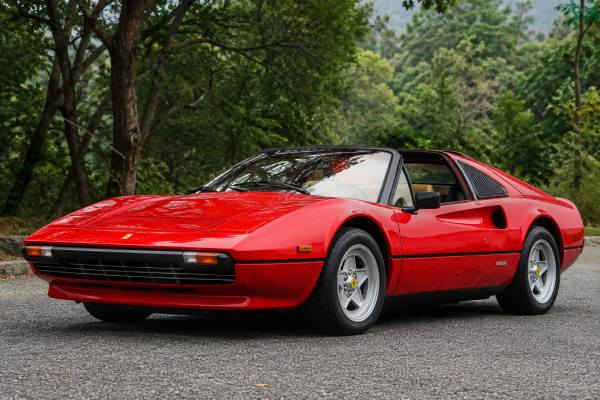
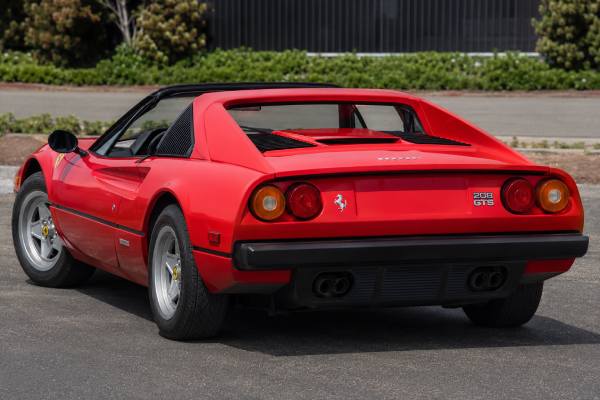
The Ferrari 208 GTS (F 106 CS 100) is the open-roof, two-seat, Italian-market version of Ferrari’s small-displacement 308 family, built from 1980 to 1982 with a 1,990.64 cc carbureted V8 rated at 155 hp. It matters because it is not simply a slower 308 GTS. It is one of the most unusual tax-era Ferraris: a mid-engined Pininfarina targa with a two-liter V8, Weber carburetors, a gated five-speed gearbox, and production of only about 140 cars.
Its engine, often identified within the F 106 CB family, was created to keep displacement below the two-liter tax threshold that shaped the Italian market at the time. That decision gave the 208 GTS a very different character from the three-liter 308 GTS. It has the same basic shape, seating position, chassis layout, and visual drama, but less torque and a more demanding high-revving personality. Today, people search for it because it sits at the intersection of rarity, 308-era styling, classic Ferrari carburetion, and a buying decision that depends heavily on originality and condition.
Quick Take
The Ferrari 208 GTS is most appealing as a rare, carbureted, targa-roof member of the 308 family with a uniquely Italian-market backstory and only modest production numbers. Its 2.0-liter V8 gives it charm, sound, and mechanical interest, but not the effortless pace of a 308, so buyers should treat it as a condition-sensitive collector car rather than a bargain alternative. The best examples are original, well documented, structurally sound, correctly numbered, and maintained by specialists who understand Weber carburetors, timing belts, cooling systems, and 308-era corrosion points.
Table of Contents
- History and Collector Context
- Engine, Chassis and Core Specs
- Production, Variants and Factory Details
- Design, Engineering and Special Features
- Road Feel, Performance and Usability
- Maintenance, Reliability and Restoration
- Market Values, Buying Advice and Rivals
History and Collector Context
The 208 GTS is historically important because it shows how Ferrari adapted a mid-engined sports car to a specific tax and market problem without abandoning the classic Ferrari formula. It gave Italian buyers the look, layout, and theatre of the 308 GTS while staying below the two-liter displacement line that made larger-engined cars more expensive to buy.
Ferrari had already explored the idea with the Dino 208 GT4, a 2+2 coupe based on the Bertone-designed 308 GT4. When the company moved toward the two-seat 308 GTB and GTS body style, it also needed a successor for buyers who still wanted a tax-friendly Ferrari. The answer was the 208 GTB and 208 GTS, introduced around 1980 and built until 1982.
The 208 GTS used the same basic visual language as the 308 GTS: a low wedge profile, pop-up headlights, scalloped side intakes, a removable targa roof panel, and Pininfarina’s clean, restrained surfaces. Under the skin, however, it carried a smaller V8. The displacement was held just under 2.0 liters, making it one of the smallest V8 engines ever fitted to a production road car.
This gives the car a special place in Ferrari history. It belongs to the 308 family, but it is not a mainstream 308. It belongs to the carburetor era, but it arrived as many markets were moving toward fuel injection. It has the classic Ferrari manual gearbox and mid-engined layout, yet it was shaped by taxation as much as by performance ambition.
The 208 GTS also has a rarity advantage. The open GTS body was made in smaller numbers than most 308-series variants. About 140 examples of the naturally aspirated 208 GTS were built, compared with thousands of 308 GTS and 308 GTSi cars. That rarity does not automatically make every 208 GTS highly valuable, because demand still depends on condition, documentation, and buyer understanding. But it does mean a correct car is not easy to replace.
Its reputation today is mixed in a useful way. Enthusiasts often describe it as one of the least powerful mid-engined Ferraris of its period, and that is fair. At 155 hp, it does not deliver the same acceleration as a three-liter carbureted 308 or later quattrovalvole model. But collectors increasingly value cars for identity, story, mechanical purity, and scarcity, not only power. On those measures, the 208 GTS has become far more interesting than its paper output suggests.
The 208 GTS is best understood as a collector’s Ferrari with a distinctive brief. It is for someone who values the 308 shape, open-roof driving, Weber carburetors, light controls, and a rare Italian-market specification. It is not the ideal choice for a buyer who wants the fastest 308-style car for the money.
Engine, Chassis and Core Specs
The core technical story is simple: the 208 GTS combined the 308-style tubular chassis and targa body with a 1,990.64 cc, 90-degree V8 fed by four Weber carburetors. The result was a mechanically traditional Ferrari that traded torque and outright speed for tax efficiency, rarity, and a very rev-focused personality.
| Item | Specification |
|---|---|
| Model | Ferrari 208 GTS |
| Chassis type | F 106 CS 100 |
| Engine family | F 106 CB-series 90-degree V8 |
| Production period | 1980–1982 |
| Body style | Two-seat targa-top berlinetta-style sports car |
| Layout | Transverse mid-engine, rear-wheel drive |
| Displacement | 1,990.64 cc |
| Bore x stroke | 66.8 mm x 71 mm |
| Induction | Four Weber 34 DCNF carburetors |
| Valve gear | Twin overhead camshafts per bank, two valves per cylinder |
| Compression ratio | About 9:1 |
| Maximum power | 114 kW / 155 hp at 6,800 rpm |
| Maximum torque | 170 Nm at 4,200 rpm |
| Transmission | Five-speed manual plus reverse |
| Brakes | Four-wheel disc brakes |
| Steering | Rack and pinion |
| Fuel capacity | 74 liters |
| Dry weight | About 1,254 kg |
| Top speed | About 215 km/h |
The engine is the car’s defining feature. A two-liter V8 sounds unusual because it is unusual. Instead of using a larger displacement engine tuned softly, Ferrari built a small, oversquare-feeling unit that needed revs and careful carburetor setup to feel lively. Its quoted 155 hp arrives high in the rev range, while the torque figure is modest by 308 standards.
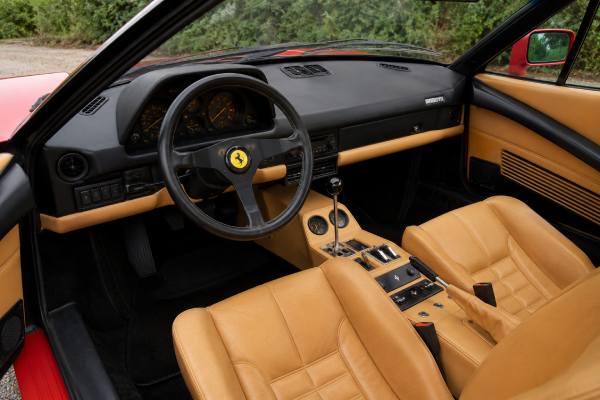
The five-speed manual gearbox sits in the classic Ferrari transverse mid-engine package. The engine and gearbox share a compact layout behind the cabin, with the famous open-gate shift pattern in the cockpit. The gearbox is one of the main reasons the 208 GTS still feels special at normal road speeds. Even when the engine is not delivering big acceleration, the mechanical action of the clutch, lever, and drivetrain keeps the driver involved.
The chassis follows the familiar 308 pattern: a tubular steel frame, independent suspension, unequal-length wishbones, coil springs, hydraulic dampers, and anti-roll bars. This was not exotic in the modern carbon-fiber sense, but it was a serious sports-car layout. The car’s balance comes from its mid-engine placement, low seating position, and compact wheelbase.
| Item | Specification |
|---|---|
| Length | 4,230 mm |
| Width | 1,720 mm |
| Height | 1,120 mm |
| Wheelbase | 2,340 mm |
| Front track | 1,460 mm |
| Rear track | 1,460 mm |
| Front suspension | Independent wishbones, coil springs, telescopic dampers, anti-roll bar |
| Rear suspension | Independent wishbones, coil springs, telescopic dampers, anti-roll bar |
| Standard tire size | 205/70 VR 14 front and rear |
The tire size is worth noting. A 208 GTS on correct 14-inch wheels and period-style Michelin XWX-type tires feels different from one wearing modern rubber or non-standard wheels. Taller sidewalls give the steering and ride a more period-correct feel. Wider wheels and modern tires may improve grip, but they can also make the steering heavier, expose worn suspension parts, or reduce originality.
The brakes are discs all round, but expectations should be period-correct. A healthy system is reassuring on the road, yet it will not feel like a modern carbon-ceramic setup. Pedal feel, hose condition, caliper health, fluid age, and pad choice matter more than any simple specification line.
Production, Variants and Factory Details
The naturally aspirated Ferrari 208 GTS was a short-run, left-hand-drive, Italian-market targa built in far smaller numbers than the 308 GTS. The key buyer detail is that the correct car is not just “a 308 with a small engine”; it has its own chassis type, engine identity, production range, and market history.
The naturally aspirated 208 two-seat line included the closed 208 GTB and the targa-roof 208 GTS. The GTB used the F 106 CB 100 chassis type, while the GTS used F 106 CS 100. Both used the two-liter V8, but the GTS is the open-roof car covered here.
Approximate production for the naturally aspirated 208 line is usually given as:
| Variant | Production period | Approximate production | Chassis number range |
|---|---|---|---|
| 208 GTB | 1980–1982 | 160 cars | 31219–41329 |
| 208 GTS | 1980–1982 | 140 cars | 31249–41265 |
These numbers make the 208 GTS one of the rarer 308-body Ferraris. However, buyers should be careful with the word “rare.” Rarity helps only when the car is correct, complete, and desirable. A tired, modified, undocumented, or poorly restored 208 GTS can be harder to sell than a more common but excellent 308.
How to identify a real 208 GTS
A correct 208 GTS should be checked through several layers, not by badges alone. Important points include:
- F 106 CS 100 chassis identity for the GTS body.
- A 1,990.64 cc V8 from the correct F 106 CB-series family.
- Left-hand-drive configuration, as these cars were not normally built in right-hand drive.
- Four Weber carburetors rather than later fuel-injection or turbo equipment.
- Single-exhaust details and 208 badging consistent with the naturally aspirated model.
- Factory-style wheels, trim, instruments, and interior details appropriate to the year.
Chassis, engine, and body numbers should be inspected by a Ferrari specialist. The aim is not only to find fraud. Many classic Ferraris have had engine work, accident repairs, replacement panels, repainting, and interior retrimming. Some work is acceptable if it is documented and done correctly. The danger is paying collector money for a car that has lost the originality that makes the model interesting.
Options and trim details
Factory equipment and options were similar to 308-era practice, but the details matter. Cars may be seen with air conditioning, metallic paint, a passenger-side mirror, front fog lights, fitted luggage, deeper front spoiler treatment, wider wheels, or a Boxer-style two-tone paint layout. Some cars may also have later updates or owner-added equipment.
Interior details can vary between early and later production. Early cars may share features with the earlier carbureted 308 interior, while later cars may show details closer to the fuel-injected 308 layout. This is why a single “correct” interior description is not enough. A buyer should compare the car against period photos, build information, and expert knowledge for its chassis number.
Documentation that adds value
For a 208 GTS, paperwork is not decoration. It can materially change the car’s value and confidence level. The strongest files usually include:
- Original service book or early service records.
- Owner’s manual, pouch, jack, tool roll, and emergency equipment.
- Old registration documents, especially from Italy.
- Invoices showing timing belt, carburetor, cooling, brake, suspension, and fuel-system work.
- Photos and invoices for any restoration or paintwork.
- Ferrari Classiche or marque-specialist confirmation when available.
A missing tool kit should not automatically kill a purchase, but it matters on a low-production Ferrari. Replacing correct books, tools, trim, wheels, and small details can become expensive and time-consuming.
Design, Engineering and Special Features
The 208 GTS looks special because it carries the same Pininfarina wedge form that made the 308 one of Ferrari’s most recognizable road cars. Its engineering is special for a different reason: Ferrari packaged a tiny two-liter V8 into a proper mid-engined targa, creating a car that is mechanically familiar yet historically unusual.
The body shape is clean and purposeful. The nose is low, the headlights retract, the waistline is crisp, and the rear deck sits over the transverse V8. The side intakes are not decoration. They feed the engine bay and cooling systems, and they give the car much of its visual tension. The satin-black trim, bumpers, window surrounds, and lower detailing keep the car rooted in early-1980s Ferrari design.
The removable targa roof is central to the GTS identity. It makes the car more open and dramatic than the GTB, especially at modest speeds where the engine note and intake sound are easier to enjoy. It also adds ownership checks. The roof panel should fit well, seal properly, latch securely, and store correctly. Wind noise and minor water leaks are not unusual on older targa cars, but poor fit can also signal accident repair, body distortion, or tired seals.
Small V8, big character
The 2.0-liter V8 is the car’s most distinctive engineering feature. A V8 of this size has very small individual cylinder displacement, so it does not deliver the low-speed shove people expect from larger Ferrari engines. Instead, it encourages revs. When the carburetors are balanced and the ignition is healthy, the engine feels crisp, light, and mechanical.
The four Weber 34 DCNF carburetors also shape the car’s character. They provide sound, response, and period authenticity, but they require correct setup. Poor synchronization, air leaks, worn throttle shafts, old fuel hoses, or incorrect jetting can make the car feel flat, hesitant, or unpleasant in traffic. A properly tuned 208 GTS feels much better than its horsepower figure suggests; a poorly tuned one can feel weaker than expected.
Packaging and cooling
The mid-engine layout creates the classic Ferrari cabin-forward stance, but it also concentrates heat behind the passenger compartment. Cooling health matters. The radiator, fans, hoses, thermostat, water pump, expansion tank, and coolant pipes should all be treated as part of a system. Because the car is now more than four decades old, overheating problems are often caused by age, blocked passages, tired fans, poor grounds, or deferred maintenance rather than a single dramatic failure.
The fuel tanks are mounted close to the engine bay area, as on related 308-series cars. This makes fuel-hose quality and smell inspection important. Any fuel odor should be taken seriously. Old carbureted Ferraris can suffer from aged lines, tired clamps, perished filler hoses, and seepage around fittings.
Cabin and controls
The cockpit is narrow by modern standards but clear and driver-focused. The driver sits low, looks over a simple instrument binnacle, and works a metal-gated manual shift. Visibility is better than in many later exotic cars, especially forward and to the sides, although rear three-quarter vision still requires care.
Interior materials include leather, vinyl, black trim, and period switchgear. The best cabins feel simple rather than luxurious. Sticky plastics are not the issue they became on later Ferraris, but leather shrinkage, seam wear, faded carpets, cracked vinyl, loose switches, and tired ventilation controls are common age-related concerns. Air conditioning, where fitted, should be judged as a classic system, not a modern climate-control unit.
Road Feel, Performance and Usability
The 208 GTS is enjoyable because it feels mechanical, compact, and communicative, not because it is brutally fast. Its best driving moments come when the engine is warm, the carburetors are cleanly metering fuel, the road is open, and the driver is willing to use revs and gears.
Acceleration is modest for a Ferrari and respectable for its period displacement. The quoted top speed is around 215 km/h, and some period data places 0–100 km/h in the high-seven-second range. More important than the number is how the car gets there. Below the mid-range, it can feel calm. Above that, the V8 becomes sharper and more alive.
The throttle response depends heavily on condition. A well-set-up Weber-fed car responds cleanly and has a crisp intake note. A neglected one may stumble, smell rich, hesitate when hot, or feel uneven between carburetor barrels. Anyone test-driving a 208 GTS should not assume a flat engine is “just how they are.” These cars are not torque monsters, but they should still feel smooth, eager, and balanced.
The five-speed gearbox is a highlight. Like many classic Ferraris, it can be stiff when cold, especially into second gear. Patience during warm-up is part of the ownership routine. Once warm, the lever should move through the gate with precision. Crunching, baulking, jumping out of gear, or heavy clutch action should be investigated.
Steering is unassisted and more communicative than most modern systems. At parking speeds it requires effort, especially if the car has wider tires than standard. On the road it lightens and gives good front-end information. The mid-engine balance helps the car rotate neatly, but the short wheelbase and rear weight bias deserve respect in wet or cold conditions.
Ride quality is one of the quiet pleasures of a correct 208 GTS. On period-style tires, it has compliance that many modern sports cars lack. The chassis is firm but not harsh, and the car feels light on its feet. Overly stiff dampers, incorrect ride height, worn suspension bushings, or very modern tire choices can spoil that balance.
Braking should feel progressive and stable. The system does not have modern electronic assistance, so the driver needs to apply real pressure. A long pedal, pulling, vibration, or weak braking can point to old hoses, seized calipers, tired pads, contaminated fluid, or uneven discs.
Warm-up and traffic behavior
A 208 GTS is not a jump-in-and-thrash car. It needs mechanical sympathy. Oil temperature, coolant temperature, gearbox temperature, and carburetor behavior all improve after a careful warm-up. In traffic, the driver should watch coolant temperature and fan operation. Hot-start behavior should also be checked during a pre-purchase inspection.
Cabin heat can be noticeable because of the mid-engine layout and older insulation. Ventilation is period-correct rather than powerful. The targa roof improves the experience, but it also adds wind noise and seal checks. Long motorway trips are possible in a healthy car, though the driving position, luggage space, noise, and air conditioning are all classic-car compromises.
How condition changes the drive
Two 208 GTS examples can feel very different. A sorted car feels light, precise, and full of texture. A tired car can feel slow, hot, vague, and expensive. The biggest differences usually come from:
- Carburetor balance and fuel-system condition.
- Ignition health and timing accuracy.
- Suspension bushings, dampers, and alignment.
- Brake caliper condition and fluid age.
- Engine mounts, gearbox linkage, and clutch adjustment.
- Correct wheels and tires.
This is why a test drive should include cold start, warm idle, low-speed running, full-temperature behavior, steady cruise, braking, tight turns, and a careful check for leaks or smells afterward.
Maintenance, Reliability and Restoration
The 208 GTS can be reliable when maintained like a classic Ferrari, but it is not forgiving of neglect. The main risks are age-related deterioration, poor carburetor setup, deferred belt service, cooling issues, corrosion, electrical faults, and past repairs that were done cheaply.
The timing belts are one of the first ownership questions. The 208’s V8 uses belt-driven camshafts, and belt service should be handled by someone who knows the 308/208 family. A seller saying “the belts look fine” is not enough. Buyers should look for dated invoices showing belts, tensioners, seals where needed, and related inspection work.
Carburetor maintenance is another key area. The Weber DCNF setup is part of the car’s appeal, but it needs clean fuel, correct filters, tight linkages, good gaskets, and expert synchronization. Many running complaints come from a combination of small faults: old fuel, weak ignition, dirty jets, vacuum leaks, and incorrect adjustment.
Common mechanical inspection areas
- Timing belt history: confirm dates, mileage, tensioners, and who performed the work.
- Fuel hoses and tanks: inspect for seepage, fumes, old rubber, and unsafe clamps.
- Carburetors: check balance, throttle-shaft wear, cold start, hot idle, and progression.
- Cooling system: inspect radiator, fans, thermostat, water pump, expansion tank, hoses, and bleeding.
- Ignition: verify correct spark, advance behavior, coil condition, wiring, and distributor-related parts where applicable.
- Clutch and gearbox: check engagement, synchromesh, linkage, leaks, and cold versus warm shifting.
- Suspension: inspect bushings, ball joints, dampers, wheel bearings, and alignment.
- Brakes: check calipers, hoses, discs, pads, master cylinder, and old fluid.
Electrical issues are usually age-related rather than mysterious. Fuse boxes, relays, grounds, connectors, window motors, fan circuits, lighting, and instruments can all suffer from heat, oxidation, and old repairs. A car with many small electrical faults may have been stored poorly or worked on by non-specialists.
Corrosion is a serious buying issue. The 208 GTS uses steel body panels over a tubular structure, with some aluminum and composite panels in specific areas. Rust can appear in lower body sections, door bottoms, sills, wheel arches, floor areas, battery zones, suspension mounting areas, and around repaired accident damage. Fresh paint can hide expensive problems.
Body and restoration risks
Restoration is costly because the car is rare but shares many labor-intensive 308-family issues. Panel fit, targa roof alignment, door gaps, front and rear clips, headlight pods, and engine cover fit should be inspected carefully. A shiny repaint is not proof of a good car. Overspray, poor masking, incorrect black trim finish, uneven gaps, bubbling, cracked filler, or missing factory details all reduce confidence.
Interior restoration can also be expensive. Correct leather grain, stitching, seat inserts, carpets, switchgear, instruments, and roof trim affect collector appeal. A retrim that looks attractive but ignores original patterns may be fine for a driver, but it can reduce value for a purist.
Parts availability is mixed. Many mechanical and service items overlap with related Ferrari models or are supported by specialists, but certain 208-specific, trim, emissions, documentation, and detail parts can be difficult. Because production was low, finding the correct small component can take longer than expected.
Originality versus upgrades
Some upgrades can make a 208 GTS easier to use, but they should be chosen carefully. Improved cooling fans, modern fuel hoses, better ignition components, and discreet electrical reliability fixes may be sensible if they are reversible and documented. Heavy visual modifications, non-standard wheels, incorrect exhausts, modernized interiors, or engine swaps usually hurt collector value.
The best approach is preservation with sympathetic maintenance. Keep the car mechanically safe and usable, but do not erase the features that make it a 208 GTS. A buyer should value a thick service file, expert invoices, original parts retained with the car, and honest disclosure more than cosmetic perfection alone.
Market Values, Buying Advice and Rivals
The 208 GTS sits in a narrow collector niche: rarer than most 308s, slower than most 308s, and most attractive to buyers who understand its Italian-market purpose. Its value is driven less by headline horsepower and more by originality, provenance, condition, documentation, and whether the car still feels like a correct carbureted 208.
Market data for the wider Ferrari 208 family moves because it includes naturally aspirated GTB/GTS cars and later turbocharged versions. Recent public listings and sales often place usable 208-family cars in the broad five-figure to low-six-figure euro or dollar range, with exceptional examples, rare specifications, or turbo variants capable of moving higher. For the naturally aspirated 208 GTS specifically, buyers should treat any advertised price as a starting point, not a final value guide. A documented, correct, freshly serviced car can justify a premium over a cheaper example needing belts, paint correction, carburetor work, and suspension renewal.
What drives value
| Factor | Why it matters |
|---|---|
| Original chassis and engine identity | The model’s rarity depends on correct 208 GTS specification, not just 308-style appearance. |
| Documentation | Service books, invoices, ownership history, and old registrations reduce uncertainty. |
| Body condition | Corrosion and accident repairs can exceed the cost difference between a cheap car and a good one. |
| Mechanical freshness | Belts, fuel hoses, carburetors, cooling, brakes, and suspension strongly affect usability. |
| Interior originality | Correct seats, trim, instruments, and roof details matter on a low-production collector car. |
| Factory color and options | Desirable colors, air conditioning, correct wheels, books, tools, and luggage can lift appeal. |
| Specialist inspection | A pre-purchase inspection can reveal expensive hidden work before negotiation. |
A 208 GTS is a poor car to buy blindly. The engine bay, underside, body seams, targa roof, fuel system, suspension mounts, brake system, and documentation should all be reviewed by a specialist. The inspection should include a compression or leak-down test when appropriate, confirmation of belt history, carburetor evaluation, a check for overheating, and a careful look for crash repair.
Cars to seek
The best examples usually share several traits:
- Long-term ownership or clear history rather than repeated short-term sales.
- Correct F 106 CS 100 identity and appropriate engine specification.
- Recent major service by a recognized Ferrari or Italian exotic specialist.
- Clean underside and known bodywork history.
- Original books, tools, jack, roof panel bag, and period documentation where possible.
- Good hot and cold behavior, stable temperatures, and clean throttle response.
- Correct wheels, tire sizing, trim, badges, and exhaust layout.
Cars to avoid
Walk away or negotiate very carefully if the car has:
- No convincing timing belt history.
- Fuel smell, visible fuel seepage, or old rubber hoses.
- Overheating during traffic or after a spirited drive.
- Poor roof fit, uneven gaps, or signs of structural repair.
- Heavy modifications that are hard to reverse.
- Missing documents combined with inconsistent numbers.
- A fresh cosmetic restoration with no photos or invoices.
- Carburetor problems dismissed as normal behavior.
The closest same-brand alternatives are the 308 GTS, 308 GTSi, 308 GTS Quattrovalvole, and later 328 GTS. A carbureted 308 GTS is faster and more famous, but usually more expensive in equivalent condition. The 308 GTSi has more accessible fuel-injection behavior but less carburetor charm. The 308 QV and 328 GTS are stronger performers and easier to recommend for regular use, though they lack the unusual two-liter story.
The 208 GTB is the closed-roof sibling and may appeal to buyers who prefer sharper structure and coupe lines. The later 208 Turbo and GTS Turbo are very different propositions. They keep the two-liter tax concept but add turbocharging, more power, and more complexity. They are historically important because the 208 GTB Turbo was Ferrari’s first turbocharged road car, but their maintenance and driving character differ from the naturally aspirated 208 GTS.
Outside Ferrari, period rivals include cars such as the Maserati Merak 2000, Lamborghini Urraco P200, Porsche 911 SC Targa, and Lotus Esprit. The Ferrari is rarer than most of these in 208 GTS form, but the Porsche is easier to use and support, while the Lotus and Maserati offer their own forms of exotic appeal. A buyer choosing the Ferrari should be doing so for the 308-family shape, the Ferrari badge, the tiny V8, and the special Italian-market history.
As a long-term collectible, the 208 GTS has a credible case. It is rare, pretty, mechanically interesting, and tied to a specific period in Ferrari and Italian motoring history. Its limitation is that it will always be compared with faster 308 and 328 models. That means the safest purchase is not the cheapest car. It is the most correct, best documented, and best maintained example within budget.
References
- Ferrari 208 GTS Specifications 2025
- PRODUCTION NUMBERS | 308 GTB Register 2026
- Ferrari 208 GTB & 208 GTS Guide — Supercar Nostalgia 2022
- Ferrari 208 & GTB/GTS Turbo Market – CLASSIC.COM 2026
- 1980 FERRARI 208 GTB & GTS OWNER’S MANUAL 188/80 1980 (Owner’s Manual)
Disclaimer
This article is for informational purposes only and is not a substitute for professional diagnosis, repair, inspection, or valuation. Specifications, torque values, service intervals, parts, and procedures can vary by VIN, market, equipment, and previous repair history. Always verify details against official service documentation and consult a qualified Ferrari specialist before buying, servicing, or restoring a Ferrari 208 GTS.
If this guide helped you, please consider sharing it on Facebook, X/Twitter, or your favorite car community to support our work.