
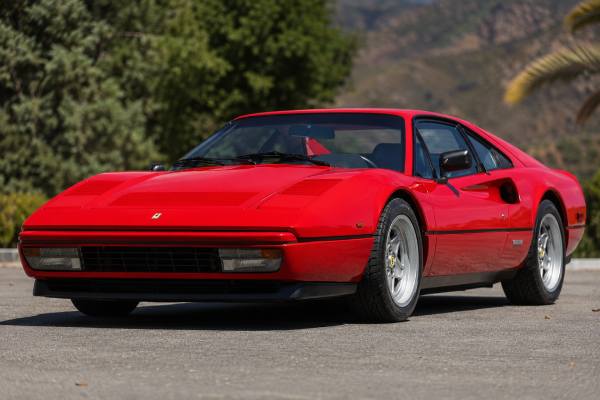
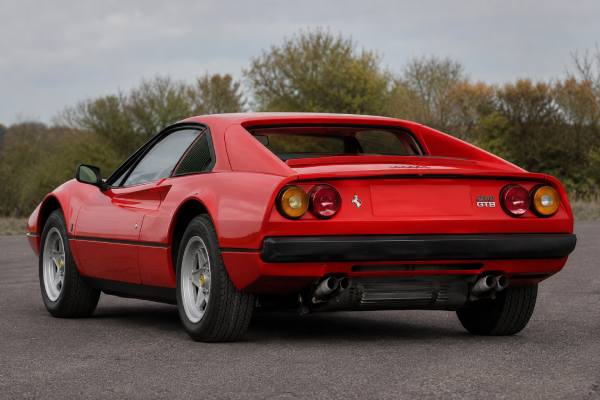
The Ferrari 208 GTB (F 106 CB 100) was Ferrari’s fixed-roof, two-seat, mid-engined 2.0-litre V8 berlinetta built from 1980 to 1982, using the F 106 CB 000 engine and producing 155 hp. It looks almost identical to a carburetted 308 GTB of the same era, but it exists for a very specific reason: Ferrari needed a car that kept the style and layout of the 308 while staying below Italy’s heavily taxed 2.0-litre displacement threshold.
That makes the 208 GTB one of the strangest and most interesting road Ferraris of the early 1980s. It is not famous for raw speed. In fact, it is often remembered as one of the least powerful mid-engined Ferraris ever sold. Its importance comes from the opposite direction: it shows how Ferrari adapted a serious sports-car platform to local tax law, created one of the smallest production V8 engines of its period, and built a very rare variant that now appeals to collectors who care about unusual specification, originality, and production history.
The 208 GTB is best understood as a niche collector Ferrari, not a budget 308 substitute. Its smaller engine, Weber carburettors, five-speed manual gearbox, steel Pininfarina body, and limited production make it appealing, but condition and documentation matter far more than headline performance. A tired car can be expensive to put right, while an original, well-kept example has a distinct place in the 208/308 family.
Quick Take
The Ferrari 208 GTB’s strongest appeal is its rarity and its unusual tax-era engineering: a 308-style mid-engined berlinetta with a naturally aspirated 2.0-litre V8, Weber carburettors, and only 155 hp. It is more collectible for its story, specification, and Pininfarina shape than for acceleration. The main caution is that maintenance and restoration costs are Ferrari-level even though the performance is modest, so buyers should focus on originality, chassis and engine identity, corrosion, accident history, service records, and specialist inspection before price.
Table of Contents
- History, Purpose and Collector Significance
- Engine, Chassis and Key Specifications
- Production, Variants and Factory Details
- Design, Engineering and Special Features
- Driving Experience and Real-World Performance
- Reliability, Maintenance and Restoration Reality
- Market Value, Buying Guide and Rivals
History, Purpose and Collector Significance
The Ferrari 208 GTB matters because it is a purpose-built 2.0-litre version of the 308 GTB, created mainly for markets where larger engines were punished by tax. It kept the 308’s mid-engined layout and Pininfarina styling, but used a smaller V8 that put it in a very different performance and collector category.
Ferrari had already explored this idea with the Dino 208 GT4, a 2.0-litre version of the Bertone-designed 308 GT4 2+2. By 1980, the two-seat 308 GTB and GTS shape was the stronger image car. The 208 GTB took that more desirable berlinetta format and adapted it to the same tax-driven brief. For Italian buyers, the key point was displacement. Staying below 2.0 litres could make a major difference to taxation, so Ferrari built an engine that came in just under the line.
The result was not a detuned 3.0-litre V8. Ferrari used a 1,990.64 cc version of its 90-degree V8, with a much smaller bore than the 308 engine. The 208 GTB therefore belongs to the same broad F106 family, but it has its own character and technical identity. It is a Ferrari shaped by national policy as much as by the normal search for speed.
In the model line, the 208 GTB sat below the 308 GTB in power and performance. It replaced the earlier 208 GT4 as Ferrari’s small-displacement domestic-market sports car and was offered alongside the 208 GTS, the removable-roof targa version. It was never intended to be Ferrari’s fastest car. It was intended to let buyers have the look, badge, mid-engine layout, and craftsmanship of a V8 Ferrari without crossing the expensive displacement boundary.
Pininfarina’s design gave the 208 GTB most of its appeal. To the casual eye, it carries the same wedge profile, flying-buttress rear quarters, pop-up headlights, side intake treatment, and compact proportions that made the 308 GTB one of Ferrari’s defining road cars of the late 1970s and early 1980s. That visual similarity is important. The 208 GTB’s smaller engine did not make it look like a lesser car.
Today, its reputation is more nuanced. Some enthusiasts focus on the low power output and call it slow by Ferrari standards. Others see it as a fascinating collector car because it is rare, mechanically unusual, and tied to a very specific period in Ferrari history. Both views are fair. It is not the car to buy if the goal is the quickest carburetted 308-family driving experience. It is far more interesting to someone who wants an uncommon factory variant with a story.
The 208 GTB also has a useful place in Ferrari’s turbo history. Its naturally aspirated 2.0-litre engine was soon replaced by the 208 GTB Turbo, Ferrari’s first turbocharged road car. That makes the 1980–1982 208 GTB the final naturally aspirated expression of the 2.0-litre two-seat V8 before forced induction became the answer to the same tax problem.
For collectors, the appeal rests on four main points:
- Very low production compared with mainstream 308 variants.
- The unusual F 106 CB 000 2.0-litre V8 engine.
- Close visual connection to the Pininfarina 308 GTB.
- Italian-market, left-hand-drive character with a clear historical reason for existing.
The car’s significance is not based on motorsport success or lap times. It is significant because it shows Ferrari responding intelligently to market conditions while preserving the design and layout that customers wanted. That kind of specificity often becomes more interesting with age.
Engine, Chassis and Key Specifications
The 208 GTB’s defining technical feature is its 1,990.64 cc transverse mid-mounted V8, identified as F 106 CB 000. It produced 155 hp at 6,800 rpm and 170 Nm of torque at 4,200 rpm, giving the car a very different feel from the larger 308 despite the similar body and chassis layout.
| Item | Specification |
|---|---|
| Model | Ferrari 208 GTB |
| Chassis type | F 106 CB 100 |
| Engine type | F 106 CB 000, 90-degree V8 |
| Layout | Transverse mid-engine, rear-wheel drive |
| Displacement | 1,990.64 cc |
| Bore x stroke | 66.8 mm x 71 mm |
| Valve gear | Twin overhead camshafts per bank, two valves per cylinder |
| Fuel system | Four Weber 34 DCNF carburettors |
| Maximum power | 155 hp at 6,800 rpm |
| Maximum torque | 170 Nm at 4,200 rpm |
| Transmission | Five-speed all-synchromesh manual |
| Lubrication | Wet sump |
The small displacement is not achieved by a short-stroke design. The 208 GTB engine uses a narrow 66.8 mm bore with a 71 mm stroke, making it undersquare. That helps explain the engine’s character. It does not have the easy mid-range strength of a 3.0-litre 308, and it needs revs and careful gear choice to feel lively. It is still a Ferrari V8, but it is a small-capacity carburetted engine working inside a relatively sophisticated sports-car platform.
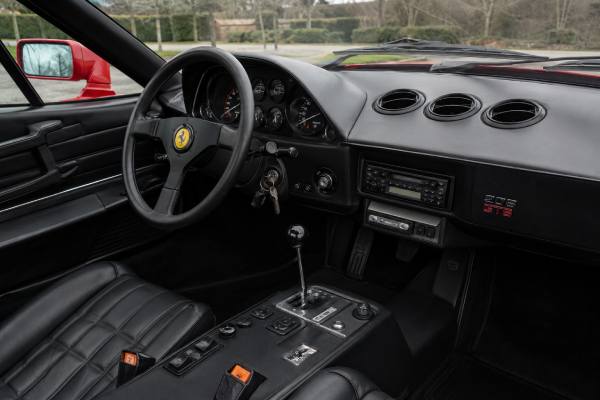
The five-speed gearbox sits in unit with the engine, below and behind the engine’s sump area. This transverse layout is a central part of the 308-family package. It keeps the car compact and places the engine mass close to the centre of the car, which helps balance and agility. The shift pattern is the traditional Ferrari open-gate manual layout, and like many period Ferraris, the gearbox is usually at its best once the oil has warmed.
The chassis is a tubular steel frame, not a modern monocoque. The body is steel, with styling by Pininfarina and construction methods closely related to the steel-bodied 308 GTB. Suspension is independent all round, using wishbones, coil springs, hydraulic dampers, and anti-roll bars front and rear. Brakes are discs at all four corners.
| Item | Specification |
|---|---|
| Front suspension | Independent wishbones, coil springs, hydraulic dampers, anti-roll bar |
| Rear suspension | Independent wishbones, coil springs, hydraulic dampers, anti-roll bar |
| Brakes | Ventilated discs front and rear |
| Steering | Rack and pinion |
| Length | 4,230 mm |
| Width | 1,720 mm |
| Height | 1,120 mm |
| Wheelbase | 2,340 mm |
| Claimed top speed | About 215 km/h |
Compared with the 308 GTB, the numbers are modest. The 208 GTB’s power-to-weight ratio is not especially strong, and its top speed is lower than a 3.0-litre 308. But the chassis hardware is still serious. It has the same basic mid-engined balance, low driving position, compact dimensions, and mechanical purity that make the 308 family engaging.
The most important technical point for buyers is that the smaller engine does not make the car cheaper to maintain in proportion to its output. It still has timing belts, carburettors, ignition components, cooling demands, and Ferrari-specific access challenges. A 155 hp output does not mean ordinary-car service costs.
Production, Variants and Factory Details
The 208 GTB was a very limited-production car, with 160 examples built from 1980 to 1982. That low number is central to its collector identity, especially when compared with the much larger production totals of 308 GTS and later 328 models.
The fixed-roof GTB was paired with the 208 GTS, the targa-roof version. Both used the same basic 2.0-litre V8 engine, but the GTB is generally the purer shape and the more rigid body style. The GTS offered open-air driving, while the GTB carried the classic berlinetta roofline that many collectors prefer.
| Model | Body style | Production period | Key identity |
|---|---|---|---|
| 208 GT4 | 2+2 coupe | 1975–1980 | Bertone-bodied 2.0-litre predecessor |
| 208 GTB | Two-seat coupe | 1980–1982 | Fixed-roof 308-style 2.0-litre V8 |
| 208 GTS | Two-seat targa | 1980–1982 | Open-roof companion to the GTB |
| 208 GTB Turbo | Two-seat coupe | 1982 onward | Turbocharged successor with much stronger performance |
The 208 GTB was left-hand drive, reflecting its primary Italian-market focus. Buyers should not expect right-hand-drive factory examples. Cars may have lived in Italy for much of their early life before being exported later, so older Italian registration documents, service stamps, and import paperwork can be important parts of the file.
Chassis numbering is especially important. The 208 GTB used the factory chassis type F 106 CB 100, while the engine type was F 106 CB 000. Known 208 GTB chassis numbers fall in the 31219 to 41329 range. A buyer does not need to memorize every number, but the type codes and identity documents should agree with the car.
Identification points that matter
A correct 208 GTB should be identified as a 2.0-litre, naturally aspirated, carburetted car, not a 208 Turbo and not a 308. The easiest confusion comes from the shared body style. Because the 208 GTB looks so much like a 308 GTB, a proper inspection should confirm the car by chassis type, engine type, documentation, and mechanical specification.
Important identity checks include:
- Chassis type F 106 CB 100.
- Engine type F 106 CB 000.
- 1,990.64 cc naturally aspirated V8.
- Weber 34 DCNF carburettors.
- Five-speed manual gearbox.
- Left-hand-drive configuration.
- Correct period body and trim details.
Factory options and trim can vary, but buyers should treat originality with care. Air conditioning, electric windows, period audio equipment, leather trim, carpeting, paint colour, and wheel specification all affect how a car presents today. Some changes may be acceptable for use, but undocumented modifications can reduce collector confidence.
Ferrari Classiche certification can be valuable, especially for a rare model where identity and matching components matter. It is not the only proof of a good car, but it can help confirm originality, correct specification, and major component identity. A car with factory documentation, service history, old registration records, owner history, and invoices from known Ferrari specialists will usually be easier to value and easier to sell.
Design, Engineering and Special Features
The 208 GTB’s design appeal comes from sharing the 308 GTB’s Pininfarina shape while hiding one of Ferrari’s most unusual small-displacement V8s underneath. It is visually familiar but mechanically specific, and that contrast is the car’s most distinctive feature.
The body is a classic late-1970s Ferrari wedge. The nose is low, the headlights are hidden when not in use, the beltline is crisp, and the rear quarter treatment gives the car a planted mid-engined stance. The flying-buttress sail panels around the rear window are a key part of the GTB profile. They make the roofline look solid and purposeful, while also visually separating the fixed-roof berlinetta from the GTS.
The 208 GTB does not shout about its smaller engine. That understatement is part of the charm. It is not covered in special tax-model graphics or obvious economy cues. It looks like a serious Ferrari because it uses the same basic design language as one. Only people who know the 208 story will understand the significance.
Engineering was focused on packaging and tax compliance rather than new technology for its own sake. The transverse V8 layout allowed a short wheelbase and compact body. The small engine sat behind the cabin, driving the rear wheels through the five-speed transaxle. The tubular chassis and independent suspension were well proven by the time the 208 GTB arrived.
The engine itself is the technical centrepiece. A 2.0-litre V8 is unusual because each cylinder is very small. With only about 249 cc per cylinder, the engine has a delicate, high-revving personality compared with larger V8s. The four Weber carburettors add period character, but they also demand correct setup. When clean, balanced, and tuned properly, they give crisp response. When neglected, they can make the car hesitant, rich, flat, or difficult to start.
Cooling and airflow are typical mid-engined Ferrari priorities. The side intake treatment is not just decoration; the car needs proper airflow through the engine bay. Heat management matters because the engine, exhaust, fuel system, and electrical parts live in a confined rear compartment. Missing shields, tired hoses, weak fans, or poor wiring repairs can turn a pretty car into a frustrating ownership experience.
Inside, the 208 GTB feels like a compact classic Ferrari rather than a luxury GT. The driving position is low, the windscreen is close, the dashboard is simple, and the gated shifter is a major part of the theatre. Controls are not modern-light. The cabin can be warm, visibility is good forward but more limited to the rear quarters, and ergonomics reflect the period rather than modern comfort expectations.
The sound is also different from a larger 308. It is still a carburetted Ferrari V8, but the smaller displacement gives it a lighter, more mechanical voice. It does not have the same torque-rich bark as the 3.0-litre car. Instead, it rewards revs, throttle precision, and a driver who enjoys keeping the engine in its useful range.
Driving Experience and Real-World Performance
The 208 GTB drives like a balanced, compact, mid-engined classic with less power than its shape suggests. Its pleasure comes from steering, gearbox interaction, engine character, and chassis feel, not from effortless acceleration.
Anyone expecting 308 GTB pace will be disappointed. The 155 hp output means the driver must work the car. Low-speed response depends heavily on carburettor condition and ignition setup. A properly tuned example should feel clean and willing, but it will not surge forward on torque. It asks for revs and gear changes.
That can be enjoyable on the right road. The smaller engine encourages commitment without immediately reaching illegal speeds. On flowing mountain roads or open secondary routes, the driver can use more throttle and more revs than in a faster Ferrari. The five-speed manual becomes part of the rhythm, and the chassis has enough balance to make the car feel special even when the speed is modest.
The steering is one of the main rewards. With no modern electronic filters, the front end gives honest feedback. At parking speeds, effort can be heavy, especially on old or incorrect tyres. Once moving, the steering lightens and becomes accurate. Tyre choice, alignment, suspension condition, and bushing health make a major difference. A fresh, properly set-up 208 GTB can feel delicate and precise. A tired one can feel vague, nervous, or heavy.
The gearbox should not be judged stone cold. Like many Ferraris of this era, the shift can be stiff until the oil warms. Second gear may be reluctant when cold, and forcing it is poor practice. A healthy gearbox should become more cooperative with temperature, though it will still feel mechanical and deliberate rather than slick in the modern sense.
Braking performance is period-appropriate. The four-wheel disc setup is capable for road use when everything is fresh, but it does not feel like a modern sports car with huge assisted brakes and advanced tyres. Pedal feel, hose age, caliper condition, fluid quality, and pad choice all matter. Pulling, vibration, or a soft pedal should be taken seriously.
Ride quality is firm but not crude when the suspension is healthy. The compact wheelbase, mid-engine layout, and low stance make the car feel alert. Old dampers, tired rubber bushings, incorrect ride height, or uneven tyres can spoil the experience. Many cars look good in photos but need suspension recommissioning to drive properly.
What the 208 GTB feels like at different speeds
In town, the 208 GTB can feel demanding. The clutch, steering, cabin heat, carburettor behaviour, and limited rear visibility require patience. It is not a relaxed commuter.
On open roads, it becomes more natural. The engine can stay in its stronger rev range, the chassis begins to breathe, and the car feels lighter than the power figure suggests.
On highways, it can cruise, but it is not as effortless as a larger 308 or a later 328. Wind noise, engine speed, cabin temperature, and seating comfort all become part of the experience.
On track, the 208 GTB is more a historic driving exercise than a performance weapon. It needs sympathetic use, good cooling, fresh brakes, and a driver who respects the age and value of the car.
The key is expectation. A 208 GTB is not a slow car in the sense of being dull, but it is slow by Ferrari mid-engined standards. Buyers who accept that usually enjoy it more. It offers classic Ferrari sensations at a pace that rewards technique over bravery.
Reliability, Maintenance and Restoration Reality
The 208 GTB should be maintained like a rare carburetted Ferrari, not like a low-output used sports car. Its smaller engine does not reduce the importance of timing belts, carburettor tuning, cooling-system health, corrosion inspection, and specialist care.
The engine is generally understandable to Ferrari specialists familiar with 308-family cars, but access and parts quality matter. Timing belt service is one of the central maintenance items. Age matters as much as mileage because many 208 GTBs cover very few kilometres. A car that has sat for years may need more attention than one used regularly and serviced properly.
Carburettors are another major area. The four Weber units must be clean, correctly jetted, synchronized, and free from air leaks. Old fuel, varnish, worn linkages, cracked hoses, and poor previous adjustment can create running problems. A badly tuned carburetted Ferrari can feel weak and unpleasant, which is especially noticeable on a 2.0-litre car that does not have much spare torque.
The ignition system must also be right. Weak spark, old leads, poor grounds, distributor issues, and incorrect timing can make the engine feel flat or difficult to start. Because the 208 GTB already has modest output, any tuning error is felt immediately.
Cooling-system condition is critical. Look for:
- Old coolant hoses.
- Corroded radiator cores.
- Weak cooling fans.
- Poor thermostat operation.
- Leaking water pump seals.
- Evidence of overheating.
- Incorrect or messy repairs in the engine bay.
Fuel-system safety is equally important. Old rubber lines near hot engine parts are a serious risk. A careful owner will replace age-sensitive fuel hoses with correct, high-quality parts and keep the routing tidy and original-looking.
Corrosion is a major buyer concern. The 208 GTB’s steel body and tubular structure need close inspection. Rust can hide behind attractive paint, and repairs can become expensive quickly. Areas to check include lower doors, sills, wheel arches, lower front and rear panels, floor areas, suspension pickup points, seams, and the underside of the chassis. Bubbling paint is only the obvious sign; poor past repairs can be more serious.
Accident damage is another risk. Mid-engined Ferraris can be expensive to repair correctly, and older crash repairs may not meet today’s collector standards. Panel gaps, uneven shut lines, overspray, distorted chassis tubes, incorrect welds, and mismatched finishes should all be investigated. A professional inspection on a lift is not optional for a serious purchase.
Common ownership cost drivers
The biggest costs usually come from deferred maintenance rather than sudden failure. A car that has been stored, cosmetically refreshed, and lightly used may need a deep mechanical recommissioning.
Potential cost drivers include:
- Timing belt and tensioner service.
- Carburettor rebuild and tuning.
- Fuel-line replacement.
- Cooling-system renewal.
- Brake caliper, hose, and master-cylinder work.
- Suspension bushings, dampers, and alignment.
- Clutch replacement.
- Exhaust repairs.
- Electrical fault tracing.
- Corrosion repair and paintwork.
- Interior leather, switchgear, and trim restoration.
Parts availability is generally better than for many obscure exotic cars because of the relationship to the 308 family, but the 208-specific engine and model details still require care. Used parts, reproduction parts, and new old stock vary in quality. Correctness matters if the car is being preserved as a collector example.
Restoration should be approached carefully. A full restoration can easily exceed the value gap between a rough car and a good car. That is why the best purchase is often the most complete, honest, and well-documented car available, not the cheapest one. Original paint, original interior, correct mechanical components, and long-term records can be more valuable than a shiny but heavily redone car with missing history.
Originality upgrades create a tradeoff. Electronic ignition updates, modern cooling improvements, better tyres, and subtle reliability changes may make a car easier to use. But visible, irreversible, or poorly documented modifications can hurt collector appeal. The safest approach is to keep original parts, document all work, and avoid changes that alter the car’s identity.
Market Value, Buying Guide and Rivals
The 208 GTB sits in a narrow collector niche: rarer than many 308 variants, but less powerful and less widely desired. Good examples can be compelling, but the market rewards originality, documentation, condition, and correct identity more than mileage alone.
Current asking prices and public sales vary by country, condition, provenance, and whether the car is a naturally aspirated 208 GTB or a later Turbo. European listings for naturally aspirated 208 GTB examples often sit around the lower-to-mid six-figure euro region for very good cars, while auction results have shown that ordinary or uncertain examples can struggle if estimates are ambitious. The most useful market view is not one fixed number, but a condition-based range.
| Value factor | Why it matters |
|---|---|
| Original identity | Chassis, engine type, and documentation must confirm the car as a real 208 GTB. |
| Mechanical condition | Deferred Ferrari maintenance can erase any apparent bargain. |
| Body and chassis condition | Rust and accident damage are expensive and can hurt collector confidence. |
| Service history | Regular specialist care is more valuable than low mileage without invoices. |
| Original colours and trim | Correct, attractive factory combinations are easier to value and sell. |
| Documentation | Books, tools, old registrations, invoices, and certification strengthen provenance. |
| Market clarity | Naturally aspirated 208 GTBs should not be priced or compared carelessly with Turbo cars. |
Buyer inspection checklist
A serious inspection should focus on authenticity and total ownership risk. Normal used-car checks are not enough.
Before purchase, confirm:
- Chassis type and number against documents.
- Engine type and visible identity markings.
- Service history, especially timing belts and recent recommissioning.
- Carburettor condition and cold-start behaviour.
- Cooling-system health and signs of overheating.
- Fuel hoses and engine-bay safety.
- Gearbox behaviour cold and warm.
- Clutch operation and engagement point.
- Brake condition, leaks, and pedal feel.
- Suspension bushings, dampers, ball joints, and alignment.
- Rust in sills, arches, floors, lower panels, and chassis areas.
- Evidence of accident repairs or non-factory welding.
- Paint thickness, panel fit, and trim correctness.
- Interior originality and condition.
- Wheels, tyres, tools, books, and spare parts supplied with the car.
Cars to seek are complete, known-history examples with correct identification, clean body structure, strong service records, and honest presentation. A slightly worn but original car can be preferable to an over-restored car with weak paperwork.
Cars to avoid include those with unclear identity, missing engine information, heavy corrosion, accident damage, poor running, long storage without recommissioning, or fresh paint hiding unknown metalwork. A cheap 208 GTB can become very expensive if it needs body repair, engine work, interior restoration, and sorting at the same time.
The 208 GTB’s closest Ferrari alternatives are the 308 GTB, 308 GTS, 308 GTBi, 308 Quattrovalvole, 328 GTB, and 208 GTB Turbo. The 308 GTB offers stronger performance and broader recognition. The 328 is more modern, easier to use, and generally more powerful. The 208 GTB Turbo is historically important as Ferrari’s first turbocharged road car and is much quicker, but it brings its own turbo-specific maintenance questions.
Non-Ferrari period alternatives might include the Maserati Merak, Lamborghini Urraco, Porsche 911 SC, and Lotus Esprit. None gives exactly the same combination of Ferrari badge, mid-engined Pininfarina shape, and tax-special 2.0-litre V8 identity. That uniqueness is the 208 GTB’s strongest argument.
Long-term collectability looks stable because production is low and the car has a clear story. It is unlikely to overtake the most desirable 308 variants in broad demand, but rarity protects it from being ignored. The best cars will remain the ones with correct identity, high originality, strong documentation, and evidence of careful specialist maintenance.
For the right buyer, the 208 GTB is not a compromise. It is a specific collector Ferrari: less powerful than it looks, more interesting than its numbers suggest, and valuable only when condition and provenance support the story.
References
- Ferrari 208 GTB (1980) 2026 (Manufacturer Archive)
- Ferrari 208 GTB Specifications 2025 (Technical Specifications)
- PRODUCTION NUMBERS | 308 GTB Register 2026 (Production Data)
- Ferrari 208 & GTB/GTS Turbo Market – CLASSIC.COM 2026 (Market Data)
- Price Guide: Ferrari 208 GTB [UPDATED 2026] 2026 (Market Data)
Disclaimer
This article is for informational purposes only and is not a substitute for professional diagnosis, inspection, repair, valuation, or restoration advice. Specifications, torque values, service intervals, parts, procedures, and identification details can vary by VIN, market, production date, and equipment. Always verify important information against official Ferrari service documentation, factory records, and a qualified Ferrari specialist before buying, servicing, or restoring a vehicle.
If you found this guide useful, please consider sharing it on Facebook, X/Twitter, or your preferred car community to support our work.