
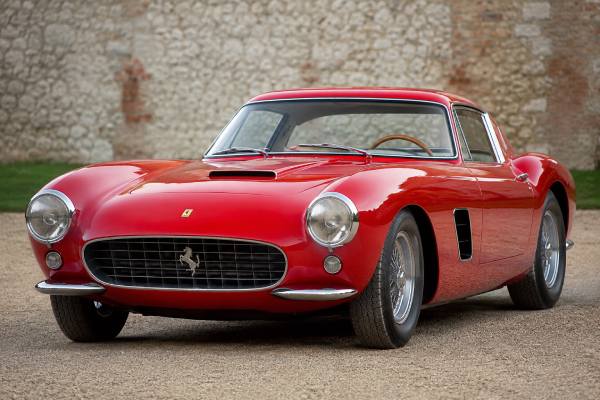
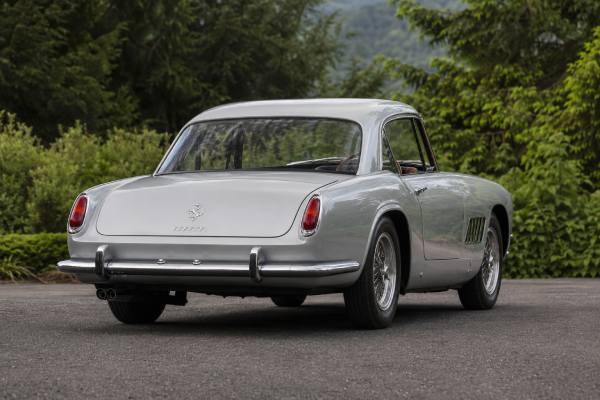
The Ferrari 250 GT Coupé Speciale Tipo 513 was a short-run, Pinin Farina-bodied 1956 grand tourer powered by Ferrari’s 3.0-litre Tipo 128 Colombo V12, rated at 240 hp. It sits in one of the most interesting corners of the early 250 GT story: not a regular Boano-bodied production coupé, not a 410 Superamerica, and not a competition berlinetta, but a coachbuilt bridge between all three.
Only four Tipo 513 Coupé Speciale examples were built, each with 410 Superamerica-inspired styling and individual customer details. That rarity is the main reason collectors study the car, but it is not the only reason. The model also shows how Ferrari was moving from low-volume bespoke road cars toward a more repeatable grand-touring formula. For buyers, owners, and serious enthusiasts, the appeal is a mix of early Colombo V12 engineering, special-order Pinin Farina design, documented provenance, and the demanding maintenance reality of a hand-built 1950s Ferrari.
Quick Take
The 1956 Ferrari 250 GT Coupé Speciale Tipo 513 is most appealing as a four-car coachbuilt Ferrari with Superamerica-style presence and the lighter, more usable 3.0-litre Colombo V12 identity of the 250 GT line. Its strongest technical and historical value comes from the Tipo 513 chassis designation, Pinin Farina bodywork, and position between bespoke early Ferraris and the coming Boano/Ellena production coupés. The caution is that every example is effectively a one-off collector car: condition, original components, restoration quality, Ferrari Classiche documentation, and chain of ownership matter far more than ordinary mileage or cosmetic freshness.
Table of Contents
- History and Collector Importance
- Tipo 128 V12, Chassis, and Specs
- Production, Variants, and Authenticity
- Pinin Farina Design and Engineering Details
- Road Character and Performance Feel
- Maintenance, Restoration, and Known Risks
- Values, Buying Advice, and Rivals
History and Collector Importance
The 250 GT Coupé Speciale Tipo 513 matters because it captures Ferrari at the moment when coachbuilt exclusivity and series-production ambition overlapped. In 1956, Ferrari was still a small manufacturer, yet the 250 GT platform was becoming the foundation for a more consistent line of road-going grand tourers.
The earlier 250 Europa and 250 Europa GT had helped define Ferrari’s postwar grand touring direction. The Europa GT was especially important because it used the compact Colombo-designed V12 rather than the larger Lampredi engine used by the first 250 Europa. That change made the 250 GT formula more agile, more adaptable, and better suited to both refined road cars and competition berlinettas.
The Coupé Speciale belongs to the same broad family as the early 250 GT coupés shown during Ferrari’s mid-1950s transition. Pinin Farina had designed important Ferrari road cars before this, but production capacity and Ferrari’s evolving model strategy meant regular coupé body production soon passed to Felice Mario Boano and later Ellena. The Tipo 513 cars were different. They were a small group of Pinin Farina-bodied special-order coupés using a unique chassis designation and a style closely related to the larger 410 Superamerica.
That connection gives the car much of its visual identity. The 410 Superamerica was a grand, powerful, elite Ferrari built for the highest level of clientele. The 250 GT Coupé Speciale borrowed that more formal, muscular look but paired it with the 3.0-litre 250 GT mechanical package. The result was more intimate than a Superamerica and more exclusive than a standard production 250 GT coupé.
The four known Tipo 513 examples were supplied to major clients, including American Ferrari importer John von Neumann, Fiat director and Agnelli family member Emanuele Nasi, Fernando Galvao of Portugal, and King Mohammed V of Morocco. That level of original ownership is important in the collector-car world because provenance is not just a story. It can influence restoration decisions, concours eligibility, market confidence, and long-term desirability.
Today, the Coupé Speciale is best understood as a coachbuilt collector Ferrari rather than a normal used classic. Its importance comes from several overlapping qualities:
- four-car production
- Pinin Farina coachwork from the pre-Pininfarina spelling era
- unique Tipo 513 chassis identity
- Tipo 128 Colombo V12 power
- 410 Superamerica-inspired styling
- early position in the 250 GT road-car lineage
- strong provenance attached to several examples
It is not as famous as the 250 GT Berlinetta “Tour de France,” the California Spider, or the later SWB. It also lacks the racing identity that pushes some 250-series cars into a different market tier. But for collectors who value early Ferrari road-car development and special coachwork, the Tipo 513 Coupé Speciale has a different kind of appeal. It is rare, elegant, technically important, and closely tied to the moment when Ferrari learned how to turn the 250 GT idea into a long-running road-car dynasty.
Tipo 128 V12, Chassis, and Specs
The Coupé Speciale uses Ferrari’s Tipo 128 version of the Colombo V12, a 2,953 cc engine rated at 240 hp. The chassis is the special Tipo 513 frame with a 2600 mm wheelbase, making the car mechanically related to early 250 GT coupés but distinct in identity and coachwork.
| Category | Specification |
|---|---|
| Model | Ferrari 250 GT Coupé Speciale |
| Chassis designation | Tipo 513 |
| Production year | 1956 |
| Coachbuilder | Pinin Farina |
| Body style | Two-door coupé / berlinetta-style grand tourer |
| Engine | Tipo 128 Colombo V12 |
| Displacement | 2,953 cc |
| Induction | Naturally aspirated, triple Weber carburettors |
| Power | 240 hp |
| Transmission | Four-speed manual |
| Drivetrain | Front engine, rear-wheel drive |
| Front suspension | Independent, unequal-length A-arms/wishbones with coil springs |
| Rear suspension | Live axle with parallel trailing arms and semi-elliptic leaf springs |
| Brakes | Four-wheel hydraulic drum brakes |
| Wheelbase | 2600 mm / 102.3 in |
The 250 name refers to the approximate swept volume of each cylinder in cubic centimetres, a Ferrari naming habit that became central to the brand’s identity. In this case, the 12-cylinder engine displaces just under 3.0 litres, giving the car a high-revving, smooth, and flexible character rather than the larger-capacity feel of Ferrari’s Superamerica models.
The Colombo V12 is compact for a twelve-cylinder engine. That matters because it helped Ferrari build road cars that were fast and refined without feeling large or heavy by 1950s GT standards. In the Tipo 513, the engine’s appeal is not only its output but also its layout: a front-mounted aluminium V12, carburetted breathing, and mechanical simplicity compared with later fuel-injected or electronically managed exotics.
The four-speed manual gearbox is part of the car’s period character. It requires a deliberate driving style, especially before the oil is warm. Shift quality depends heavily on adjustment, clutch condition, gearbox wear, and driver patience. These cars reward mechanical sympathy.
The chassis and suspension are typical of Ferrari’s mid-1950s road and GT practice. Independent front suspension gives the car decent precision for the era, while the live rear axle is durable and predictable when properly set up. The rear layout is not modern, but it suits the car’s grand-touring purpose. The handling balance depends on tire choice, damper condition, bushing quality, alignment, and how carefully the rear axle has been restored.
The brakes are hydraulic drums at all four corners. They can work well when correctly rebuilt and adjusted, but they do not offer the repeated high-speed stopping performance of later disc-braked Ferraris. This is one of the main differences between the driving expectations of a 1956 250 GT and a later 250 GT SWB or Lusso. The Coupé Speciale can cover ground quickly, but it asks the driver to plan ahead.
Production, Variants, and Authenticity
Only four Tipo 513 Coupé Speciale cars were built, and each should be treated as an individual coachbuilt Ferrari rather than as a trim level within a normal production run. The most important identification factors are chassis number, engine number, body details, original specification, and factory or expert documentation.
The four-car sequence is generally associated with chassis numbers 0463 GT, 0465 GT, 0467 GT, and 0469 GT. They were consecutive odd-numbered Ferrari GT chassis and were clothed by Pinin Farina in the Superamerica-influenced coupé style. Although they share a concept, they are not identical.
| Chassis | Known significance | Collector note |
|---|---|---|
| 0463 GT | First of the four Tipo 513 Coupé Speciale cars | Associated with John von Neumann, an important Ferrari figure on the U.S. West Coast |
| 0465 GT | Second example | Known for special-order features and later concours recognition |
| 0467 GT | Third example | Noted as the example with side fender vents similar to the 410 Superamerica |
| 0469 GT | Fourth example | Originally supplied to King Mohammed V of Morocco, with especially notable provenance |
The word “Speciale” is important here. It does not mean a modern performance package. It means special coachwork and customer-specific detail at a time when Ferrari was still building many road cars in close cooperation with outside carrozzerie. A Tipo 513 buyer today should expect each car to have small differences in trim, gauges, interior details, paint history, window hardware, fuel-system layout, and body features.
Originality is therefore not as simple as comparing the car against a mass-produced brochure specification. The correct question is not “does it match every other Tipo 513?” but “does it match its own original build record and known history?”
Key authenticity points include:
- original chassis stamping and frame identity
- engine number and engine type
- gearbox and rear axle identity where documented
- body-number evidence and coachbuilder details
- original color and interior trim records
- evidence of original or period-correct carburettors
- proper 1956 Ferrari instruments and switchgear
- period-correct wheels, trim, lights, and hardware
- accident history and evidence of major body reconstruction
- Ferrari Classiche certification or equivalent expert documentation
Factory documentation is especially valuable. Ferrari Classiche certification is not a casual accessory on a car like this. It can help confirm that the major mechanical and structural components correspond to the original factory record or have been restored to accepted original specification. For a coachbuilt four-car Ferrari, that level of confirmation can materially affect buyer confidence.
Older restorations must be examined carefully. A restoration completed decades ago may have been excellent for its time but still contain incorrect details by current standards. Paint color, leather grain, carpets, carburettors, instruments, fasteners, and even subtle body contours can all influence value when the car is judged at major concours events.
The 0467 GT fender-vent detail is a good example of why model knowledge matters. A buyer who assumes all four cars should look identical may misunderstand one of the most visible differences in the group. On the other hand, non-original vents, incorrect trim, or later-added details on another chassis would need careful explanation.
Pinin Farina Design and Engineering Details
The defining visual feature of the Tipo 513 Coupé Speciale is its 410 Superamerica-style Pinin Farina body scaled to the 250 GT mechanical package. It gives the car a more formal, powerful look than a standard early 250 GT coupé while retaining the compact proportions of a 3.0-litre Ferrari.
The front end is more upright and grand than the later, cleaner Pinin Farina coupés of the late 1950s. The grille treatment, long hood, restrained chrome, and carefully balanced cabin position all reflect a period when Ferrari road cars were expected to combine speed with formal elegance. This was not yet the era of wind-tunnel drama or aggressive aerodynamic add-ons. Design credibility came from proportion, stance, surface control, and the confidence of hand-built details.
Pinin Farina’s bodywork also gives the car a strong relationship to Ferrari’s luxury GT customers of the period. Compared with the competition-oriented 250 GT berlinettas, the Coupé Speciale has a calmer, more dignified character. It is still sporting, but its message is different. It was built for fast travel, status, and individuality, not primarily for rally stages or endurance racing.
Because these cars were hand-built, the body construction must be evaluated as craftsmanship rather than industrial repeatability. Door gaps, panel shapes, shut lines, and trim fit can vary, but they should still show coherent restoration quality. A badly restored coachbuilt Ferrari often looks subtly wrong before it looks obviously poor. The roofline, rear haunches, grille opening, bumper position, and window frames are all areas where incorrect metalwork can change the car’s character.
The engineering is equally period-specific. The front-engine, rear-drive layout gives generous mechanical access compared with later mid-engine Ferraris, but that does not make the car simple to restore. The V12 is compact, yet it has twelve cylinders, multiple carburettors, twin banks of ignition and valve gear concerns, and a cooling system that must be in excellent order. The brake and suspension systems are straightforward in concept but expensive to return to correct condition.
Cabin and grand touring details
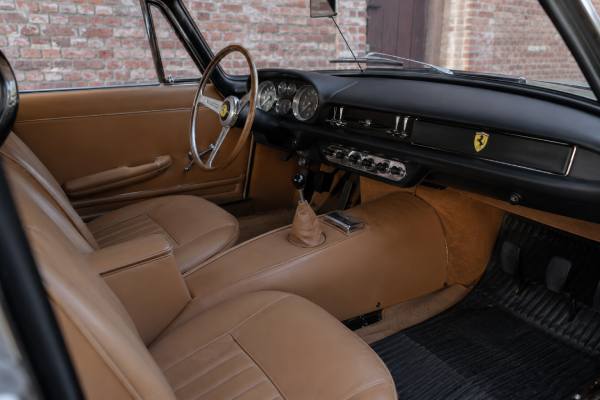
The interior should feel like an early luxury Ferrari, not a stripped competition car. Depending on the individual chassis, details may include special gauges, unique seating, special steering-column features, custom window hardware, and high-quality leather trim. Correct interior restoration requires research, not guesswork.
The driving position is classic 1950s Italian GT: close relationship with the large steering wheel, a prominent view over the hood, and a cabin that feels narrow by modern standards. Ventilation, heat management, and noise control depend heavily on restoration quality. A fresh interior can look beautiful and still be uncomfortable if insulation, seals, and ventilation details were not handled correctly.
Sound and sensory character
The Tipo 128 Colombo V12 is central to the car’s appeal. It does not deliver power like a large American V8 or a later high-torque supercar engine. Its character is lighter, smoother, and more mechanical. With the carburettors properly tuned, the engine should feel crisp and eager, with a layered intake and exhaust note that becomes richer as revs rise.
That sensory quality is one reason originality matters. Incorrect exhaust systems, poorly chosen carburettor settings, modernized ignition shortcuts, or badly rebuilt engine internals can change the way the car feels. A Tipo 513 that looks correct but runs flat, hot, or rough is not delivering the experience buyers pay for.
Road Character and Performance Feel
A healthy 250 GT Coupé Speciale should feel quick, smooth, and mechanically alive by 1956 grand-touring standards. It is not a modern performance car, but the combination of a 240 hp Colombo V12, manual gearbox, and relatively compact chassis gives it real pace when driven with skill.
The engine is the centre of the experience. It needs proper warm-up and careful carburettor tune, especially after storage or slow running. Once warm, the V12 should pull cleanly, respond sharply to throttle inputs, and feel happiest when the driver uses revs rather than relying on low-speed torque. Poor running, spitting through carburettors, reluctance to idle, or rising temperatures are not charming quirks. They are signs that the car needs attention.
The gearbox should be approached with patience. Cold shifts may be stiff, and rushing the lever can punish synchros or reveal wear. A well-sorted four-speed car rewards a measured hand and good timing. A badly adjusted clutch or worn linkage can make the whole car feel older and less precise than it should.
Steering effort is higher at parking speeds than in any modern assisted car, but it should lighten naturally once moving. The steering should communicate road texture and front-end load clearly. Excess play, wandering, shimmy, or heavy kickback can point to worn suspension joints, steering-box issues, wheel imbalance, tire problems, or chassis alignment concerns.
Ride quality is usually better than people expect from a 1950s Ferrari, provided the suspension has been rebuilt correctly. The long wheelbase for a compact GT helps the car settle into flowing roads. It is not soft in the modern luxury sense, but it should not crash or hop nervously over every surface. Dampers, spring condition, tires, and rear axle location all make a large difference.
The drum brakes shape the driving style. Properly rebuilt drums can be strong for normal road use, but they require more anticipation than discs. Repeated heavy stops, long descents, and fast modern traffic expose their period limits. A careful driver keeps space, uses engine braking, and avoids treating the car like a later Ferrari with four-wheel discs.
Visibility is generally good by modern exotic-car standards, with slim pillars and a clear forward view. The long hood is part of the appeal, but it also reminds the driver that this is a hand-built front-engine GT. Urban driving requires patience, especially with engine heat, clutch effort, and the value of the bodywork always in mind.
The difference between a restored car and a tired car is enormous. A correct, well-maintained Tipo 513 can feel elegant and cohesive. A neglected one can feel hot, vague, noisy, smoky, and fragile. Many complaints about 1950s Ferraris come from cars that are out of tune, incorrectly restored, or running on unsuitable tires rather than from the basic design itself.
Maintenance, Restoration, and Known Risks
The main ownership reality is that a Tipo 513 is a hand-built, high-value 1950s Ferrari that needs specialist care. Reliability depends less on the model’s reputation and more on engine health, cooling condition, brake setup, fuel-system cleanliness, wiring quality, and the standard of past restoration.
The Colombo V12 is durable when correctly assembled and maintained, but it is expensive to rebuild properly. Compression, oil pressure, coolant temperature control, valve-train condition, timing, carburettor balance, and ignition health all need expert assessment. A car that has spent many years on display or in storage may need major recommissioning even if it looks presentable.
The fuel system deserves special attention. Old fuel residue, deteriorated hoses, incorrect pumps, dirty tanks, and poorly rebuilt carburettors can make the car difficult to start and unsafe to operate. Some examples had special-order fuel arrangements, so originality and function must be considered together.
Cooling is another critical area. The V12 should not be allowed to run hot because overheating can lead to expensive damage. Radiator condition, water pump health, thermostat function, fan setup, hose quality, and internal block cleanliness all matter. A restored car that overheats in traffic has not been fully sorted.
The drum brakes require knowledgeable setup. Shoes must be correctly arced, cylinders must be healthy, drums must be within usable limits, and hydraulic lines must be safe. Pulling under braking, fade, long pedal travel, or fluid leaks should never be dismissed.
Body and chassis concerns
The body is one of the most valuable parts of the car, and also one of the hardest to correct. Accident damage, poorly repaired corrosion, incorrect panel replacement, thick filler, and lost coachbuilder details can all reduce value. The frame should be inspected for straightness, old repairs, cracks, corrosion, and evidence of racing-style abuse or later modification.
Areas to inspect carefully include:
- lower door skins and sills
- wheel arches and lower fenders
- floor panels and footwells
- front chassis tubes and suspension mounting areas
- rear axle mounting points
- spare-wheel and luggage areas
- bonnet, boot, and door frames
- signs of heat or fluid damage around the engine bay
- old repairs hidden by underseal or heavy paint
Because each car is rare and special-bodied, restoration decisions should be conservative. Replacing original material may make the car look better in the short term but reduce historical value if done carelessly. The best restorations preserve what can be preserved and document what must be replaced.
Parts, labor, and documentation
Parts availability is mixed. Some mechanical components relate to the broader 250 GT family, but correct early details can be difficult and expensive. Body trim, interior hardware, instruments, lights, and special-order features may require restoration rather than replacement. Fabricating missing parts is possible, but the work must be accurate.
Labor is the real cost driver. A proper engine rebuild, gearbox overhaul, brake restoration, or body correction requires specialists who understand early Ferraris. General classic-car experience is not enough. The wrong shop can make an expensive car less authentic while still generating a large bill.
Documentation should be treated as part of the car. Service invoices, restoration photos, correspondence, old registrations, concours records, ownership history, factory records, and Classiche paperwork all help establish confidence. Missing history does not automatically make a car bad, but it increases the inspection burden.
Values, Buying Advice, and Rivals
The Tipo 513 Coupé Speciale sits above standard Boano/Ellena coupés in rarity and coachbuilt interest, but below the most valuable competition and open 250-series Ferraris. Public auction results are limited, so each sale must be judged by chassis identity, condition, provenance, restoration needs, and market timing.
The 2012 public sale of chassis 0465 GT at $1.43 million and the 2023 public sale of chassis 0469 GT at $1.655 million are useful reference points, but they do not create a simple price guide. The two cars had different histories, conditions, and market contexts. The 0469 GT sale was especially tied to its unrestored or long-stored status and royal provenance, while 0465 GT was known as a restored and concours-recognized example. In a four-car market, one sale can move perception, but it cannot define every car.
Value is driven by:
- exact chassis and ownership history
- matching engine and drivetrain components
- originality of bodywork and trim
- quality and age of restoration
- Ferrari Classiche certification
- original colors and interior specification
- special-order features
- concours history
- completeness of documentation
- mechanical readiness
- absence of major accident or corrosion issues
A buyer should not approach the car with normal used-car logic. Mileage is far less important than condition and authenticity. A low-mileage car stored for decades may need a full mechanical rebuild. A higher-mileage car with expert maintenance may be much more usable. A shiny restoration may hide incorrect details, while a patinated car may preserve valuable original material.
A sensible pre-purchase process should include:
- Confirm chassis, engine, gearbox, and body identity against expert records.
- Review Ferrari Classiche documents, restoration files, and ownership history.
- Inspect the chassis for damage, corrosion, and old repairs.
- Check the body for correct contours, coachbuilt details, and filler.
- Test engine health with compression, leak-down, oil-pressure, and cooling checks.
- Inspect carburettors, ignition, fuel tanks, pumps, and lines.
- Evaluate gearbox, clutch, rear axle, and suspension under load.
- Confirm brake condition and drum serviceability.
- Compare interior, instruments, trim, and paint against known original specification.
- Budget for recommissioning even after buying a strong example.
The closest Ferrari alternatives depend on the buyer’s priorities. A Boano or Ellena 250 GT coupé offers broader availability and similar early 250 GT mechanical charm at a lower rarity level. A later Pinin Farina 250 GT coupé is more standardized and often easier to evaluate. A 250 GT Cabriolet adds open-body desirability. A 250 GT Berlinetta “Tour de France” brings competition identity and much higher performance-market status. A 410 Superamerica offers the larger, more formal grand-touring image that influenced the Tipo 513 design, usually with a different buyer profile.
Non-Ferrari rivals include the Maserati A6G/2000 and 3500 GT, Aston Martin DB2/4 and early DB Mark III, Mercedes-Benz 300 SL Coupé, and coachbuilt Alfa Romeo 1900 or 6C-derived cars. These alternatives can be wonderful, but none gives the exact mix of early Ferrari 250 GT mechanical identity, Pinin Farina special coachwork, and four-car production.
For long-term collectability, the Tipo 513 has durable strengths: rarity, beauty, brand importance, V12 power, and strong historical placement. The risks are equally clear. The buyer pool is specialized, restoration can be very expensive, and small authenticity questions can have large financial consequences. The best examples will continue to attract collectors who understand early Ferrari road cars, while compromised cars will need careful pricing and a realistic restoration plan.
Period safety expectations should also be clear. This is a 1956 GT with drum brakes, no modern crash structure, no airbags, and none of the electronic stability or driver-assistance systems found in contemporary performance cars. That does not reduce its historical importance, but it does affect how it should be driven and insured.
References
- Ferrari 250 GT Coupé (1954) 1954 (Manufacturer Model Page). ([Ferrari][1])
- Ferrari 410 Superamerica (1956) 1956 (Manufacturer Model Page). ([Ferrari][2])
- 1956 Ferrari 250 GT Coupe Speciale by Pinin Farina | Monterey 2023 | RM Sotheby’s 2023 (Auction Catalog). ([RM Sotheby’s][3])
- 1956 Ferrari 250 GT Coupe Speciale by Pinin Farina | Amelia Island 2012 | RM Sotheby’s 2012 (Auction Catalog). ([RM Sotheby’s][4])
- 1956 Ferrari 250 GT Speciale – conceptcarz.com 2021 (Specifications and Production Summary). ([conceptcarz.com][5])
Disclaimer
This article is for informational purposes only and is not a substitute for professional diagnosis, repair, appraisal, or restoration advice. Specifications, torque values, service intervals, originality standards, and procedures can vary by chassis number, market, equipment, restoration history, and factory documentation. Always verify details against official Ferrari service information, Ferrari Classiche records, and a qualified early-Ferrari specialist before buying, repairing, or restoring a vehicle.
If this guide helped you, please consider sharing it on Facebook, X/Twitter, or your preferred car community to support our work.