
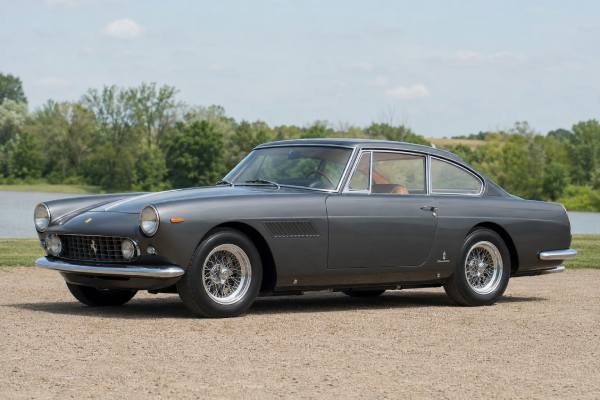
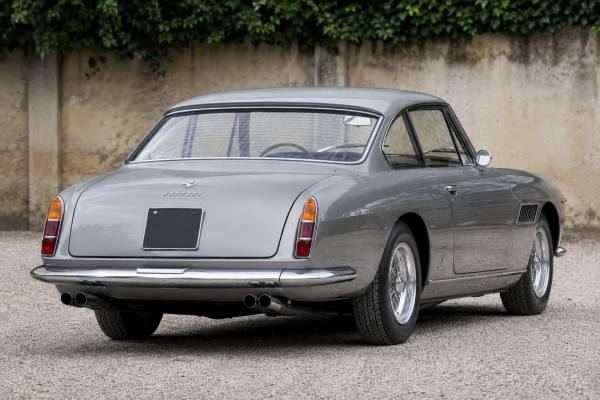
The 1963 Ferrari 250 GTE 2+2, built on the Tipo 508E/63 chassis and powered by the Tipo 128E 3.0-liter Colombo V12, is one of the most important road Ferraris of the early 1960s because it made the V12 grand tourer usable for more than two people. It kept the essential 250-series ingredients: front-mounted V12, rear-wheel drive, Pininfarina styling, a tubular steel chassis, disc brakes, and a long-distance GT character. What changed was the packaging. The engine moved forward in the chassis, the cabin was made roomier, and Ferrari created its first true series-production 2+2.
For collectors, the 250 GTE sits in an interesting place. It is not a short-wheelbase Berlinetta, California Spider, or Lusso, yet it shares the same broad 250-family appeal: a Colombo V12, elegant coachbuilt design, and Enzo-era provenance. The 1963 cars are especially relevant because they are late-production Series III examples, with the most developed specification and the clearest link to the later 330 America. The car still attracts buyers who want a classic V12 Ferrari that can be driven, shown, maintained, and understood without entering the price world of the most famous two-seat 250s.
Quick Take
The 1963 Ferrari 250 GTE 2+2 is appealing because it delivers a genuine 250-series V12 experience in a more practical, elegant, and historically significant 2+2 body. Its identity is built around the Tipo 128E Colombo V12, Pininfarina’s restrained coupe shape, and Ferrari’s move toward commercially important grand tourers. The main caution is that restoration quality, corrosion, matching numbers, and documentation matter more than ordinary condition labels. A cheaper car with hidden rust, missing original components, or vague history can quickly become more expensive than a well-documented, properly restored example.
Table of Contents
- Why the 250 GTE Matters
- Tipo 128E V12 and Core Specs
- Production Series and Authenticity
- Pininfarina Design and Engineering
- Road Character and Performance
- Maintenance, Restoration and Known Risks
- Market Value, Buying Guide and Rivals
Why the 250 GTE Matters
The 250 GTE matters because it turned Ferrari’s 250 GT formula into a usable four-seat grand tourer without abandoning the V12 character that made the series famous. It helped Ferrari broaden its customer base at a time when road-car sales were becoming increasingly important to the company’s future.
The model appeared publicly in 1960, famously serving as a course car at Le Mans before its formal motor-show debut. That context says a lot about Ferrari at the time. The company was still deeply linked to racing, but it also needed refined road cars that wealthy clients could use for travel, business, and family duty. Aston Martin and Maserati already understood this market. Ferrari’s answer was not a soft luxury sedan, but a proper grand touring coupe with occasional rear seats and the mechanical heart of a 250.
The 250 GTE used the same basic 2,600 mm wheelbase associated with several long-wheelbase 250 GT models, but the packaging was heavily revised. Ferrari moved the V12 forward to create more passenger space within the same wheelbase. Pininfarina raised and extended the roofline enough to make the rear compartment useful, while keeping the car low, formal, and balanced. It was a clever solution because it preserved the proportions of a Ferrari coupe rather than simply stretching the body into something awkward.
In Ferrari history, the GTE is also important because it proved that a 2+2 could be central to the brand rather than a side project. Later Ferrari four-seat and 2+2 grand tourers, including the 330 GT 2+2, 365 GT 2+2, 400-series cars, 456, 612 Scaglietti, and GTC4Lusso, all owe something to the commercial path opened by the 250 GTE.
Its collectability today is based on several factors:
- It is part of the Enzo-era 250 family.
- It uses a 3.0-liter Colombo V12 rather than a later mass-market engine.
- It was styled by Pininfarina and built with traditional coachbuilt character.
- It was Ferrari’s first genuinely practical production 2+2.
- It remains more attainable than the most famous two-seat 250 models.
- Late Series III cars have strong identification appeal for buyers who want the final development of the model.
The 1963 Tipo 508E/63 cars are not rare in the same way a 250 GTO or California Spider is rare, but they are still hand-built classic Ferraris. Survival, originality, and documentation vary greatly. That is why a 250 GTE should be judged as an individual car, not simply as a model name.
Tipo 128E V12 and Core Specs
The 1963 250 GTE 2+2 uses the classic Ferrari 3.0-liter Colombo V12 in Tipo 128E form, producing 240 hp at high revs. Its specification is traditional early-1960s Ferrari: front engine, rear-wheel drive, manual gearbox, tubular steel chassis, independent front suspension, live rear axle, and disc brakes.
| Category | Specification |
|---|---|
| Model | Ferrari 250 GTE 2+2 Series III |
| Chassis type | Tipo 508E/63 tubular steel chassis |
| Engine type | Tipo 128E 60-degree Colombo V12 |
| Displacement | 2,953.21 cc |
| Bore x stroke | 73 mm x 58.8 mm |
| Output | 240 hp at 7,000 rpm |
| Induction | Three Weber twin-choke carburetors |
| Drivetrain | Front engine, rear-wheel drive |
| Transmission | Manual gearbox, commonly four-speed with overdrive on GTE models |
| Body style | Two-door 2+2 coupe by Pininfarina |
| Brakes | Four-wheel disc brakes |
| Wheelbase | 2,600 mm |
| Length | 4,700 mm |
| Width | 1,710 mm |
| Height | 1,340 mm |
| Dry weight | About 1,280 kg |
| Top speed | About 230 km/h |
The engine is the main reason the car remains desirable. The Colombo V12 is compact, light for a twelve-cylinder engine of its era, and highly characterful. It uses a single overhead camshaft per cylinder bank and two valves per cylinder. The 250 name comes from the approximate displacement of each cylinder, a Ferrari naming habit used across the 250 family.
The Tipo 128E is an “outside-plug” development of the Colombo engine. In simple terms, the spark plugs are positioned on the outside of the cylinder heads rather than buried inside the V of the engine. This improved access and reflected Ferrari’s continued development of the engine family through the late 1950s and early 1960s.
The chassis is equally important. The Tipo 508E/63 structure is a multi-tube steel frame, not a modern monocoque. The body is steel, with some closures and trim details varying by car and restoration. This construction gives the 250 GTE a traditional coachbuilt feel. It also means that body condition and chassis integrity are central to value.
The suspension layout is period-correct rather than exotic by modern standards. The front uses independent suspension with wishbones and coil springs. The rear is a live axle on leaf springs, with later cars benefiting from additional refinement. Series III cars are often noted for rear suspension revisions that improve ride control compared with earlier examples.
The disc brakes were advanced for a road Ferrari of the period and give the car better stopping ability than earlier drum-brake classics. Even so, modern drivers should remember that tire technology, brake materials, pedal effort, and heat management are not comparable with a contemporary performance car.
Production Series and Authenticity
The 250 GTE was built in three main series from 1960 to 1963, with total production usually cited at around 954 cars. The 1963 examples belong to the final Series III group, making them the most developed and among the easiest to identify for knowledgeable buyers.
Ferrari production from this era was not as standardized as modern manufacturing. Cars were hand-built, details changed during production, and individual history matters. That is why the exact chassis number, engine number, gearbox number, body number, and factory records are critical when evaluating a specific 250 GTE.
Series differences
The three-series structure is useful, but buyers should not rely only on broad labels. Details such as lighting, dashboard layout, trim, suspension changes, and small body features can vary by production period and individual car.
| Series | Typical period | Buyer relevance |
|---|---|---|
| Series I | Early production | Appeals to buyers who like the first expression of the model; details can be more delicate and early-specific. |
| Series II | Middle production | Often seen as the main-volume version; condition and history matter more than the label alone. |
| Series III | Late production, including 1963 | Most relevant to this guide; later specification, final styling and mechanical development, and strong market recognition. |
Late Series III cars are sometimes described as the most desirable 250 GTEs because they represent the final version before the 330 America. The 330 America used the same general 2+2 body idea but with a larger 4.0-liter V12. That makes the 1963 250 GTE an important closing chapter for the 3.0-liter 250 GTE line.
Matching numbers and factory records
For a 250 GTE, “matching numbers” is not just a sales phrase. It can materially affect value. A car retaining its original chassis, engine, gearbox, and body identity is usually more desirable than one assembled from mixed components. That does not automatically make every non-matching car bad, but it changes how the car should be priced and described.
Important documents include:
- Ferrari factory build records or data sheets.
- Ferrari Classiche certification where available.
- Marcel Massini or other respected historian reports.
- Old registrations, service invoices, and ownership records.
- Restoration invoices with photographs.
- Original color and trim confirmation.
- Engine, gearbox, and body number verification.
- Import and tax documentation for cars moved between markets.
Ferrari Classiche certification can be valuable because it confirms the car against factory records at a point in time. It is not a replacement for a full inspection, and it does not guarantee that the car has remained unchanged since certification, but it gives buyers a useful authenticity baseline.
Originality versus sympathetic restoration
The best 250 GTEs are not always the shiniest. A well-preserved car with known history, original body panels, and correct mechanical components may be more interesting than a freshly restored car with weak documentation. On the other hand, a properly restored car from a respected specialist can be the better ownership choice if the work is complete, documented, and correct.
Watch carefully for cars described as “restored” without invoices, photographs, or specialist names. A paint refresh over old corrosion, a retrim in the wrong pattern, or a rebuilt engine with missing original components can all reduce confidence.
Pininfarina Design and Engineering
The 250 GTE’s design is special because it hides its practicality inside an elegant Ferrari coupe shape. Pininfarina created a car that looks formal and mature without losing the long-hood, short-deck feeling expected of an early-1960s Ferrari GT.
The packaging challenge was serious. Ferrari wanted rear seats, but the company did not want the car to look heavy or unbalanced. The solution was to move the engine forward by roughly 200 mm, raise the roofline, and shape the rear cabin area with enough height for passengers. This gave the car a more upright glasshouse than a pure two-seat Berlinetta, yet the result remains graceful.
The front end has a wide egg-crate grille, open headlamps, slim chrome detailing, and a clean hood line. The sides are simple, with a long shoulder line and restrained brightwork. The rear is conservative and elegant rather than dramatic. That restraint is part of the car’s appeal today. The GTE does not shout like a competition Ferrari. It looks like a fast, expensive, hand-built grand tourer for people who wanted to travel quickly and discreetly.
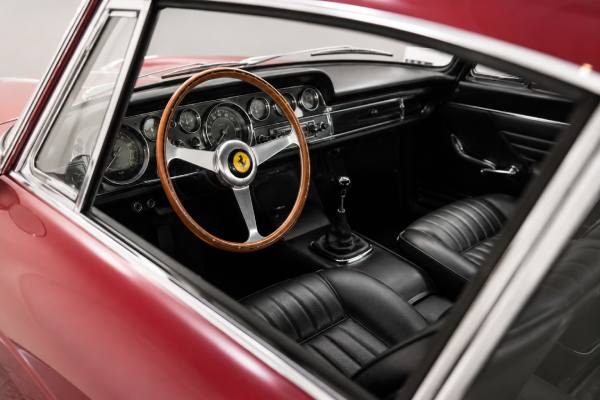
Inside, the 250 GTE is more practical than most earlier road Ferraris. The front seats are comfortable for long drives, the rear seats can carry children or small adults over shorter distances, and the trunk is more useful than the compact luggage space of many two-seat sports cars. The dashboard varies by series, but the overall feel is classic Ferrari: large instruments, polished details, leather, thin pillars, and a commanding view over the hood.
The engineering is a mix of sporting and touring priorities. The engine, brakes, and chassis are clearly Ferrari. The body, seating position, cabin trim, and ride tuning lean toward long-distance use. That blend is why the 250 GTE still makes sense as an ownership proposition. It is not the sharpest 250, but it is one of the most usable.
Sound and mechanical feel
The car’s sensory character comes mainly from the V12. At low rpm, it is smooth and cultured. As revs rise, the carburetors, valve gear, and exhaust create the layered mechanical sound that defines classic Ferraris. It is not a modern loud-exhaust experience. It is more complex, metallic, and precise.
Small details matter. Correct carburetor setup, ignition timing, exhaust specification, and engine condition can make the difference between a 250 GTE that feels crisp and one that feels flat. A tired V12 may still run, but it will not deliver the clean response and high-rpm smoothness that justify the car’s reputation.
Road Character and Performance
A healthy 1963 250 GTE feels like a refined classic GT rather than a raw racing car. It is quick for its period, stable at speed, and satisfying because the engine, gearbox, steering, and chassis all ask the driver to participate.
The 240 hp figure gives the car strong period performance, especially once the V12 is warm and properly tuned. The top speed of around 230 km/h was impressive in the early 1960s and still explains why the GTE was a serious grand tourer, not just a stylish four-seat coupe. Acceleration depends heavily on tune, gearing, tires, and the condition of the engine and carburetors. Period figures vary, so the better way to understand the car is by character rather than a single stopwatch number.
The throttle response should be clean and progressive. A well-sorted 250 GTE pulls smoothly from low revs, then becomes more energetic as it climbs toward the upper range. Carburetor balance is crucial. Hesitation, uneven idle, popping through the intake, or fuel smell may point to tuning needs, worn linkages, ignition problems, or deeper mechanical issues.
The gearbox requires a deliberate touch. It is not a modern short-throw unit, and cold oil can make the first miles stiff. Once warm, the shift should feel mechanical and positive. The overdrive, where fitted, makes the car more relaxed on faster roads and is part of the model’s grand touring identity.
Steering is unassisted and more physical at parking speeds. On the move, it becomes clearer and lighter. The car rewards smooth inputs, especially because the rear axle and period tires prefer flowing driving over abrupt changes. The 250 GTE is not about attacking corners like a modern sports car. It is about rhythm, balance, and carrying speed.
Ride quality is one of the car’s strengths. Compared with more focused two-seat Ferraris, the GTE has a calmer, more settled touring feel. The longer cabin, added weight, and suspension tuning make it comfortable on open roads. A restored suspension should feel composed, not loose or floating. Excessive wandering, clunks, harshness, or uneven braking should trigger closer inspection.
Braking performance is good for the era, thanks to four-wheel discs, but buyers should keep expectations realistic. Pedal feel, brake balance, and stopping confidence depend on the condition of calipers, lines, master cylinder, servo assistance, pads, discs, and tires. Cars that have been stored often need complete brake recommissioning before regular use.
Living with the car
A 250 GTE is more usable than many Enzo-era Ferraris, but it is still a hand-built V12 classic. It needs warm-up time, mechanical sympathy, and regular exercise. It may produce cabin heat, fuel smells, oil smells, and mechanical noise that would be unacceptable in a modern GT but are normal in a classic Ferrari when kept within reason.
The difference between a sorted car and a tired car is huge. A sorted GTE feels elegant, eager, and cohesive. A neglected one can feel heavy, vague, hot, and expensive within the first few miles.
Maintenance, Restoration and Known Risks
The main ownership risk with a 250 GTE is not ordinary reliability; it is the cost of correcting age, corrosion, poor restoration, and missing originality. A good car can be robust by classic Ferrari standards, but a bad car can consume enormous time and money.
The Tipo 128E V12 is a durable and beautiful engine when maintained correctly, but it is not cheap to rebuild. Compression, leak-down results, oil pressure, coolant behavior, carburetor condition, ignition health, and service history all matter. Smoke on start-up, overheating, contaminated fluids, noisy valve gear, poor hot starting, or weak oil pressure should be taken seriously.
Fuel systems need special attention. Old tanks, lines, pumps, filters, and carburetor seals can cause running problems and safety risks. Modern fuel can be hard on older rubber components, so recent fuel-system renewal is a real advantage.
Cooling is another key area. A 250 GTE should not be accepted as “just an old Ferrari that runs hot” without investigation. Radiator condition, fan operation, water pump health, hoses, thermostat behavior, internal corrosion, and correct tuning all affect temperature. Overheating can turn a usable car into an engine-out repair project.
Electrical systems are simple compared with modern Ferraris, but age creates problems. Brittle wiring, poor grounds, tired switches, weak charging, and old fuse boxes can all cause intermittent faults. A car with restored instruments and refreshed wiring is more appealing than one where every drive involves a new electrical mystery.
Corrosion and body structure
Rust is one of the biggest 250 GTE inspection issues. The car has a steel body over a tubular frame, and corrosion repair can be complex. Areas to inspect include:
- Door bottoms and lower door skins.
- Sills and rocker structures.
- Floor pans and footwells.
- Trunk floor and spare-wheel area.
- Wheel arches and lower fenders.
- Battery area.
- Front and rear chassis tubes.
- Suspension pickup points.
- Firewall and lower bulkhead areas.
- Previous repair seams hidden under underseal or paint.
Panel fit is a major clue. Uneven gaps, doors that sag or shut poorly, distorted hood alignment, or ripples in the body may indicate accident damage, corrosion repair, or poor restoration. Because these cars were hand-built, perfection is not the only standard, but inconsistency deserves investigation.
Restoration cost drivers
The expensive parts of a 250 GTE restoration are usually bodywork, engine work, trim, chrome, wheels, and missing correct components. A car that appears complete but lacks original carburetors, instruments, trim pieces, Borrani wheels, or correct lighting can become difficult and costly to return to factory specification.
Major cost drivers include:
- Full engine rebuild.
- Gearbox and overdrive repair.
- Differential noise or wear.
- Chassis tube corrosion.
- Poorly repaired accident damage.
- Complete bare-metal repaint.
- Interior retrim in correct materials.
- Chrome restoration.
- Wheel rebuilding and correct tire replacement.
- Recreating missing original details.
- Correcting older restorations done to the wrong standard.
Many 250 GTEs were once less valuable than other 250 models, and some suffered from neglect, modification, or use as donor cars. That history makes documentation especially important. A beautiful presentation can hide a complicated past.
Market Value, Buying Guide and Rivals
The 250 GTE remains one of the more approachable ways into a classic Ferrari 250-series V12, but “approachable” is relative. Recent public market activity shows a wide spread, with restoration needs, originality, documentation, and provenance creating large differences between cars.
As of the 2025–2026 collector-car market, driver-quality and recommissioning-needed 250 GTEs can sit well below freshly restored, highly documented, matching-numbers examples. Public sales have shown cars around the low-to-mid six figures in euros or dollars, while stronger examples with excellent histories, colors, and certification can bring meaningfully more. The best way to think about value is not as one fixed price, but as a ladder.
| Value factor | Why it matters |
|---|---|
| Matching numbers | Original engine, gearbox, body, and chassis identity support collector confidence. |
| Ferrari Classiche | Factory authentication can strengthen market appeal, especially for higher-value examples. |
| Rust-free structure | Body and chassis corrosion can exceed the apparent price advantage of a cheaper car. |
| Restoration quality | Specialist work with invoices and photos is worth more than cosmetic refurbishment. |
| Original colors | Factory-correct color and trim can improve desirability, especially with documentation. |
| Provenance | Known ownership, period records, and respected historian reports reduce uncertainty. |
| Mechanical condition | A tired V12, weak gearbox, or old braking system can change the economics quickly. |
Buyer inspection priorities
A 250 GTE should always be inspected by a specialist who knows early Ferrari construction. A general classic-car inspection is not enough. The car’s value depends too heavily on correct identity, original components, and hidden structural condition.
Start with identity. Confirm chassis, engine, gearbox, and body numbers against records. Compare stamped numbers, plates, and documents. Look for signs of restamping, replacement plates, mismatched paperwork, or stories that rely on vague claims.
Then inspect the structure. Use a lift, bright lighting, thickness readings where appropriate, and a careful look at the underside. Door bottoms and lower sills deserve special attention. Rust seen on visible panels may only be the surface of a deeper issue.
Mechanical inspection should include:
- Cold start and hot restart.
- Oil pressure when cold and fully warm.
- Coolant temperature in traffic and at speed.
- Compression and leak-down test.
- Carburetor balance and throttle linkage condition.
- Gearbox synchromesh and overdrive operation.
- Clutch bite, noise, and engagement.
- Differential noise on acceleration and overrun.
- Brake pull, pedal feel, and fluid condition.
- Suspension bushing, damper, and steering-box wear.
- Tire age, wheel condition, and spoke integrity.
Documentation should be reviewed with the same care as the car. A file full of vague invoices is less useful than a smaller file containing factory records, restoration photographs, specialist receipts, and ownership continuity.
Cars to seek and cars to avoid
The best 1963 250 GTE for most buyers is a matching-numbers Series III with known history, honest structural condition, correct major components, and recent mechanical sorting. It does not need to be concours-perfect unless the buyer wants a show car, but it should be transparent.
Good candidates include:
- Long-term owned cars with continuous records.
- Cars restored by recognized Ferrari specialists.
- Cars with factory data, historian reports, or Classiche certification.
- Structurally sound drivers that have been maintained rather than stored.
- Original-color cars with correct trim and known repaint history.
Be careful with:
- Fresh paint over unknown metalwork.
- Missing engine or gearbox identity.
- Cars advertised as “easy restoration” without dismantling evidence.
- Long-static cars sold as “running” but not road-ready.
- Non-original interiors presented as factory correct.
- Cars with rust in doors, sills, floors, or chassis tubes.
- Cars with incomplete import, tax, or registration history.
Rivals and alternatives
The closest period rivals are not exact matches, but they help explain the 250 GTE’s appeal. An Aston Martin DB4 or DB5 offers British six-cylinder elegance, strong touring ability, and high collector recognition. A Maserati 3500 GT offers Italian style, a sophisticated straight-six, and a more understated personality. The Iso Rivolta IR 300 and later Gordon-Keeble-type alternatives offer powerful GT character, though not the same Ferrari V12 identity.
Within Ferrari, the obvious alternatives are the 250 GT Lusso, 330 GT 2+2, and 330 America. The Lusso is prettier and more valuable, but less practical and significantly more expensive. The 330 GT 2+2 is generally more affordable and more usable, but it belongs to a different chapter with a larger engine and later styling. The 330 America is rare and closely related in body concept, yet its 4.0-liter engine gives it a different identity.
The 250 GTE’s long-term collectability looks secure because it is historically important, mechanically charismatic, and tied directly to the 250 line. It is unlikely to match the top two-seat 250s, but it does not need to. Its strength is a different one: it offers a genuine Enzo-era V12 Ferrari experience with more usability, more cabin space, and a market position that rewards careful buying.
References
- Ferrari 250 GT 2+2 (1960) 1960
- Ferrari 250 GT 2+2: Ferrari History 1960
- Ferrari Classiche: Certification – Ferrari.com 2026
- 1963 Ferrari 250 GTE 2+2 Series III by Pininfarina | Paris 2026 | RM Sotheby’s 2026
- 1963 Ferrari 250 GTE 2+2 Series III by Pininfarina | Milan | RM Sotheby’s 2021
Disclaimer
This article is for informational purposes only and is not a substitute for professional diagnosis, repair, valuation, or restoration advice. Specifications, torque values, service intervals, factory details, and procedures can vary by chassis number, market, equipment, restoration history, and individual vehicle condition. Always verify details against official Ferrari service documentation, factory records, and a qualified marque specialist before buying, repairing, or restoring a Ferrari 250 GTE.
If you found this guide useful, please consider sharing it on Facebook, X/Twitter, or your favorite car community to support our work.