
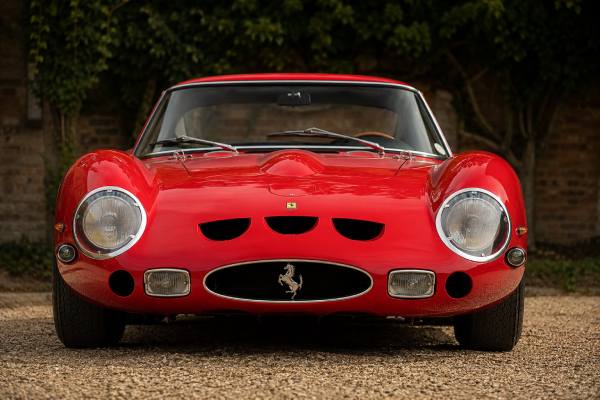
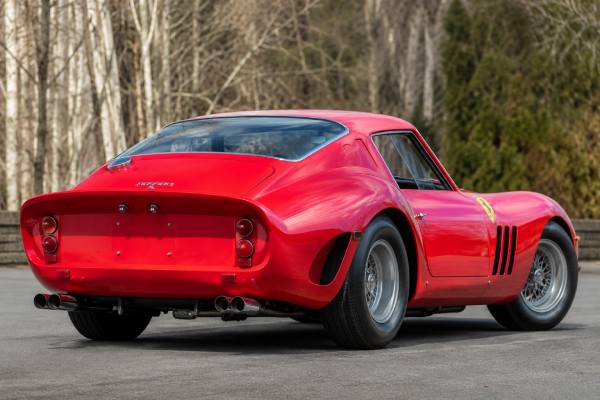
The Ferrari 250 GTO/64 was the final three-litre evolution of Ferrari’s 250 GTO line, built for the 1964 racing season with Tipo 539/64 competition chassis development, the Tipo 168/62 Comp 3.0-litre Colombo V12, and about 300 hp. It was not a normal road-going Ferrari with racing trim. It was a front-engined GT weapon created to keep Ferrari competitive after the mid-engined 250 LM failed to gain the GT homologation Ferrari wanted.
The 1964 version is often called the Series II or GTO/64. Its lower, wider body, drawn with Pininfarina influence and built by Scaglietti, gave the famous GTO a sharper link to the 250 LM era while retaining the earlier car’s front-engine layout, five-speed gearbox, tubular frame, and dry-sump V12 character. Only three new 1964 cars were built, while several earlier GTOs received the later bodywork in period, making originality and identity unusually important.
Quick Take
The Ferrari 250 GTO/64 is most appealing because it combines the ultimate 250 GTO identity with the rarer 1964 Series II body and the last great front-engined Ferrari GT racing chapter. Its technical identity is still classic GTO: a 3.0-litre Colombo V12, lightweight tubular chassis, aluminum body, five-speed manual gearbox, and live rear axle tuned for endurance racing. The caution is that every car has its own history, configuration, repairs, and documentation trail, so value depends less on generic condition and more on chassis identity, factory history, race record, Ferrari Classiche documentation, and the quality of old restoration work.
Table of Contents
- History and Racing Importance
- Technical Specifications and Chassis
- Production, Variants and Authenticity
- Design, Engineering and Signature Details
- Driving Feel and Period Performance
- Maintenance, Restoration and Ownership Risk
- Market Values, Buying Checks and Rivals
History and Racing Importance
The 250 GTO/64 matters because it was Ferrari’s emergency answer to a changing GT racing world. By 1964, the original 250 GTO was no longer new, Shelby’s Cobra Daytona Coupe was a serious threat, and Ferrari’s intended replacement, the 250 LM, could not simply take over the GT class.
The original 250 GTO had appeared for the 1962 season as the most developed form of the 250 GT competition berlinetta idea. Its name stood for Gran Turismo Omologato, meaning a grand touring car homologated for racing. Under the rules, Ferrari was able to use the earlier 250 GT SWB family as the homologation base, then add major competition updates.
The 1964 GTO/64 kept the core formula because Ferrari had little choice. The car still used the front-mounted Colombo V12, a steel tube frame, a lightweight aluminum body, rear-wheel drive, and a five-speed gearbox. What changed most visibly was the body. The new Series II shape was lower, wider, and more closely related in look to Ferrari’s mid-engined 250 LM.
The GTO/64 also marked the end of a line. Ferrari’s great 1950s and early 1960s front-engined competition GTs had moved from Tour de France berlinettas to SWB cars and then to the GTO. After the GTO/64, Ferrari’s endurance racing focus moved more firmly toward mid-engined prototypes and sports racers. That makes the 1964 GTO both a final chapter and a bridge between eras.
Its reputation today comes from several overlapping factors:
- It belongs to the 250 GTO family, one of the most valuable and historically important Ferrari groups.
- It represents the rare 1964 Series II body style rather than the better-known 1962–1963 body.
- It carries real period racing history, not just show-car mythology.
- It sits at the center of Ferrari’s battle with Shelby, Jaguar, Aston Martin, and Porsche in the early 1960s.
- It is eligible for the most selective concours, tours, and historic motorsport events, subject to owner preference and event rules.
The car’s significance is not just rarity. Plenty of rare cars are obscure. The GTO/64 is rare, beautiful, fast, famous, and directly tied to Ferrari’s top-level GT racing effort. That combination explains why a correct example is treated as a cultural object as much as a motor car.
Technical Specifications and Chassis
The GTO/64 used proven 250 GTO mechanicals rather than a clean-sheet platform. Its appeal comes from how Ferrari refined a familiar package: light weight, high-revving V12 power, strong brakes, race gearing, and a chassis tuned for long-distance road circuits.
| Category | Specification |
|---|---|
| Production year | 1964 |
| Model type | Front-engined competition GT berlinetta |
| Chassis type | Tipo 539/64 competition tubular steel frame |
| Body | Hand-formed aluminum body by Scaglietti |
| Engine | Tipo 168/62 Comp Colombo 60-degree V12 |
| Displacement | 2,953 cc |
| Induction | Six Weber 38 DCN carburetors |
| Lubrication | Dry sump |
| Output | About 300 hp |
| Transmission | Five-speed manual |
| Drivetrain | Rear-wheel drive with limited-slip differential |
| Front suspension | Double wishbones, coil springs, anti-roll bar, telescopic dampers |
| Rear suspension | Live axle, semi-elliptic springs, Watts linkage, telescopic dampers |
| Brakes | Dunlop disc brakes front and rear |
| Steering | Worm-and-peg type steering |
| Wheels | 15-inch Borrani wire wheels, wider than early GTO fitments |
The engine is the heart of the car. The Colombo V12 was compact, light, and already well proven in Ferrari’s sports racing program. In competition form it used dry-sump lubrication, which allowed better oil control under sustained cornering and helped the engine sit lower in the chassis. That mattered because the GTO’s handling and aerodynamics depended on reducing frontal area and lowering the center of gravity.
The cylinder heads used a single overhead camshaft per bank and two valves per cylinder. That sounds simple today, but it was an effective racing layout in the early 1960s. With six twin-choke Weber carburetors, careful ignition tuning, and a free-flowing exhaust, the engine produced its power high in the rev range and rewarded drivers who kept it on cam.
The gearbox was one of the GTO’s major advantages over earlier 250 GT competition cars. A five-speed manual gave drivers closer ratios and better flexibility on road circuits, where a lap could include hairpins, fast sweepers, long straights, and steep climbs. Final-drive ratios and race preparation could vary depending on the event.
The chassis was not exotic in a modern carbon-fiber sense, but it was highly developed. Ferrari used a steel tube frame because it was light, repairable, and familiar to the racing department. The aluminum body helped keep mass down, while suspension changes and wider wheels helped the later car cope with rising speeds and stronger rivals.
Production, Variants and Authenticity
The 250 GTO/64 is rare even by GTO standards because only three new Series II cars were built for 1964. Several earlier 250 GTOs were also rebodied in the later style, so buyers must separate “born as GTO/64” cars from period-converted Series I examples.
| Group | What it means | Collector importance |
|---|---|---|
| New 1964 GTO/64 cars | Built new with Series II bodywork for the 1964 season | Core GTO/64 identity; extremely rare |
| Series I cars rebodied in period | Earlier GTOs updated with 1964-style coachwork by Scaglietti or under Ferrari direction | Highly important, but history depends on each chassis |
| GTO-related 330 cars | Similar family context but using larger-displacement engines | Often discussed alongside GTOs, but not the same as a three-litre GTO/64 |
The three new 1964 cars are generally identified as chassis 5571GT, 5573GT, and 5575GT. Earlier GTOs that received 1964-style bodies in period are also central to the story because they show how Ferrari and owners tried to keep the GTO competitive. Chassis 3413GT is one of the best-known examples because of its period racing record and later public auction history.
This is where authenticity becomes complex. A GTO/64 is not judged like a normal restored classic. A buyer has to understand the chain of evidence around chassis, engine, gearbox, rear axle, bodywork, factory records, race entries, old photographs, ownership files, and restoration records.
Important identification and originality factors include:
- Chassis number and frame stamping.
- Engine number and whether the original block is fitted, stored, replaced, or lost.
- Gearbox and rear axle numbers.
- Factory body configuration and any period body changes.
- Period race modifications, including vents, lights, roof details, and cooling changes.
- Ferrari Classiche certification and supporting reports.
- Marcel Massini or other recognized historian documentation.
- Old race photos that confirm body details at specific events.
- Continuous ownership history and export/import records.
Factory colors and interiors also matter, but not in the same way as on a normal road car. Many GTOs changed liveries, racing numbers, trim details, and small body features during their active lives. A concours restoration that erases a meaningful period competition detail can be less appealing to some collectors than a carefully preserved car with visible history.
Matching numbers can affect value sharply, but the phrase needs care. In a race car, original parts may have been removed, damaged, replaced, or preserved decades ago. The best cars have clear documentation explaining what is fitted, what is original but stored separately, and what has been recreated.
Design, Engineering and Signature Details
The GTO/64’s design is distinctive because it makes the 250 GTO look more like a 1960s prototype while keeping the proportions of a front-engined GT. The lower nose, wider stance, revised cabin, and fastback tail give it a harder, more modern look than the earlier Series I car.
The original 250 GTO shape was created through practical racing development, with input from Ferrari engineers and Scaglietti craftsmanship. The 1964 body moved closer to the design language of the 250 LM. Pininfarina influence is usually associated with the Series II shape, while Scaglietti handled the aluminum construction.
The body served several purposes. It reduced height, allowed wider track and wider wheels, and gave the car a more planted look. The steep windshield and altered roofline changed airflow around the cabin. The Kamm-style tail helped manage air separation at the rear. Vents and ducts were not decorative; they existed to feed the engine, cool the brakes, and release heat from a hard-working competition car.
Because these cars were hand-built and raced, small differences matter. One car may have a slightly different roof edge, intake treatment, brake duct layout, lamp arrangement, or rear treatment from another. Some changes were made for Le Mans, some for shorter races, and some during repair or restoration.
Key design and engineering signatures include:
- Long hood and set-back cabin, showing the front-mid-engine layout.
- Low oval grille opening with covered headlamp treatment.
- Hand-shaped aluminum panels with subtle differences between cars.
- Roof and rear-quarter forms influenced by the 250 LM.
- Side vents and brake-cooling openings that vary by chassis and event.
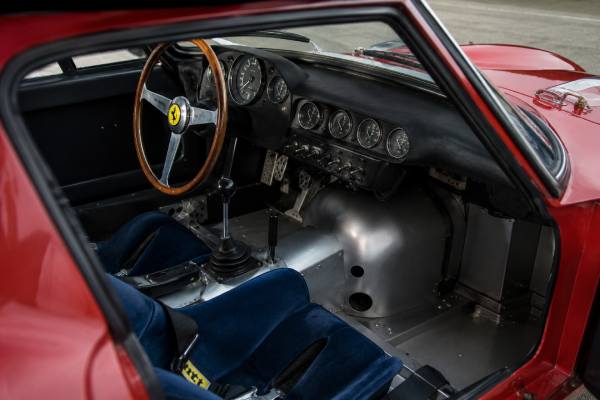
- Sparse racing cockpit with only the instruments and controls needed to compete.
- Rear bodywork shaped for high-speed stability rather than luxury styling.
The cockpit is simple, hot, loud, and purposeful. The driver sits behind a large thin-rimmed steering wheel with a view over a long hood. Instruments are clear and functional. There is no sense of mass-produced perfection. The whole car feels made by a racing department and a coachbuilder working quickly toward a specific competitive goal.
Its sound is a major part of the identity. The V12 does not deliver modern low-rpm torque in a lazy way. It builds energy, hardens as revs rise, and produces the layered mechanical note that made early Ferrari competition cars famous. Intake noise from the Webers, exhaust crackle, gear whine, and body resonance all contribute to the experience.
Driving Feel and Period Performance
A well-sorted GTO/64 feels light, alert, mechanical, and demanding rather than brutally fast by modern supercar standards. Its performance comes from balance, low weight, gearing, braking stamina, and a V12 that wants revs.
Period acceleration figures vary because gearing, tires, race preparation, and test conditions varied. A 250 GTO family car is often quoted at roughly 0–60 mph in the low six-second range, with top speed dependent on gearing and body setup. The 1964 body was not simply a guaranteed top-speed improvement; it was part of a broader attempt to improve stability, tire use, and competitiveness.
The engine needs heat and attention. Cold carburetors, oil temperature, plug condition, fuel quality, and ignition setup all affect how cleanly the V12 runs. Once warm, the engine rewards precision. It pulls best when the driver keeps it in the upper part of the rev range, where throttle response is sharp and the car feels alive.
The gearbox is a central part of the experience. A careful driver uses deliberate shifts, respects oil temperature, and avoids forcing the mechanism. The reward is direct engagement that no paddle-shift modern car can copy. Every downshift, throttle blip, and gear selection matters.
The steering is heavy at low speed and rich in feedback once moving. The front tires communicate clearly, and the long hood helps place the car, but the driver must understand weight transfer. This is not a car that hides mistakes with electronics. There is no stability control, no ABS, no traction control, and no modern safety net.
The chassis balance is more sophisticated than the simple live rear axle might suggest. The Watts linkage helps keep the rear axle located, and the car can be very composed when fresh bushings, correct dampers, good alignment, and proper tires are in place. A tired or poorly restored car can feel nervous, loose, or vague.
Brakes are strong for the era, but they require period expectations. Dunlop discs were advanced in the early 1960s, yet pedal feel, fade resistance, and stopping distance depend heavily on pad material, fluid, cooling, and event use. On a fast historic rally or circuit session, brake preparation is as important as engine output.
The biggest difference between a great GTO/64 and a tired one is not horsepower. It is setup. Correct suspension geometry, fresh dampers, round wheels, good tires, properly adjusted carburetors, sound brakes, and a tight driveline transform the car. A car with old rubber, loose linkages, weak ignition, or poor alignment will still be valuable, but it will not show the engineering at its best.
Maintenance, Restoration and Ownership Risk
Owning a GTO/64 is less about routine maintenance and more about stewardship. The mechanical systems are understandable, but the car’s value, originality, and historical importance make every repair decision unusually serious.
The engine needs specialist care. The Tipo 168/62 Comp V12 uses a dry-sump oiling system, multiple carburetors, high-performance ignition, and period racing tolerances. Rebuild work must be done by specialists who understand early Ferrari competition engines, not just general classic-car shops. Incorrect machining, wrong cam timing, poor carburetor setup, or unsuitable modern parts can reduce both performance and confidence.
Common mechanical attention areas include:
- Carburetor wear, air leaks, jetting, and synchronization.
- Magneti Marelli ignition components, distributors, leads, plugs, and timing.
- Oil leaks from dry-sump lines, tanks, fittings, and engine seals.
- Cooling system condition, including radiator efficiency and hose quality.
- Gearbox synchro wear, bearings, selector adjustment, and clutch condition.
- Differential noise, backlash, limited-slip function, and axle seals.
- Brake calipers, discs, lines, master cylinder, and fluid condition.
- Wire wheel cracks, spoke tension, hub wear, and spline condition.
The chassis and body require even more caution. The tubular steel frame can suffer from corrosion, fatigue, old accident repairs, and hidden misalignment. Aluminum body panels can hide stress cracks, filler, old patches, and repairs from period racing accidents. Some repairs may be historically valid; others may be later shortcuts.
A pre-purchase inspection should include:
- Frame measurement against known correct data.
- Inspection of suspension pickup points.
- Review of old accident history and repair invoices.
- Check for corrosion in tubes, brackets, floors, and hidden seams.
- Paint-depth and panel inspection, used carefully because coachbuilt bodies vary.
- Verification of engine, gearbox, and axle identity.
- Review of Ferrari Classiche documents and historian reports.
- Comparison with period photographs.
Restoration is expensive not just because parts cost money, but because decisions can change the car’s historical meaning. Replacing a damaged panel may make a car cleaner. Preserving a period-modified panel may make it more authentic. Returning a car to one race configuration may conflict with another important chapter in its history.
Parts availability is a specialist ecosystem. Many components can be restored, remanufactured, or sourced through established Ferrari competition specialists, but originality is the issue. A new part may work better, yet the original part may carry major value. Owners often preserve original components even when using replacement parts for controlled running.
Safety expectations must stay realistic. The GTO/64 is a 1960s racing car. It has period crash protection, no airbags, no modern belts unless fitted for events, and no electronic driver aids. Event preparation may require modern safety equipment, but installation should be reversible and documented where possible.
Market Values, Buying Checks and Rivals
The GTO/64 sits at the very top of the Ferrari collector market, but each car is valued individually. A buyer is not buying a model in the normal sense; they are buying one specific chassis, its identity, its story, and the confidence of its documentation.
Public GTO sales are rare. Chassis 3413GT, a Series I car rebodied in 1964 style, sold publicly for $48.405 million in 2018. A 330 LM / 250 GTO brought more than $50 million at public auction in 2023, and a white 1962 250 GTO sold at Mecum Kissimmee 2026 for $38.5 million. These results are useful market markers, but they do not create a simple price guide for a born-1964 GTO/64.
Value drivers include:
- Born identity as a 1964 GTO/64 versus period-converted Series I history.
- Race record, especially major international events.
- Original engine, gearbox, differential, and body details.
- Quality and transparency of restoration.
- Preservation of period racing modifications.
- Ferrari Classiche certification.
- Historian reports and uninterrupted ownership trail.
- Event eligibility and acceptance by major concours and tours.
- Market timing and private-buyer demand.
The main buying risk is not normal mechanical failure. It is uncertainty. Any gap in identity, any disagreement over an original component, any unclear restoration history, or any unresolved legal issue can affect confidence. At this level, a buyer should use Ferrari historians, marque specialists, lawyers, tax advisers, and restoration experts before committing.
A serious inspection should prioritize:
- Confirm the chassis identity through factory records and physical inspection.
- Verify the engine, gearbox, and rear axle status.
- Compare current bodywork with period photographs.
- Review all Ferrari Classiche and historian documentation.
- Inspect the frame and suspension for old crash damage.
- Evaluate engine health with specialist testing, not casual road impressions.
- Check whether valuable original components are fitted, stored, or missing.
- Understand import status, taxes, title history, and legal ownership.
- Estimate restoration or recommissioning cost before negotiating.
- Decide whether the car will be shown, toured, raced, or preserved.
Rivals depend on the buyer’s goal. For pure Ferrari mythology, the closest alternatives are the 250 GTO Series I, 250 Testa Rossa, 250 LM, 275 GTB/C Speciale, and 330 LMB. For front-engined GT racing history outside Ferrari, important alternatives include the Aston Martin DB4 GT Zagato, Shelby Cobra Daytona Coupe, Jaguar Lightweight E-Type, and competition-bodied Maseratis of the era.
None is a direct substitute. A Cobra Daytona may represent the American challenge that finally pressured Ferrari. A DB4 GT Zagato has coachbuilt beauty and rarity. A 250 LM brings mid-engined Le Mans relevance. But the GTO/64 offers something narrower and harder to duplicate: the final form of Ferrari’s three-litre front-engined GTO, wrapped in the rare 1964 body that marked the closing act of the line.
For most enthusiasts, the GTO/64 is not a practical purchase. For the tiny group of qualified buyers, it is a stewardship decision. The best example is not necessarily the shiniest one. It is the car with the clearest identity, strongest history, most honest condition, and least compromised originality.
References
- Ferrari 250 GTO (1962) – Ferrari.com 1962 (Manufacturer Archive)
- 1962 Ferrari 250 GTO by Scaglietti | Monterey 2018 | RM Sotheby’s 2018 (Auction Provenance)
- CROSS Customs Rulings Online Search System 2016 (Customs Ruling)
- Ferrari 250 GTO 64 – All Results – Racing Sports Cars 2026 (Racing Results)
- Ferrari 250 GTO Hammers For $38.5 Million at Mecum 2026 (Market Reference)
Disclaimer
This article is for informational purposes only and is not a substitute for professional diagnosis, repair, appraisal, legal review, or restoration advice. Specifications, torque values, service intervals, procedures, component identity, and correct configurations can vary by chassis number, market, race history, restoration history, and equipment. Always verify details against official service documentation, Ferrari Classiche records, and recognized marque specialists before buying, restoring, servicing, or operating a Ferrari 250 GTO/64.
Please share this article on Facebook, X/Twitter, or your preferred car community if it helped support your research.