
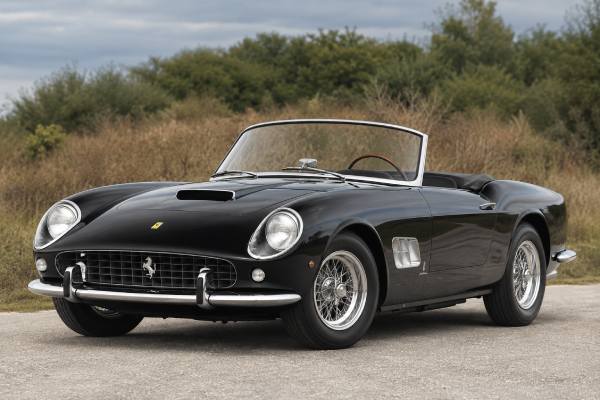
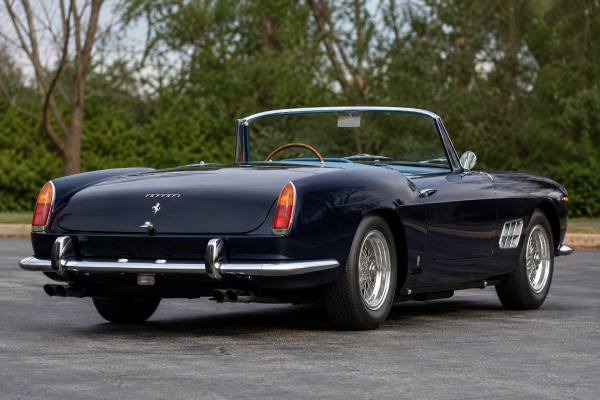
The Ferrari 250 GT Cabriolet Pinin Farina Series II with the Tipo 508D chassis and Tipo 128D 3.0-liter Colombo V12 sits at an important turning point in Ferrari road-car history. Built from late 1959 into 1960 in this early Series II form, it combined Ferrari’s 240 hp front-mounted V12 with elegant Pinin Farina open bodywork, a more usable grand-touring layout, and the more standardized production approach that helped Ferrari grow beyond purely low-volume specials.
This was not the raw, competition-minded 250 GT California Spider. The Pinin Farina Cabriolet was the more refined Ferrari 250 convertible: luxurious, composed, expensive, and aimed at customers who wanted speed with civility. Today it matters because it blends three things collectors care about deeply: hand-built 1950s Ferrari engineering, Pinin Farina design, and enough road usability to make the car more than a static concours object.
Quick Take
The Ferrari 250 GT Cabriolet Pinin Farina Series II is one of the most elegant early Ferrari open grand tourers, with its strongest appeal coming from the 3.0-liter Colombo V12, Pinin Farina coachwork, and genuine 250-series pedigree. Its key identity is refinement rather than racing drama, although 240 hp, a manual gearbox, and a tubular chassis still give it serious period performance. The main caution is that value depends heavily on originality, body integrity, matching numbers, documentation, and the quality of past restoration work; a poor car can absorb vast sums before it becomes a correct one.
Table of Contents
- History and Collector Importance
- Engine, Chassis and Key Specs
- Production, Variants and Originality
- Pinin Farina Design and Engineering
- Road Feel and Performance Character
- Maintenance, Restoration and Known Risks
- Market Values, Buying Advice and Rivals
History and Collector Importance
The 250 GT Cabriolet Pinin Farina Series II matters because it helped make the open Ferrari grand tourer a repeatable production model rather than a one-off coachbuilt experiment. It gave Ferrari a refined, high-status convertible that shared the 250 GT mechanical family but served a different buyer from the more aggressive California Spider.
The first Pinin Farina Cabriolet appeared in the late 1950s as Ferrari was moving toward more regular road-car production. Earlier Ferraris were often built in tiny batches, with bodies and details tailored to individual clients. That created wonderful variety, but it also made production slow and expensive. The 250 GT family helped Ferrari build cars in a more organized way while still keeping the hand-built feel that defined the marque.
The Series II Cabriolet arrived for the 1959 model period and was shown publicly at the Paris Salon. It replaced the earlier Series I Cabriolet, which was produced in much smaller numbers and had more individual body differences. The Series II was cleaner, more mature, and more closely related in style to the 250 GT Pinin Farina Coupé. It had open headlamps, a more balanced profile, improved cabin practicality, and a more settled grand-touring personality.
The car’s role inside the 250 GT line is important. The 250 GT Berlinetta models were the more competition-focused cars. The California Spider, especially in later short-wheelbase form, became the glamorous sporting open car. The Pinin Farina Cabriolet was more formal and luxurious. It was designed for fast touring, city use, social presence, and long-distance comfort rather than racing.
That does not make it lesser. In some ways, it makes the car more historically revealing. The Series II Cabriolet shows how Ferrari balanced racing-derived engineering with the needs of wealthy road-car clients. Buyers wanted the sound, speed, and prestige of a Ferrari V12, but they also wanted proper trim, weather equipment, luggage space, and road manners.
Pinin Farina’s role was central. The Turin coachbuilder did not merely style the car; it helped give Ferrari a visual language for refined production grand tourers. The Cabriolet’s clean flanks, elegant nose, restrained chrome, and compact rear deck helped define the look of early 1960s Ferrari luxury. The design was not as dramatic as some later Ferraris, but its restraint is part of the appeal.
For collectors, the early Series II cars from 1959–1960 are interesting because they sit in a transitional period. The Tipo 508D chassis and Tipo 128D V12 belong to Ferrari’s evolving 250 GT mechanical family, while later Series II cars received further running changes, including outside-plug engine developments in many examples. This makes the exact build date, engine type, chassis number, and factory records especially important.
Today, the 250 GT Cabriolet Pinin Farina Series II is collectible for several reasons:
- It is a real 250-series Ferrari with a Colombo V12.
- It has coachwork by Pinin Farina, not a later replica body.
- It was produced in small numbers, usually quoted at about 200 Series II cars.
- It is more usable than the more intense competition-derived 250 variants.
- It has strong concours and touring-event appeal when correct and well prepared.
- It sits below the California Spider and SWB Berlinetta in value, but still belongs to the same golden-era Ferrari world.
The car’s reputation has also changed over time. For years, the Pinin Farina Cabriolet was overshadowed by racier 250 models. Modern collectors now see its elegance, rarity, and usability more clearly. A correct, well-documented Series II is not just a beautiful open Ferrari; it is one of the cars that helped establish Ferrari as a serious maker of luxury grand tourers.
Engine, Chassis and Key Specs
The heart of the 1959–1960 Ferrari 250 GT Cabriolet Pinin Farina Series II is the 2,953 cc Colombo V12, listed here in early Tipo 128D form with a 240 hp rating. The chassis is the Tipo 508D tubular steel frame, using the 2,600 mm long-wheelbase 250 GT layout that favored stability and grand-touring refinement.
| Category | Specification |
|---|---|
| Model | Ferrari 250 GT Cabriolet Pinin Farina Series II |
| Production focus | Early Series II, 1959–1960 |
| Chassis type | Tipo 508D tubular steel frame |
| Engine type | Tipo 128D Colombo 60-degree V12 |
| Displacement | 2,953.21 cc |
| Bore x stroke | 73 mm x 58.8 mm |
| Valvetrain | Single overhead camshaft per bank |
| Induction | Triple Weber twin-choke carburetors, specification varying by car |
| Power | 240 hp at about 7,000 rpm |
| Transmission | 4-speed manual, with overdrive on many Series II cars |
| Drivetrain | Front engine, rear-wheel drive |
| Wheelbase | 2,600 mm |
| Front suspension | Independent unequal-length wishbones with coil springs |
| Rear suspension | Live axle with semi-elliptic leaf springs and trailing arms |
| Brakes | Hydraulic four-wheel disc brakes on Series II cars |
| Steering | Manual steering, period Ferrari worm-and-sector type layout |
| Body style | Two-door cabriolet by Pinin Farina |
The engine is the feature that gives the car its lasting identity. Gioachino Colombo’s compact V12 design became one of Ferrari’s defining engines. In 250 form, each cylinder displaced about 250 cc, which explains the 250 name. The engine is small by modern performance-car standards, but it is smooth, eager, and highly musical. It rewards revs rather than low-speed torque.
The Tipo 128D version used in early Series II cars belongs to the inside-plug development line of the 250 GT engine family. Later Series II examples are often associated with outside-plug Tipo 128F developments, so buyers should not assume every Series II has the same engine configuration. The number stamped on the engine and the factory records matter more than broad model labels.
The 240 hp figure must be understood in period context. This was a strong output for a luxury road car in 1959–1960, especially with a relatively light body and a manual gearbox. The Ferrari was not a relaxed large-displacement cruiser. It made its best power high in the rev range and needed proper tuning to feel sharp.
The gearbox is another key part of the driving character. The basic four-speed manual has a deliberate, mechanical feel. Many Series II Cabriolets were fitted with overdrive, which made high-speed touring more comfortable by reducing engine speed on long roads. On a car meant for wealthy clients crossing Europe, that mattered.
The chassis follows classic 250 GT practice. The tubular steel structure is strong but depends heavily on correct alignment, sound previous repair work, and corrosion-free mounting points. Front suspension uses independent wishbones and coil springs, while the rear uses a live axle located by leaf springs and trailing arms. This is traditional, but well-sorted examples feel stable and satisfying rather than crude.
Disc brakes were a major improvement over the earlier drum-brake road cars. They gave the Series II Cabriolet better stopping confidence and made it more suitable for real high-speed touring. Brake condition, servo function, caliper condition, and hydraulic integrity are still major inspection areas because age and inactivity can cause expensive problems.
Dry-weight figures for the wider 250 GT Cabriolet family are often quoted around 1,050 kg, but real road weight depends on trim, tools, fluids, hardtop equipment, and restoration choices. The Cabriolet is not as light as a competition berlinetta, but it is still light compared with modern grand tourers. That is one reason the car feels alive at normal speeds.
Performance figures vary by source, gearing, tire choice, and engine tune. A healthy car is generally described as capable of roughly 0–60 mph in the seven-second range and a top speed in the 140 mph-plus range. Some published Ferrari data for the broader 250 GT Cabriolet family gives a higher top-speed figure. In practical terms, the car is fast enough to feel genuinely special, but its value lies more in engine response, balance, and sound than in headline numbers.
Production, Variants and Originality
The Series II Cabriolet is the more standardized and more numerous version of the 250 GT Pinin Farina Cabriolet, but “standardized” does not mean identical. Hand-built production, running mechanical changes, special-order trim, and later restoration choices mean that each car must be judged by its own chassis file.
The first major split is between Series I and Series II. The Series I cars are rarer, more varied, and usually more valuable because of their lower production and early coachbuilt character. The Series II cars are cleaner, more usable, and produced in greater numbers. They are still rare by any normal standard, but they were Ferrari’s more mature open luxury GT.
| Version | Period | Key identity | Collector note |
|---|---|---|---|
| Series I | 1957–1959 | Low-volume early cabriolet with more individual body details | Rarer and generally more expensive |
| Early Series II | 1959–1960 | Revised Pinin Farina body, Tipo 508D chassis, early 250 GT engine development | Important transition cars; verify exact engine and factory build data |
| Later Series II | 1960–1962 | Further mechanical updates, often including outside-plug engine development | May offer improved serviceability but must be checked for correct configuration |
Production totals for Series II cars are usually given at about 200 examples, with some records and auction descriptions quoting 200 or 201 depending on counting methods. That small uncertainty is normal with hand-built Ferraris of the period. For buyers, the exact chassis number, body number, engine number, gearbox number, and rear-axle number are more useful than a single production headline.
The 1959–1960 cars are often discussed alongside the later Series II cars, but a serious buyer should separate them. Engine specification is one reason. Early cars associated with the Tipo 128D engine should be checked against factory documentation, because later engine developments, replacement units, rebuilt heads, and period-correct service changes can complicate the picture. A car can be valuable and usable with sympathetic changes, but its market value depends on how those changes are documented.
Body identification also matters. Series II cars normally have open headlamps and a cleaner front-end treatment than the earlier cars. The side profile is more formal than a California Spider, with a taller windshield, refined side glass, and a more practical cabin. Some cars have side vents or trim differences. A removable hardtop became associated with later production and is desirable when original to the car, but not every Cabriolet had one from new.
Interior details are just as important. Correct gauges, steering wheel, switchgear, seat patterns, leather type, carpets, top frame, and dashboard finish all affect authenticity. Restorers can reproduce much of this, but a car with original surviving details or carefully documented restoration work will usually be more trusted.
Factory colors can be a major value factor. The Series II Cabriolet looks especially strong in elegant period colors: silver, dark blue, black, deep red, and subtle metallic shades. Unusual factory colors can be valuable if documented, but a dramatic modern repaint without proof may not help. A color change is not automatically fatal, but it should be priced correctly.
The most important originality checks include:
- Chassis number and Ferrari identity documents.
- Engine number and whether it matches factory records.
- Gearbox and rear-axle numbers where recorded.
- Body number and signs of original Pinin Farina structure.
- Correct engine type for build date.
- Carburetor type and intake configuration.
- Brake system specification.
- Original color and trim records.
- Tool roll, jack, books, and period accessories.
- Ferrari Classiche certification or other respected expert documentation.
Ferrari Classiche certification is highly relevant for this model. It is not the only form of useful documentation, but it gives buyers a factory-backed reference point for originality and specification. A Massini report, older correspondence, restoration invoices, period registration documents, concours records, and long-term ownership history can also be valuable.
Because many 250 GT Cabriolets have lived through decades of repainting, trimming, repairing, and mechanical updating, originality is rarely a simple yes-or-no question. The best cars have a clear story. The riskiest cars have gaps, undocumented replacement parts, old accident damage, or restored appearances that do not match the records.
Pinin Farina Design and Engineering
The Series II Cabriolet’s design is special because it turns Ferrari’s 250 GT mechanical package into a restrained luxury object. It is elegant rather than flashy, and much of its appeal comes from proportion, surface quality, and hand-finished detail.
Pinin Farina’s update for the Series II made the Cabriolet look more resolved than the earlier version. The open headlamps gave the front a cleaner and more modern face. The grille was simple and upright, the hood was long without seeming exaggerated, and the rear bodywork had a soft, formal sweep. The car was expensive, but it did not need excessive decoration to say so.
The body sits on the 2,600 mm long-wheelbase 250 GT platform. That wheelbase gave the car a composed stance and enough cabin space for comfortable touring. It also helped separate the Pinin Farina Cabriolet from the more sporting California Spider image. The Cabriolet was still a two-door open Ferrari, but it was dressed for the Riviera, not the start line at Sebring.
Body construction was hand-finished, and this is critical for restoration. Gaps, shut lines, door fit, hood alignment, trunk fit, and top-frame geometry depend on careful metalwork. A freshly painted car can still be poor underneath if the structure was not properly repaired. On a coachbuilt Ferrari, beauty is not only in the outer panel; it is in the way every panel sits on the chassis.
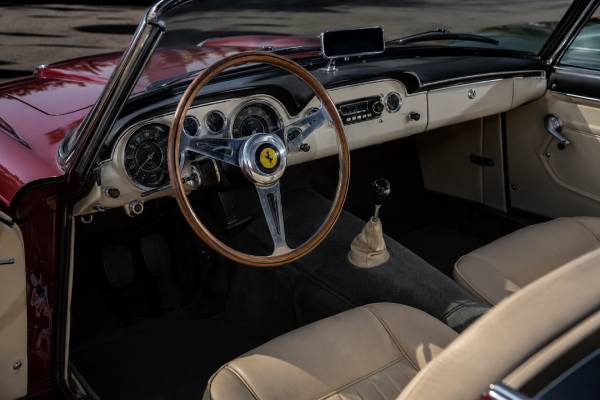
The cockpit has a period grand-touring feel. The driver faces a large wood-rim steering wheel and a dashboard with clear round instruments. The cabin is more luxurious than a competition Ferrari, with leather trim, proper carpets, and more attention to comfort. Visibility is good by classic GT standards, and the open body makes the car feel less confined than a coupé.
The convertible top is a major part of the design. A correct top frame should fold and seal properly, and the fabric should sit cleanly without bulky or awkward lines. Poorly restored tops can spoil the look of the car and allow water into expensive trim. The top mechanism should be inspected as carefully as the engine because correcting it can require specialist work.
Mechanically, the Series II Cabriolet uses established Ferrari solutions rather than radical inventions. The front-mounted V12 sits behind a long hood, feeding power through a manual gearbox to the rear wheels. The live rear axle may sound basic today, but Ferrari had long experience tuning this layout. In a properly prepared car, it gives predictable behavior and a strong sense of mechanical connection.
Cooling is important because the car combines a high-revving V12 with a dressed open body and city-capable grand-touring expectations. Radiator condition, fan operation, water pump health, and correct ducting all matter. A car that behaves well on a cool morning may struggle in traffic if the cooling system has not been restored as a whole.
The sound is one of the car’s defining features. A healthy Colombo V12 has a layered note: smooth at idle, crisp through the carburetors, and increasingly urgent as revs rise. Exhaust choice affects character and value. A period-correct or documented exhaust system is preferable to a loud modern setup that overwhelms the car’s refined personality.
Special features and details that deserve attention include:
- Pinin Farina body-number tags and stampings.
- Correct grille, bumpers, side trim, and light units.
- Borrani wire wheels where fitted.
- Veglia instrumentation.
- Proper convertible top frame and weather equipment.
- Factory-correct leather and carpet patterns.
- Correct engine-bay finishes and clamps.
- Period-correct carburetor and intake presentation.
- Tool kit, jack, manuals, and original accessories.
The design has aged well because it is not trying too hard. Modern supercars use vents, wings, active systems, and aggressive lighting to announce speed. The 250 GT Cabriolet Series II uses line, proportion, material, and sound. That difference is why it remains so appealing to collectors who value subtlety.
Road Feel and Performance Character
A well-sorted 250 GT Cabriolet Pinin Farina Series II feels like a fast, refined 1950s Ferrari grand tourer, not a modern sports car. Its performance is real, but the experience is built around warm-up discipline, carburetor response, mechanical controls, and the sound of a small V12 working hard.
Starting and warming the car properly matters. The Colombo V12 should not be treated like a modern engine that can be started cold and driven hard immediately. Oil temperature, coolant temperature, and carburetor behavior all need time. A properly tuned car will settle into a clean idle, but it may feel slightly rich or hesitant until warm.
Once ready, the engine is smooth and willing. It does not deliver modern turbocharged low-rpm shove. Instead, it builds speed through revs, throttle opening, and gear choice. The reward is precision. The driver hears the induction, feels the engine clear its throat, and senses the car becoming sharper as the revs rise.
The gearbox needs respect. Shifts should be deliberate, not rushed. A healthy transmission feels mechanical and satisfying, but worn synchros, poor linkage adjustment, or tired mounts can make the car difficult. Overdrive, where fitted, changes the touring character by making relaxed high-speed cruising easier.
Steering effort is heavier at parking speed than in any modern assisted car. Once moving, the steering becomes more natural and communicative. The front end tells the driver what the tires are doing, but the car prefers smooth inputs. It is not a point-and-fire machine. It is a rhythm car.
Ride quality is one of the Series II Cabriolet’s strengths. The long-wheelbase chassis and grand-touring setup make it more composed than the racier 250 variants. It can cover distance with real elegance. Poor shock absorbers, old tires, worn bushings, or incorrect ride height can ruin that quality, so driving feel is a useful inspection tool.
The brakes are reassuring when properly rebuilt. Four-wheel discs give the Series II a meaningful advantage over earlier drum-brake cars, especially in modern traffic and mountain driving. Even so, the brake pedal feel, stopping distance, and heat tolerance are period features. Old hoses, sticky calipers, poor fluid, or tired servo assistance can make a car feel unsafe.
Cornering balance is classic front-engine rear-drive Ferrari. The car is stable and flowing rather than razor sharp. It likes clean entry speed, progressive throttle, and room to settle. The rear axle can feel lively over poor surfaces, but a good car is not nervous. Tire choice makes a large difference. Modern tires with the wrong profile or grip balance can make the steering heavy and the ride harsh.
The open body adds charm but also brings classic convertible realities. There is more wind noise than in a coupé. The cabin can be warm. Top-up visibility and sealing depend on restoration quality. On a beautiful road with the roof down, those compromises become part of the car’s appeal rather than faults.
Compared with a California Spider, the Pinin Farina Cabriolet is less extroverted. Compared with a 250 GT Coupé, it feels more glamorous and more special on a sunny day. Compared with a modern Ferrari, it is slower, more demanding, and more fragile, but also more intimate. The driver is involved in every action.
The difference between a restored, properly sorted example and a tired car is enormous. A good car feels cohesive. The engine pulls cleanly, the brakes are straight, the steering is accurate, the body is quiet, and the temperature stays controlled. A tired car may still look magnificent, but it can feel loose, hot, smoky, difficult to shift, and expensive within minutes.
Maintenance, Restoration and Known Risks
The 250 GT Cabriolet Series II is not maintained like an ordinary classic car; it needs Ferrari 250 expertise, correct parts, careful documentation, and a budget that matches its value. The biggest risks are hidden corrosion, poor old body repairs, incorrect mechanical components, and attractive restorations that were done without proper historical accuracy.
The engine itself is strong when built and maintained correctly, but it is expensive to put right. A Colombo V12 rebuild is a specialist job. It involves careful machining, correct cam timing, carburetor setup, ignition accuracy, oiling checks, and attention to parts that may have been altered over decades. A cheap rebuild is rarely cheap by the time it is corrected.
Carburetion is a regular maintenance area. Triple Weber carburetors need clean fuel, proper synchronization, correct jetting, and sound throttle linkage. Cars that sit for long periods can develop blocked jets, stale fuel deposits, leaking gaskets, and poor idle quality. Many drivability complaints on these cars begin with fuel and ignition basics.
The cooling system should be treated as a complete system. Radiator, hoses, thermostat, water pump, fan, cap, and internal engine passages all matter. A partially restored cooling system can still overheat. Any pre-purchase drive should include low-speed running and a check for stable temperature, not just a short open-road blast.
Ignition condition is equally important. Distributor wear, old coils, weak wiring, incorrect timing, and poor plug condition can make the engine feel flat or unreliable. Because these engines are smooth when correct, roughness should not be dismissed as normal classic-car behavior.
The gearbox and overdrive need careful inspection. Listen for bearing noise, check for weak synchros, and confirm that overdrive engages correctly if fitted. A gearbox number that matches the car’s records is a value factor. A replacement gearbox may still work well, but it changes the originality story.
Brake restoration must be done properly. Disc calipers, hoses, hard lines, master cylinder, servo, and parking brake all need attention. A car that has been stored for years may need complete hydraulic renewal even if it has low mileage. Brake fluid absorbs moisture, and corrosion inside hydraulic parts can be hidden until the car is driven.
Suspension wear changes the whole personality of the car. Bushings, kingpins, dampers, leaf springs, wheel bearings, steering box, and alignment all affect confidence. A freshly trimmed interior and bright paint do not compensate for a chassis that wanders or clunks.
Corrosion is one of the most serious concerns. Buyers should inspect:
- Sills and lower body sections.
- Floor structure and footwells.
- Door bottoms and hinge areas.
- Wheel arches and lower fenders.
- Trunk floor and spare-wheel area.
- Battery area.
- Chassis tubes and suspension pickup points.
- Areas hidden by old underseal.
- Water-trap points around the convertible top and rear deck.
Accident damage is another major risk. These cars were valuable when new, but for many years they were not worth what they are worth now. Some repairs were done to keep cars usable rather than historically correct. A chassis that has been bent and repaired poorly can be very costly to correct. Measure the structure, inspect welds, and look for asymmetry.
Restoration quality is a major value driver. A proper restoration should have photographs, invoices, expert names, and evidence of correct parts. It should show what was repaired, not just the finished result. A glossy car with no restoration file is a risk. A slightly older restoration with excellent records may be a better buy.
Originality versus upgrades requires judgment. Sensible hidden improvements for safety or reliability may be acceptable to some owners, especially if reversible. Examples include better cooling fans, modern fluids, or discreet electrical improvements. Visible non-original changes, incorrect trim, modern gauges, modified bodywork, or wrong engine components can reduce collector value.
Parts availability is mixed. Some service parts and restoration materials are available through specialists, but original components can be rare and expensive. Correct instruments, trim pieces, carburetors, wheels, and body hardware may take time to source. The more incomplete the car, the more dangerous the project.
A proper inspection should be done by a Ferrari 250 specialist, not a general classic-car shop. The cost of expert inspection is small compared with the cost of correcting a wrong engine, a twisted chassis, or a poor body restoration.
Market Values, Buying Advice and Rivals
The 250 GT Cabriolet Pinin Farina Series II occupies a valuable but nuanced place in the Ferrari market: far below the most famous competition 250s, but well above ordinary classic grand tourers. The best examples are bought for authenticity, condition, provenance, and elegance, not simply for horsepower or rarity.
Recent public sales and listings show Series II Cabriolets commonly trading or being estimated in the low seven-figure range, with many good cars around roughly $1 million to $1.5 million and exceptional examples capable of more. Results vary widely because no two cars have the same history. A matching-numbers, Classiche-certified, beautifully restored car in a strong original color is a very different proposition from a color-changed car with gaps in its file.
The most important value factors are:
- Matching engine, gearbox, and rear axle.
- Confirmed Tipo 508D chassis identity and correct engine type for the build date.
- Ferrari Classiche certification or respected historian documentation.
- Original body and body-number continuity.
- Factory color and interior combination.
- Quality and age of restoration.
- Mechanical sorting after restoration.
- Proven ownership history.
- Complete tools, books, jack, and accessories.
- Concours history or eligibility for major events.
- Absence of serious accident or corrosion history.
Mileage is less important than condition and documentation. Many cars have uncertain mileage, and a low odometer reading means little without records. A regularly exercised, expertly maintained car can be better than a static museum piece.
The buyer inspection should focus on identity first, condition second, cosmetics third. Paint and leather are visible. Correct numbers, structure, and mechanical health are where the real money is.
| Priority | What to check | Why it matters |
|---|---|---|
| Identity | Chassis, engine, gearbox, axle, body numbers | Defines authenticity and market value |
| Documentation | Factory records, Classiche, historian reports, ownership file | Supports provenance and reduces uncertainty |
| Structure | Chassis alignment, corrosion, accident repairs | Most expensive hidden risk |
| Body | Panel fit, top fit, Pinin Farina details | Coachbuilt metalwork is costly to correct |
| Mechanical health | Compression, oil pressure, cooling, gearbox, brakes | Determines whether the car is usable or due for major work |
| Restoration quality | Invoices, photos, specialist names, correctness | Separates a real restoration from a cosmetic refresh |
Cars to seek include those with long-term ownership, factory-correct colors, matching major components, complete documentation, and recent specialist mechanical sorting. A car that has already been driven and debugged after restoration is often more enjoyable than a fresh restoration that has not been tested.
Cars to approach cautiously include those with missing records, replacement engines, unclear chassis history, poor panel fit, excessive filler, incorrect interiors, non-original colors without documentation, or signs of long storage. A low advertised price can be misleading if the car needs body correction or engine work.
The closest Ferrari alternatives depend on what the buyer wants. A 250 GT Pinin Farina Coupé offers similar engine character with lower open-car glamour and usually lower cost. A 250 GT California Spider offers a much more sporting and famous open 250 experience, but at a far higher market level. A 250 GT Lusso is later, closed, and more sculptural, with a different balance of usability and design drama. A 275 GTS offers 1960s open Ferrari refinement with a later mechanical feel.
Period rivals include the Aston Martin DB4 and DB5 convertibles, Maserati 3500 GT Spyder, Mercedes-Benz 300 SL Roadster, and certain high-end coachbuilt Alfa Romeo and Lancia models. The Ferrari stands apart through its V12, 250-series identity, and Pinin Farina connection. The Aston may feel more robust and British, the Maserati more relaxed, and the Mercedes more technically distinctive, but the Ferrari has a unique mix of delicacy, sound, and collector magnetism.
Long-term collectability looks strong because the car has the right fundamentals: golden-era Ferrari, V12, open coachwork, rarity, beauty, and usability. It is not likely to overtake the California Spider in desirability, and it should not be bought as a cheaper substitute for one. It should be bought for what it is: a refined, elegant, historically important Ferrari 250 GT Cabriolet.
For the right owner, the Series II offers a rare balance. It can appear at a serious concours, take part in prestigious tours, and still deliver the essential joy of a carbureted Ferrari V12 on an open road. The best purchase is the car with the clearest identity, not necessarily the shiniest paint.
References
- Ferrari 250 GT Cabriolet (1957) 1957 (Manufacturer Specification) ([Ferrari][1])
- Ferrari Classiche: Certification – Ferrari.com 2026 (Manufacturer Certification) ([Ferrari][2])
- 1960 Ferrari 250 GT Cabriolet Series II by Pinin Farina | Monterey 2024 | RM Sotheby’s 2024 (Auction Listing) ([RM Sotheby’s][3])
- 1960 Ferrari 250 GT Series II Cabriolet | Gooding Christie’s 2024 (Auction Result) ([goodingco.com][4])
- Ferrari 250 GT Cabriolet Pinin Farina Series II Market – CLASSIC.COM 2026 (Market Data) ([Classic.com][5])
Disclaimer
This article is for informational purposes only and is not a substitute for professional diagnosis, inspection, repair, restoration, or valuation. Specifications, torque values, service intervals, procedures, and correct parts can vary by chassis number, market, build date, and equipment. Always verify details against official Ferrari documentation, factory records, and a qualified Ferrari 250 specialist before buying, servicing, or restoring a car.
If you found this guide useful, please consider sharing it on Facebook, X/Twitter, or your favorite enthusiast community to support our work.