
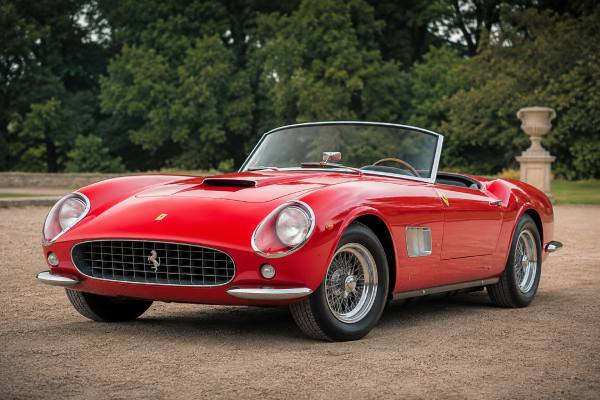
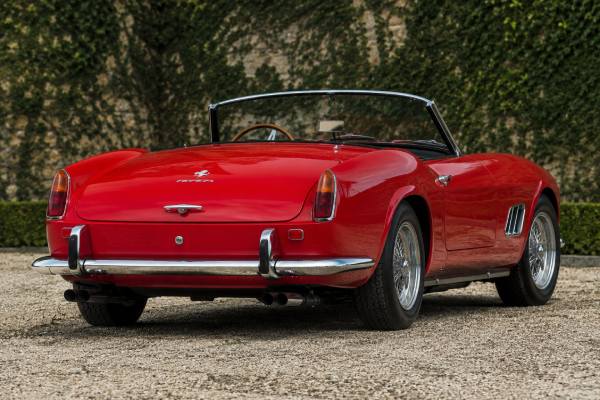
The Ferrari 250 GT SWB California Spyder, built from 1960 to 1963, is the short-wheelbase version of Ferrari’s open 250 GT California line, using the Tipo 539 chassis and the Colombo-derived Tipo 168 3.0-liter V12. In its most desirable competition specification, output was around 280 hp, although many road examples were quoted closer to 240 hp depending on engine tune, carburetion, and factory build details. It matters because it joined three things that rarely meet so cleanly: a serious Ferrari GT chassis, a hand-built open Scaglietti body, and enough competition credibility to make it more than a glamorous boulevard car.
The SWB California Spyder sits at the top of the open Ferrari hierarchy for many collectors because it is not simply a convertible version of a famous coupe. It was shaped by American demand for a fast open Ferrari, refined through the same short-wheelbase thinking that made the 250 GT Berlinetta SWB so effective, and built in very small numbers. Covered headlights, alloy-body competition cars, factory hardtops, original drivetrains, and Ferrari Classiche documentation can make enormous differences to identity and value. It is beautiful, but beauty is only part of the reason people still study it closely.
Quick Take
The Ferrari 250 GT SWB California Spyder is one of the most desirable open Ferraris because it combines Scaglietti coachwork, a short-wheelbase 250 GT chassis, disc brakes, and a Colombo V12 in a car that can feel both elegant and genuinely sporting. Its strongest appeal is the mix of open-air style and competition-bred engineering; its main caution is that no two cars are exactly alike, and value depends heavily on originality, body configuration, engine specification, history, and restoration quality. For buyers, the most important factor is not just condition, but whether the chassis, body, engine, gearbox, rear axle, documents, and claimed factory features all support the same story.
Table of Contents
- History and Collector Importance
- Engine, Chassis and Key Specs
- Production, Variants and Options
- Design, Engineering and Special Details
- Driving Character and Performance
- Maintenance, Restoration and Known Risks
- Values, Buying Advice and Rivals
History and Collector Importance
The 250 GT SWB California Spyder matters because it turned Ferrari’s open California concept into a sharper, more modern, short-wheelbase GT. It kept the glamour of the earlier long-wheelbase California, but added the handling, braking, and chassis development associated with Ferrari’s most successful late-1950s and early-1960s road-racing cars.
The California Spyder idea came from the needs of wealthy American sports-car customers, especially on the West Coast. Ferrari’s U.S. representatives understood that some buyers wanted an open car that was not soft, slow, or merely decorative. They wanted something that could be driven hard, entered in events, and still look appropriate outside a hotel in Beverly Hills, Palm Beach, or the French Riviera.
The earlier LWB California Spyder used a longer 2,600 mm wheelbase. It had the broad character of the 250 GT Tour de France family: front-mounted V12, rear-wheel drive, lightweight coachwork, and a racing connection. The SWB version, introduced in 1960, shortened the wheelbase to 2,400 mm and moved the California closer to the 250 GT Berlinetta SWB. That change gave the car a more compact stance and a more immediate driving character.
Carrozzeria Scaglietti built the bodies, while Pinin Farina’s design influence helped define the proportions. The result was not a mass-produced convertible but a coachbuilt Ferrari with small differences from car to car. Some had open headlights, some had covered headlights. Some were steel-bodied road cars, while a tiny number used alloy coachwork for competition. Factory hardtops, special colors, competition engines, and unique interior details add further complexity.
The SWB California arrived during a golden period for Ferrari. The company was still small enough for individual customer requests to matter, but strong enough in competition to sell road cars with genuine racing substance. The 250 GT Berlinetta SWB, 250 Testa Rossa, and later 250 GTO all helped define Ferrari’s image as a builder of fast, elegant, dual-purpose machines. The SWB California belonged to that world, but with the added appeal of open coachwork.
Today, collectors value it for several overlapping reasons:
- It is a true 250-series Ferrari with the classic Colombo V12.
- It has the short 2,400 mm wheelbase, which gives it a stronger connection to the SWB Berlinetta.
- It was built in extremely limited numbers.
- It carries Scaglietti bodywork, often with hand-finished details.
- It has strong concours appeal and major event eligibility.
- The best cars have known histories, original major components, and Ferrari Classiche certification.
Its reputation is also helped by the fact that it is easy to understand emotionally. Some collector cars require technical explanation before their importance becomes clear. The SWB California does not. The low nose, open cockpit, long hood, compact tail, wire wheels, and V12 identity make the appeal immediate. The deeper story, however, is what separates great examples from merely attractive ones.
Engine, Chassis and Key Specs
The SWB California Spyder used Ferrari’s 3.0-liter Colombo V12, mounted in front and driving the rear wheels through a 4-speed manual gearbox. The key mechanical identity is the combination of the Tipo 539 short-wheelbase tubular chassis, Tipo 168 V12 family, disc brakes, and hand-built Scaglietti spider bodywork.
Because Ferrari built these cars in small numbers and to individual specifications, published figures vary. Competition engines, road engines, carburetor specifications, compression ratios, final-drive ratios, and body materials can change the numbers. The table below gives the most useful broad specification picture for the 1960–1963 SWB California Spyder, with emphasis on the 280 hp Tipo 168 competition-style specification named in this article.
| Item | Specification |
|---|---|
| Production period | 1960–1963 |
| Chassis type | Tipo 539 tubular steel short-wheelbase chassis |
| Body style | Two-seat open spider by Scaglietti |
| Engine | Tipo 168 60-degree Colombo V12 |
| Displacement | 2,953 cc |
| Bore x stroke | 73 mm x 58.8 mm |
| Valve gear | Single overhead camshaft per bank, two valves per cylinder |
| Fuel system | Triple Weber twin-choke carburetors, specification varies by car |
| Quoted output | Up to about 280 hp at 7,000 rpm in competition tune |
| Transmission | 4-speed manual |
| Drivetrain | Front engine, rear-wheel drive |
| Front suspension | Independent front suspension with coil springs and telescopic dampers |
| Rear suspension | Live rear axle with leaf springs and locating links |
| Brakes | Dunlop hydraulic disc brakes on all four wheels |
| Wheelbase | 2,400 mm |
The V12 is often described as a “3.0-liter” engine, but the exact displacement is 2,953 cc. The 250 name comes from the approximate displacement of each cylinder, not the total engine size. The engine’s character is central to the car: light alloy construction, modest individual cylinder size, high-revving delivery for the period, and a sound that changes from mechanical chatter at low rpm to a hard, clean V12 note as the revs rise.
The four-speed gearbox is part of the period experience. It is not a modern fast-shifting unit, and it should not be rushed when cold. A well-built and correctly adjusted gearbox has a precise, mechanical feel, but synchros, linkage condition, clutch adjustment, and oil temperature matter. A tired gearbox can make even a valuable car feel reluctant.
The chassis was a major step forward from the earlier LWB California. The shorter wheelbase reduced the distance between the axles by 200 mm, helping the car rotate more easily and feel more alert on winding roads. Disc brakes were another important improvement. Earlier Ferrari GTs with drum brakes can be wonderful, but the SWB California’s disc setup gives greater confidence, especially when the car is driven briskly.
Road and competition tune
One point often misunderstood is horsepower. Many SWB California Spyders are road cars and are often described with output around 240 hp. Competition-style examples, especially those with higher-spec Tipo 168 engines and larger Weber carburetors, are commonly quoted at about 280 hp. That difference matters for valuation, identity, and driving feel, but buyers should not rely on a catalog sentence alone. The engine number, internal build records, carburetor type, cylinder-head specification, and Ferrari Classiche file matter more than a simple horsepower claim.
Production, Variants and Options
Ferrari built the SWB California Spyder in very small numbers, generally accepted as 56 examples. The key distinctions are open versus covered headlights, steel versus alloy bodywork, road versus competition specification, factory hardtop presence, and whether the car still retains its original major components.
The model followed the LWB California, which itself was rare. The SWB version is rarer still and more technically mature. It overlaps with the 250 GT Berlinetta SWB era, so many parts of its identity are tied to that car’s chassis and mechanical development. However, the open body required its own structural considerations, and the hand-built nature of the coachwork means details can vary.
Important identification and desirability factors include:
- Chassis number: The starting point for any serious inspection. The chassis identity must match period records and later documentation.
- Engine number: Matching engine status is crucial, especially on cars claimed to retain original drivetrains.
- Gearbox and rear axle numbers: These can affect value, particularly at the top of the market.
- Body number and coachwork details: Scaglietti bodies were hand-built, and body identity matters.
- Headlight treatment: Covered-headlight cars are often especially desirable, though condition and provenance can outweigh a single feature.
- Body material: Alloy-bodied cars are much rarer than steel-bodied cars.
- Hardtop: A factory removable hardtop is a major value and identity factor.
- Competition specification: Genuine factory competition features must be proven through documentation, not assumed from later upgrades.
Factory colors and interiors can also have a large effect on collector interest. A car restored in its original delivery colors often has stronger appeal than one finished in a popular but non-original red. That does not mean a red car is undesirable. It means originality and documented correctness carry extra weight in this market.
Open headlights and covered headlights
Covered headlights are one of the most visible and desirable features on a SWB California Spyder. They give the nose a smoother, more competition-like appearance and are often associated with the most valuable examples. Open-headlight cars, however, can still be highly important if they have strong provenance, original components, and excellent restoration quality.
A buyer should be careful here. A covered-headlight conversion may look attractive but does not carry the same meaning as factory-supplied covered lights. The difference should be confirmed through build records, period photographs, expert inspection, and Ferrari Classiche documentation.
Road cars and competition cars
Most SWB California Spyders were road cars, even though they were based on serious GT hardware. The competition cars are a smaller and more valuable subset. They may include alloy coachwork, higher-output engines, external fuel fillers, competition carburetion, special instrumentation, and other details tied to event use or factory build sheets.
The most desirable competition cars are not simply modified road cars. Their value comes from documented factory specification, period use, and retained original parts. Later “upgrades” may improve driving performance, but they can reduce historical purity if they replace original components or blur the car’s identity.
Design, Engineering and Special Details
The SWB California Spyder is visually powerful because it combines a racing-derived stance with open coachbuilt elegance. Its design is low, simple, and balanced, with a long hood for the front V12, a compact cabin, and a short rear deck that looks more athletic than the earlier long-wheelbase cars.
Scaglietti’s bodywork is central to the car’s appeal. These were not stamped-out bodies with perfectly identical panel shapes. They were hand-formed bodies built in small numbers, which is why details such as vents, headlight covers, door fit, cockpit trim, and rear-end contours deserve close inspection. Slight differences are normal. Poor panel alignment, incorrect repairs, or modern over-restoration are different matters.
The proportions come from function as much as style. The front engine sits behind the front axle line enough to give the car a classic front-mid-engine balance for its era. The open cockpit is set well back. The short wheelbase tightens the whole shape, giving the SWB California a more purposeful look than many luxury convertibles of the same period.
Body construction and materials
Most SWB California Spyders had steel bodies with aluminum opening panels or selected lightweight panels, while the rarest competition cars used alloy bodywork. The difference is important for weight, identity, and value. Alloy panels are more easily damaged, harder to repair correctly, and more difficult to authenticate without expert help.
The chassis itself is a tubular steel frame. The open body means the car depends heavily on the quality of the underlying structure. Accident damage, corrosion, and old repairs can affect not only appearance but also door fit, steering feel, suspension geometry, and long-term value.
Cockpit and controls
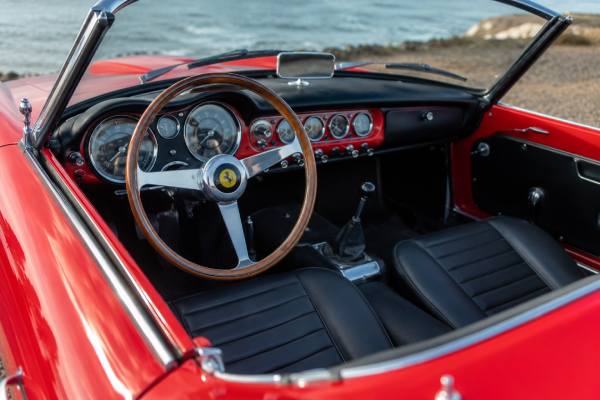
Inside, the SWB California is simple, intimate, and driver-focused by modern standards. Large analog instruments, a wood-rim steering wheel, leather seats, and a straightforward gear lever define the cabin. Some cars have unique dashboard details or special trim arrangements, so originality must be judged against the individual chassis.
The driving position is period-correct rather than modern. The wheel is large, the pedals may feel offset, and taller drivers should check comfort before assuming the car will fit. Heat, noise, fuel smell, and wind buffeting are part of the open vintage Ferrari experience. A well-sorted car feels alive rather than crude; a tired car can feel loose, hot, and demanding.
Sound and sensory character
The engine sound is one of the defining features. The Colombo V12 is not about huge low-rpm torque. It rewards revs, clean carburetor tuning, and proper ignition setup. At low speed, the car has mechanical texture: valvetrain noise, gear whine, intake pulse, exhaust resonance, and the small vibrations of a hand-built machine. As the engine climbs toward the upper rev range, the note becomes sharper and more urgent.
That sensory character is one reason originality matters. Exhaust design, carburetor type, air boxes, engine tune, and even insulation choices can change how the car feels. A restored car that looks perfect but has lost its mechanical delicacy may be less satisfying than a slightly older restoration that has been carefully maintained and driven.
Driving Character and Performance
A good 250 GT SWB California Spyder feels light, responsive, and far more serious than a typical early-1960s luxury convertible. It is not a modern supercar, but in period it was extremely fast, and today its appeal comes from the way its V12, steering, brakes, and chassis work together.
The engine needs proper warm-up. Oil temperature, coolant temperature, carburetor behavior, and ignition health all affect how cleanly it runs. Once warm, the V12 should pull smoothly and build power with a refined but urgent character. In competition tune, the car feels more eager at the top end. In road tune, it may feel sweeter and more flexible, with less need to chase every last rpm.
The gearbox is best handled with patience. First gear can feel heavy when cold, and rapid shifts are not the point. The reward is in matching the rhythm of the machine: firm clutch action, deliberate lever movement, and clean throttle work. A properly set up car gives the driver a sense of direct mechanical connection that modern dual-clutch cars cannot duplicate.
Steering effort is higher at parking speed because there is no power assistance. Once moving, the steering should lighten and become detailed. The front end gives clear information, and the short wheelbase helps the car feel eager on a winding road. It should not feel nervous if the suspension, tires, and alignment are correct, but it is still a powerful rear-drive classic on narrow tires by modern standards.
The brakes are one of the SWB car’s major advantages over earlier drum-brake Ferraris. Dunlop discs give better consistency and confidence, though they still require period expectations. Pedal feel, servo condition, pad material, fluid age, and caliper condition all matter. A car that has been sitting may need significant brake work before it can be driven hard.
Performance expectations
Period performance figures vary, but a healthy SWB California is capable of strong acceleration and a top speed in the broad region of 140–150 mph depending on tune, gearing, body, and test conditions. The point is not only maximum speed. The car’s real performance quality is the way it covers fast roads: long-legged gearing, stable high-speed manners, strong brakes for its day, and an engine that enjoys sustained work.
Modern tires can change the car. Correct-style vintage tires preserve steering feel and breakaway behavior, while more modern rubber may add grip but place higher loads on suspension and chassis components. Buyers and owners should choose tires with expert advice, especially if the car will be used in historic rallies or concours events where correctness matters.
City, road and event use
In city traffic, the SWB California can be demanding. It may run warm if the cooling system is not perfect, the clutch can feel heavy, and visibility with the roof or hardtop in place is not like a modern convertible. On open roads, the car makes far more sense. It wants space, temperature, and flow.
For events, preparation is everything. A California Spyder that has been maintained as a usable car can handle tours and rallies well. A car that has spent years as a static showpiece may need careful recommissioning before serious use. Fuel hoses, brake hydraulics, wheel bearings, cooling system parts, carburetor seals, ignition components, and tires should all be treated as safety-critical items.
Maintenance, Restoration and Known Risks
The 250 GT SWB California Spyder is not “reliable” or “unreliable” in a normal used-car sense. It is a rare coachbuilt Ferrari that can be dependable when maintained by the right specialists, but neglect, incorrect restoration, old accident damage, and undocumented parts changes can create enormous cost and value risk.
The engine is robust in concept, but expensive in reality. A Colombo V12 rebuild requires deep model knowledge, proper machining, correct parts, and careful assembly. Carburetor tuning and ignition setup are not minor details; they define how the car starts, idles, pulls, and survives under load. Overheating, oil leaks, tired valve gear, worn timing components, and poor previous machine work can lead to large bills.
The fuel system deserves close attention. Old tanks, degraded lines, incorrect pumps, blocked filters, and carburetor leakage are common risks on vintage cars. Ethanol-blended modern fuel can worsen hose and seal problems if the system has not been updated with suitable materials. Any smell of fuel should be treated seriously.
Cooling is another major area. A clean radiator, healthy water pump, correct hoses, proper fan operation, and clear coolant passages are essential. These cars can be driven, but they do not tolerate years of deferred maintenance followed by hard use in hot traffic.
Body, chassis and corrosion
The most expensive risks often sit underneath the paint. A shiny restoration can hide corrosion, old crash damage, poor panel work, and incorrect structural repair. The tubular chassis should be inspected for straightness, corrosion, cracks, and signs of past impact. Door gaps, hood fit, trunk fit, and windshield frame alignment can reveal deeper problems.
Corrosion-prone and inspection-sensitive areas include:
- Lower body sections and sills
- Floor structure
- Door bottoms and lower fenders
- Trunk floor and rear structure
- Battery area
- Suspension mounting points
- Chassis tubes and outriggers
- Areas around previous accident repairs
- Junctions between steel and aluminum panels
Alloy bodywork needs especially careful evaluation. Aluminum can be stretched, work-hardened, patched badly, or reshaped in ways that are hard to detect without expert eyes. A correct repair may be beautiful and acceptable. An undocumented body replacement or major reshaping can affect value dramatically.
Mechanical systems to inspect
A serious pre-purchase inspection should go far beyond a test drive. It should include compression and leak-down tests, oil pressure readings, cooling-system checks, gearbox behavior hot and cold, differential noise, brake condition, suspension wear, steering play, wheel condition, and electrical operation.
Key mechanical concerns include:
- Engine originality and internal condition
- Carburetor specification and tuning quality
- Ignition timing, distributors, coils, and wiring
- Gearbox synchro wear and bearing noise
- Clutch condition and adjustment
- Differential whine or incorrect ratio
- Brake caliper, rotor, servo, and hydraulic condition
- Suspension bushings, dampers, springs, and geometry
- Steering box wear and linkage play
- Wheel integrity and tire age
Electrical systems are simple compared with modern cars but still important. Old wiring, weak grounds, incorrect switches, poor charging, and non-original modifications can cause frustrating problems. A concours-quality restoration should not merely look correct; it should function correctly.
Restoration choices
Restoration can protect value or damage it. Returning a car to its original factory colors, preserving original panels where possible, rebuilding the original engine rather than replacing it, and documenting every step can strengthen a car’s position. Over-restoration, incorrect finishes, modern materials used visibly, or changes made for convenience can hurt authenticity.
The best restorations are transparent. They include photographs, invoices, expert reports, parts records, and a clear explanation of what was preserved, repaired, replaced, or recreated. For a car at this level, “restored” is not enough. Buyers need to know who restored it, when, to what standard, and with what evidence.
Values, Buying Advice and Rivals
The SWB California Spyder sits in the top tier of blue-chip Ferrari collecting, with values driven by specification, originality, documentation, condition, and public sale history. Recent auction results show that ordinary rules do not apply: a highly important competition car can sell far above a more standard example, even when both carry the same basic model name.
As of the mid-2020s, public results for SWB California Spyders have ranged from the high single-digit millions for less exceptional but still important cars to more than $20 million for the rarest competition examples. A 1961 SWB California Spider Competizione sold for $25,305,000 at Pebble Beach in 2025, while another 1961 SWB California Spider at the same venue sold for $7,550,000. That spread is the buying guide in one lesson: specification, history, and authenticity can be worth more than the model badge alone.
The biggest value drivers are:
- Original chassis, body, engine, gearbox, and differential
- Ferrari Classiche certification and supporting factory records
- Known ownership history
- Period race history or major event history
- Covered headlights if factory original
- Alloy bodywork if factory original
- Factory hardtop
- Original colors or a historically important livery
- Restoration by a recognized specialist
- Documentation by respected Ferrari historians
- Eligibility and acceptance for major concours, tours, and historic events
Buyers should avoid cars where the story is stronger than the evidence. A claim of competition specification, covered headlights, factory hardtop, or original drivetrain must be supported by records. The higher the value, the more important the paper trail becomes.
Pre-purchase checklist
A proper buying process should be disciplined. Emotion is unavoidable with a SWB California, but emotion should not replace verification.
| Area | What to verify |
|---|---|
| Identity | Chassis number, body number, engine number, gearbox number, rear axle number |
| Documentation | Factory records, Classiche file, historian reports, old titles, period photographs |
| Specification | Original headlight type, body material, engine tune, hardtop, color, interior |
| Body and chassis | Corrosion, accident repairs, panel originality, chassis straightness |
| Mechanical condition | Engine health, gearbox, differential, brakes, suspension, steering, cooling |
| Restoration quality | Who performed the work, what was replaced, photographic record, invoices |
| Usability | Recent service, event use, tire age, fuel system, brake hydraulics, road test |
A car to seek is one with a consistent identity, original major components, known history, high-quality restoration, and clear documentation. A car to approach carefully is one with missing records, unclear engine status, major undocumented body repair, long storage without recommissioning, or attractive upgrades presented as factory features.
Rivals and alternatives
The closest Ferrari alternative is the 250 GT Berlinetta SWB. It offers a more focused closed-body driving experience and stronger competition identity, but lacks the open-air glamour of the California. The earlier LWB California Spyder has its own charm and historical importance, often with a softer, more classic late-1950s feel. The 275 GTS is more relaxed and less valuable, while the 275 GTB/4 NART Spider is far rarer and in a different market category.
Outside Ferrari, natural comparisons include the Aston Martin DB4 GT, Mercedes-Benz 300 SL Roadster, Maserati 3500 GT Spyder, and certain Jaguar competition-derived road cars. None offers exactly the same mix of open coachwork, Ferrari V12 identity, short-wheelbase GT engineering, and extreme rarity.
The long-term collectability outlook remains strong because the supply is fixed, the model is universally understood, and the best examples have global demand. That does not mean every car is equally safe as an investment. At this level, the wrong restoration decision or a weak documentation file can move value by millions. The best approach is to buy the most correct, best-documented, best-inspected example available, not merely the first car that appears for sale.
References
- Ferrari 250 California (1957) – Ferrari.com 1957
- Ferrari 250 GT Berlinetta passo corto (1959) 1959
- 1960 Ferrari 250 GT SWB California Spider by Scaglietti | Monterey 2024 | RM Sotheby’s 2024
- 1961 Ferrari 250 GT SWB California Spider Competizione | Gooding Christie’s 2025
- Gooding Christie’s Achieves New Auction Record with $25.3 Million Ferrari 250 GT California Spider Competizione, Grosses over $128 Million at 21st Annual Pebble Beach Auctions 2025
Disclaimer
This article is for informational purposes only and is not a substitute for professional diagnosis, repair, valuation, authentication, or restoration advice. Specifications, torque values, service intervals, repair procedures, and original equipment can vary by chassis number, market, factory build, later modifications, and individual history. Owners and buyers should verify all details against official service documentation, factory records, Ferrari Classiche materials, and a qualified Ferrari specialist.
If you found this guide useful, please consider sharing it on Facebook, X/Twitter, or your preferred car community to support our work.