
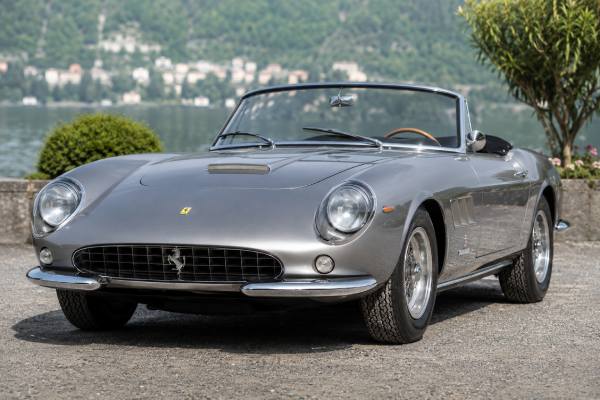
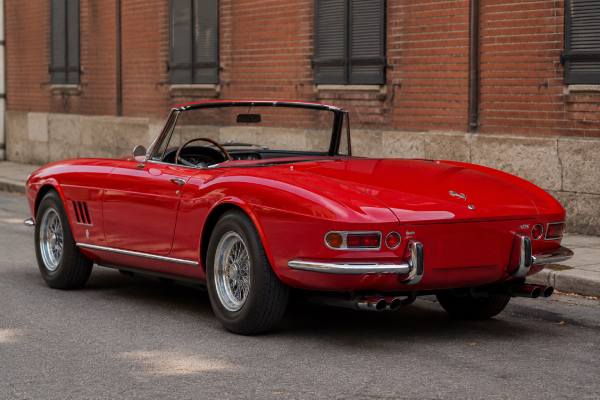
The Ferrari 275 GTS was the open grand-touring version of Ferrari’s first 275 road-car generation, built from late 1964 into 1966 with the Tipo 213 3.3-liter Colombo V12, a Tipo 563 tubular chassis, rear-mounted 5-speed transaxle, and 260 hp factory output. It arrived alongside the sharper 275 GTB but served a different purpose: refined open-air travel rather than hard-edged berlinetta drama.
Its importance comes from that mix. The 275 GTS carried major modern Ferrari engineering into a more elegant Pininfarina spider body, including four-wheel independent suspension and a rear transaxle, while keeping the classic front-engine V12 character collectors expect from a 1960s Maranello road car. Only 200 were built, so buyers still study this model closely for originality, matching numbers, factory colors, restoration quality, and Ferrari Classiche documentation.
Quick Take
The Ferrari 275 GTS is most appealing as a rare, elegant, open Enzo-era V12 Ferrari that combines graceful Pininfarina coachwork with the more advanced 275 chassis layout. Its identity is not maximum power, but balance, usability, and refinement: a 260 hp wet-sump Tipo 213 V12, 5-speed rear transaxle, independent suspension, disc brakes, and Borrani wire wheels in a relaxed two-seat spider. The caution is that condition and authenticity matter enormously; corrosion, poor older restorations, non-original major components, and incomplete documentation can change both the driving experience and the market value.
Table of Contents
- History and Collector Significance
- Engine, Chassis and Key Specifications
- Production, Variants and Factory Details
- Design, Engineering and Special Features
- Road Character and Performance
- Maintenance, Reliability and Restoration
- Market Values, Buying Guide and Rivals
History and Collector Significance
The 275 GTS matters because it brought Ferrari’s new 275-generation engineering to an open, luxurious grand tourer. It replaced the older 250-series cabriolet idea with a more modern chassis, a larger V12, a rear transaxle, and independent rear suspension.
Ferrari introduced the 275 line at the 1964 Paris Salon. The family included the 275 GTB berlinetta and the 275 GTS spider. Both used the same broad mechanical platform, but they were aimed at different clients. The GTB was the more aggressive closed car. The GTS was the calmer, more formal convertible for long-distance touring, coastal roads, city arrivals, and open-air driving without losing serious Ferrari engineering underneath.
The model name follows Ferrari’s traditional displacement-per-cylinder logic. Each cylinder displaced about 275 cc, giving the twelve-cylinder engine a total capacity just under 3.3 liters. The “GTS” name stood for Gran Turismo Spider. The factory chassis type is commonly identified as Tipo 563, while the engine is the Tipo 213 Colombo V12.
Pininfarina played a central role. Unlike the 275 GTB, whose bodies were associated with Scaglietti production, the 275 GTS body was designed and built by Pininfarina. That matters to collectors because the GTS does not simply look like a roofless GTB. It has its own proportions, shorter-looking nose, uncovered headlamps, formal side treatment, and a more restrained character closer to the earlier Pininfarina cabriolet tradition.
The 275 GTS also sits in an interesting place in Ferrari history. It followed the glamorous 250 GT cabriolets and California Spiders, but it preceded the later 330 GTS and 365 GTS. It therefore bridges two eras: the delicate 250-series Ferraris of the early 1960s and the larger, more powerful grand tourers that followed.
Its reputation today is shaped by three points:
- It is rare, with only 200 examples built.
- It is a true open Ferrari V12 from the Enzo Ferrari period.
- It offers advanced 275 mechanicals in a more usable and refined body style.
The 275 GTS is not usually treated as a direct motorsport icon in the way the 275 GTB/C or 275 GTB competition cars are. Its significance is different. It is a blue-chip road Ferrari, valued for originality, grace, mechanical sophistication, and low production. Good examples are often concours candidates, while preserved cars with strong documentation can be especially desirable because the model is now old enough that restoration quality varies widely.
Engine, Chassis and Key Specifications
The 275 GTS uses a front-mounted 60-degree Colombo V12 with wet-sump lubrication, three twin-choke Weber carburetors, and a claimed 260 hp at 7,000 rpm. The most important engineering point is the complete 275 layout: front V12, rear 5-speed transaxle, four-wheel independent suspension, and disc brakes.
| Item | Specification |
|---|---|
| Production period | 1964–1966 |
| Chassis type | Tipo 563 tubular steel chassis |
| Body style | Two-seat spider by Pininfarina |
| Engine type | Tipo 213 front longitudinal 60-degree V12 |
| Displacement | 3,285.72 cc |
| Bore x stroke | 77 mm x 58.8 mm |
| Compression ratio | 9.2:1 |
| Valve gear | Single overhead camshaft per bank, two valves per cylinder |
| Fuel system | Three Weber 40 DCZ/6 or 40 DFI/1 carburetors |
| Maximum power | 260 hp at 7,000 rpm |
| Lubrication | Wet sump |
| Transmission | 5-speed manual rear transaxle |
| Drive | Rear-wheel drive |
| Brakes | Four-wheel hydraulic disc brakes |
The Tipo 213 engine is part of the Colombo V12 family, the engine line that defined many early Ferrari road and competition cars. In the 275 GTS, it was tuned for smoothness and flexibility rather than headline output. The berlinetta version was quoted higher, but the spider’s 260 hp rating suited its grand-touring role.
The rear transaxle is one of the car’s key advances over older Ferraris. Instead of placing the gearbox directly behind the engine, Ferrari located the gearbox at the rear axle. This helped weight distribution and gave the 275 family a more balanced feel than earlier front-engine Ferraris with more traditional layouts.
| Area | Ferrari 275 GTS detail |
|---|---|
| Length | 4,350 mm |
| Width | 1,675 mm |
| Height | 1,250 mm |
| Wheelbase | 2,400 mm |
| Front track | 1,377 mm |
| Rear track | 1,393 mm |
| Dry weight | About 1,120 kg |
| Fuel tank capacity | 84 liters |
| Front suspension | Independent unequal-length wishbones, coil springs, telescopic dampers, anti-roll bar |
| Rear suspension | Independent unequal-length wishbones, coil springs, telescopic dampers, anti-roll bar |
| Steering | Worm-and-roller steering |
| Wheels and tires | Borrani wire wheels with 195 or 205 x 14 tires |
| Top speed | About 242 km/h, or 150 mph |
The specification tells you why the 275 GTS is more than a pretty convertible. It has the engineering substance expected of a serious Ferrari: a high-revving V12, proper manual gearbox, modern suspension for the era, disc brakes, and a body built for refined use rather than racing sacrifice.
Production, Variants and Factory Details
Ferrari built 200 examples of the 275 GTS, making it much rarer than the related 275 GTB coupe. The model was not produced in many formal variants, so authenticity depends more on individual chassis history, original colors, body details, and matching major components than on trim-level differences.
All production cars followed the same basic concept: two-seat Pininfarina spider, 3.3-liter Tipo 213 V12, 5-speed transaxle, independent suspension, disc brakes, and Borrani wire wheels. Left-hand drive was most common, while right-hand-drive examples are especially scarce.
The chassis numbers followed Ferrari’s odd-numbered road-car sequence of the period. For buyers, the important point is not only the chassis number itself, but whether the chassis, engine, gearbox, body, and factory records agree. A 275 GTS can look correct from a distance yet lose significant value if major components do not match the original build records.
Factory identity points
Useful identifiers and documentation points include:
- Tipo 563 chassis identity.
- Tipo 213 V12 engine number and internal configuration.
- Pininfarina body number and body features.
- Original color and interior trim.
- Original delivery market and dealer.
- Factory hardtop, if supplied.
- Borrani wire wheels and correct period-style tires.
- Ferrari Classiche certification where available.
- Owner’s manual, tool roll, jack, service records, and historian reports.
The 275 GTS was offered with a folding soft top. A removable hardtop was available and is now a meaningful value factor when original to the car or convincingly documented. Hardtops can be especially desirable because they add usability and rarity, but buyers should be careful. A hardtop that merely fits the car is not the same as a documented original factory-supplied item.
Color also matters. Many cars have changed colors during restorations, sometimes more than once. A repaint into resale-friendly red may look attractive, but the market often rewards a return to the original factory color, especially if the shade is elegant and period-correct. Interior materials, stitching style, instruments, switchgear, carpets, soft-top materials, and trim details all affect how a serious collector judges the car.
Relationship to other 275 models
The 275 GTS should not be confused with the 275 GTS/4 NART Spider. The NART Spider was a later, ultra-rare open car based on the four-cam 275 GTB/4 and built in only a tiny number. It is a different model with a different engine specification, different market position, and much higher collector value.
The standard 275 GTS is also visually very different from the 275 GTB. It shares much of the engineering idea, but not the same body shape. That separation is important. The GTS is not simply a convertible GTB; it is a distinct Pininfarina spider with its own design identity and collector audience.
Design, Engineering and Special Features
The 275 GTS is distinctive because it wraps advanced 275 mechanicals in a calm, elegant Pininfarina body rather than the dramatic long-nose shape associated with the GTB. Its special character comes from restraint: open headlamps, a clean side profile, slim bumpers, wire wheels, and a formal cockpit.
The body is often described as more conservative than the 275 GTB, but that is not a weakness. The GTS was intended to be a refined spider for wealthy road-car clients. It needed to look dignified with the roof up, graceful with the roof down, and suitable for long-distance touring. Its proportions reflect that job.
The front end has smaller uncovered headlamps rather than the faired-in lamps of many berlinettas. The hood appears shorter and less dramatic than the GTB’s. The rear is tapered and tidy, without unnecessary decoration. The overall shape has links to earlier Pininfarina cabriolets, while the chassis beneath belongs to Ferrari’s newer 275 generation.
Body construction combined hand-built craftsmanship with the usual variation found in low-volume Italian cars of the period. Panel fit, door gaps, hood alignment, trunk fit, and windshield-frame details should be assessed carefully during inspection. Small differences from car to car are normal; poor symmetry, heavy filler, or strange shut lines are not.
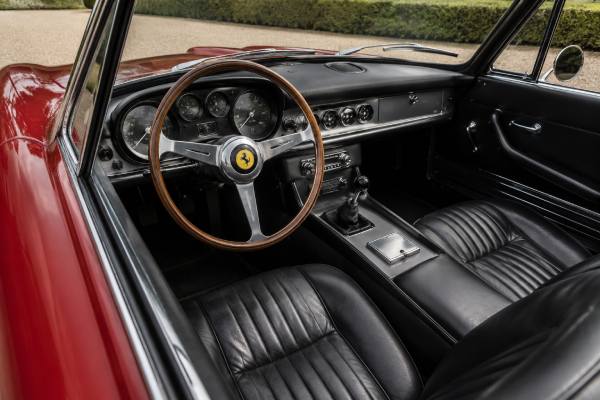
The cockpit is more luxurious than a competition-minded Ferrari. The driver faces clear analog instruments, a traditional wood-rim steering wheel, a gated manual shifter, and a cabin trimmed for touring rather than weight saving. Compared with modern cars, it feels narrow, airy, mechanical, and direct. Compared with many earlier Ferraris, it feels more mature and better balanced.
The engineering features that matter most are the rear transaxle and independent suspension. Together, they give the car a more sophisticated chassis balance than many older front-engine Ferraris. The GTS does not need huge tires or excessive power to feel special. It relies on engine response, steering feedback, chassis poise, and the sound of a Colombo V12 working through carburetors.
The exhaust note is part of the car’s appeal. It is not as hard or theatrical as some later Ferrari V12s, but it has the crisp, metallic, layered sound expected from a small-displacement twelve-cylinder engine. At low speeds it can feel cultured. Above midrange, it becomes more urgent and complex without turning the car into a harsh track machine.
Road Character and Performance
The 275 GTS drives like a sophisticated 1960s grand tourer, not like a modern supercar and not like a stripped competition Ferrari. Its best qualities are throttle response, balance, open-air sound, mechanical feel, and the sense that the whole car was built for fast road travel rather than short bursts of drama.
With 260 hp and a dry weight of about 1,120 kg, the 275 GTS has strong period performance. A top speed around 150 mph was serious in the mid-1960s, especially for an open road car on wire wheels and relatively narrow tires. Acceleration depends heavily on state of tune, carburetor setup, gearing, tires, and driver sympathy.
The engine is the center of the experience. It needs proper warm-up, clean carburetor tune, and good ignition health. When right, it should pull smoothly from moderate revs and become more vivid as the tachometer climbs. It is not a lazy large-displacement V12. The charm is in the revs, response, and sound.
The 5-speed transaxle gives the car a special feel, but it also asks for patience. Cold gear oil, worn synchros, poor linkage adjustment, or weak clutch hydraulics can make shifts less clean. A good car should not feel vague or obstructive once warm, but the driver still needs mechanical sympathy. Rushed shifts are not part of the experience.
Steering is unassisted and uses a worm-and-roller system. At parking speeds, effort is noticeable. Once moving, the steering becomes more natural and communicative. The narrow period tires help. They allow the chassis to speak clearly instead of masking everything with modern grip.
Ride quality is one of the GTS’s strengths. The independent suspension gives it composure over uneven roads, and the setup is less aggressive than a hard-driven berlinetta. A tired suspension, old dampers, worn bushings, or incorrect ride height can make the car feel loose, harsh, or unsettled. A correctly rebuilt example should feel supple but controlled.
Braking expectations must be period-correct. Four-wheel discs were advanced for the time, and the system is capable when maintained. It will not feel like a modern carbon-ceramic setup with electronic assistance. Pedal feel, straight-line stability, and heat management depend on fresh hydraulics, correct pads, good rotors, and properly adjusted components.
The best roads for a 275 GTS are flowing routes where the driver can use the V12, gearbox, and chassis rhythm without abusing the car. It is less satisfying in heavy traffic, where heat, clutch wear, and carburetor behavior become more noticeable. On the highway, it can still feel like a proper grand tourer, but wind noise, roof fit, gearing, and tire condition all shape the experience.
Maintenance, Reliability and Restoration
A 275 GTS can be reliable by classic Ferrari standards, but only when it is maintained by specialists who understand Colombo V12s, carburetors, transaxles, and hand-built coachwork. The greatest risks are not ordinary “used car” problems; they are age, corrosion, incorrect restoration, missing parts, and expensive mechanical neglect.
The engine is durable when properly built and serviced, but rebuilds are complex and costly. Compression, leak-down, oil pressure, smoke, coolant behavior, valve-train noise, and carburetor tune all deserve expert evaluation. A V12 that starts easily, idles cleanly, pulls smoothly, and holds temperature is a very different ownership proposition from one that has been made presentable for sale but not mechanically sorted.
Key engine and fuel-system concerns include:
- Worn timing components or poor valve adjustment.
- Carburetor wear, air leaks, incorrect jetting, or poor synchronization.
- Aging fuel lines and old rubber components.
- Cooling-system weakness from scale, blocked radiators, tired hoses, or poor fan performance.
- Oil leaks that may be normal in small amounts but concerning if heavy or widespread.
- Ignition problems from tired coils, distributor wear, old leads, or weak grounds.
The transaxle is a major inspection area. Noise, poor synchros, difficult shifts, leaks, clutch judder, and drivetrain vibration can point to expensive work. Because the gearbox is part of the car’s identity and value, originality and condition both matter.
The brake system should be treated as a safety-critical restoration item. Old hydraulic lines, tired calipers, worn discs, weak master cylinders, and contaminated fluid are common concerns on classics that sit for long periods. A car may look concours-ready and still need a full brake-system refresh.
Corrosion is one of the most serious risks. The chassis is tubular steel, and the body is coachbuilt. Rust, old accident damage, poor metal repairs, hidden filler, and misaligned panels can turn a beautiful-looking car into a major restoration project. Inspection should include the chassis tubes, sills, floor areas, wheel arches, lower doors, trunk floor, suspension pickup points, and areas around the windshield and soft-top structure.
Restoration quality matters more than shine
A 275 GTS restoration should be judged by accuracy, workmanship, documentation, and how the car functions. Fresh paint alone proves very little. Over-restored cars can lose character, while poorly restored cars can hide serious faults under attractive trim.
A proper inspection should ask:
- Are the chassis, engine, gearbox, and body numbers consistent with factory records?
- Does the car retain its original colors or have documented color changes?
- Are the body panels correctly shaped and aligned?
- Are the instruments, switches, trim, seats, carpets, and top details period-correct?
- Are there invoices from known Ferrari specialists?
- Does the car drive as well as it presents?
- Has Ferrari Classiche certification been issued, and what exactly does it confirm?
Parts availability is better than for some obscure classics, but that does not mean ownership is simple. Correct components can be expensive, and some trim or body pieces may require specialist fabrication. Labor is the larger issue. The right expert can save money by diagnosing accurately; the wrong shop can create expensive problems.
Originality versus upgrades is another real decision. Some owners choose discreet improvements for cooling, ignition reliability, tires, or drivability. These can make the car easier to use, but visible or irreversible changes may reduce collector appeal. For a high-value 275 GTS, the safest approach is usually to preserve original parts and make any updates reversible.
Market Values, Buying Guide and Rivals
The 275 GTS sits in the seven-figure collector-Ferrari market, with value driven by originality, provenance, condition, color, documentation, and restoration quality. It is generally less expensive than the most desirable 275 GTB variants and far below the 275 GTS/4 NART Spider, but it remains a major collector car.
Recent public sales and listings show that good 275 GTS examples commonly trade in the low-to-mid seven figures, with exceptional cars, rare colors, special histories, factory hardtops, or unusually strong documentation commanding more. Weak cars, incomplete projects, fire-damaged remains, non-original major components, or cars with uncertain histories can trade very differently.
The buying process should be treated like a collector-car due-diligence project, not a normal used-car purchase. A 275 GTS may have been restored decades ago, repainted in a different color, repaired after damage, fitted with replacement parts, or mechanically refreshed only where visible. Each of those details affects value.
| Priority | Why it matters |
|---|---|
| Matching major components | Original chassis, engine, gearbox, and body identity strongly influence value. |
| Factory documentation | Build records, Classiche certification, manuals, tools, and historian reports reduce uncertainty. |
| Body and chassis condition | Corrosion or poor accident repair can be more serious than mechanical wear. |
| Restoration quality | Correct materials, panel shape, mechanical setup, and details separate top cars from shiny average cars. |
| Original colors | Period-correct and factory-original colors can add desirability, especially when documented. |
| Mechanical sorting | A well-tuned V12 and healthy transaxle change both usability and near-term cost. |
| Special equipment | A documented factory hardtop, tools, books, and original trim can add appeal. |
Examples to seek
The strongest cars usually have a clear chain of ownership, documented original colors, matching major components, respected specialist maintenance, and a restoration that is old enough to have settled but good enough to remain accurate. A car that has been used regularly and maintained properly may be better than a static showpiece that needs recommissioning.
Preservation can be especially attractive. A car with original trim, known history, and honest aging may be more interesting than a heavily restored example with lost details. That said, preservation only works when the structure and mechanical systems are sound.
Examples to avoid
Be cautious with cars that have unclear identity, missing numbers, poorly documented engine swaps, heavy filler, inconsistent panel gaps, vague restoration invoices, or claims that cannot be verified. A cheap 275 GTS is rarely cheap after proper sorting.
Also be careful with cars that have spent long periods unused. Static storage can harm fuel systems, brakes, seals, cooling passages, clutch hydraulics, tires, and electrical connections. The cost of recommissioning a dormant Ferrari V12 can be substantial even when the car looks excellent.
Rivals and alternatives
The closest Ferrari alternatives depend on what the buyer wants. A 250 GT Cabriolet Series II offers earlier Pininfarina elegance and a softer 250-series character. A 330 GTS gives a larger engine and later styling in a similarly elegant open package. A 365 GTS continues the same refined front-engine spider idea with more displacement and a later feel.
Within the 275 family, the GTB is the more dramatic driver’s car, especially in desirable long-nose or alloy-bodied form. The 275 GTB/4 adds the four-cam engine and greater performance. The 275 GTS/4 NART Spider is related in spirit as an open 275, but it is so rare and valuable that it belongs in a different market conversation.
Period rivals from other brands include Aston Martin DB5 and DB6 Volante models, Maserati Mistral Spider, and high-end Mercedes-Benz 300 SL Roadster examples. None gives exactly the same mix of open Ferrari V12 sound, Pininfarina restraint, 275 chassis engineering, and low-volume Maranello appeal.
For long-term collectability, the 275 GTS has the right ingredients: Enzo-era production, open V12 layout, limited numbers, Pininfarina bodywork, advanced Ferrari chassis engineering, and a clear position between the 250 cabriolets and later 330/365 spiders. The best cars should remain desirable, but the market will continue to separate exceptional, documented examples from cars with stories, missing parts, or expensive needs.
References
- Ferrari 275 GTS (1964) 1964
- Ferrari 275 GTS Specifications 2025
- 1965 Ferrari 275 GTS by Pininfarina | Monterey 2025 | RM Sotheby’s 2025
- 1965 Ferrari 275 GTS 2025
- Price Guide: Ferrari 275 GTS [UPDATED 2026] 2026
Disclaimer
This article is for informational purposes only and is not a substitute for professional diagnosis, repair, appraisal, or pre-purchase inspection. Specifications, torque values, service intervals, procedures, and correct parts can vary by chassis number, market, equipment, restoration history, and factory updates. Always verify details against official Ferrari service documentation and consult a qualified classic Ferrari specialist before buying, servicing, or restoring a 275 GTS.
If this guide helped you, please share it on Facebook, X/Twitter, or your favorite car community to support our work.