
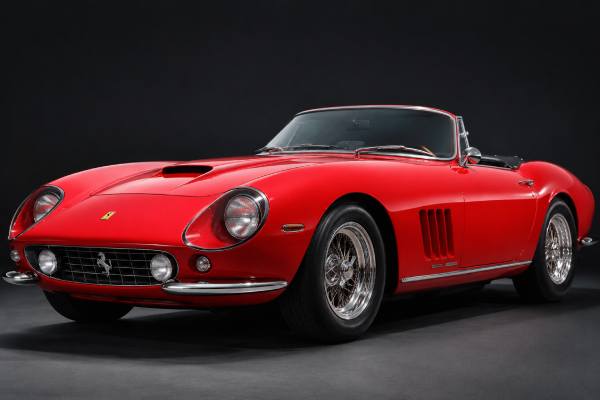
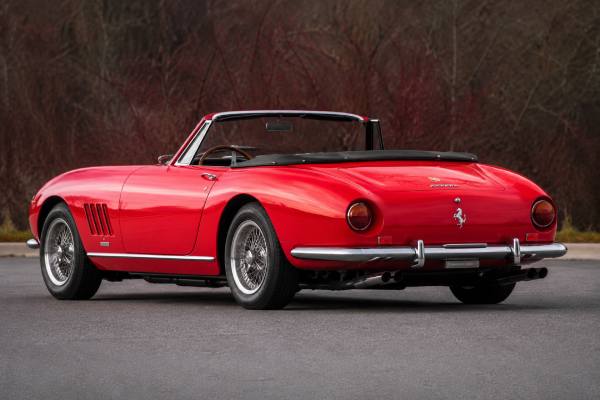
The Ferrari 275 GTS/4 NART Spider is the open, Scaglietti-built version of the four-cam 275 GTB/4, powered by Ferrari’s Tipo 226 3.3-liter Colombo V12 and built in tiny numbers for 1967 and 1968. It matters because it combines three things collectors rarely get in one car: the final development of the 275 platform, the 300 hp four-cam engine, and an open body commissioned through Luigi Chinetti’s North American Ferrari network.
Although the name is often written in different ways — 275 GTS/4 NART Spider, 275 GTB/4S N.A.R.T. Spider, or simply NART Spider — the identity is clear. This was not the softer 275 GTS roadster from 1964–1966. It was closer to a roofless 275 GTB/4, with the long-nose berlinetta’s mechanical layout, rear transaxle, independent rear suspension, torque tube, dry-sump V12, and a body shaped by Scaglietti for a very small group of buyers. Only 10 were built, and that number drives almost every modern discussion about originality, value, documentation, and restoration quality.
Quick Take
The 275 GTS/4 NART Spider is one of the most desirable open classic Ferraris because it has the four-cam 275 GTB/4 mechanical package, a 300 hp Tipo 226 V12, Scaglietti coachwork, and an American-market story tied to Luigi Chinetti and N.A.R.T. Its appeal is huge, but so is the risk: condition, chassis history, matching numbers, Ferrari Classiche certification, and restoration accuracy matter more than normal “used car” concerns, and the market is so thin that one car’s provenance can move value by millions.
Table of Contents
- History and Collector Significance
- Engine, Chassis and Key Specifications
- Production, Variants and Authenticity
- Design, Engineering and Special Details
- Driving Character and Performance
- Maintenance, Restoration and Known Risks
- Market Value, Buying Guide and Rivals
History and Collector Significance
The 275 GTS/4 NART Spider is important because it took Ferrari’s most advanced open-road 275 package and turned it into an ultra-limited spider. It sits at the end of the 275 line, after Ferrari had moved the series beyond the earlier two-cam cars and into the more complex four-cam GTB/4 era.
The 275 family was already a major step for Ferrari road cars. The line brought together a front-mounted V12, a rear-mounted five-speed transaxle, and independent rear suspension. That made the 275 a more modern grand tourer than the earlier 250-series road cars, which were famous but more traditional in layout.
The 275 GTB/4 arrived in 1966 with Ferrari’s first production four-overhead-camshaft V12 road-car engine. That change was more than a headline. Four camshafts improved breathing at high rpm and helped the 3.3-liter V12 make a quoted 300 hp. The GTB/4 also used dry-sump lubrication, a torque tube, and the long-nose body form developed late in the 275 GTB series.
Luigi Chinetti, Ferrari’s powerful North American importer and founder of the North American Racing Team, wanted an open version. American buyers had loved cars such as the 250 GT California Spider, and Chinetti understood the market for fast, glamorous Ferrari convertibles better than almost anyone. The normal 330 GTS existed, but it was more refined and less sharp-edged than a four-cam 275. The NART Spider answered a different desire: open-air driving with the harder mechanical character of the 275 GTB/4.
The result was a car that was never built in volume. Chinetti reportedly hoped for a larger run, but the price was high and demand was limited at the time. Ferrari and Scaglietti built only 10 examples. That tiny production number has become central to the model’s modern standing.
The first NART Spider, chassis 09437, also gave the model a competition and cultural story. It ran at the 1967 Sebring 12 Hours, driven by Denise McCluggage and Marianne Rollo, and finished 17th overall and second in class. The same car later appeared in the 1968 film The Thomas Crown Affair. These details matter because collectors value not only the object, but also the documented life around it.
Today, the NART Spider stands above the normal 275 GTS and even above most 275 GTB/4 berlinettas in value. It is not only rarer; it is also more romantic. It has the engineering of the four-cam coupe, the drama of open coachwork, and the Chinetti/N.A.R.T. connection that ties it directly to Ferrari’s American racing and sales history.
Engine, Chassis and Key Specifications
The NART Spider’s core specification is essentially the four-cam 275 GTB/4 mechanical package in a limited open body. The key ingredients are the Tipo 226 3.3-liter V12, five-speed rear transaxle, torque-tube driveline, tubular Tipo 596 chassis, independent suspension, and four-wheel disc brakes.
| Item | Specification |
|---|---|
| Production years | 1967–1968 |
| Chassis type | Tipo 596 tubular steel frame |
| Engine | Tipo 226 Colombo-derived V12 |
| Displacement | 3,285.72 cc |
| Valvetrain | Four overhead camshafts, two valves per cylinder |
| Fuel system | Six Weber twin-choke carburetors |
| Output | About 300 hp at 8,000 rpm |
| Lubrication | Dry sump |
| Transmission | Five-speed manual rear transaxle |
| Drivetrain | Front engine, rear-wheel drive |
| Suspension | Independent front and rear with wishbones, coil springs, telescopic dampers, and anti-roll bars |
| Brakes | Four-wheel disc brakes |
| Wheelbase | 94.5 in / 2,400 mm |
The Tipo 226 V12 is the main reason the NART Spider feels so different from the earlier 275 GTS. The earlier open 275 used a two-cam version of the 3.3-liter V12 and made less power. The NART Spider used the four-cam engine associated with the 275 GTB/4, giving it a sharper top-end character and stronger collector identity.
The rear transaxle helped weight distribution by moving the gearbox to the back of the car. This was one of the 275 series’ defining engineering features. Instead of a gearbox bolted directly behind the engine, the 275 used a layout closer to serious sports-racing thinking, with the engine up front and the transmission at the rear.
The torque tube is also important. It ties the engine and transaxle together more rigidly, reducing driveline movement and improving smoothness under load. On a high-value 275, the presence and correctness of these driveline parts are not minor inspection points. They are central to the car’s identity.
The dry-sump oiling system helped the V12 survive sustained high-speed use. Rather than keeping the oil supply in a deep wet sump under the engine, the system uses a separate tank and scavenge system. This helps control oil supply during hard cornering and allows better engine placement.
Period performance figures vary because few NART Spiders were tested and individual cars differed in tune, tires, gearing, and condition. A commonly cited period benchmark for the model is around 6.7 seconds from 0–60 mph and a top speed near 155 mph. For the late 1960s, that made the car extremely fast, especially for an open road car with full grand-touring usability.
Production, Variants and Authenticity
The most important production fact is simple: only 10 NART Spiders were built. That makes identification, chassis history, factory records, and matching-number components far more important than trim options or ordinary equipment differences.
The car was not a catalog model in the normal sense. It was a special open version commissioned through Luigi Chinetti, built by Scaglietti, and linked to the 275 GTB/4. This is why names vary. Auction houses and historians often use “275 GTB/4*S N.A.R.T. Spider,” while many enthusiasts use “275 GTS/4 NART Spider.” Both point to the same small group of cars.
Known production identity
The 10 original cars are commonly identified by their chassis numbers. For a buyer, these numbers are the starting point, not the end of due diligence. A correct chassis number must be supported by engine number, gearbox number, body number, factory documents, period records, restoration records, and expert inspection.
| Area | Why it matters |
|---|---|
| Total production | Only 10 cars, making every example individually known and heavily researched |
| Coachwork | Scaglietti-built spider body based on the 275 GTB/4 concept |
| Market orientation | Commissioned through Luigi Chinetti for open Ferrari demand, especially in North America |
| Mechanical basis | Four-cam 275 GTB/4 engine and driveline layout |
| Certification | Ferrari Classiche certification is highly valuable but should still be checked against broader history |
The first two cars are often noted as having alloy bodies, while later examples used the more typical steel body construction with aluminum opening panels. As with many hand-built Ferraris, small differences from car to car are expected. Those differences can be legitimate, but they need documentation. A unique detail is valuable only when it is original or period-correct, not when it is an undocumented later change.
Factory colors and interiors also matter. Original color is a major value factor on a NART Spider, especially if the car wears a rare or attractive factory shade. Red is not automatically the most valuable color in this group. A documented original blue, yellow, gray, or silver car can be just as compelling, and sometimes more interesting, depending on provenance.
Matching numbers are critical. On an ordinary classic, a replacement engine may be a drawback. On a NART Spider, it can be a major value event. Buyers should care about:
- Original chassis stamping and frame history
- Original engine number and internal engine type
- Original gearbox and rear transaxle identity
- Body number and Scaglietti construction evidence
- Original color and trim records
- Continuous ownership history
- Period photos, registration papers, invoices, and correspondence
- Ferrari Classiche red book and supporting documents
Conversions also require caution. Some 275 GTB/4 coupes have been converted into spider-style cars. A high-quality conversion can be beautiful and valuable on its own terms, but it is not one of the 10 factory NART Spiders. The difference is not cosmetic. It is the difference between a historic factory-built limited Ferrari and a later rebody.
Design, Engineering and Special Details
The NART Spider’s design is special because it keeps the muscular long-nose 275 GTB/4 character while removing the roof cleanly. It is not a separate, softer roadster shape like the earlier 275 GTS; it is a sharper, more dramatic open interpretation of the four-cam berlinetta.
The body was built by Scaglietti, whose work on Ferrari competition and GT cars gave the NART Spider its taut proportions. The long hood, covered headlights, low waistline, short rear deck, and cut-down open cockpit give the car a very different personality from the 330 GTS. The 330 GTS is elegant and formal. The NART Spider is leaner and more aggressive.
The roof mechanism is simple by modern standards. A folding canvas top stores behind the seats, allowing the car to keep a clean rear deck when open. The shape works because the base 275 GTB/4 already had a strong visual balance: long front, cabin set back, compact tail. Removing the roof did not make the car look heavy or improvised.
The front of the car carries the classic late-275 face, with covered lamps and a wide oval grille. The hood bulge is not decoration. It reflects the packaging needs of the four-cam engine and carburetor setup. Cooling was handled in the conventional front-engine Ferrari way, with airflow through the grille and heat management around a tightly packed V12 bay.
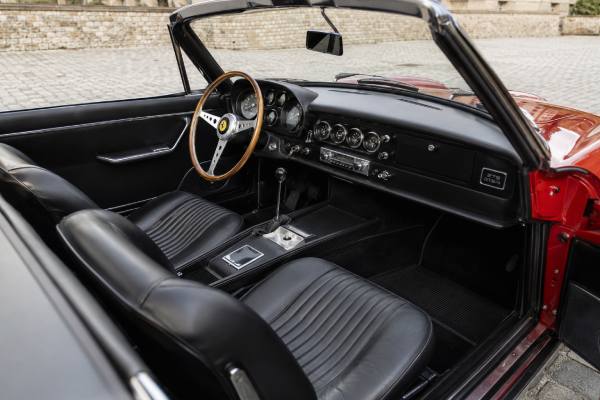
Inside, the car is more purposeful than luxurious. The cockpit has large analog instruments, a wood-rim steering wheel, leather trim, and a gated manual shifter. The layout is intimate. Drivers sit close to the car’s major controls, and the long hood dominates the forward view.
The N.A.R.T. badge on the rear is one of the model’s signature details. It connects the car to Chinetti’s North American Racing Team, which had deep Ferrari endurance-racing history. On this car, the badge is not just decoration. It explains why the model exists.
The sound is another special feature. Six carburetors feeding a small-displacement, high-revving V12 create a crisp intake and exhaust note that is very different from larger later Ferraris. The car does not rely on huge displacement. It relies on revs, breathing, throttle response, and mechanical precision.
Driving Character and Performance
A healthy NART Spider should feel fast, mechanical, and alive, but not easy in the way a modern performance car is easy. It needs warm-up, correct carburetor tune, deliberate gearshifts, strong legs for low-speed control, and respect for period brakes and tires.
The engine is the star. The Tipo 226 V12 is smooth at modest speeds, but its real personality arrives as revs rise. The four-cam heads and six Weber carburetors reward clean throttle openings and proper tune. Below the strongest part of the rev range, the car feels flexible rather than brutal. Above that, it becomes sharper, louder, and more urgent.
Throttle response depends heavily on setup. A well-sorted car should respond cleanly, without coughing, flat spots, or excessive fuel smell once warm. A tired or poorly tuned car can feel disappointing and expensive within the first few miles. Carburetor balance, ignition health, fuel pressure, and cam timing all shape the experience.
The five-speed transaxle gives the NART Spider a special feel. It is not a modern short-throw gearbox, and it should not be rushed when cold. Once warm, the shift should be precise and satisfying, with a mechanical gate feel. Second gear synchro condition is a common area to assess on older Ferraris because aggressive cold shifting can cause wear.
Steering is unassisted. At parking speed, effort is high. On the move, the steering lightens and becomes one of the car’s pleasures. The driver feels the front tires, the road surface, and the balance of the chassis in a direct way that later power-assisted cars often dilute.
The independent rear suspension gives the 275 more composure than many earlier live-axle Ferraris. It helps the car stay settled over uneven roads and makes it less old-fashioned than its 250-series ancestors. Still, tire choice and suspension condition matter enormously. Old tires, worn dampers, tired bushings, or incorrect alignment can make even a great car feel vague.
The brakes are four-wheel discs, strong for the period, but they require realistic expectations. They do not feel like modern carbon-ceramic brakes, and repeated hard use demands attention to fluid, pads, hoses, and cooling. A buyer should judge braking by smoothness, stability, pedal feel, and evidence of proper maintenance, not by modern stopping-distance standards.
Usability is better than the car’s value might suggest. The NART Spider was built as a road car, not a fragile showpiece. It can cover long distances when properly prepared. Heat, noise, weather sealing, and luggage space are all period-Ferrari compromises, but the reward is an open V12 experience with rare mechanical integrity.
Maintenance, Restoration and Known Risks
The main ownership risk is not ordinary reliability; it is the cost of making a rare, hand-built four-cam Ferrari correct. A NART Spider can be maintained and driven, but every major job should be handled by specialists who understand 1960s Ferrari engines, transaxles, chassis structures, and Classiche-level authenticity.
The Tipo 226 engine is durable when maintained properly, but it is complex and expensive. It has four camshafts, carburetors, dry-sump oiling, and many parts that must be set up with care. Poor work can cause oil leaks, timing issues, weak compression, overheating, or poor drivability.
Important mechanical inspection areas include:
- Compression and leak-down results on all 12 cylinders
- Camshaft, valve-train, and timing-chain condition
- Carburetor type, jetting, balance, and linkage wear
- Dry-sump tank, hoses, fittings, and oil pressure behavior
- Cooling system cleanliness, radiator condition, and fan operation
- Ignition system health, including coils, distributor condition, and wiring
- Transaxle noise, synchro wear, and differential condition
- Clutch operation and driveline vibration
Corrosion is a serious concern. These cars use tubular steel chassis construction and hand-built bodies. Even if a car looks beautiful, the structure, sills, floors, lower body sections, suspension pickup points, and repaired accident areas need careful inspection. Paint quality alone is not enough.
Accident history is especially important because many valuable Ferraris were damaged, repaired, restored, or rebodied during periods when they were worth far less than they are today. A repair done in the 1970s or 1980s may have been practical at the time but unacceptable today if it changed structure, panel shapes, or original body identity.
Restoration quality varies widely. The best restorations preserve original material where possible, document every step, and keep removed original parts with the car. Over-restoration can also be a problem. A NART Spider should not look like a modern replica of itself. Correct finishes, hardware, leather grain, instruments, wiring style, and panel fit all matter.
Parts availability is mixed. Some mechanical parts can be sourced through specialist networks or remanufactured, but original components are rare and costly. Body parts are not simple replacements. A damaged Scaglietti panel must be repaired or recreated by experts who understand the original shape and construction methods.
Upgrades should be judged carefully. Reversible improvements for safe driving, such as discreet cooling improvements or modern tire choices in correct sizes, may be acceptable to some owners. Permanent changes that alter identity, structure, engine specification, or interior appearance can reduce value.
A proper maintenance file should include invoices from known Ferrari specialists, engine and gearbox rebuild records, fuel-system work, brake hydraulic work, suspension rebuilds, tire dates, and documentation of any paint or body restoration. For a car of this importance, missing paperwork is not a small inconvenience. It is a major valuation issue.
Market Value, Buying Guide and Rivals
The NART Spider sits in the top tier of open classic Ferraris, and its market is too thin for normal price-guide thinking. Public results show the scale, but individual value depends on the specific chassis, originality, provenance, certification, color, restoration quality, and whether the car is available at all.
The best-known modern benchmark is the 1967 chassis 10709 sale at RM Sotheby’s Monterey in 2013, where the car sold for $27.5 million. That result remains one of the defining public auction moments for the model. Another major public data point is chassis 11057, the final NART Spider, offered by RM Sotheby’s in Monaco in 2016 with a €19 million to €23 million estimate and not sold publicly at that sale.
Because cars this rare often trade privately, a “current value” should be treated as a negotiated figure rather than a neat range. As of 2026, a serious buyer should assume that a real factory NART Spider with excellent history remains a low-eight-figure car, with the best examples capable of sitting far above ordinary 275 GTB/4 values. A weak history, incorrect components, unclear restoration, or unresolved title issue can change the number dramatically.
What drives value
- Factory-built NART Spider identity, not a later conversion
- Matching chassis, engine, gearbox, and body numbers
- Ferrari Classiche certification and supporting documentation
- Original color and trim, especially if rare or attractive
- Continuous ownership history and period photographs
- Important owners, concours results, or period competition history
- Quality of restoration and amount of original material retained
- Mechanical freshness without loss of authenticity
- Absence of serious accident, corrosion, or rebody concerns
Buyer inspection priorities
A NART Spider should be inspected by a marque specialist before any commitment. The inspection should not be limited to a road test and paint-meter readings. It should verify identity.
| Check | What to confirm |
|---|---|
| Identity | Chassis number, engine number, gearbox number, body number, and factory records align |
| Documentation | Classiche book, ownership chain, restoration photos, invoices, and period evidence are consistent |
| Body | Scaglietti shape, panel structure, repairs, and material use are correct for that chassis |
| Engine | Tipo 226 specification, compression, leak-down, oil pressure, carburetor setup, and cooling are healthy |
| Driveline | Transaxle, torque tube, clutch, differential, and mounts operate correctly |
| Chassis | Tubular frame shows no hidden corrosion, distortion, or poor old repair work |
| Market position | Price reflects the specific car, not just the model name |
The closest Ferrari alternatives depend on the buyer’s goal. A 275 GTB/4 coupe gives much of the mechanical experience for far less money, though without the open body and 10-car rarity. A 250 GT California Spider offers an earlier, equally romantic open Ferrari identity, with its own huge market. A 330 GTS is more refined and more available, but it lacks the NART Spider’s four-cam 275 edge. A 365 GTS/4 Daytona Spider offers later speed, more torque, and greater usability, but a different personality.
Non-Ferrari rivals are difficult because the NART Spider’s value is tied so strongly to Ferrari mythology. Period alternatives might include the Lamborghini Miura for mid-engine drama, Aston Martin DB5 or DB6 Volante for British elegance, and Maserati Ghibli Spyder for Italian open V8 style. None gives the same combination of four-cam Ferrari V12, Scaglietti open coachwork, N.A.R.T. history, and 10-car production.
The right buyer is not simply someone who wants an expensive convertible. This is a car for a collector who understands provenance, accepts specialist maintenance, and values historical correctness as much as driving pleasure. The wrong car, or the right car with unresolved questions, can be financially punishing. The best one is among the most rewarding open Ferraris ever built.
References
- Ferrari 275 GTB4 (1966) 1966 (Manufacturer Specifications) :contentReference[oaicite:0]{index=0}
- Ferrari 275 GTS (1964) 1964 (Manufacturer Specifications) :contentReference[oaicite:1]{index=1}
- 1967 Ferrari 275 GTB/4*S N.A.R.T. Spider by Scaglietti | Monterey 2013 | RM Sotheby’s 2013 (Auction Record) :contentReference[oaicite:2]{index=2}
- 1968 Ferrari 275 GTS/4 NART Spider by Scaglietti | Monaco 2016 | RM Sotheby’s 2016 (Auction Record) :contentReference[oaicite:3]{index=3}
- Ferrari 275 GTB/4 & 275 GTS/4 Guide — Supercar Nostalgia 2020 (Historical and Technical Guide) :contentReference[oaicite:4]{index=4}
Disclaimer
This article is for informational purposes only and is not a substitute for professional diagnosis, inspection, repair, restoration, or valuation. Specifications, torque values, service intervals, factory details, and procedures can vary by chassis number, market, equipment, restoration history, and individual car condition. Always verify critical information against official Ferrari documentation, Ferrari Classiche records, and a qualified marque specialist.
Please share this article on Facebook, X/Twitter, or your favorite enthusiast community if it helped you. Your support helps us keep producing detailed, practical classic-car guides.