
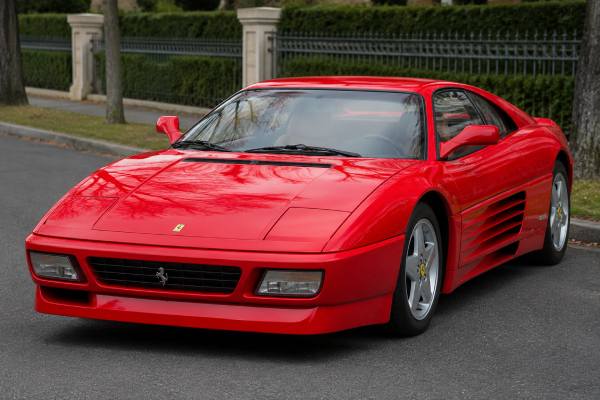
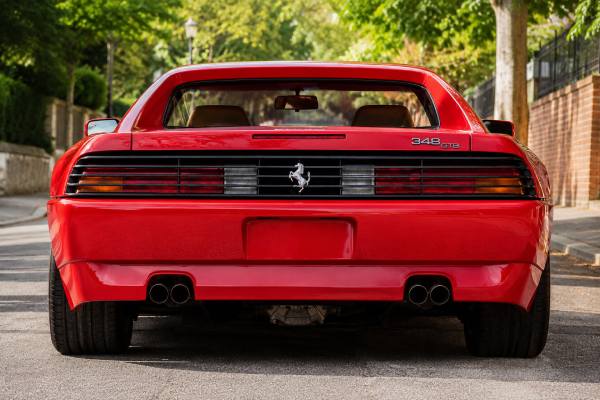
The Ferrari 348 GTB is the fixed-roof late-series version of the 348, powered by the Tipo F119H 3.4-litre naturally aspirated V8 and built during the final phase of 348 production. It matters because it is not simply a renamed 348 tb. The GTB brought the most developed road-going version of the 348 coupe package, with more power, revised engine management, updated chassis tuning, body-coloured lower panels, and a sharper identity before the F355 arrived.
For buyers, the 348 GTB sits in an interesting space. It has the classic mid-engine Ferrari layout, a gated five-speed manual gearbox, compact 1990s proportions, and a rawer feel than the F355 that replaced it. It is also rare enough that originality, factory documentation, and careful maintenance records matter more than they do on ordinary used sports cars. A good one can feel direct and involving. A neglected one can become expensive very quickly.
Quick Take
The Ferrari 348 GTB’s strongest appeal is its rare fixed-roof, late-production 348 specification: the F119H V8, manual gearbox, improved chassis setup, and cleaner body-colour trim make it the most desirable closed 348 for many collectors. Its main tradeoff is ownership sensitivity. Timing-belt service, cooling-system age, clutch condition, suspension wear, electrical issues, accident history, and originality can separate a strong car from a costly project. The best buys are documented, unmodified examples with verified chassis identity, specialist service history, correct trim, and evidence that major engine-out work has been done properly.
Table of Contents
- Late-348 History and Collector Importance
- F119H Engine, Chassis, and Key Specs
- Production Details, Variants, and Options
- Design, Engineering, and Special Features
- Road Feel, Speed, and Usability
- Maintenance, Reliability, and Restoration Risks
- Market Values, Buying Advice, and Rivals
Late-348 History and Collector Importance
The 348 GTB is important because it represents Ferrari’s final refinement of the 348 berlinetta before the F355 reset expectations for the company’s junior mid-engine V8 line. It took the basic 348 formula and addressed several of the early car’s criticisms, especially power delivery, chassis balance, and visual detailing.
The original 348 arrived for the 1989 model year as the successor to the 328. It was a major change. Where the 328 was compact, rounded, and closely related to the 308 bloodline, the 348 looked more angular and modern. Its side strakes, rectangular rear lights, and broad rear stance echoed the Testarossa family. The car used a longitudinally mounted V8 and a transverse five-speed manual gearbox, a layout that gave the model its early “tb” and “ts” names: trasversale berlinetta and trasversale spider.
The 348 GTB came later, when Ferrari revised the model into a more polished form. The “GTB” badge restored a more traditional Ferrari naming style, while the technical package moved forward. The F119H engine brought higher output than the early 348 tb, and the late cars received Bosch Motronic M2.7 engine management, revised exhaust tuning, and suspension improvements. Ferrari also cleaned up the exterior by painting the lower body panels and engine cover in body colour, making the car look more unified and less visually heavy than the black-sill early cars.
The 348 GTB sits between two better-known Ferrari eras. On one side is the analogue 328, often praised for its simplicity and delicacy. On the other is the F355, a more advanced, higher-revving car with five valves per cylinder, more dramatic sound, and broader modern appeal. That position has sometimes made the 348 underestimated. Yet it is also part of its attraction. The GTB offers a more mechanical, less filtered experience than the F355, but with a stronger and more developed package than the earliest 348s.
The model is also historically interesting because it belongs to the last period before Ferrari’s V8 cars became more electronically complex. There is no paddle-shift gearbox, no adaptive suspension mode system, no traction-control suite, and no electronic differential. The driver manages the clutch, gated shift, throttle, braking, and chassis balance directly. For collectors who value driver involvement, that matters.
The 348 GTB is not a homologation special like the 348 GT Competizione, and it does not have the open-air appeal of the Spider. Its importance comes from being the rare late-production coupe: the body style many purists prefer, with the highest-output normal 348 road engine and the cleaner late styling. That makes it a car where specification and condition carry real weight.
One nuance matters for production dates. The wider late-348 family ran into the mid-1990s, especially the Spider, while GTB coupe production is generally treated as a shorter 1993–1994 run, with some market and registration references extending into 1995. For buying purposes, the key identity is not only the calendar year. It is whether the car is a genuine GTB with the correct late-series F119H specification, chassis details, trim, and documentation.
F119H Engine, Chassis, and Key Specs
The 348 GTB uses the Tipo F119H version of Ferrari’s 3.4-litre quad-cam V8, mounted behind the cabin and ahead of the rear axle. Its headline figures are 3404.70 cc, 235 kW, commonly quoted as 320 hp or 320 PS, and 324 Nm of torque.
Core technical specification
| Category | Specification |
|---|---|
| Model | Ferrari 348 GTB |
| Internal family | F119 |
| Engine code | Tipo F119H |
| Engine layout | Rear-mid-mounted 90-degree V8, longitudinal |
| Displacement | 3404.70 cc |
| Bore x stroke | 85 mm x 75 mm |
| Compression ratio | 10.8:1 |
| Valvetrain | Double overhead camshafts per bank, four valves per cylinder |
| Fuel and ignition | Bosch Motronic M2.7 electronic injection and ignition |
| Lubrication | Dry sump |
| Maximum output | 235 kW, commonly listed as 320 hp or 320 PS, at 7200 rpm |
| Maximum torque | 324 Nm at 5000 rpm |
| Transmission | Five-speed manual, gated shifter |
| Drivetrain | Rear-wheel drive |
| Suspension | Independent unequal-length wishbones, coil springs, dampers, anti-roll bars |
| Brakes | Ventilated discs with ABS |
| Steering | Rack and pinion with power assistance |
| Wheelbase | 2450 mm |
| Length | 4230 mm |
| Width | 1894 mm |
| Height | 1170 mm |
| Dry weight | About 1370 kg |
| Fuel capacity | About 88 litres on late GT specification cars |
| Top speed | Over 280 km/h, about 174 mph |
| 0–100 km/h | About 5.4 seconds |
The numbers only tell part of the story. The F119H engine was a development of the earlier 348 unit, not a clean-sheet replacement. The higher compression ratio, engine-management changes, intake and exhaust revisions, and calibration changes gave the GTB a stronger top end and a more polished feel than the original 348 tb. It still has the character of a classic Ferrari V8: it prefers revs, sounds sharper as the needle climbs, and rewards a driver who keeps the engine in its useful range.
The 348’s chassis is often described as a steel platform or monocoque structure with a rear subframe carrying the powertrain and suspension. That rear structure is important for maintenance, because major engine work commonly involves removing the rear subframe and powertrain assembly. It also means accident repair must be inspected carefully. A shiny exterior can hide distorted mounting points, poor jig work, or alignment problems.
The five-speed manual gearbox is central to the car’s appeal. It is not a modern short-shift unit. It can feel heavy when cold, and second gear may need patience until the oil warms. Once warm and properly adjusted, the gated shift becomes part of the rhythm of the car. A worn clutch, tired bushings, old gearbox mounts, or poor linkage setup can make the car feel worse than it really is.
The late 348 setup also improved the car’s stance and handling compared with early examples. The rear track and suspension geometry revisions helped calm the nervousness that some early road tests and owners noted. Tire choice is still critical. Old, hard, mismatched, or incorrect tires can make a 348 feel skittish. Correct modern rubber, proper alignment, healthy dampers, and fresh suspension bushes can transform the car.
Production Details, Variants, and Options
The 348 GTB is one of the rarer regular-production 348 road variants, and buyers should treat identity verification as part of the purchase process. The most commonly cited production figure is around 252 GTB coupes, though some registries and market sources list lower counts depending on how they classify cars by market, chassis range, or completed production.
Where the GTB fits in the 348 family
| Variant | Body style | General identity |
|---|---|---|
| 348 tb | Fixed-roof berlinetta | Early coupe with 300 PS-era specification and black lower trim |
| 348 ts | Targa-roof model | Early removable-roof version, more common than the GTB |
| 348 GTB | Fixed-roof berlinetta | Late coupe with F119H engine, 320 hp/PS reporting, updated chassis and trim |
| 348 GTS | Targa-roof model | Late removable-roof companion to the GTB |
| 348 Spider | Full convertible | Open 348 with late-style mechanical updates |
| 348 Challenge | Race-prepared series cars | Competition-focused examples with strong provenance sensitivity |
| 348 GT Competizione | Lightweight road/competition special | Much rarer, more valuable, and materially different from the GTB |
The GTB’s most obvious visual identifier is the late body-colour treatment. On early 348 tb and ts models, the lower sill and lower body areas are usually black, creating a two-tone look. On the GTB, these areas are painted in the body colour, which makes the car appear lower, cleaner, and more modern. The engine cover is also body-coloured, and the late cars have detail changes to the grille, badging, and interior trim.
The fixed-roof GTB is generally more desirable to driving-focused buyers than the GTS because the closed body feels more rigid and has the classic berlinetta profile. The GTS has its own appeal, especially for owners who want a removable roof panel, but the coupe has the purist advantage.
Factory options and market equipment were not as complex as on modern Ferraris. Buyers should still pay close attention to:
- original paint colour and interior colour;
- seat type and correct leather trim;
- original wheels and correct tire sizing;
- market specification, especially European versus U.S. equipment;
- tool kit, books, pouch, jack, spare items, and accessories;
- factory stickers, data plates, engine number, gearbox number, and body tags;
- service book stamps and invoices from Ferrari dealers or recognized specialists;
- Ferrari Classiche or other factory documentation where available.
Matching-numbers status matters. It is not enough for a seller to say the car has “a Ferrari V8.” The engine, gearbox, chassis identity, and major components should be checked against documentation. A non-original engine does not always make a car unbuyable, but it changes value and collector appeal. A car with documented factory replacement parts is easier to evaluate than one with vague history.
Ferrari certification can add confidence, but it is not a substitute for a physical inspection. A certificate is most useful when it matches what the car actually shows: correct mechanical specification, original structure, proper trim, correct market equipment, and no hidden accident history. On a rare late 348 coupe, the paper trail can be as important as the test drive.
Design, Engineering, and Special Features
The 348 GTB looks distinctive because it combines compact mid-engine proportions with late-1980s Ferrari visual themes. Its side strakes, flat rear deck, rectangular tail lamps, low nose, and wide rear haunches make it much more angular than the 328 and more visually related to the Testarossa era.
The shape is not just styling drama. The side intakes feed the rear-mounted powertrain and cooling systems, while the broad rear bodywork packages the V8, transverse gearbox, exhaust, suspension, and rear structure. The 348’s proportions make the cabin sit forward, with the engine close behind the driver and passenger. That packaging gives the car much of its character: you hear and feel the drivetrain as part of the driving experience.
Pininfarina’s design has aged in a more interesting way than many critics expected. During the 1990s and early 2000s, the 348 was often judged against the smoother and more technically advanced F355. Today, the sharper lines feel more period-correct. The 348 GTB does not try to look timeless in the soft sense. It looks like a precise moment in Ferrari design, when the brand still used strong side graphics, thin pillars, pop-up headlights, and a cockpit built around analogue gauges.
The F119H package
The F119H engine is the core engineering feature. It is a naturally aspirated, flat-plane-crank Ferrari V8 with four valves per cylinder, dry-sump lubrication, and Bosch electronic management. Dry-sump lubrication helps control oil supply under hard cornering and allows the engine to sit lower than a conventional wet-sump design would permit. That benefits centre of gravity and packaging.
Compared with the early 348 engine, the F119H specification is more desirable because it represents the late factory development of the platform. The power increase did not turn the 348 into a supercar in the Diablo sense, but it made the GTB stronger and more responsive at the top end. The car still rewards revs rather than low-rpm torque.
The transverse gearbox layout
The gearbox layout is one of the 348’s defining engineering talking points. The V8 sits longitudinally, while the manual gearbox is mounted transversely behind it. This layout helped Ferrari manage drivetrain length and weight distribution, and it links the 348 to a broader Ferrari engineering tradition. In use, the driver experiences it through the gated shift: a mechanical, deliberate action that becomes more satisfying as the gearbox warms.
Cabin and sensory character
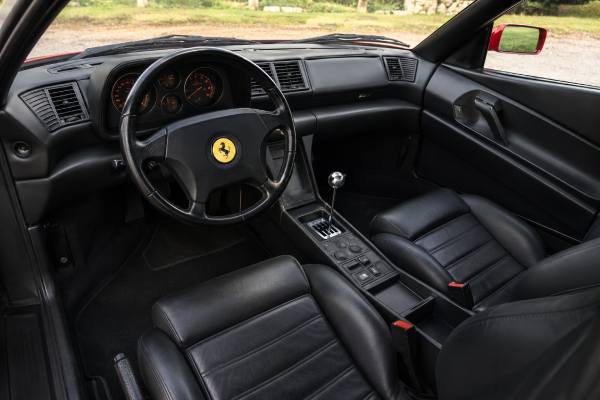
The interior is simple by modern standards. There are analogue instruments, a low seating position, leather trim, a metal gear gate, and relatively little isolation from the machinery. The driving position can feel slightly offset to some drivers, and pedal spacing is very Ferrari of the period. Taller drivers should sit in the car before buying, especially if the seat padding, carpets, or steering wheel have been changed.
The GTB’s sound is cleaner and more mechanical than many later cars. Intake noise builds behind the cabin, the exhaust hardens with revs, and the engine has the crisp, busy quality of a small-capacity Ferrari V8. Aftermarket exhausts are common, but buyers should be careful. A tasteful system may improve sound, while a poorly chosen one can create drone, fail emissions checks, or reduce originality.
Road Feel, Speed, and Usability
A healthy 348 GTB feels more involving than its raw numbers suggest. It is quick, but its real appeal is the combination of mid-engine balance, a rev-hungry V8, manual steering feel through the rack, and the physical process of driving a gated Ferrari.
The engine is not especially muscular at low rpm. It prefers to be warmed properly and worked through the middle and upper rev range. Below that, it can feel restrained compared with modern turbocharged cars. Above it, the F119H wakes up, the induction note sharpens, and the car feels much more alive. That character makes the 348 GTB rewarding on open roads, where the driver can use second, third, and fourth gears with some commitment.
The gearbox is part of the ritual. When cold, it should not be forced. A careful driver lets the oil warm, uses deliberate inputs, and avoids rushing second gear. Once warm, a properly set-up gearbox should shift with a defined mechanical feel. If it baulks badly when hot, jumps out of gear, crunches, or feels vague, inspection is needed. The issue may be linkage adjustment, clutch hydraulics, mounts, or internal wear.
The steering is one of the car’s strengths. It is assisted, but it is not numb in the way many modern systems can be. The front end communicates surface, load, and camber changes. The car’s mid-engine layout means it responds quickly, so alignment and tires matter. A tired 348 can feel nervous. A sorted GTB feels alert and precise.
Ride quality is firm but not brutally harsh when the suspension is healthy. Old dampers, cracked bushes, incorrect ride height, and aged tires can make the car skip or tramline. Replacing worn rubber components often makes more difference than chasing expensive performance upgrades.
Braking performance is period-correct rather than modern-supercar strong. The ventilated discs and ABS are adequate for fast road use when the system is fresh, but brake hoses, fluid, pads, discs, calipers, and ABS components must be maintained. On track, heat management becomes more important. The 348 GTB was not designed as a modern track-day appliance, even though Challenge cars proved the platform could work in competition.
Visibility is better than in many later supercars. The low scuttle, upright glass, and compact size make the car usable on normal roads. Rear visibility is limited by the buttresses and engine cover, but it is manageable. The cabin can get warm, air-conditioning performance depends heavily on system condition, and traffic driving is not where the car shines. A 348 GTB is happiest on flowing roads, where its compact dimensions and direct controls make sense.
Compared with a 328, the 348 GTB feels wider, stronger, more planted, and more modern. Compared with an F355, it feels less polished, less powerful, and less sonorous, but also more mechanical and less complex. That is the key to understanding the car. It is not the best Ferrari V8 if judged only by speed. It is one of the more interesting ones if judged by driver involvement, rarity, and late-analogue character.
Maintenance, Reliability, and Restoration Risks
The 348 GTB can be reliable when maintained correctly, but it is not a low-cost classic. Its biggest ownership risks are deferred engine-out service, ageing rubber and fuel components, clutch and gearbox wear, cooling-system neglect, electrical faults, poor accident repair, and incorrect restoration work.
Major service expectations
The timing belts are the central maintenance topic. On the 348, proper belt service is commonly treated as an engine-out or powertrain-out job because of the engine layout and access. A seller saying “belts were inspected” is not the same as a documented major service with belts, tensioners, seals, water pump checks, hoses, fluids, and related while-you-are-there work.
A strong service file should show:
- timing belts and tensioners replaced at sensible time intervals;
- cam seals, accessory belts, and related gaskets inspected or renewed;
- water pump condition checked or rebuilt when appropriate;
- coolant hoses, fuel hoses, and vacuum lines replaced as age requires;
- clutch wear measured and hydraulic parts maintained;
- gearbox oil changed with correct lubricant;
- brake fluid changed regularly;
- valve-cover and cam-cover leaks addressed;
- engine mounts and exhaust mounts inspected;
- suspension bushes, ball joints, and dampers checked;
- air-conditioning, alternator, starter, and charging system tested.
Annual servicing is normal for a car like this, even at low mileage. Low use does not stop seals, hoses, belts, fuel lines, electrical contacts, and tires from ageing. In some ways, a rarely driven 348 can need more recommissioning than a regularly exercised one.
Known weak points and inspection areas
| Area | What to check | Why it matters |
|---|---|---|
| Timing belts | Invoices, dates, mileage, tensioners, seals | Deferred belt service can lead to severe engine damage |
| Cooling system | Radiators, fans, thermostat, hoses, expansion tank | Overheating can cause major engine problems |
| Fuel system | Hoses, clamps, pump area, smell of fuel, leaks | Ageing fuel parts are a safety and reliability risk |
| Clutch | Engagement point, slip, hydraulic leaks, service records | Replacement is costly and affects drivability |
| Gearbox | Cold second gear, hot shifts, synchros, linkage | Weak shifting may indicate adjustment or internal wear |
| Suspension | Bushes, dampers, ball joints, ride height, alignment | Worn parts make the car feel unstable or harsh |
| Brakes and ABS | Discs, pads, calipers, hoses, warning lights | Old components reduce confidence and safety |
| Electrical system | Fuse panel, windows, HVAC, lights, warning lamps | Electrical diagnosis can be time-consuming |
| Body and chassis | Panel gaps, sills, jacking points, subframe mounts, paint depth | Accident repair can affect value and handling |
| Interior | Leather shrinkage, dash, switchgear, seat wear, trim originality | Correct trim is costly to restore and affects collector value |
Corrosion is not the first thing many people think about with a 1990s Ferrari, but it should not be ignored. Inspect the lower sills, wheel arches, door bottoms, windshield surrounds, floor areas, battery area, jacking points, and repaired panels. Cars that lived in damp climates, sat unused, or had poor accident repairs can hide problems.
Accident damage is a major value factor. Many 348s were driven hard when values were low, and some repairs were done to a budget. Look for uneven gaps, mismatched paint, overspray, cracked underbody coatings, distorted suspension pick-up areas, non-original fasteners, and missing factory labels. A specialist inspection on a lift is not optional for a serious buyer.
Originality versus upgrades is a delicate subject. Some sensible improvements can make a 348 easier to use, such as modern tires, upgraded hose materials, improved fuse-board solutions, or a carefully chosen exhaust. But heavy modification reduces collector appeal. Cut interiors, non-original wheels, poorly installed stereos, aftermarket body parts, and missing original components should affect price.
Parts availability is generally better than for obscure low-volume exotics, but that does not make parts cheap. Some trim pieces, electrical parts, body panels, and model-specific details can be difficult or expensive. Labour is the larger issue. A 348 needs a technician who knows the platform, not just a general performance shop.
Market Values, Buying Advice, and Rivals
The 348 GTB occupies a stronger market position than it did a decade ago because collectors increasingly value manual, analogue Ferraris. It remains below the F355 Berlinetta in broad desirability, but the GTB’s rarity gives it a clearer collector story than a common early 348.
Current market guides and auction data generally place ordinary 348 models in the mid-five-figure to low-six-figure dollar range, with GTB coupes often sitting toward the stronger end when they are correct, documented, and low-mileage. Exceptional cars, rare market specifications, very low-mileage examples, and cars with outstanding provenance can exceed normal guide expectations. Projects, modified cars, incomplete cars, or examples needing major engine-out work should be priced with caution.
The biggest value drivers are:
- genuine GTB identity rather than an early tb visually updated to look like one;
- documented F119H specification;
- original colour combination or desirable factory colours;
- low but credible mileage;
- complete service history;
- recent major service by a known Ferrari specialist;
- matching engine and gearbox;
- original books, tools, keys, and accessories;
- clean accident history;
- correct wheels, trim, glass, lights, and badges;
- factory or recognized certification;
- no major modifications.
What to seek
The ideal 348 GTB is a complete, documented, unmodified car with clear ownership history and recent specialist maintenance. It should start cleanly, idle correctly, hold temperature, pull strongly through the rev range, shift well once warm, stop straight, track straight, and show no warning lights. It should also feel tight. A rattly, wandering, hot-running 348 is telling you something.
A higher-mileage car with excellent maintenance can be a better buy than a low-mileage car with old belts, old tires, no invoices, and years of storage. Mileage matters to collectors, but condition matters to owners. On a car this age, “delivery mileage” can mean recommissioning risk if the car has not been maintained.
What to avoid
Be careful with cars that have:
- missing service records;
- no proof of recent belt service;
- inconsistent chassis, engine, or gearbox information;
- cheap repaint work;
- accident damage or unclear import history;
- non-original interiors;
- persistent overheating;
- fuel smell;
- gearbox crunch when warm;
- clutch slip;
- warning lights hidden or disconnected;
- incomplete tools and books priced as if complete;
- heavy aftermarket modifications.
A pre-purchase inspection should include compression or leak-down testing when justified, full underbody inspection, paint-depth readings, cooling-system pressure checks, electrical diagnosis, review of all records, and confirmation that the car is actually the claimed variant.
Rivals and alternatives
| Alternative | Why compare it | Main tradeoff |
|---|---|---|
| Ferrari 328 GTB/GTS | Older, simpler, classic V8 Ferrari appeal | Less power and older dynamics, but often easier to love visually |
| Ferrari F355 Berlinetta | Successor with more power, sound, and polish | More complex and usually more expensive to buy and maintain |
| Acura/Honda NSX | Mid-engine 1990s benchmark with superb usability | Less Ferrari drama, but easier ownership |
| Porsche 911 Turbo 964/993 | Period performance icon with strong market demand | Different rear-engine character and much higher values for top cars |
| Lotus Esprit S4/S4s | Another compact mid-engine 1990s exotic | Turbocharged character and different parts/support picture |
| Lamborghini Diablo | Far more dramatic period exotic | Much larger, faster, costlier, and less comparable as a usable V8 alternative |
The 348 GTB makes the most sense for a buyer who wants a rare manual Ferrari coupe with strong mechanical involvement and is willing to maintain it properly. It is not the cheapest way into Ferrari ownership once service costs are counted. It is not the fastest 1990s exotic. Its attraction is more specific: a late, improved, fixed-roof 348 with real analogue character and enough rarity to reward careful buying.
Long-term collectability looks healthy for the right examples. Manual Ferraris from the pre-digital era are finite, and the GTB’s production scarcity helps. Still, value will remain highly condition-sensitive. The market is unlikely to treat a tired, modified, poorly documented car the same way it treats a correct, serviced, original one. Buy the history and condition first, then the mileage, then the colour.
References
- Ferrari 348 GTB (1993) 1993 (Manufacturer Specifications) ([Ferrari][1])
- Vehicle Detail Search – 1994 FERRARI 348 | NHTSA 2026 (Recall Database) ([NHTSA][2])
- Ferrari North America Technical Information 2019 (Technical Information)
- 1994 Ferrari 348 tb Base | Hagerty Valuation Tool® 2026 (Valuation Guide) ([Hagerty][3])
- Ferrari 348 GTB Market 2026 (Market Data) ([Classic.com][4])
Disclaimer
This article is for informational purposes only and is not a substitute for professional diagnosis, repair, inspection, valuation, or restoration advice. Specifications, torque values, service intervals, procedures, equipment, emissions hardware, safety systems, and market details can vary by VIN, market, production date, and individual vehicle history. Always verify details against official Ferrari service documentation and use a qualified Ferrari specialist before buying or repairing a Ferrari 348 GTB.
If this guide helped, please share it on Facebook, X/Twitter, or your preferred car community to support our work.