
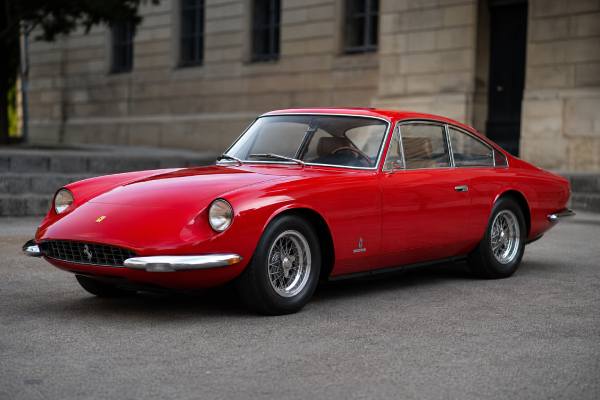
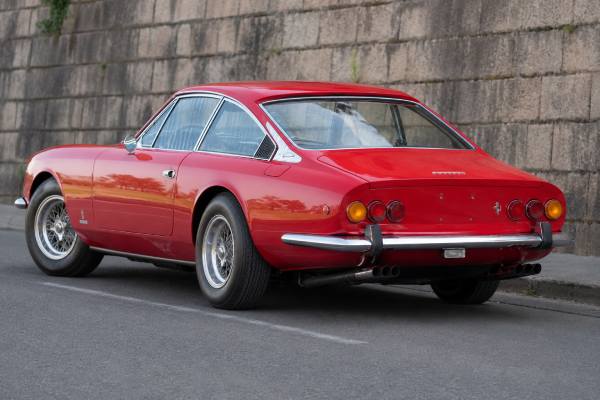
The Ferrari 365 GT 2+2 (Tipo 591), built from 1967 to 1971, is the large Pininfarina-bodied V12 grand tourer that bridged Ferrari’s elegant 1960s 2+2 tradition with a more modern idea of comfort. Its Tipo 245 4.4-liter Colombo V12 produced 320 hp, and its long-wheelbase steel body gave it real four-seat usefulness without removing the sound, throttle response, and mechanical character people expect from a classic front-engined Ferrari.
It replaced the 330 GT 2+2 and brought important engineering changes, especially independent rear suspension with self-levelling equipment, power-assisted steering, a five-speed manual gearbox, and a more refined cabin. The result was not a lightweight sports car. It was a fast, expensive, long-distance Ferrari for owners who wanted a usable V12 rather than a weekend-only two-seater.
Today, the 365 GT 2+2 is often searched by buyers who want a classic Ferrari V12 at a lower price than a Daytona, 275, or 365 GTC. That value gap is part of the attraction, but it can also hide the real ownership risk. This is a hand-built, carbureted, coachbuilt Ferrari with complex trim, expensive mechanical systems, and a market that strongly rewards originality, matching numbers, correct documentation, and careful restoration quality.
Quick Take
The Ferrari 365 GT 2+2 is most appealing as a refined, usable, front-engined V12 Ferrari with Pininfarina style, a 320 hp Tipo 245 Colombo engine, and a more comfortable cabin than many two-seat Ferraris of the same period. Its identity is grand touring rather than sharp-edged sports-car aggression, with independent suspension and power assistance making it unusually relaxed for a late-1960s Ferrari. The caution is that purchase price can be only a small part of the story: corrosion, tired self-levelling suspension, carburetor and ignition issues, old restorations, missing tools, non-original colors, and weak documentation can change the car’s value and ownership cost dramatically.
Table of Contents
- History and Collector Importance
- Tipo 245 V12, Chassis and Specs
- Production, Identity and Options
- Pininfarina Design and Engineering Details
- Road Feel, Performance and Usability
- Maintenance, Restoration and Known Issues
- Values, Buying Checks and Rivals
History and Collector Importance
The 365 GT 2+2 matters because it was Ferrari’s most mature 1960s four-seat V12 GT, not simply a longer version of a sports car. It gave Ferrari customers a fast, luxurious alternative to the two-seat berlinettas while keeping the brand’s front-engine V12 identity intact.
Ferrari introduced the 365 GT 2+2 at the Paris Motor Show in 1967. The car arrived at a time when Ferrari’s road-car business depended heavily on grand tourers. The 250 GTE had proved that a Ferrari 2+2 could sell in meaningful numbers, and the 330 GT 2+2 carried that idea through the mid-1960s. The 365 GT 2+2 took the same basic mission and made it more refined, more powerful, and more comfortable.
The model name follows Ferrari’s traditional single-cylinder displacement logic. “365” refers to the approximate displacement of one cylinder, while “GT 2+2” identifies it as a grand touring coupe with two main front seats and two rear seats. The Tipo 591 reference applies to the chassis, while Tipo 245 identifies the 4.4-liter V12 engine family used in this model.
The car was designed by Pininfarina and built as a large, elegant coupe rather than a compact sports berlinetta. It is often nicknamed “Queen Mary” because of its size and stately road presence. The nickname can sound dismissive, but it also captures the car’s true character. It is long, broad, comfortable, and made for high-speed distance work.
Its place in Ferrari history is more important than its market ranking suggests. It was the first Ferrari four-seat V12 GT to use independent rear suspension, replacing the live-axle layout of the earlier 330 GT 2+2. That change helped ride comfort, rear-end composure, and load-carrying behavior. The 365 GT 2+2 also embraced power-assisted controls and a more luxurious cabin at a time when Ferrari was learning how to make cars that could be driven by wealthy clients in real traffic, not just by committed enthusiasts on open roads.
The 365 GT 2+2 sat alongside far more famous Ferrari models. During its production life, Ferrari also offered cars such as the 275 GTB/4, 330 GTC, 365 GTC, Dino 206/246, and 365 GTB/4 Daytona. This makes the 365 GT 2+2 look understated in comparison, but that understatement is also why many serious owners like it. It provides the sound and engineering of a classic Colombo V12 Ferrari in a body that can carry luggage, passengers, and long journeys with less drama.
Collectors value it for several reasons:
- It is a genuine Enzo-era Ferrari V12 road car.
- It has Pininfarina coachwork and classic front-engine proportions.
- It uses a carbureted Colombo-derived V12 with a five-speed manual gearbox.
- It is rarer than most modern limited-production cars, even though it was one of Ferrari’s stronger sellers in period.
- It remains more approachable than many two-seat 1960s Ferrari V12s.
- It rewards preservation, correct colors, matching numbers, and complete history files.
The model is not a major motorsport car, and that affects its value ceiling. It was built for fast touring, not competition. Its concours relevance is different: judges and collectors look closely at originality, factory-correct trim, tool rolls, books, colors, carburetion, engine numbers, and restoration accuracy. A preserved or carefully restored 365 GT 2+2 can be highly respected, but a poorly repaired example can be difficult to justify even if the purchase price looks tempting.
Tipo 245 V12, Chassis and Specs
The heart of the 365 GT 2+2 is its Tipo 245 4.4-liter V12, a single-overhead-cam-per-bank Colombo-derived engine rated at 320 hp. The chassis is a tubular steel Tipo 591 structure with independent suspension, four-wheel disc brakes, rear-wheel drive, and a five-speed manual gearbox.
| Item | Specification |
|---|---|
| Model | Ferrari 365 GT 2+2 |
| Factory chassis type | Tipo 591 |
| Engine type | Tipo 245 front-mounted 60-degree V12 |
| Displacement | 4,390.35 cc |
| Bore x stroke | 81 mm x 71 mm |
| Valve gear | Single overhead camshaft per bank, two valves per cylinder |
| Fuel system | Three Weber 40 DFI/5 carburetors |
| Compression ratio | 8.8:1 |
| Maximum power | 320 hp at 6,600 rpm |
| Transmission | Five-speed manual |
| Drivetrain | Front engine, rear-wheel drive |
| Steering | Power-assisted recirculating ball |
| Brakes | Four-wheel hydraulic disc brakes, ventilated discs commonly specified |
| Front suspension | Independent unequal-length wishbones, coil springs, telescopic dampers, anti-roll bar |
| Rear suspension | Independent unequal-length wishbones, coil springs, telescopic dampers, self-levelling system |
The engine is an enlarged development of Ferrari’s long-running Colombo V12 family. It is all about smoothness, response, and flexible high-speed touring rather than only peak output. The 81 mm bore and 71 mm stroke give it more displacement than the 330 GT’s four-liter unit, and the triple Weber carburetors give it the classic induction sound expected from a late-1960s Ferrari.
Unlike later Ferraris with belt-driven camshafts, this engine uses timing chains. That removes the periodic belt-change concern associated with many later models, but it does not make the engine inexpensive to maintain. Valve adjustment, carburetor synchronization, ignition condition, cooling health, oil leaks, and fuel-system cleanliness all matter.
| Item | Figure |
|---|---|
| Wheelbase | 2,650 mm |
| Length | 4,974 mm |
| Width | 1,786 mm |
| Height | 1,345 mm |
| Dry weight | About 1,480 kg |
| Fuel capacity | About 100 liters in commonly quoted factory data |
| Top speed | About 245 km/h |
| 0–100 km/h | Period figures vary, generally just over seven seconds |
The chassis was not a monocoque. Like other classic Ferraris of the era, the 365 GT 2+2 used a tubular steel frame with coachbuilt bodywork. The suspension was a major step forward for a Ferrari 2+2. Earlier four-seat V12 Ferraris used a live rear axle, while the 365 GT 2+2 moved to independent rear suspension. The self-levelling rear system was intended to preserve ride height when passengers and luggage were aboard.
The five-speed manual gearbox is central to the car’s appeal. It gives the car long-legged cruising ability and a more modern feel than earlier four-speed grand tourers. The engine’s broad torque means the driver does not need to chase the redline all the time, but the V12 still rewards revs when properly warmed and tuned.
Production, Identity and Options
The 365 GT 2+2 was built in relatively small numbers by modern standards, with commonly quoted production figures sitting around 800 cars. Exact totals vary by source because some counts treat prototypes, special cases, or chassis accounting differently, so buyers should focus on individual identity and documentation rather than only the headline number.
The model was produced from late 1967 into 1971. Most cars were left-hand drive, and right-hand-drive examples are much rarer. It was offered as one main body style: a Pininfarina two-door 2+2 coupe. There was no regular factory spider, lightweight competition version, or separate high-performance package.
Important identification points include chassis number, engine number, gearbox number, body details, delivery market, original color, interior trim, and factory equipment. Ferrari road cars of this period used odd-numbered chassis sequences, and many serious buyers will want confirmation through Ferrari Classiche documentation, marque specialists, historical records, older invoices, ownership history, or known registry data.
Production Numbers and Series Changes
The 365 GT 2+2 did not have the obvious Series I and Series II split seen on some earlier Ferraris, but there were running changes and market-related differences. U.S.-market cars can have emissions-related equipment, and individual cars vary because of factory practice, customer requests, dealer changes, and later restoration work.
A good file should ideally show:
- chassis number and engine number
- original exterior and interior colors
- original delivery market and supplying dealer
- gearbox and differential information where available
- past ownership chain
- restoration invoices
- major mechanical rebuild invoices
- Ferrari Classiche certification where present
- old photographs that confirm trim, color, and body details over time
Matching numbers matter. A 365 GT 2+2 with its original engine is usually more desirable than a car with an engine swap, even if the replacement is a correct Ferrari V12 unit. A non-original gearbox or differential is not always fatal, but it should affect price and must be disclosed clearly.
Factory Equipment and Options
The 365 GT 2+2 was generously equipped for its era. Leather upholstery, electric windows, power-assisted steering, and power-assisted braking were central to its luxury GT identity. Air conditioning is often seen on cars and is widely associated with the model, but buyers should verify whether a specific car had factory air conditioning, dealer-installed equipment, later retrofit parts, or missing components.
Period and commonly encountered equipment can include:
- leather interior trim
- electric windows
- power steering
- servo-assisted brakes
- air conditioning on many examples
- radio equipment
- electric aerial
- Borrani wire wheels on some cars
- cast alloy wheels on others
- center-lock wheel hardware
- tinted glass depending on market and specification
- fog lamps or market-specific lighting details
Wheels are a common originality point. Some cars have Borrani wire wheels, while others have period cast alloy wheels. A change of wheel style can be reversible, but correct wheel type, size, hub hardware, tire age, and spare wheel condition all matter.
Interior details are also important. The dashboard, wood trim, leather, switches, instruments, carpets, door panels, and rear-seat trim are expensive to restore correctly. A retrim that looks attractive but uses incorrect grain, stitching, carpet, or color can reduce collector confidence.
Paint color can significantly affect value. Many cars have been repainted, sometimes more than once. A color change is not automatically bad if the work is excellent, but original colors supported by factory records usually carry more weight. Unusual but documented period colors can be more interesting than another resale-red repaint.
Pininfarina Design and Engineering Details
The 365 GT 2+2 looks the way it does because it was designed as a high-speed luxury coupe, not a compact back-road weapon. Its long hood, glassy cabin, flowing roofline, and spacious rear quarters express Ferrari’s late-1960s grand touring language in a larger and more formal shape.
Pininfarina gave the car a clean, balanced profile. The front is low and elegant, with covered or open headlamp treatments depending on market and specification. The side view emphasizes length, while the rear tapers gently rather than ending with the sharp, abrupt aggression of a Daytona. It is restrained rather than flamboyant.
Body construction mixed traditional coachbuilt methods with practical production needs. The body is mainly steel, with aluminum used for some panels such as the bonnet and boot lid in commonly cited specifications. The steel body is one reason corrosion inspection is so important. These cars can look beautiful from ten feet away while hiding expensive structural or panel issues underneath.
Cabin Layout and GT Character
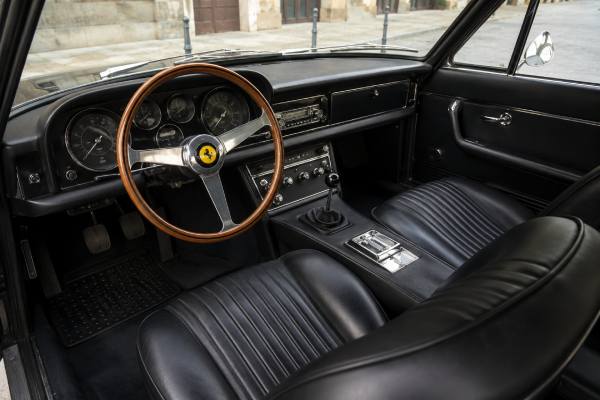
Inside, the 365 GT 2+2 feels more like a luxury express than a stripped sports car. The driving position is upright by modern supercar standards, visibility is good, and the large glass area makes the car less intimidating than its size suggests. The rear seats are not limousine-like, but they are more usable than the token rear seats in many 2+2 coupes.
The dashboard layout places the main instruments in front of the driver, with secondary gauges and controls arranged for long-distance monitoring. This matters because a classic V12 Ferrari driver needs to watch temperature, oil pressure, charging behavior, and fuel level. A healthy 365 GT 2+2 is a relaxed touring machine; an unhealthy one will usually give early warnings through heat, smell, noise, or gauge behavior.
The wood-rimmed steering wheel, leather trim, chrome details, and analog instruments give the car much of its emotional appeal. Those parts also create restoration risk. Missing interior hardware, incorrect switches, non-original radios, cracked veneers, and poorly fitted leather can all be costly to correct.
Engineering Features That Set It Apart
The most important engineering feature is the independent rear suspension with self-levelling. Earlier Ferrari 2+2s could be fast and charming, but the 365 GT 2+2 was more sophisticated under load. The self-levelling system helped the car keep its stance with passengers and luggage, supporting its purpose as a real grand tourer.
Other important engineering points include:
- a front-mounted 4.4-liter V12 with triple Weber carburetors
- five-speed manual transmission
- tubular steel chassis
- independent front and rear suspension
- power-assisted steering
- four-wheel disc brakes
- large fuel capacity for long-distance touring
- spacious luggage area by classic Ferrari standards
- cooling and ventilation designed for a larger, more luxurious cabin
The engine bay is visually and mechanically important. Correct carburetors, air cleaner assemblies, ignition parts, hoses, clamps, finishes, and routing all matter to knowledgeable buyers. A shiny engine bay is not the same as a correct one. Over-restored finishes, incorrect modern parts, poorly routed fuel lines, and improvised wiring can suggest deeper issues.
The sound is part of the engineering experience. The Tipo 245 V12 is smoother and less frantic than smaller-displacement earlier Ferrari V12s, but it still has the layered mechanical sound of timing chains, valvetrain, carburetors, and exhaust. A well-tuned car should idle cleanly when warm, pull smoothly from low revs, and become more urgent as the revs rise.
Road Feel, Performance and Usability
A good 365 GT 2+2 drives like a refined classic Ferrari GT: quick, smooth, stable, and mechanical, with enough performance to feel genuinely fast even today. It is not as sharp as a 275 GTB or Daytona, but it is far more relaxed over distance and easier to enjoy at moderate speeds.
The V12 is the centerpiece. It has enough displacement to pull strongly without constant gear changes, and the Weber carburetors give crisp response when properly tuned. Cold behavior depends heavily on setup. A car with clean carburetors, correct ignition, good fuel delivery, and proper choke or starting technique should settle into a stable warm idle. A tired car may load up, cough, smell rich, run hot, or hesitate.
Acceleration is brisk rather than brutal by modern standards. Period 0–100 km/h figures generally sit a little above seven seconds, with a top speed around 245 km/h. Those numbers are still impressive for a large, comfortable late-1960s four-seat coupe. More important than the numbers is the way the car gains speed. It does not need drama. It gathers pace with a long, smooth V12 surge.
The five-speed gearbox should feel mechanical and deliberate. It will not shift like a modern short-throw transmission, especially when cold. Second gear can be reluctant in many classic Ferraris until the oil is warm, and sympathetic shifting is part of the experience. A gearbox that grinds when warm, jumps out of gear, or feels vague should be investigated before purchase.
Steering is power-assisted, which suits the car’s size and touring mission. It should not feel numb, loose, or wandering. A good car tracks well on the highway, responds cleanly to inputs, and feels settled through long bends. Excessive play can come from steering components, suspension wear, poor alignment, old tires, or chassis issues.
Ride quality is one of the car’s strengths when the rear self-levelling system and dampers are healthy. The 365 GT 2+2 should feel composed rather than floaty. If the rear sits oddly, bounces, feels harsh, or changes attitude under load, the suspension needs close attention.
Braking performance is period-correct. The disc brakes are strong for the era, but they do not feel like modern carbon-ceramic or ABS-assisted brakes. Pedal feel should be firm, confidence-inspiring, and consistent. A long pedal, pulling, vibration, sticking calipers, or fluid leaks are warning signs.
In everyday use, the 365 GT 2+2 is more manageable than many people expect. Visibility is good, the cabin is airy, and the engine is flexible. The challenges are size, heat, fuel consumption, old-car ventilation, and the need for mechanical sympathy. It prefers regular use to long storage. Cars that sit often develop fuel varnish, brake issues, leaking seals, weak batteries, flat-spotted tires, and cooling problems.
The best use case is fast touring: open roads, long weekends, rallies, and relaxed events where the car can warm fully and run at steady speeds. City traffic is possible, but not where the car shines. Heat management, clutch wear, and carburetor behavior become more important in slow traffic.
Maintenance, Restoration and Known Issues
The 365 GT 2+2 is not unreliable when properly maintained, but deferred maintenance can be extremely expensive. Buyers should think less in terms of ordinary used-car reliability and more in terms of age, originality, specialist workmanship, parts availability, and the cost of correcting old shortcuts.
The engine is durable in the way a well-built classic Ferrari V12 can be durable, but it needs correct care. Oil leaks, tired valve guides, worn timing-chain components, weak ignition, dirty carburetors, old fuel lines, cooling neglect, and poor tuning can make a good engine feel bad. A compression and leak-down test by a Ferrari specialist is strongly recommended before purchase.
Mechanical Areas to Inspect
Key inspection points include:
- cold-start behavior and warm idle quality
- oil pressure when cold and fully hot
- coolant temperature in traffic and on open roads
- smoke on start-up, overrun, and acceleration
- carburetor balance and fuel leaks
- distributor, coils, plug wires, and ignition timing
- gearbox synchros, especially when warm
- clutch take-up and release bearing noise
- differential noise or leaks
- brake caliper condition and brake hose age
- steering box play and power-steering leaks
- rear self-levelling suspension function
- wheel bearings, bushings, ball joints, and dampers
Cooling health is especially important. A classic V12 with an old radiator, tired water pump, blocked passages, weak fans, incorrect thermostat, or poor ignition tune can run hot. Overheating can become very expensive very quickly.
Fuel-system condition is another priority. Old hoses, incorrect clamps, dirty tanks, weak pumps, and carburetor leaks are safety and reliability concerns. Ethanol-blended modern fuel can accelerate deterioration in old rubber parts if the system has not been updated correctly.
Corrosion and Body Structure
The body and chassis deserve as much attention as the engine. The 365 GT 2+2 is a steel-bodied coachbuilt car, and corrosion repair can be complex. Paint can hide poor metalwork, filler, patched floors, and accident repairs.
Check carefully around:
- sills and rocker panels
- lower doors
- wheel arches
- floor pans
- boot floor and fuel tank area
- front valance and nose
- rear valance
- suspension mounting points
- chassis tubes and outriggers
- windscreen and rear-window surrounds
- bonnet and boot-lid edges
- jacking points
Accident damage is a major value issue. Panel fit on hand-built cars may not be modern-perfect, but doors, bonnet, boot lid, and glass openings should make sense. Uneven shut lines, strange welds, rippled inner panels, poor underbody repairs, or mismatched finishes can point to old crash damage.
Restoration Costs and Originality Tradeoffs
A cheap 365 GT 2+2 can become an expensive car very quickly. Paint, chrome, leather, wood, gauges, suspension, engine work, gearbox work, and correct missing parts can easily exceed the price gap between a poor car and a good one. Full restorations can run into very large sums, especially if metalwork and drivetrain rebuilding are both required.
Originality must be judged intelligently. A preserved car with worn but authentic interior trim may be more desirable than a glossy car restored with incorrect materials. Mechanical upgrades can make sense if they are discreet, reversible, and documented, but obvious modern substitutions can reduce collector appeal.
Reasonable ownership maintenance includes regular fluid changes, valve and ignition checks, carburetor tuning, brake-fluid renewal, coolant-system care, tire replacement by age, suspension inspection, and frequent exercise. The car should not be treated like a modern vehicle that can sit for months and then be driven hard immediately.
A specialist inspection is not optional. The right expert will know where these cars rust, what correct parts look like, how the rear suspension should sit, how the V12 should sound, and whether documentation supports the car’s claimed identity.
Values, Buying Checks and Rivals
The 365 GT 2+2 remains one of the more attainable classic Ferrari V12s, but “attainable” does not mean inexpensive to own. Current public market data often places usable examples in the low-to-mid six-figure range, with condition, provenance, originality, and documentation creating large differences.
Recent auction and listing activity shows why buyers need context. Some driver-quality or needs-attention cars trade far below the best restored or highly original examples. A car with matching numbers, attractive original colors, good history, tools, books, Classiche certification, and strong mechanical condition deserves a premium. A car with corrosion, missing parts, uncertain numbers, old paint, poor trim, or no invoices should be priced with restoration risk in mind.
The biggest value drivers are:
- matching original engine
- documented original color combination
- complete ownership and service history
- Ferrari Classiche certification where available
- high-quality specialist maintenance
- correct carburetors, wheels, trim, and instruments
- strong body condition with no hidden corrosion
- preserved original interior or accurate restoration
- books, tools, jack, and accessories
- desirable period colors
- right-hand drive rarity in markets where that matters
Buyers should be cautious of cars described only with vague phrases such as “older restoration,” “recently serviced,” or “believed to be original.” Those phrases can mean very different things. Ask for invoices, inspection reports, restoration photographs, numbers confirmation, and cold-start videos. Then have the car inspected in person.
| Priority | What to Check | Why It Matters |
|---|---|---|
| Identity | Chassis, engine, gearbox, factory records | Originality strongly affects value |
| Body | Sills, floors, wheel arches, panel fit, old repairs | Metalwork can exceed mechanical repair costs |
| Engine | Compression, leak-down, oil pressure, smoke, leaks | V12 rebuild work is highly expensive |
| Fuel and ignition | Carburetors, fuel lines, pumps, distributors, coils | Poor setup ruins drivability and can create fire risk |
| Suspension | Rear self-levelling system, bushings, dampers | Correct ride height and handling depend on it |
| Interior | Leather, wood, switches, gauges, carpets, radio | Correct trim is costly and hard to source |
| Documentation | Invoices, old photos, ownership chain, tools, books | Paperwork can separate a real collector car from a risky project |
The closest Ferrari alternatives include the 330 GT 2+2, 365 GTC, 365 GTC/4, 365 GT4 2+2, and 400-series cars. The 330 GT 2+2 is usually earlier in feel and less sophisticated at the rear. The 365 GTC is smaller, sportier, rarer, and much more valuable. The 365 GTC/4 offers a different early-1970s style with a more complex four-cam V12. The 365 GT4 2+2 and later 400/412 cars are more angular and less 1960s in character, often cheaper to buy but not necessarily cheap to restore.
Non-Ferrari rivals include the Lamborghini Espada, Maserati Mexico, Maserati Indy, Aston Martin DBS, and Iso Rivolta models. The Lamborghini Espada is the most direct Italian V12 four-seat rival and has a more dramatic shape. The Aston Martin DBS has strong British GT appeal but a different mechanical character. The Maseratis and Isos can offer style and performance at lower prices, but Ferrari’s brand strength, engine identity, and Classiche ecosystem give the 365 GT 2+2 a distinct collector position.
The best 365 GT 2+2 to buy is not necessarily the cheapest or the shiniest. It is the car with a coherent story: correct identity, honest condition, strong mechanical health, good body structure, known ownership, and documentation that supports what the seller claims. A slightly more expensive car with a clean file is often cheaper in the long run than a bargain car that needs paint, trim, suspension, and engine work.
For long-term collectability, the 365 GT 2+2 has a stable argument. It is a front-engined Enzo-era Ferrari V12 with Pininfarina coachwork, usable seating, and relatively low production. It will probably remain below the most famous two-seat Ferraris, but that is exactly why it continues to attract informed buyers who want the experience of a classic V12 Ferrari without entering the highest tier of the market.
References
- Ferrari 365 GT 2+2 (1967) 2026 (Manufacturer Model Page)
- FERRARI 365 GT2+2 OPERATING AND SERVICE MANUAL Pdf Download | ManualsLib 1968 (Operating and Service Manual)
- Ferrari 365 GT 2+2 Registry – Ferrari 365 GT 2+ 2 Technical Specifications 2022 (Technical Specifications)
- 1969 Ferrari 365 GT 2+2 by Pininfarina | Paris 2025 | RM Sotheby’s 2025 (Auction Reference)
- Ferrari 365 GT 2+2 Market – CLASSIC.COM 2026 (Market Data)
Disclaimer
This article is for informational purposes only and is not a substitute for professional diagnosis, inspection, repair, valuation, or restoration advice. Specifications, torque values, service intervals, procedures, equipment, and correct parts can vary by VIN, market, production date, and individual vehicle history. Always verify details against official Ferrari documentation, factory records, and a qualified classic Ferrari specialist before buying, repairing, or restoring a 365 GT 2+2.
Please share this article on Facebook, X/Twitter, or your favorite automotive community if it helped you. Sharing supports our work and helps other enthusiasts find useful classic Ferrari information.