
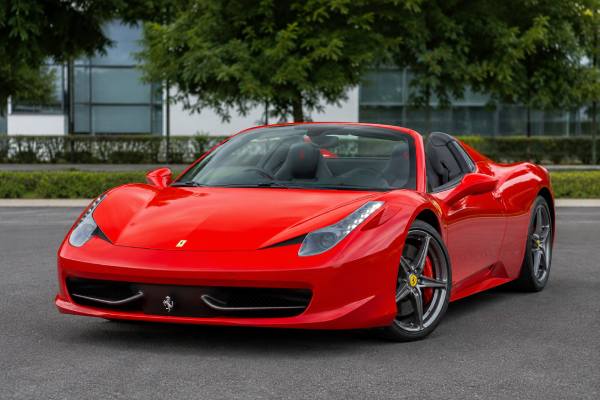
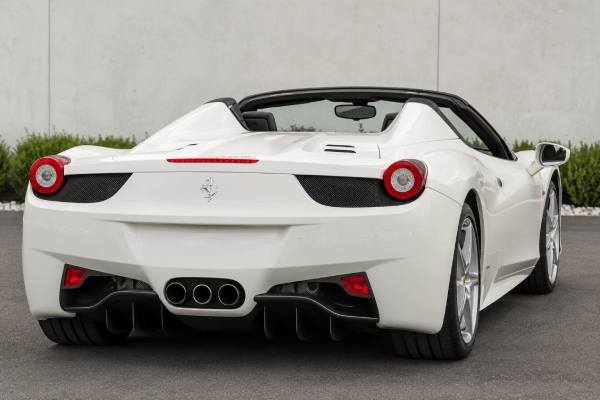
The Ferrari 458 Spider (F142) is the open-top version of the 458 Italia, built from 2011 to 2015 and powered by Ferrari’s 4.5-liter naturally aspirated V8 from the F136 family. In standard Spider form, it delivered 570 CV, often rounded in enthusiast shorthand as 570 hp, through a 7-speed dual-clutch transmission and rear-wheel drive.
Its lasting appeal is simple: the 458 Spider combines the last generation of Ferrari’s naturally aspirated mid-engine V8 road cars with a folding aluminum hardtop, sharp modern electronics, and a soundtrack that the later turbocharged 488 could not copy. It is not a rare limited-production Ferrari in the way a 458 Speciale A is, but good examples are now treated as serious collector-grade cars. Buyers care about mileage, options, service history, originality, accident records, sticky interior controls, roof operation, carbon-ceramic brake condition, and whether all recall work has been completed.
Quick Take
The Ferrari 458 Spider is strongest as a usable modern exotic with genuine end-of-era importance: a high-revving naturally aspirated V8, mid-engine balance, a fast dual-clutch gearbox, and a retractable hardtop that does not turn the car into a soft boulevard cruiser. Its main tradeoff is ownership sensitivity. A neglected 458 Spider can become expensive quickly, especially if it has weak service records, worn carbon-ceramic brakes, accident repairs, roof faults, overdue fluids, or unresolved recall work. The best cars are original, well-documented, regularly serviced, and bought after a proper Ferrari specialist inspection.
Table of Contents
- Model History and Why the 458 Spider Matters
- Engine, Chassis, and Key Specifications
- Production, Variants, and Factory Options
- Design, Engineering, and Special Features
- Driving Experience and Real-World Performance
- Reliability, Maintenance, and Restoration Reality
- Market Value and Buying Guide
Model History and Why the 458 Spider Matters
The 458 Spider matters because it joined Ferrari’s most celebrated modern V8 platform with a proper retractable hardtop and kept the naturally aspirated character intact. It sits between the F430 Spider and the turbocharged 488 Spider, which gives it a clear historical identity.
Ferrari introduced the 458 Italia coupe for the 2010 model year as a major step beyond the F430. The 458 moved Ferrari’s mid-engine V8 car into a more modern era, with direct fuel injection, a dual-clutch gearbox, advanced stability systems, sharp aerodynamics, and a far more integrated chassis electronics package. The Spider followed in 2011 and reached the U.S. market mainly as a 2012 model.
The 458 Spider was not just a coupe with the roof cut off. Its main engineering statement was the aluminum retractable hardtop. Ferrari had used soft tops on earlier mid-engine V8 Spiders, but the 458 Spider used a folding metal roof that opened or closed in about 14 seconds and packaged itself above the engine bay. This gave owners much of the security, insulation, and visual finish of a coupe while keeping the open-air drama people expect from a Ferrari Spider.
The car’s place in Ferrari history became more important after the 488 arrived. The 488 Spider is quicker and has far more torque, but it uses a twin-turbocharged V8. That makes the 458 Spider one of the final standard-production, naturally aspirated, mid-engine Ferrari V8 convertibles. For many buyers, that matters more than the raw performance gap.
Today, the 458 Spider attracts three kinds of buyers. The first group wants a usable modern Ferrari that still feels mechanical and emotional. The second wants a collectible car with a high-revving V8 and no hybrid or turbo system. The third wants an investment-grade example with low miles, ideal colors, factory carbon options, complete records, and strong originality. The same car can satisfy all three groups, but only if condition and history are right.
The Spider is less track-focused than a 458 Speciale and less rare than the 458 Speciale A, but that is part of its appeal. It is fast enough to feel special every time it is driven, comfortable enough for weekend use, and important enough that good cars are no longer judged like ordinary used exotics.
Engine, Chassis, and Key Specifications
The 458 Spider’s core specification is its 4.5-liter naturally aspirated V8, 7-speed dual-clutch gearbox, rear-wheel drive, aluminum chassis, and folding hardtop. It is a modern Ferrari, but the engine defines the car more than any single number.
The F136-family V8 is mounted behind the cabin and drives the rear wheels. It uses a flat-plane crankshaft, dry-sump lubrication, direct injection, and an extremely high 9,000 rpm maximum engine speed. Unlike many turbocharged engines, it does not rely on a wave of low-rpm torque. It builds intensity as the revs climb, which is central to the 458 Spider’s character.
Ferrari’s 570 CV rating equals about 562 mechanical horsepower, though many markets and listings simplify the car as a 570 hp model. Torque is 540 Nm, or about 398 lb-ft, at 6,000 rpm. The figures do not fully explain the experience because the engine response, sound, and top-end pull are the reasons many enthusiasts still prefer the 458 to the later 488.
| Item | Specification |
|---|---|
| Model code | F142 |
| Production period | 2011–2015 |
| Engine family | F136 naturally aspirated V8 |
| Displacement | 4,497 cc, 4.5 liters |
| Power | 570 CV at 9,000 rpm |
| Torque | 540 Nm at 6,000 rpm |
| Induction and fuel system | Naturally aspirated, direct fuel injection |
| Lubrication | Dry sump |
| Transmission | 7-speed dual-clutch F1 gearbox |
| Drivetrain | Rear-wheel drive |
The chassis uses aluminum construction rather than a carbon-fiber tub. That does not make it old-fashioned. The 458 platform was designed around stiffness, low weight, crash performance, and suspension response, and it gave Ferrari a strong base for the coupe, Spider, Speciale, Challenge, GT3, and GTE competition cars.
Suspension is by double wishbones at the front and a multi-link layout at the rear, with magnetorheological dampers. The electronics bring together E-Diff, F1-Trac traction control, high-performance ABS, stability control, and the steering-wheel manettino drive-mode switch. These systems are not decorative. They shape how the car puts power down, how much slip it allows, and how approachable the chassis feels.
| Item | Specification |
|---|---|
| Front suspension | Double wishbone |
| Rear suspension | Multi-link |
| Dampers | Magnetorheological adaptive dampers |
| Brakes | Carbon-ceramic discs |
| Front tires | 235/35 ZR20 |
| Rear tires | 295/35 ZR20 |
| Wheelbase | 2,650 mm |
| Length | 4,527 mm |
| Width | 1,937 mm |
| Top speed | 320 km/h, about 199 mph |
| 0–100 km/h | About 3.4 seconds |
The Spider is heavier than the coupe because of its folding roof and structural changes, but it keeps the same official 0–100 km/h claim. At high speed, the coupe has the advantage, yet the Spider’s top speed remains well beyond normal road use. For most owners, the more important difference is not speed. It is the ability to drop the roof and hear the V8 without losing the secure feel of a hardtop car when the roof is closed.
Production, Variants, and Factory Options
The standard 458 Spider was a regular-production model, not a numbered limited edition. That means condition, specification, mileage, and documentation usually matter more than chasing a production number that Ferrari did not publicize in a simple global total.
The main 458 road-car family includes the 458 Italia coupe, 458 Spider, 458 Speciale, and 458 Speciale A. The Spider covered here is the standard 570 CV retractable-hardtop model, not the 605 CV Speciale A. The Speciale A is a much rarer, track-focused open model limited to 499 examples and sits in a different market category.
| Variant | Body style | Power | Buyer relevance |
|---|---|---|---|
| 458 Italia | Coupe | 570 CV | Lightest standard road version and often the sharper driver’s choice |
| 458 Spider | Retractable-hardtop Spider | 570 CV | Open-air usability with the standard naturally aspirated V8 |
| 458 Speciale | Track-focused coupe | 605 CV | More aggressive, rarer, and much more expensive |
| 458 Speciale A | Limited open Speciale | 605 CV | Top collectible open 458, limited to 499 examples |
Factory options have a major effect on value. A base 458 Spider can still be wonderful to drive, but collector buyers often pay more for the right options, colors, and trim. Desirable equipment commonly includes carbon-fiber driver-zone trim with LED shift lights, carbon racing seats, forged wheels, front suspension lift, Scuderia Ferrari shields, parking sensors or camera, upgraded audio, Alcantara or extended leather interior trim, contrast stitching, and carbon-fiber exterior pieces.
The front suspension lift is especially useful on a Spider that will be driven regularly. It helps with steep driveways, parking ramps, and road crowns. Carbon racing seats can make the car feel more focused and are desirable in the resale market, but they do not suit every body type. Standard seats are more relaxed for longer drives.
Color also matters. Rosso Corsa remains the classic Ferrari choice, but Grigio Silverstone, Nero, Bianco Avus, Giallo Modena, Blu Tour de France, and special-order colors can all be attractive depending on interior pairing. Unusual colors can either add value or narrow the buyer pool. The best result is a color and trim combination that looks intentional, is documented by factory records, and has not been altered later.
For authenticity, buyers should check the factory build sheet, original window sticker where available, books, tools, battery tender, tire inflator, car cover, keys, service invoices, and Ferrari dealer records. Matching the visible options to the factory specification is important. Aftermarket wheels, exhausts, wraps, lowered suspension, non-factory carbon, and tuned ECUs may suit some owners, but they usually reduce collector confidence unless the original parts come with the car.
Design, Engineering, and Special Features
The 458 Spider’s design works because the roof mechanism is integrated into the car rather than looking like an afterthought. With the roof up, it has a clean coupe-like profile; with the roof down, it becomes one of the most dramatic modern Ferrari open cars.
The folding hardtop is the car’s signature feature. It uses aluminum panels and stores neatly behind the cabin, above the engine area. The roof does not fold into the luggage compartment like many front-engine convertibles, so the Spider keeps reasonable practicality for the type of car. It also gives better security and weather isolation than a fabric top.
The change from coupe to Spider required a different rear deck and engine cover treatment. The coupe shows the V8 through a rear glass panel, while the Spider uses a body-color rear section shaped around the roof storage area and cooling needs. Some buyers prefer the coupe’s exposed engine view, but the Spider counters with stronger roof-down theater.
Aerodynamics and cooling are central to the 458’s appearance. The low nose, front intakes, sculpted side surfaces, and rear outlets are not only styling gestures. They manage airflow into radiators, around the body, and through the engine bay. The 458’s body is smoother and more integrated than the F430’s, and the Spider keeps that clean surface language while accepting the roof packaging.
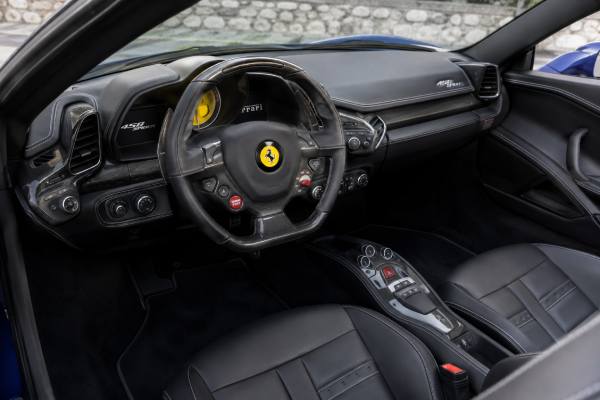
The cockpit is another major part of the car’s identity. Ferrari moved many controls to the steering wheel, including turn signals, wipers, lights, the engine start button, damper control, and manettino mode selector. This layout divides opinion. Some drivers love the race-car feel and the way the wheel becomes the command center. Others find the turn-signal buttons less intuitive than conventional stalks. Either way, it is part of the 458 experience.
The 458 Spider also has a more modern dual-screen instrument layout flanking the central tachometer. The large yellow or black tach remains the emotional center. The gearbox paddles are fixed to the steering column, not the wheel, which suits fast road driving because the paddles stay in the same place while the driver adds steering lock.
Sound engineering is one of the car’s defining qualities. The flat-plane V8 has a crisp, hard-edged tone that rises to a fierce upper-rpm wail. The roof-down experience makes the intake and exhaust character far more present. Aftermarket exhausts are common, but buyers should be careful. A badly chosen exhaust can introduce drone, trigger emissions or valve-control issues, or make the car harder to sell. A standard or reversibly upgraded exhaust is usually the safest path for value.
Driving Experience and Real-World Performance
The 458 Spider feels fast, sharp, and theatrical, but its biggest strength is response rather than brute force. The engine, steering, gearbox, and chassis all react quickly, which makes the car feel alive at speeds where some modern supercars still feel half-asleep.
The V8 is the center of the drive. At low rpm it is smooth enough for town use, but it does not feel lazy. As the revs climb, the engine becomes harder, louder, and more urgent. The final third of the tachometer is where the 458 earns its reputation. The car rewards drivers who use revs rather than leaning on low-end torque.
The dual-clutch gearbox is a major upgrade over the single-clutch automated manuals used in earlier Ferraris. Shifts are quick, clean, and much smoother in traffic. In automatic mode, it can behave politely, though the car still feels like an exotic rather than a luxury GT. In manual mode, the fixed paddles suit aggressive driving and make downshifts feel precise.
Steering is very quick. Drivers coming from older Ferraris may need time to adapt because the 458 reacts with little steering input. The benefit is agility. On a good road, the car changes direction with little delay and feels smaller than its width suggests. The downside is that poor alignment, mismatched tires, worn suspension parts, or old rubber can make the car nervous. Tires matter greatly on a 458 Spider.
Ride quality is better than many people expect. The adaptive dampers allow the car to breathe over imperfect roads, and the bumpy-road damper setting helps separate suspension compliance from the more aggressive powertrain modes. That is one reason the 458 Spider works well as a weekend road car instead of feeling useful only on perfect pavement.
The carbon-ceramic brakes are powerful and durable when healthy. On the road, they can feel slightly different from steel brakes at low temperature, but a good system should inspire confidence. Any pulsing, warning lights, brake-fluid messages, unusual pedal travel, or uneven rotor wear needs specialist attention immediately.
On track, the Spider is capable but not the best 458 for repeated hard use. The coupe and especially the Speciale are more natural choices for heavy circuit work. The Spider’s value lies in road use: mountain drives, coastal routes, fast open-road touring, and short roof-down blasts where the engine sound is the main event. Track days increase brake, tire, fluid, and inspection demands, so buyers should treat a tracked car differently from a carefully used road car.
Visibility is decent for a mid-engine exotic, though rear-quarter vision is limited with the roof up. The front end is low, so the suspension lift option is useful. Cabin heat, tire noise, firm seats, and wide-body parking issues are all part of the ownership experience, but the 458 Spider is still one of the more usable modern Ferraris when maintained correctly.
Reliability, Maintenance, and Restoration Reality
The 458 Spider has a stronger reliability reputation than many older Ferraris, but it is still a complex exotic with expensive wear items. A car that has been serviced yearly and inspected by specialists is very different from one that has simply covered few miles.
The 4.5-liter V8 is generally respected for durability, especially compared with belt-service older Ferraris. It uses timing chains rather than routine timing-belt replacements, and many cars have accumulated meaningful mileage without engine drama. That does not make it cheap to ignore. Fluids, filters, plugs, belts, leaks, mounts, sensors, and cooling-system condition still matter.
Ferrari’s seven-year maintenance program helped many early owners keep cars serviced properly, but most 458 Spiders are now beyond that original coverage. Buyers should not assume a low-mile car is fully sorted. Low use can create its own issues: old tires, weak batteries, sticky switches, dry seals, flat-spotted rubber, aged fluids, and electronic faults from poor battery maintenance.
Common inspection and ownership areas include:
- Sticky interior buttons and switches, a known issue on many Ferraris of this era.
- Retractable hardtop operation, including alignment, hydraulic or electric function, seals, sensors, and warning messages.
- Carbon-ceramic brake rotor condition, pad life, and service records.
- Clutch and gearbox behavior, even though the dual-clutch unit is not a traditional manual clutch setup.
- Engine mounts, suspension bushings, ball joints, dampers, and alignment.
- Battery health and tender use, because weak voltage can cause misleading electronic faults.
- Cooling-system leaks, hose condition, radiator damage, and fan operation.
- Exhaust valve function and evidence of non-factory modifications.
- Accident repairs, paintwork, undertray damage, and front-lift function if fitted.
Recall status is important. U.S.-market cars may be affected by the front trunk latch recall for certain 2010–2014 458 Italia and 458 Spider vehicles, and by the later brake-fluid-related recall covering many 458 and 488 models. The brake recall involved the possibility of brake fluid leakage and included replacement of the reservoir cap and software changes for the warning logic. Recall applicability depends on VIN, so the right answer is not “all cars” or “no cars.” The right answer is a Ferrari dealer or official recall check by VIN.
Maintenance should be annual even when mileage is low. The basic pattern is yearly inspection and fluid service, with mileage- and time-based items added as required. Brake fluid, engine oil, filters, auxiliary belts, spark plugs, gearbox checks, coolant condition, and diagnostic scans all need proper attention. A stamped book is useful, but invoices are better because they show what was actually done.
Restoration is not the right word for most 458 Spiders yet, but repair quality is already a market issue. A crashed 458 repaired with used panels, poor paint blending, damaged underbody panels, aftermarket carbon, or incomplete calibration can look tempting at a discount and become hard to resell. The aluminum structure, electronics, roof system, and Ferrari-specific parts make bargain repairs risky.
Originality usually beats modification. Reversible upgrades, such as a high-quality exhaust with original parts included, may be acceptable. Permanent changes, ECU tuning, non-factory paint, missing catalytic converters, poorly installed audio equipment, or cheap carbon trim can hurt value. For a collector-grade example, originality, factory records, and clean diagnostic history are worth paying for.
Market Value and Buying Guide
The 458 Spider has moved from used exotic to modern collectible, and the market now rewards the right examples sharply. The most desirable cars combine low-to-moderate mileage, strong options, clean history, original paint, complete records, and no stories.
Recent tracked sales and listings show a wide spread. Driver-quality cars with higher mileage or less ideal history can trade far below exceptional low-mile examples. Strongly specified cars with desirable colors, carbon options, racing seats, lift, shields, complete accessories, and Ferrari dealer history can command large premiums. Very low-mile cars may look attractive, but they still need inspection because sitting is not the same as preservation.
Value drivers include:
- Mileage, but only when supported by condition.
- Original paint and clean body measurements.
- Complete Ferrari service history and detailed invoices.
- Desirable factory options, especially carbon driver zone, racing seats, lift, forged wheels, and shields.
- Original books, tools, keys, cover, tender, and window sticker where available.
- Conservative ownership history with no accident or auction-story baggage.
- Factory-correct color and interior combination.
- Healthy carbon-ceramic brakes and recent tires.
- Completed recalls and no unresolved warning lights.
The safest buying approach is to start with history, not photos. A 458 Spider can photograph beautifully while hiding expensive issues underneath. Ask for the VIN, build sheet, service invoices, recall record, paint-meter readings if available, tire dates, brake wear data, diagnostic scan results, and details of any modifications. Then have the car inspected by a Ferrari dealer or independent specialist who knows the 458 platform.
| Area | What to check | Why it matters |
|---|---|---|
| Documentation | VIN, build sheet, books, records, recalls | Confirms identity, service care, and originality |
| Body and paint | Panel gaps, paint depth, undertray, crash signs | Accident history can heavily affect value |
| Roof system | Full open-close cycle, seals, warnings, alignment | Hardtop faults can be complex and costly |
| Brakes | Rotor condition, pads, fluid, warning history | Carbon-ceramic components are expensive |
| Powertrain | Cold start, leaks, shifts, mounts, diagnostics | Confirms the car is healthy, not just polished |
| Interior | Sticky switches, leather shrinkage, seat wear | Cosmetic correction can become expensive |
| Options | Factory equipment versus later additions | Original specification affects desirability |
Avoid cars with vague service history, repeated battery problems, unresolved brake warnings, roof malfunction messages, non-matching tires, visible accident repairs, missing records, heavy aftermarket changes, or sellers who resist inspection. A cheap 458 Spider can become expensive quickly if it needs brakes, tires, sticky-button refinishing, roof work, suspension repairs, and major fluid service at the same time.
The best examples are not always the lowest-mile examples. A carefully driven car with annual service, recent tires, clean diagnostics, healthy brakes, and complete records may be a better ownership choice than a near-static garage queen with old rubber and deferred maintenance. For collectors, mileage still matters. For drivers, condition and service quality matter more.
Long-term collectability looks strong because the 458 Spider represents a clear turning point. It is modern enough to use, old enough to feel distinct from turbo and hybrid Ferraris, and emotional enough to remain desirable even as newer cars become faster. The safest purchase is the car you would still want to own if values stayed flat: original, documented, properly serviced, and specified in a way that suits both driving and resale.
References
- Ferrari 458 Spider (2011) – Ferrari.com 2011 (Manufacturer Specifications)
- Ferrari Owner’s Manuals | Ferrari of Fort Lauderdale 2026 (Owner’s Manual Index)
- Part 573 Safety Recall Report 21V-833 2022 (Recall Database)
- USA RECALL CAMPAIGN REF. NO. 54 FRONT TRUNK LATCH MODEL YEARS 2010 – 2014 SEPTEMBER 2014 2014 (Recall Campaign)
- Ferrari 458 Spider Market – CLASSIC.COM 2026 (Market Data)
Disclaimer
This article is for informational purposes only and is not a substitute for professional diagnosis, repair, valuation, or inspection. Specifications, torque values, maintenance intervals, recall applicability, and service procedures can vary by VIN, market, model year, and equipment. Always verify details against official Ferrari service documentation and have any purchase or repair decision reviewed by a qualified Ferrari specialist.
If this guide was useful, please consider sharing it on Facebook, X/Twitter, or with other Ferrari enthusiasts to support our work.