
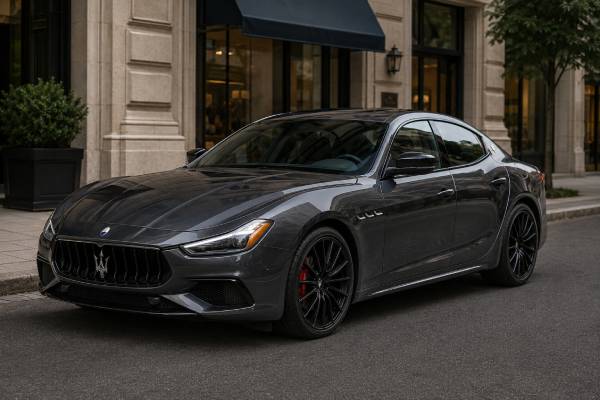
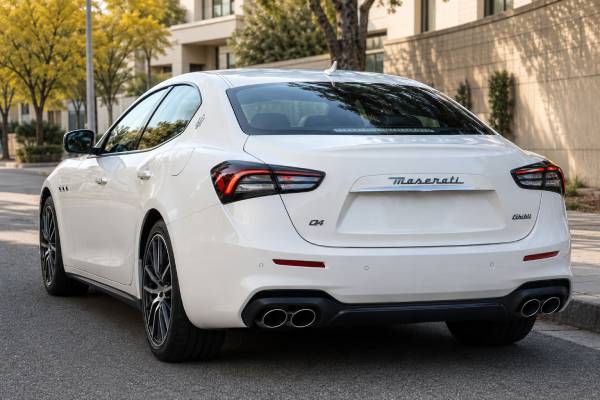
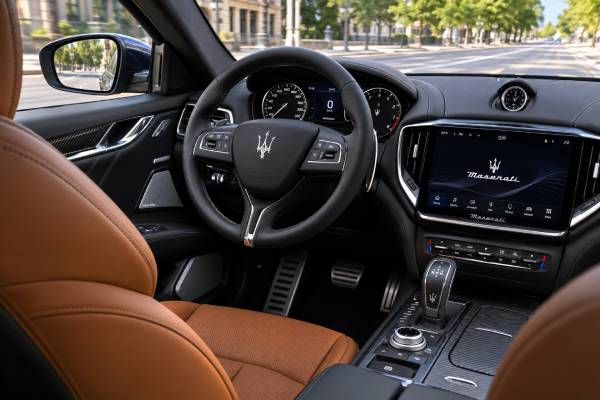
The 2024 Maserati Ghibli Modena Ultima Q4 is the final-year North American expression of the V6 M157, combining the high-output 3.0-liter twin-turbo engine, Q4 all-wheel drive, and an unusually broad standard-equipment list. Maserati quoted 424 SAE hp—commonly described as about 430 metric horsepower—along with a 4.7-second 0–60 mph time and 178 mph maximum speed. “Ultima” here means the last model-year package, not the numbered 334 Ultima V8 edition. The Modena Ultima Q4 uses the F160 V6, carries ordinary production VIN identification, and was offered in multiple colors rather than the 103-car Persia-themed specification. A U.S. window sticker shows features such as 21-inch black Titano wheels, large dual-cast brakes, full premium leather, heated and ventilated front seats, heated rear seats, soft-close doors, the 10.1-inch MIA system, Harman Kardon audio, surround cameras, and a full driver-assistance suite. That completeness makes the car attractive as a final daily-use Ghibli. It also means a pre-purchase inspection must test every mechanical, electronic, comfort, and Q4 function, verify recalls, and separate harmless expired connected services from expensive module, sensor, or calibration faults.
Table of Contents
- The Final-Year V6 Ghibli
- Modena Ultima Q4 Equipment and Numbers
- One-Year Production and Standard Features
- How Ultima Closed the M157 Story
- The Mature Q4 Driving Experience
- Warranty, Recalls, and Long-Term Upkeep
- Buying the Last North American Ghibli
The Final-Year V6 Ghibli
The Modena Ultima Q4 is the last regular-production Ghibli offered in the United States, built for the 2024 model year with the strongest V6 and all-wheel drive. It closes the M157 program as a fully equipped road car rather than a numbered collector special.
Maserati launched the M157 Ghibli for the 2014 U.S. model year and continued refining it for roughly a decade. The sedan progressed from hydraulic to electric steering, gained stronger V6 calibrations, revised bumpers and lamps, more driver assistance, and a much better 10.1-inch infotainment system. The final car contains the accumulated improvements while retaining the original body architecture and F160 engine family.
The name needs to be read in full. Modena identifies the sport-oriented late trim. Q4 identifies all-wheel drive. Ultima marks the final-year presentation. It should not be shortened to “334 Ultima,” “V8 Ultima,” or “Trofeo Ultima,” because those descriptions imply a different engine and collector program.
In U.S. specification, the engine is rated at 424 SAE hp, which is why assignment databases and international conversions often state 430 hp. Maserati’s current U.S. model information lists 406 lb-ft of torque for the 2024 Modena Ultima Q4, while other international 430 CV brochures quote 580 Nm for related versions. The original window sticker, emissions label, build data, and market documentation should govern the exact car.
The final-year strategy simplified the buying choice. Rather than offering a long menu of Ghibli variants, Maserati packaged much of the desirable equipment into one V6 Q4 model. That approach raised the original price but reduced the chance of finding a sparsely equipped final car.
Its historical position is different from the 334’s. The V8 edition commemorates the end of Maserati eight-cylinder road cars and has a fixed run of 103. The Modena Ultima Q4 commemorates the end of the Ghibli’s North American production life through a well-equipped commercial trim. It may become desirable, but it should not be marketed as individually numbered unless evidence supports a separate special allocation.
For an owner, the car’s appeal is practical. It is quick, weather-capable, comfortable, and familiar to specialists who know the M157. It is also the most electronically equipped stage of the platform. Long-term value will depend on complete function, factory configuration, and service records more than on the word Ultima by itself.
Modena Ultima Q4 Equipment and Numbers
The 2024 Modena Ultima Q4 uses the F160 twin-turbo V6, ZF eight-speed automatic, and rear-biased Q4 system. Official U.S. figures include 424 hp, 4.7 seconds to 60 mph, and a 178 mph maximum speed.
| Item | Specification |
|---|---|
| Engine | F160 60-degree twin-turbocharged V6 |
| Displacement | 3.0 liters / 2,979 cc |
| Maximum power | 424 SAE hp; approximately 430 metric hp |
| Maximum torque | 406 lb-ft in U.S. MY24 model data |
| Transmission | ZF eight-speed automatic with manual mode |
| Drivetrain | Q4 intelligent all-wheel drive with limited-slip differential |
| 0–60 mph | Approximately 4.7 seconds |
| Top speed | Approximately 178 mph |
| Wheelbase | 118 inches / 2,998 mm |
| Length | 195.7 inches / 4,971 mm |
| Width without mirrors | 76.6 inches / 1,945 mm |
| Height | 57.5 inches / 1,461 mm |
| U.S. listed curb weight | Approximately 4,122 lb |
The F160 uses aluminum construction, two turbochargers, direct injection, and variable valve timing. It delivers strong torque at moderate engine speed, letting the automatic move the car quickly without constant high revs. The engine should build boost smoothly and consistently; hesitation or a stepped surge is a diagnostic issue.
Q4 operates as an intelligent, rear-biased system rather than a fixed equal split. Vehicle software monitors wheel speed, steering, yaw, throttle, and available grip, then involves the front axle as needed. The driver should notice traction, not a harsh engagement. Binding or hopping during tight turns is a warning.
A representative U.S. window sticker lists 21-inch black Titano wheels with summer tires and an 18-inch spare. It also identifies dual-cast brakes with 360-by-32 mm front discs and 345-by-28 mm rear discs, red calipers, a limited-slip differential, Sport mode, aluminum column-mounted paddles, and quad stainless-steel exhaust outlets.
The brake dimensions and large wheel package make condition important. A car with low mileage may still have cracked inner wheel barrels, flat-spotted tires, corroded disc faces, or old brake fluid. The original summer tires also limit cold-weather usefulness despite Q4.
Maserati’s U.S. information and individual window stickers should be read together. Online pages can be updated or contain market-data errors. The VIN-specific sticker establishes what a particular car left the distributor with, while the service system confirms later campaigns and software.
Performance claims require correct tires, fuel, temperature, and surface. Repeated 0–60 testing is unnecessary during a purchase inspection. Smooth torque delivery, equal tire circumference, no driveline vibration, stable temperature, and clean diagnostic data provide better evidence of health.
One-Year Production and Standard Features
The 2024 Modena Ultima Q4 is notable for how much equipment was included rather than for a published numbered production cap. Buyers should verify the actual window sticker because distributor and dealer options can still alter the final configuration.
A U.S. sticker describes a sport exterior with gloss-black detailing, adaptive full-LED headlamps, black Titano wheels, red brake calipers, and quad exhaust tips. Nerissimo or dark-headlamp packages may appear as added options. Exterior colors include familiar Ghibli choices such as Bianco, Nero Assoluto, and Grigio tones rather than one mandatory final-edition color.
The cabin specification is extensive. Full premium leather, 12-way sport front seats, driver memory, heating and ventilation, a heated rear seat, a heated power-adjustable steering wheel, piano-black trim, a power sunroof, soft-close doors, rear sunblind, and power trunk were listed on the representative car.
The infotainment package includes the 10.1-inch Maserati Intelligent Assistant screen, navigation, Apple CarPlay, Android Auto, wireless phone charging, Bluetooth, connected services, and Harman Kardon ten-speaker audio. Alexa and satellite-radio functions depend on service availability and subscriptions.
Driver-assistance content to test
- Adaptive cruise control and Active Driver Assist.
- Lane-keeping and active blind-spot assistance.
- Forward-collision warning and autonomous emergency braking.
- Pedestrian recognition and traffic-sign recognition.
- Surround-view cameras and front/rear parking sensors.
- Adaptive LED headlamps and automatic high-beam behavior where equipped.
The breadth of standard equipment changes used-car inspection. A failed ventilated-seat fan, weak audio channel, soft-close door motor, rear blind, camera, or radar may not stop the car, but it reduces the value of a trim whose purpose was completeness. Test every switch and menu rather than accepting a seller’s list.
Original accessories also matter. Confirm both keys, manuals, compressor or spare-tire equipment, wheel-lock key, cargo items, and any dealer-supplied protection package. A missing key can be costly because programming and physical blade work require proper security access.
Production was confined to the final model-year phase, but first registration may occur later. A car sold as new in a later calendar year is still a 2024 model. Use the VIN and production label to establish build date, then verify warranty in-service date separately.
Unlike the 334, the Modena Ultima Q4 was not tied to a single numbered interior plaque or one global count in the official U.S. sales material. Sellers may describe it as limited because production ended, but rarity claims should be supported by allocation or registration data rather than marketing language.
How Ultima Closed the M157 Story
The final car preserves the M157’s original strengths—proportion, V6 sound, rear-drive-based balance, and physical controls—while adding the platform’s most mature infotainment and assistance hardware. It is a conclusion, not a redesign.
The body still uses the long bonnet, rearward cabin, frameless side glass, and short deck introduced a decade earlier. Three vents behind each front wheel and the concave grille identify the Ghibli immediately. Late boomerang rear lamps and darker Modena details keep the design current without obscuring the original shape.
Underneath, front double wishbones and a five-link rear suspension remain. Q4 adds front drive hardware within that architecture. Skyhook adaptive damping allows the sedan to vary body control, though wheel size and tire construction have a large effect on comfort.
The final interior combines old and new. Analog-style instruments and a physical dashboard clock sit beside the 10.1-inch MIA screen. Fixed metal paddles remain mounted to the steering column. Buttons control important drive functions directly, reducing reliance on the touchscreen.
The powertrain is similarly evolutionary. F160 had served the Ghibli since launch, with output and calibration developed over time. In Modena Ultima Q4 form, it offers the strong late output rather than a new engine family. The exhaust preserves the model’s recognizable V6 sound at a time when many competitors were moving to smaller or electrified systems.
The front bumper packages cooling inlets, parking sensors, camera views, and radar. This integration makes repair quality critical. An apparently minor impact can damage ducts, shutters, brackets, heat exchangers, undertrays, or calibration. Inspect the car from below and scan it after body work.
Design completeness depends on condition. Black gloss trim shows scratches, large wheels show curb damage, and leather can stretch or dye-transfer. Soft-close doors and the power trunk should operate quietly. A final-year badge does not make worn presentation acceptable at a premium price.
The Modena Ultima also represents the last North American chance to buy a compact Maserati sedan before the brand’s range shifted toward newer architectures. That context may support long-term interest, but it does not turn every example into a collector car. Documented originality and low deferred maintenance will separate the best cars.
The Mature Q4 Driving Experience
The Modena Ultima Q4 feels like a fully developed Ghibli: fast in the middle range, secure in poor weather, stable on the highway, and more digitally polished than early cars. Its 21-inch wheels can make the ride firm, so condition and tire choice are decisive.
At startup, the V6 should fire promptly and settle without a persistent rattle or misfire. The automatic should engage Drive and Reverse without a long delay. Low battery voltage can make both engine and transmission behavior seem inconsistent, so the road test should begin with a battery and module scan.
Normal mode uses the engine’s torque and early shifts to keep the cabin calm. The car should creep smoothly and respond to small accelerator inputs without hunting. Sport mode sharpens the accelerator, holds lower gears, opens the exhaust valves, and changes the car’s character substantially.
The Q4 system gives the car a clean launch on dry or damp pavement. At parking speed, it should turn tightly without binding, hopping, or repeated clunks. A shudder may come from mismatched tires, transfer behavior, front joints, mounts, wheel-speed data, or steering calibration.
Electric steering is accurate and supports the active driver aids. It is less textured than the hydraulic system in early Ghiblis, but it should remain stable around center and return naturally. Pull, tramlining, or an off-center wheel usually points toward tires, alignment, suspension, or collision history.
Twenty-one-inch summer tires give sharp response but limited impact protection. Bent rims can create a narrow-speed vibration, and inner tire wear may be hidden. A more compliant factory wheel option can improve real-road comfort, but any change must preserve Q4-compatible circumference, offset, load rating, and brake clearance.
Skyhook should reduce body float and offer a firmer setting without becoming uncontrolled. A leaking or electronically failed damper can make one corner react differently. Compare modes over the same rough section and inspect the dampers on a lift.
Braking should be strong and progressive. The large dual-cast discs are expensive, so measure thickness and inspect inner surfaces. Pulsation can originate in discs, wheel mounting, bent wheels, or suspension joints. One hot wheel after a gentle drive suggests caliper or parking-brake drag.
Highway travel is the car’s natural role. The wheelbase gives stability, eighth gear lowers engine speed, and the V6 supplies immediate passing power. Wind noise near replaced glass, exhaust drone, wheel-bearing hum, or load-sensitive driveline vibration should be investigated before purchase.
The driver aids are assistance, not autonomy. Active Driver Assist depends on readable lane markings, correct camera and radar calibration, clean sensors, and driver supervision. Intermittent warnings after glass or bumper work are evidence of a problem, even if the system returns after a restart.
Warranty, Recalls, and Long-Term Upkeep
The 2024 car may still have time-based factory coverage, but warranty status must be verified by VIN and in-service date. Long-term ownership will still depend on preventive mechanical and electronic maintenance after coverage ends.
A representative U.S. sticker states a transferable four-year/50,000-mile new-vehicle limited warranty with roadside assistance, subject to the warranty booklet. Confirm transfer rules, exclusions, servicing requirements, modifications, and whether the car was first registered in the same country.
Check open recalls with an official VIN lookup. A 2024 Maserati campaign involved certain seat-belt warning behavior across relevant vehicles, but applicability is determined by VIN. Dealer campaigns and software updates may exist even when no public recall appears.
The F160 needs correct oil, clean filters, healthy spark plugs and coils, sealed intake plumbing, and prompt diagnosis of fuel or boost faults. Check cold-start misfire, fuel trims, readiness monitors, and stored counts. Unknown engine software can affect warranty, emissions, thermal control, and driveline load.
Cooling service should cover both visible and hidden areas. Inspect reservoirs, pumps, hoses, radiators, charge-air cooling, fans, caps, and debris between heat exchangers. A sweet smell, dried residue, or repeated top-up requires pressure testing rather than reassurance.
Battery condition is central to the late Ghibli. Load-test the 12-volt battery, inspect grounds, and verify charging. Low voltage can generate faults in the transmission, Q4, ABS, steering, parking brake, MIA, cameras, radar, lighting, seats, and soft-close doors.
Long-term cost centers
- Four Q4-compatible performance tires and repair or replacement of 21-inch wheels.
- Large front and rear discs, pads, caliper service, parking brake, and fluid.
- Skyhook dampers, front arms, rear links, bearings, and precision alignment.
- Transfer-case, front-shaft, boot, seal, differential, and driveline-mount work.
- MIA display, Harman Kardon components, cameras, radar, LED lamps, and coded modules.
- Windscreen replacement, body-sensor mounting, and required calibrations.
The automatic transmission should engage and shift consistently cold and hot. Any flare, bang, or delay needs diagnosis of fluid, adaptations, software, mounts, engine torque, and internal wear. Service must use the correct fluid and fill-temperature procedure.
Tire management is especially important. Replace incompatible wear levels and models as a coordinated set. Record pressures and tread depth across each tire, not just the center. A single replacement can create circumference differences that keep Q4 working unnecessarily.
Connected services, satellite radio, and voice functions may expire or change as networks evolve. That is different from a failed screen, antenna, microphone, amplifier, or control module. Determine whether a missing function is subscription, compatibility, or hardware before pricing a repair.
Buying the Last North American Ghibli
The best Modena Ultima Q4 is the car whose VIN-specific sticker, condition, software, tire set, and service history all support the final-year specification. Do not pay a rarity premium for an ordinary late Modena with added badges.
Obtain the original window sticker, build sheet, title, production label, service invoices, warranty in-service date, and both keys. Confirm the 2024 Modena Ultima Q4 model description, 3.0-liter V6, Q4 drivetrain, standard equipment, and any added packages.
Inspect the car fully cold. Watch every warning lamp, listen to cranking and idle, note smoke or belt noise, and assess first gear engagement. Perform a complete module scan before codes are cleared, including engine, transmission, Q4, ABS, steering, battery, MIA, cameras, radar, and seat systems.
Final-year inspection plan
- Measure paint and inspect panel gaps, glass dates, bumper sensors, radar brackets, cooling ducts, undertrays, and structural fasteners.
- Record wheel part numbers, repairs, tire make, size, age, pressure, and full-width tread depth at all four corners.
- Inspect oil, coolant, leaks, turbo plumbing, transfer hardware, shafts, boots, mounts, suspension, brakes, exhaust, and spare equipment on a lift.
- Drive tight circles, parking maneuvers, rough roads, steady cruise, moderate boost, manual shifts, bends, and controlled braking.
- Test Sport, Skyhook, exhaust valves, soft-close doors, trunk, seats, rear blind, roof, climate, MIA, audio, cameras, driver aids, lighting, locks, and both keys.
- Re-scan hot and check for fresh codes, uneven wheel temperature, fan problems, odors, or new leaks.
- Price every missing feature, overdue service, calibration, wheel, tire, brake, and cosmetic repair before negotiating.
Compare mileage with use pattern. A very low-mile car may have old tires, weak battery, flat spots, dry seals, and incomplete annual service. A higher-mile example may be healthier if it has regular, documented maintenance and mostly highway use.
Modifications reduce clarity. Engine tuning, lowering, spacers, nonstandard wheels, exhaust changes, trackers, hardwired accessories, and aftermarket audio can affect emissions, Q4 behavior, alignment, module communication, and warranty. Reversible work with invoices and original parts is easier to accept.
Distinguish this model from the 334 Ultima during valuation. The V8 car is a numbered 103-unit special with unique color, carbon, interior, tires, spoiler, and 334 km/h claim. The Modena Ultima Q4 is the final U.S. V6 package. Both are legitimate final cars, but their rarity, engine, performance, and collector rationale are not interchangeable.
Set aside a first-year reserve even when coverage remains. Tires, brakes, a battery, alignment, annual fluids, keys, wheel repair, and sensor calibration may be wear or damage items outside warranty. Written estimates create a more accurate purchase price.
A strong example should have an honest body, matched tires, smooth tight turns, clean boost, stable temperature, consistent shifts, complete cabin operation, current campaigns, and a fault-free hot re-scan. Bought on that evidence, the Modena Ultima Q4 is a fitting last North American Ghibli: the mature V6 platform, all-weather performance, and nearly every useful option in one final model year.
References
- Maserati Ghibli – Model Overview: Info, Performance, Design (Manufacturer Model Page)
- Maserati Sedans (Manufacturer Range Page)
- 2024 Ghibli Modena Ultima Q4 Window Sticker 2024 (Manufacturer Vehicle Label)
- Download the Ghibli catalogue 2024 (Manufacturer Brochure)
- Part 573 Safety Recall Report 24V-269 2024 (Recall Database)
Disclaimer
This article is for informational purposes and does not replace professional diagnosis, repair, coding, calibration, warranty review, or a vehicle-specific inspection. Specifications, torque ratings, equipment, tires, fluids, intervals, software, recalls, connected services, and coverage vary by VIN and market. Verify all details with official documentation for the exact car.
Please share this guide on Facebook, X/Twitter, or an enthusiast community if it was helpful. Sharing supports more detailed model-specific resources.