
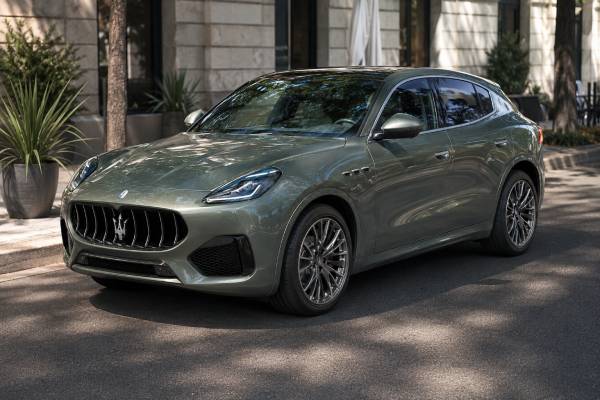
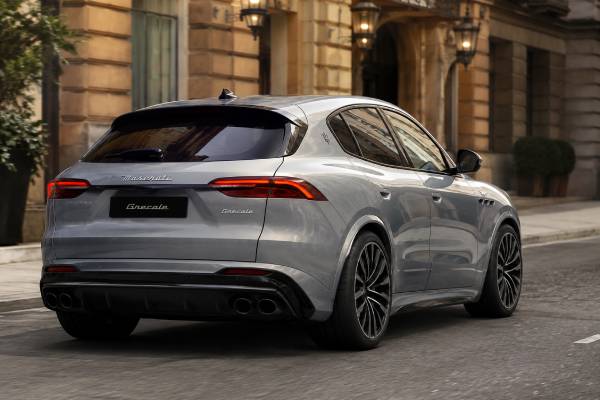
The 2027 Maserati Grecale V6 brings a 390 hp version of the Nettuno-derived 3.0-liter twin-turbo engine into the middle of the M182 SUV range. It fills the large gap between the 300 and 330 hp four-cylinder mild hybrids and the much more aggressive Trofeo V6. The 2027 range includes the Grecale V6 and Modena V6 as separate 390 hp petrol versions, although availability and naming vary by market. That distinction matters: “Grecale V6” is not merely a loose description for every six-cylinder Grecale, and it should not be confused with the 530 hp Trofeo. The new engine delivers 500 Nm, a 260 km/h top speed, and a 0–100 km/h time of about 5.1 seconds in broad range specifications, with some markets listing 4.9 seconds. More important than the raw number is the character change. The V6 gives the everyday Grecale stronger low-rpm force, a more natural performance sound, and a smoother climb to the limiter without pushing buyers into the Trofeo’s cost and intensity. Because the model is newly introduced for 2027, this guide focuses on validated specifications, engineering, early ownership priorities, and the practical checks that matter when ordering or buying one.
Table of Contents
- Why the Grecale V6 Matters
- Nettuno Engine and Chassis Data
- Versions, Markets, and Factory Options
- MY2027 Design and Engineering Changes
- V6 Driving Character and Performance
- New-Model Maintenance and Risk Areas
- Ordering and Buying Strategy
Why the Grecale V6 Matters
The 390 hp Grecale V6 matters because it restores a six-cylinder engine to a broadly usable, non-Trofeo position in the lineup. It gives buyers a more traditional Maserati powertrain without forcing them to choose the most expensive and performance-focused Grecale.
Maserati introduced Grecale in 2022 and began broad market sales shortly afterward. The compact luxury SUV was designed to sit below Levante and compete in a segment where daily practicality is essential. The original range used 300 and 330 hp four-cylinder mild hybrids, a 530 hp Trofeo V6, and later the electric Folgore. That structure left a major step between the four-cylinder Modena and Trofeo.
For model year 2027, Maserati refreshed the Grecale and added the 390 hp petrol V6 in two stated versions: Grecale V6 and Modena V6. The strategy is significant for three reasons.
First, it makes the Nettuno family available to buyers who care about engine character more than maximum acceleration. Second, it creates a closer link between the regular Grecale and Maserati’s current sports cars. Third, it provides a combustion-engine alternative for customers who do not want a mild hybrid or battery-electric SUV.
The 390 hp calibration is deliberately less extreme than Trofeo. It produces enough power for very rapid road use but aims for smooth torque, acoustic comfort, and everyday flexibility. The calibration provides generous torque at low engine speed and a progressive pull toward the limiter. At 2,000 rpm, the V6 offers a substantial torque advantage over the 2.0-liter engine, which should be more noticeable in overtaking and loaded driving than a simple horsepower comparison suggests.
The model also arrives during a broader brand update. Maserati used the centenary of the Trident logo to renew Grecale, GranTurismo, and GranCabrio. The Grecale received a lower, more horizontal front treatment, new interior contact points, revised controls, additional wheel designs, and upgraded driver-monitoring technology. The V6 therefore belongs to a revised model, not just an engine swap in an unchanged shell.
Current reputation is still being formed because customer cars are new. The early appeal is clear: a 390 hp twin-turbo V6, AWD, a conventional automatic, useful rear space, and more restrained styling than Trofeo. Long-term reliability and resale behavior cannot yet be judged with confidence, so buyers should place unusual weight on warranty, dealer support, and complete production records.
Nettuno Engine and Chassis Data
The Grecale V6 uses a 3.0-liter twin-turbocharged Nettuno-derived engine with patented pre-chamber combustion, 390 hp, and 500 Nm. It drives all four wheels through an eight-speed automatic and is listed with a 260 km/h maximum speed.
| Item | Specification |
|---|---|
| Model platform | M182 |
| Engine | Nettuno-derived twin-turbocharged V6 petrol engine |
| Displacement | Approximately 3.0 liters |
| Bore and stroke | 88 mm × 82 mm |
| Maximum power | 390 hp at approximately 6,500 rpm |
| Maximum torque | 500 Nm at approximately 2,000–3,750 rpm |
| Transmission | Eight-speed torque-converter automatic |
| Drivetrain | AWD |
| 0–100 km/h | Approximately 5.1 seconds; some market specifications list 4.9 seconds |
| Top speed | 260 km/h |
| Wheelbase | 2,901 mm |
The engine’s defining feature is Maserati Twin Combustion, the company’s pre-chamber ignition concept. A small chamber above the main combustion space helps initiate a faster, more controlled flame front under suitable operating conditions. A conventional spark plug remains part of the system for operating areas where normal ignition is more appropriate. The arrangement is intended to support high specific output, response, and combustion control.
Two turbochargers serve the V6. Twin-turbo packaging helps each bank receive fast boost response while allowing the engine to move a large mass of air at higher load. The 390 hp calibration is not simply a Trofeo engine with a lower software limit. Powertrain hardware, cooling, exhaust, control logic, and market emissions equipment should always be identified by the exact part number and VIN before assuming interchangeability.
The torque curve is central to the model’s purpose. Maximum torque begins around 2,000 rpm, so the engine should not need constant high-rev operation to feel strong. That broad delivery suits an SUV carrying passengers or luggage and makes the V6 useful in real traffic rather than impressive only during full-throttle acceleration.
The eight-speed automatic combines a torque converter with close intermediate ratios and tall cruising gears. It supports smooth low-speed maneuvering, fast kickdown, and relaxed motorway engine speed. Steering-wheel paddles provide manual control. Market material also describes rapid restart behavior for stop-and-go operation, but the exact start-stop calibration can differ by emissions specification.
All-wheel drive helps transfer 500 Nm without relying on the rear tires alone. The Grecale platform is designed to retain a rear-oriented feel, with the front axle contributing when acceleration, grip, or stability requires it. Exact differential hardware and control strategies may differ between Grecale V6, Modena V6, and Trofeo, so buyers should not assume all six-cylinder versions share identical dynamic equipment.
The chassis uses independent suspension and electrically assisted steering. Air suspension appears within the Grecale option and equipment structure, but its standard status depends on trim and market. Brake size, wheel width, tire specification, curb weight, and cargo capacity should be checked on the final order sheet because the new V6 versions may be homologated differently across countries.
European fuel figures show the cost of choosing the V6. Current Modena V6 material lists roughly 10.6–11.1 L/100 km combined and 243–253 g/km of CO₂, depending on configuration. The exact Grecale V6 figures may differ, but owners should expect materially higher fuel use and taxation than the four-cylinder mild hybrids.
Versions, Markets, and Factory Options
The 390 hp powertrain is announced for both Grecale V6 and Modena V6, but not every country will sell both names. Buyers must confirm the official local lineup rather than treating an international press release as a guarantee of availability.
The six-version global structure announced for the revised range includes:
- Grecale with 250 or 300 hp four-cylinder mild-hybrid power, depending on market.
- Modena with a 330 hp four-cylinder mild hybrid.
- Grecale V6 with the 390 hp petrol V6.
- Modena V6 with the same headline output and a higher trim position.
- Trofeo V6 with a much stronger Nettuno calibration.
- Folgore with battery-electric propulsion.
This makes the Grecale V6 a real factory category, not simply a shorthand for Modena V6. However, some live configurators currently show only the Modena V6, while other official material lists both. Launch timing, homologation, pricing, and stock can change by country.
How Grecale V6 and Modena V6 may differ
The basic engine output can be shared while the rest of the vehicle changes. Likely differences include exterior trim, grille treatment, wheels, upholstery, cabin materials, seat design, standard assistance systems, suspension equipment, brake presentation, and personalization access. The only safe comparison is between two local order guides for the same model year.
Do not identify the trim from a wheel design or badge alone. Wheels can be ordered separately, removed, or replaced. Confirm the complete build through:
- The VIN-linked factory equipment list.
- The sales contract and order code.
- The registration power rating.
- The exact market model name.
- The option and package codes.
- The conformity certificate.
Options with the greatest practical effect
A well-specified V6 should support its higher performance and price. Prioritize equipment that changes daily use:
- Air suspension or adaptive damping, where available.
- 360-degree cameras and comprehensive parking sensors.
- Adaptive cruise control and active-lane assistance.
- Head-up display.
- Heated, ventilated, and memory seating.
- Three-zone climate control.
- Premium Sonus faber audio.
- Panoramic roof.
- Moderate wheel sizes with suitable performance tires.
- A spare-wheel or mobility solution appropriate to local travel.
The revised Grecale offers new wheel designs, including 20-inch and 21-inch choices. Large wheels strengthen the visual effect but increase tire price and road-damage exposure. Drivers using the car daily on rough roads should weigh comfort and durability against appearance.
Fuoriserie expands paint, trim, badge, and interior possibilities. Personalization can create a desirable car, but unusual choices may reduce the resale audience. Factory documentation is essential because later wraps, painted badges, and retrimmed seats can resemble official work without carrying the same value.
MY2027 Design and Engineering Changes
The 2027 Grecale V6 is visually and functionally updated around the driver, with a lower-looking front end, revised controls, new digital details, and aerodynamic changes. These updates help distinguish it from the earlier M182 even when the body shell and 2,901 mm wheelbase remain familiar.
The nose uses a more horizontal and pronounced fascia. The “shark-nose” theme makes the vehicle appear wider and lower. Shaped side air curtains guide airflow along the wheel arches, while the grille and bumper treatment vary between combustion and electric versions. The revisions are not only decorative; cooling and aerodynamic management become more important with a 390 hp twin-turbo engine.
New wheel designs refresh the side view, and an additional Fuoriserie gray finish joins the palette. The broader Grecale shape remains recognizable through its long hood, three side vents, frameless glass, and muscular rear shoulders.
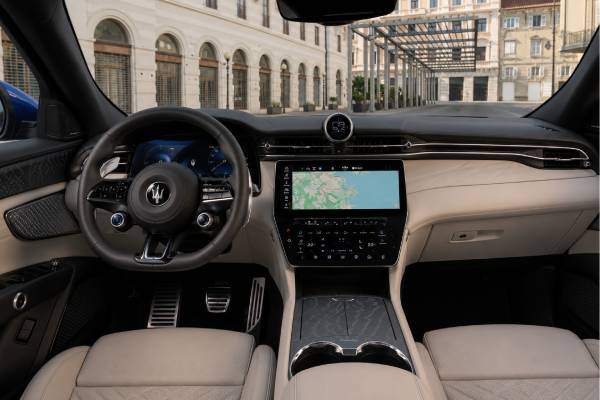
Inside, nearly every driver contact point has been reconsidered. The steering wheel gains an octagonal form and a six-o’clock spoke. Perforated leather is available, while more performance-focused material appears on selected trims. The digital clock receives a mineral-crystal face and metal bezel that visually connects with the steering wheel.
The PRND selector uses real metal controls, haptic operation, and integrated lighting. Revised paddle logic can allow low-speed switching between drive and reverse in supported configurations, with safeguards based on vehicle speed. This is a convenience feature rather than a substitute for deliberate gear selection; owners should learn the operation before using it in a tight parking space.
The digital interface combines a 12.3-inch central screen, an 8.8-inch comfort display, a configurable instrument cluster, and an available head-up display. A driver-monitoring system checks distraction and fatigue. Because more functions depend on cameras, software, and displays, correct calibration and stable battery voltage become as important as traditional switchgear quality.
Laminated glass and tailored sound design aim to keep the cabin refined while allowing the V6 to provide more character under load. The result should not be judged solely by exhaust volume. A true grand-touring setup must remain quiet enough at steady speed and avoid boom during long journeys.
The engine installation also changes the vehicle’s thermal and mass balance compared with a four-cylinder Grecale. Twin turbochargers, denser exhaust hardware, additional cooling demand, and a heavier powertrain influence underhood packaging. Owners should keep cooling inlets clear and insist on correct underbody panels after any repair.
V6 Driving Character and Performance
The 390 hp Grecale V6 is designed to feel stronger, smoother, and more expressive than the four-cylinder versions without adopting the Trofeo’s full intensity. Its defining road advantage should be effortless midrange acceleration, not launch-control spectacle.
From low engine speed, 500 Nm gives the automatic more flexibility. The gearbox can hold a higher ratio and still accelerate decisively, which reduces the busy feeling sometimes associated with smaller turbo engines. When the driver asks for full power, the V6 should continue building toward 6,500 rpm rather than delivering one strong midrange surge and fading.
The quoted 0–100 km/h figures vary between about 4.9 and 5.1 seconds. Differences can come from market calibration, launch method, tires, equipment, test standard, or later homologation. Either figure places the model well above the four-cylinder Grecale in subjective urgency, even if Trofeo remains much faster.
A 260 km/h top speed shows that the 390 hp engine is not merely a comfort option. Such speed is irrelevant on most public roads, but it indicates cooling capacity, gearing, tire approval, and high-speed stability requirements. Owners must use tires with the exact approved load and speed ratings.
The eight-speed automatic should make the V6 easy in traffic. In a relaxed mode, it will favor smooth shifts and lower revs. Sport mode should sharpen the accelerator, hold gears, and increase engine presence. Corsa remains associated with Trofeo, so a Grecale V6 buyer should not assume access to the same launch and stability-control functions.
Steering and chassis behavior depend on final trim and suspension. The M182 platform’s long wheelbase and rear-oriented AWD layout provide a solid foundation. The added engine mass may make front-end control more dependent on damper calibration and tire choice, but the V6’s stronger torque can also make the vehicle feel more settled because fewer downshifts are needed.
Air suspension, when fitted, broadens the vehicle’s role. A comfort-focused setting can isolate rough surfaces, while a lower and firmer mode controls body motion during faster driving. On steel springs or passive dampers, wheel size becomes even more influential.
Brakes should deliver a firm, progressive response with enough thermal capacity for repeated road use. Buyers who plan mountain driving should inspect pad and disc specifications, not just caliper color. Large wheels can expose impressive hardware but do not automatically mean a different brake package.
The Grecale V6’s ideal environment is a long, fast journey. It combines quick overtaking, stable motorway behavior, space for four adults, and a more distinctive engine note than the mild hybrids. In cities, its width, fuel use, and expensive wheels are greater compromises. On a circuit, Trofeo’s chassis, power, cooling, and drive modes remain the more appropriate tools.
New-Model Maintenance and Risk Areas
There is not yet enough real-world time to declare the 2027 Grecale V6 reliable or unreliable. The correct ownership approach is preventive: protect warranty coverage, follow VIN-specific service instructions, keep software current, and investigate small symptoms before they become expensive.
Engine and turbocharger care
Use only the approved oil grade and specification. The Nettuno combustion system, direct injection, twin turbochargers, and high output place heavy demands on lubrication. Time-based oil changes matter for cars driven short distances because fuel dilution and moisture may accumulate before the mileage limit is reached.
Allow the engine to reach normal temperature before sustained high load. After hard driving, finish with a calmer section so oil and coolant temperatures can stabilize. A persistent rattle, misfire, smoke, oil smell, coolant loss, or reduced-power warning requires diagnosis with Maserati-capable tools.
The cooling system deserves close attention. Twin-turbo heat load, charge cooling, air conditioning, transmission cooling, and tightly packaged bodywork rely on unobstructed heat exchangers and intact ducting. Front-end damage can affect shutters, sensors, brackets, or radiators behind an apparently minor bumper mark.
Transmission and AWD
The eight-speed automatic should engage quickly and shift consistently when cold and warm. Repeated delayed engagement, flare, vibration, or harshness is not something to accept without a documented explanation. Software adaptation can alter feel, but it cannot repair worn hardware.
Use four matching tires with similar tread depth. The correct rolling circumference protects AWD components and keeps stability-control calculations accurate. Check inner shoulder wear, wheel runout, and alignment after pothole impacts.
Electronics and software
The revised cabin adds haptic controls, driver monitoring, new display graphics, and more interconnected functions. Test all of them. A weak 12-volt battery can trigger many false or secondary warnings, while improper software updates can leave modules out of synchronization.
Key inspection points include:
- Infotainment and comfort-screen stability.
- Digital cluster and head-up display.
- PRND selector response and backlighting.
- Paddle-based parking logic where fitted.
- Cameras, radar, and driver-monitoring functions.
- Window indexing and frameless-glass sealing.
- Seat, roof, climate, tailgate, and audio operation.
- Both keys and connected-account transfer.
Air suspension adds compressors, air springs, valves, and height sensors. A vehicle that settles unevenly, changes height slowly, or runs the compressor repeatedly should be inspected. Brake, tire, and alignment costs will also exceed ordinary crossover expectations.
Early-production vehicles can receive software campaigns or revised parts. Keep every work order, even when the repair is performed free of charge. A complete history helps future technicians and supports resale.
Ordering and Buying Strategy
The Grecale V6 is the right choice for a buyer who wants Nettuno character and strong road performance in a less aggressive, potentially less expensive package than Trofeo. The buying decision should begin with local availability and exact equipment, because international model names cannot substitute for a signed order specification.
Ordering a new car
Ask the dealer to provide a dated configuration printout showing:
- Exact version name and market code.
- Engine output in hp and kW.
- Torque and performance figures.
- Suspension type.
- Brake and wheel specification.
- Standard and optional driver assistance.
- Interior material and seat functions.
- Warranty, service plan, and roadside coverage.
- Expected production date and model year.
Confirm whether the car is Grecale V6 or Modena V6. If both are available, compare total equipment rather than the base price. A modestly priced Grecale V6 can become expensive after adding cameras, audio, seats, wheels, roof, and assistance packages. A Modena V6 may bundle some of those items more efficiently.
Choose wheels for the roads you actually use. A 20-inch setup can be the intelligent choice for comfort and tire survival. A 21-inch wheel may suit smooth roads and visual priorities. Verify winter-wheel approval before ordering because large brakes and offsets can limit alternatives.
Do not rely on verbal statements about future software functions or connected services. Put promised equipment and subscriptions in writing. Confirm whether the quoted performance and emissions figures apply to the chosen wheel and option combination.
Buying an early used example
For a nearly new car, the most important documents are the factory build, warranty start date, service and campaign record, accident history, and proof that the connected account can transfer. Low mileage is useful only when battery health and storage conditions are good.
A specialist inspection should include a full diagnostic scan, battery tests, cold start, cooling-system check, paint-depth measurement, underbody review, tire and wheel measurements, brake assessment, and ADAS calibration verification. The inspector should confirm that all software modules report compatible versions.
Compare the V6 with three alternatives. The 330 hp Modena mild hybrid may be cheaper to tax and fuel. The Trofeo is much faster and more specialized. A lightly used Folgore may offer strong value where charging is easy. The 390 hp V6 wins when engine character, long-distance range, quick refueling, and balanced performance matter most.
The final recommendation is to buy carefully but not fear the new powertrain simply because long-term data are limited. Factory warranty and competent local support reduce early risk. The Grecale V6 has a clear role: it brings the sound, torque, and identity of a Maserati V6 to a practical SUV without demanding the full Trofeo experience.
References
- New Maserati GranTurismo, GranCabrio and Grecale 2026
- Maserati Grecale: 2027 Luxury SUV Versions & Specs | Maserati 2026
- Maserati Grecale 300 HP – Design & Features 2027 2026
- Maserati Grecale Modena – Version 2027 2026
- Maserati Owner Documentation 2026 (Owner’s Manual)
Disclaimer
This article is for informational purposes only and is not a substitute for professional diagnosis, maintenance, or repair. Specifications, torque values, intervals, equipment, performance, and procedures can vary by VIN, market, production date, and options. Verify all technical information against the vehicle’s official service documentation and consult a qualified Maserati technician. Please share this article on Facebook, X/Twitter, or another platform if it was helpful; sharing supports our work.