
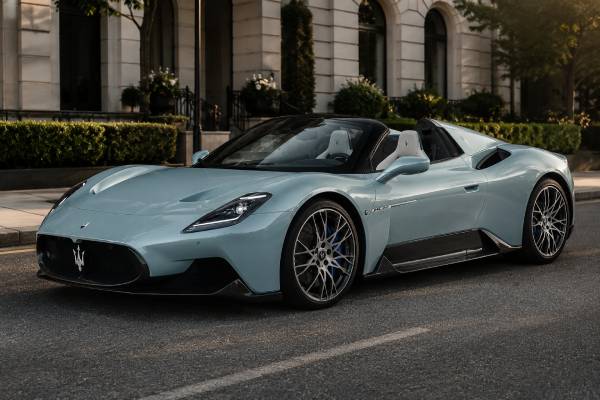
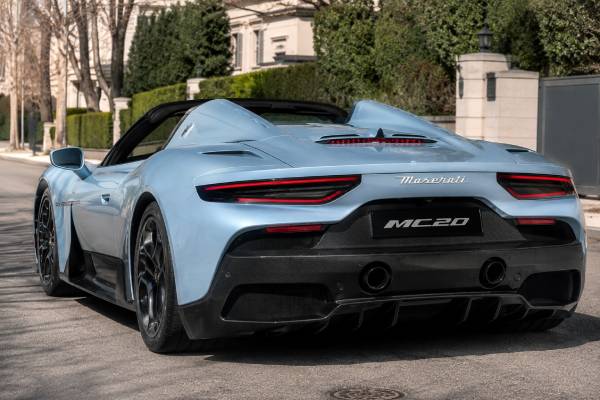
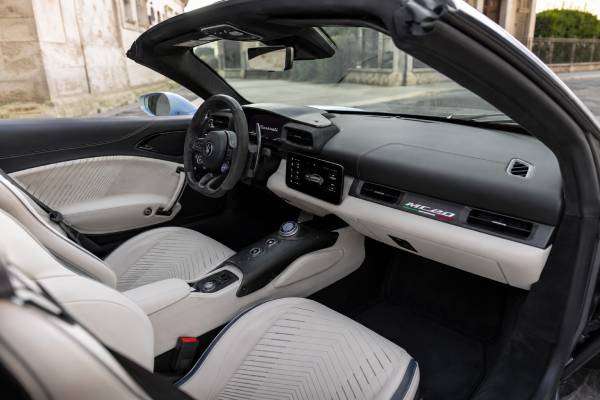
The Maserati MC20 Cielo PrimaSerie Launch Edition is the most collectible factory specification from the opening chapter of the Cielo story. Limited to 65 examples, it combines the open-top MC20’s carbon-fiber structure, 630-CV Nettuno V6, and electrochromic retractable glass roof with a tightly defined Acquamarina color theme that was not simply a normal option bundle. The value of the PrimaSerie lies in that combination: it is mechanically familiar to any MC20 Cielo specialist, yet visually specific enough that missing trim, repainted panels, substituted wheels, or incomplete documentation can materially affect desirability.
As a car, it remains a usable modern supercar rather than a static display piece. The eight-speed dual-clutch transmission, adaptive suspension, front-axle lift, digital controls, and compact dimensions make it less intimidating than its performance suggests. Ownership still demands discipline. Low battery voltage, software status, tire age, roof calibration, carbon-ceramic brake condition, recall completion, and evidence of correct servicing matter more than a low odometer alone.
Table of Contents
- Why the PrimaSerie Matters
- Nettuno Power and Cielo Hardware
- The 65-Car Launch Specification
- Acquamarina Design and Roof Engineering
- How the PrimaSerie Drives
- Ownership Risks and Service Priorities
- Buying an Authentic PrimaSerie
Why the PrimaSerie Matters
The PrimaSerie matters because it records the exact moment Maserati turned the MC20 coupe into a folding-hardtop spyder without abandoning the car’s central engineering idea. It was the launch edition for the MC20 Cielo, restricted to 65 cars and presented in a distinctive specification centered on Acquamarina three-layer paint, Ice-colored cabin materials, and Matte White Gold details.
MC20 means Maserati Corse 2020. The name linked the new super sports car to Maserati’s racing identity and to the year in which the brand opened a new product era. The Cielo suffix, Italian for “sky,” identified the open version revealed in 2022. Rather than remove the roof and accept the usual compromises, Maserati developed the carbon monocoque architecture from the outset to support coupe, open-top, and originally planned electric configurations. The Cielo therefore arrived as a deliberate member of the program, not an improvised conversion.
PrimaSerie translates roughly as “first series.” In this application, it was more than a badge placed on a regular production car. Maserati chose a launch palette intended to evoke sea light, sky, and the Trident’s connection to Neptune. The three-layer Acquamarina finish begins with a racing-inspired pastel gray base and adds iridescent aquamarine mica. Under weak light it can read as cool silver-gray; under direct sun the blue-green character becomes much stronger. That changeability is central to the car’s identity and difficult to reproduce convincingly after damage.
The edition also sits at an important point in Maserati history. The MC20 returned the company to an in-house-branded mid-engine halo car after the MC12 era, introduced the Nettuno engine, and became the foundation for the GT2 racing program, GT2 Stradale, MCXtrema, and later MCPURA family. The PrimaSerie is therefore connected to a much broader technical lineage than its decorative content suggests.
Collectors tend to care about four things:
The car’s reputation today is strongest when it remains complete. A perfectly preserved paint finish, original wheels, proper seat embroidery, correct badges, books, keys, charger, covers, and factory records can be more important than a modest difference in mileage. Unlike a normal MC20 Cielo, the PrimaSerie cannot be accurately judged by color name alone.
Nettuno Power and Cielo Hardware
Mechanically, the PrimaSerie uses the regular MC20 Cielo package: a rear-mid-mounted 3.0-liter twin-turbo V6, an eight-speed dual-clutch transmission, rear-wheel drive, and a carbon-fiber passenger cell. Its special-edition status changes appearance and equipment, not the basic 630-CV powertrain.
Core Maserati MC20 Cielo PrimaSerie specifications
| Item | Specification |
|---|---|
| Engine | 2,992 cc 90-degree twin-turbocharged V6 |
| Engine position | Longitudinal, rear-mid-mounted |
| Lubrication | Dry-sump system |
| Fuel system | Direct and port injection |
| Maximum output | 630 CV at 7,500 rpm |
| Maximum torque | 730 Nm from 3,000 rpm |
| Transmission | Eight-speed dual-clutch automatic |
| Drivetrain | Rear-wheel drive |
| Structure | Carbon-fiber monocoque with aluminum subframes |
| Suspension | Double wishbones with adaptive dampers |
| Wheels | 20-inch PrimaSerie design |
| Front tires | 245/35 ZR20 |
| Rear tires | 305/30 ZR20 |
| Wheelbase | 2,700 mm |
| Length | Approximately 4,669 mm |
| Width without mirrors | Approximately 1,965 mm |
| Fuel capacity | 60 liters |
| 0–100 km/h | About 3.0 seconds |
| 0–200 km/h | About 9.2 seconds |
| Top speed | More than 320 km/h |
The Nettuno engine is the technical centerpiece. Its most publicized feature is the Maserati Twin Combustion system, which uses a pre-chamber above the conventional combustion chamber, a second spark plug, and a dedicated passage arrangement to promote rapid, stable combustion under high load. The concept has roots in Formula One-style pre-chamber combustion, but the production engine also has to idle, meet emissions rules, restart in traffic, and tolerate normal road use.
Two turbochargers, electronic wastegates, dry-sump lubrication, and a compact 90-degree layout help the engine suit a low mid-engine chassis. Direct injection supports precise high-load fueling, while port injection helps in other operating conditions and can reduce deposit-related compromises. Output reaches 630 metric horsepower, commonly quoted as 621 hp in markets using mechanical horsepower.
The eight-speed dual-clutch gearbox is closely integrated with the drive modes. In GT it prioritizes smoothness and early upshifts. Sport keeps the engine more alert and sharpens shift behavior. Corsa gives the most aggressive calibration and permits launch control, while Wet softens responses for poor grip. ESC Off removes the final electronic safety layer and belongs in controlled conditions with an experienced driver.
The chassis uses double-wishbone suspension front and rear, with a virtual steering-axis arrangement intended to preserve tire contact and steering precision as the car loads up. Adaptive dampers change with the selected mode. Many cars have a hydraulic front lift, an important practical option because the low nose and carbon trim are vulnerable on ramps and speed humps.
Standard iron brakes are powerful, but many PrimaSerie examples are fitted with carbon-ceramic discs. Ceramic brakes reduce unsprung mass and resist repeated high-temperature use, yet replacement costs can be substantial. A visual inspection is not enough; a buyer should obtain measured disc condition and confirm there are no edge chips, deep scoring, impact marks, or signs of inappropriate pad material.
The 65-Car Launch Specification
The PrimaSerie is identified by a coordinated group of factory details, not merely by Acquamarina paint. A genuine car should present the edition-specific exterior, cabin, wheels, embroidery, and supporting documentation as one consistent package.
Key factory elements include:
- Acquamarina three-layer exterior paint.
- Matte White Gold Maserati lettering and emblems.
- A painted Trident on the rear tonneau cover.
- 20-inch wheels in iridescent Matte White Gold.
- Laser-marked PrimaSerie identification on the wheels.
- Ice Alcantara and leather seating surfaces.
- Acquamarina contrast stitching.
- Special seat-back treatment.
- PrimaSerie embroidery on the head restraints.
- Edition-specific presentation and ordering records.
Because only 65 were made, market-specific equipment can still vary. Driver-assistance features, audio equipment, lift system, brake type, exterior carbon packages, seat adjustment, and homologation details may differ by destination. “Limited edition” does not mean every vehicle left Modena with an identical option code sheet.
That distinction matters during authentication. A prospective buyer should separate three categories:
The production plate and vehicle identification number establish the underlying Cielo, but the build record is the strongest way to verify how the car was ordered. Ask a Maserati retailer or qualified specialist to print or confirm the factory equipment list. Photographs from delivery, original sales paperwork, correspondence, and the first service invoice can provide useful continuity.
Wheel condition deserves unusual attention. The pale gold finish is visually prominent and easy to damage during tire work. A wheel can be structurally sound yet lose collector value if it has been refinished in the wrong tone, gloss level, or metallic grain. Laser markings should remain crisp and consistent. Any repair should be documented by a specialist familiar with the original finish.
The same principle applies to the body. A color-matched repair may look acceptable indoors but diverge badly in sunlight because the Acquamarina effect depends on layer thickness, base tone, mica orientation, and clearcoat. Paint-depth readings on composite panels require interpretation; carbon panels do not always produce the same readings or repair clues as steel. Inspection under several light sources is more revealing than relying on a meter alone.
Acquamarina Design and Roof Engineering
The PrimaSerie’s defining visual feature is the contrast between a restrained body shape and a highly reactive finish. Its engineering centerpiece is the retractable electrochromic glass roof, which gives the Cielo a second experience even when the roof remains closed.
Maserati Centro Stile kept the MC20’s upper surfaces clean, placing major aerodynamic work under the car and around functional openings rather than covering the body with large wings. The nose uses low air intakes and a compact grille. Butterfly doors cut into the roof area and improve access across the wide sill. The rear body concentrates cooling outlets, flying surfaces, and exhaust openings around the mid-mounted engine.
The carbon monocoque is especially important in the Cielo. Removing a fixed roof normally reduces torsional stiffness, forcing engineers to add heavy bracing. The MC20 architecture was planned with open-body requirements in mind, so the Cielo’s weight increase was held to roughly 65 kg compared with the coupe. The result is a claimed dry weight around 1,540 kg, depending on specification and measurement convention.
The roof system uses polymer-dispersed liquid-crystal glass, often abbreviated PDLC. Electrical control changes the glass from opaque to transparent in about one second. This is separate from the mechanical opening sequence. A driver can therefore brighten the cabin while keeping the roof closed, or retract the hardtop into the rear compartment in roughly 12 seconds. Operation is permitted at low road speed, up to about 50 km/h.
That complexity creates several inspection points:
- The roof should complete repeated open and close cycles without hesitation, warning messages, asymmetric movement, or abnormal noise.
- The electrochromic panel should change evenly, without persistent cloudy zones or delayed sections.
- Side windows should perform their short drop and rise correctly when the butterfly doors open and close.
- Header, side, and rear seals should be clean, flexible, and free of compression damage.
- Drain paths should be clear, and the cabin should show no moisture odor or staining.
- The rear deck and painted tonneau Trident should align cleanly after roof operation.
The cabin is intentionally simple for a modern supercar. A digital instrument panel sits directly ahead of the driver, while a central touchscreen handles navigation, media, settings, and connected functions. The drive-mode selector occupies the center console. Carbon trim, Alcantara, and leather provide the visual drama; the PrimaSerie’s Ice and Acquamarina treatment makes the cockpit feel lighter than the darker standard combinations.
Visibility is reasonable forward but restricted rearward, especially with the roof closed. Parking cameras and sensors are therefore not trivial conveniences. Confirm every camera view, parking warning, mirror function, and driver-assistance feature during inspection. A software defect can be as disruptive as a mechanical one in a car whose controls and roof logic depend on networked modules.
How the PrimaSerie Drives
The PrimaSerie drives like a well-specified MC20 Cielo: extremely quick, light in its controls, stable at speed, and more compliant in GT mode than its carbon structure and supercar proportions suggest. The edition’s visual rarity does not make it dynamically fragile, but old tires or poor alignment can quickly undermine the intended balance.
Below 3,000 rpm, the Nettuno feels tractable rather than explosive. Boost builds strongly through the midrange, and the engine pulls with increasing urgency toward its upper rev range. The pre-chamber system is not something a driver can isolate as a distinct sensation; its value appears in the engine’s combination of output, response, emissions control, and road manners.
The dual-clutch gearbox behaves differently by mode. In traffic, GT mode can be smooth, though any automated clutch system may feel less natural at parking speed than a torque-converter automatic. Sport brings faster responses without turning every shift into an event. Corsa is best reserved for open roads or a circuit because throttle mapping, damper control, gearbox logic, and stability thresholds all become more intense.
Steering is quick and relatively light. The car changes direction with little delay, while the wide rear tires give strong traction once warm. Cold, old, or mismatched tires can make the rear axle feel abrupt. The MC20 platform depends heavily on correct tire specification, pressure, temperature, and alignment. All four tires should match the approved type unless a documented specialist setup is being evaluated for a specific purpose.
Ride quality is one of the Cielo’s strengths. GT mode allows enough compliance for normal roads, and the carbon tub does not automatically create a punishing experience. Short, sharp impacts still reach the cabin through low-profile tires and stiff suspension links. Sport and Corsa tighten body control, with Corsa best suited to smooth surfaces.
The roof changes the sensory experience more than the measured performance. Open, the driver hears more turbo rush, exhaust texture, tire noise, and surrounding traffic. Closed, the glass panel preserves a bright cabin while reducing buffeting and weather exposure. At high speed, the Cielo feels close to the coupe in structure, but the extra mass sits high enough that a sensitive driver may notice slightly softer responses during rapid transitions.
Braking feel depends on the installed system. Iron brakes tend to be easier to read at low temperature and cheaper to replace. Carbon-ceramics offer greater heat capacity and lower mass but can feel less consistent when cold, wet, or lightly used. Squeal does not automatically mean failure; cracks, chips, thickness, mass loss, pad condition, and vibration matter more.
For real-world use, the front lift is essential in many cities. The nose is low, the turning circle is not small, and the doors need vertical and lateral space. The car can tour, but luggage capacity is divided between small front and rear compartments. A careful owner plans routes, parking, tire support, and charging for the 12-volt battery rather than treating it like an ordinary grand tourer.
Ownership Risks and Service Priorities
The best PrimaSerie is not necessarily the lowest-mileage example; it is the car with stable electronics, complete campaigns, healthy consumables, careful roof use, and documented annual attention. Long storage without battery support can create more problems than regular, respectful driving.
Battery and electronic health
A modern Maserati supercar contains many control modules that expect stable voltage. A weak 12-volt battery can trigger warning lights, failed wake-up sequences, roof interruptions, window indexing problems, and communication faults that disappear after voltage is restored. The factory-style maintainer should be used during storage, and the battery’s age and test results should be recorded.
Do not accept “it only needs a drive” as a diagnosis. Scan every module, note stored and historic fault codes, verify software versions, and retest after a complete operating cycle. Confirm that recalls and rapid updates have been applied by VIN. Relevant MC20 and Cielo actions have included software, labeling, camera, door, and limited structural concerns in specific production groups.
Roof, doors, and seals
The roof and butterfly doors combine motors, latches, sensors, window modules, seals, and precise body alignment. Test them when the car is cold and after it has warmed. Listen for changes in motor speed. Inspect the A-pillar moldings and glass edges. Check that the short window drop occurs before the door clears the seal.
Water testing should be controlled, not improvised with a pressure washer. Look beneath carpets and around storage areas for moisture evidence. A roof adjustment may be straightforward for a trained dealer, but damaged painted panels, glass, or mechanisms can be costly and slow to source.
Powertrain and cooling
The Nettuno uses dry-sump lubrication, two turbochargers, high-pressure fuel systems, complex ignition, and tightly packaged cooling circuits. Review cold-start behavior, idle quality, fluid levels, hose condition, and any history of coolant odor or oil residue. Early MC20 service campaigns included checks involving breather and coolant-related components on affected cars, making VIN verification important.
The dual-clutch gearbox should engage drive and reverse promptly without harsh bangs, excessive delay, or persistent warnings. Low-speed clutch take-up should be assessed on level ground and an incline. Fluid services and software updates should match the official schedule for the car’s market and use.
Consumables and major cost drivers
Budget for time-sensitive parts even when mileage is low:
- Replace tires based on age, condition, and heat history, not tread depth alone.
- Measure carbon-ceramic discs and inspect pads before purchase.
- Check dampers, lift hydraulics, ball joints, bushings, and alignment.
- Confirm brake fluid service, engine oil service, filters, and scheduled spark-plug work.
- Inspect the underbody, front splitter, diffuser, wheel barrels, and jacking points for impact damage.
- Price insurance, paintwork, glass, wheel refinishing, and transport before committing.
Buying an Authentic PrimaSerie
Buy the most complete, correctly documented, and carefully inspected PrimaSerie you can find, even if it has modest road mileage. Rarity alone does not protect a neglected, repaired, or incomplete example from expensive ownership.
Begin with identity. Match the VIN on the body, glass records, invoices, registration, and diagnostic report. Obtain the factory build specification and verify the defining PrimaSerie content. Confirm that the car was originally Acquamarina rather than repainted to resemble the edition.
Next, evaluate condition in a fixed order:
- History and status. Review ownership, accident records, title status, import history, warranty, campaigns, and service chronology.
- Paint and carbon. Inspect in shade, sun, and artificial light. Check panel gaps, clearcoat texture, film edges, underside damage, and evidence of removed parts.
- Edition details. Verify wheel finish and laser markings, head-rest embroidery, seat materials, stitching, tonneau Trident, badges, plates, and accessories.
- Roof and doors. Perform several complete cycles and inspect seals, glass, drains, window indexing, and warning history.
- Diagnostics. Scan every module, record software levels, test battery condition, and investigate historic faults rather than clearing them.
- Chassis and brakes. Measure tires, alignment, brake wear, disc condition, ride height, lift operation, and suspension play.
- Road test. Start from cold, use all normal drive modes, check gearbox behavior at parking speed, listen for trim movement, and verify temperature stability.
A pre-purchase inspection should be performed by a Maserati dealer experienced with MC20 products or an independent specialist with factory-level diagnostic access. A generic exotic-car inspection may miss edition details, campaign status, roof calibration, or MC20-specific module faults.
Originality decisions should remain practical. Paint-protection film is sensible if installed without cutting into edges or lifting badges. A reversible exhaust may be acceptable if the original system accompanies the car and software remains standard. Non-original wheels, aggressive suspension settings, engine tuning, or altered emissions hardware create larger questions about warranty, driveline stress, legality, and future collectibility.
Market value depends on more than the “one of 65” claim. The strongest examples usually combine:
- Low to moderate mileage with regular use.
- Complete Maserati service history.
- No unresolved recalls or warning lights.
- Original PrimaSerie cosmetic components.
- Excellent Acquamarina paint and film condition.
- Fresh, matching approved tires.
- Measured brake condition.
- All books, keys, tools, charger, covers, and delivery items.
- A documented storage environment.
The weakest purchase is a car that appears cheap because deferred work has been hidden behind low mileage. Four old tires, damaged ceramic brakes, a weak battery, roof faults, refinished wheels, and incomplete paint history can erase the price advantage quickly.
For the right owner, the PrimaSerie offers a rare balance. It has a clear production story, a visually distinctive factory finish, modern road manners, and the full character of Maserati’s first open-top Nettuno supercar. Treat it as both a machine and a limited object: drive it enough to keep systems exercised, maintain it by time as well as distance, and preserve every piece that proves what it is.
References
- MC20 Cielo PrimaSerie Limited Edition | Maserati IN 2022
- New Maserati MC20 Cielo Global Premiere | Maserati | Stellantis Media 2022
- Maserati MC20 Cielo – Model Overview: Info, Performance, Design | Maserati 2025
- Vehicle Detail Search – 2023 MASERATI MC20 CIELO | NHTSA 2026 (Recall Database)
- MC20 Prepaid Maintenance programs | Maserati US 2025
Disclaimer
This article is for informational purposes and is not a substitute for professional diagnosis, inspection, or repair. Specifications, torque values, service intervals, campaign status, and procedures can vary by VIN, market, production date, and equipment. Verify all work against the vehicle’s official Maserati service documentation and current retailer information.
Please share this guide on Facebook, X/Twitter, or your preferred enthusiast community to support our work.