
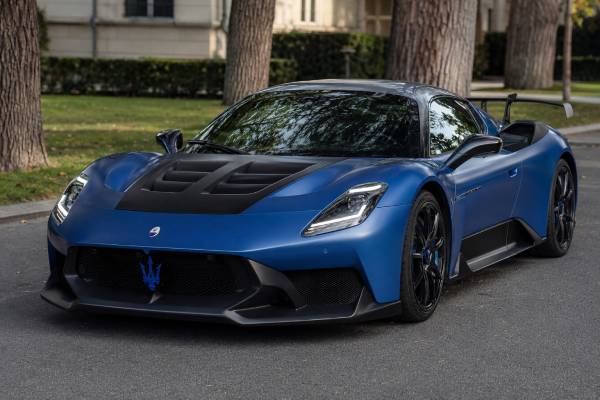
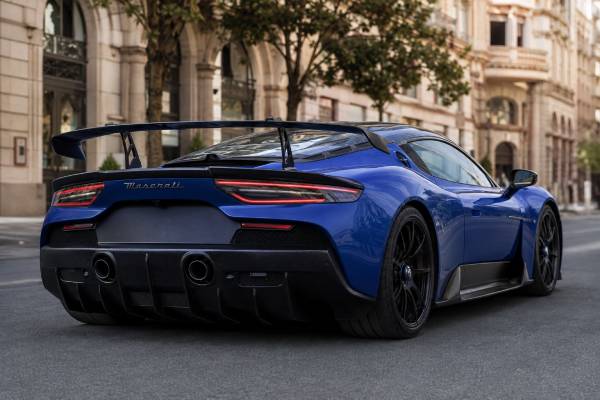
The Maserati GT2 Stradale is the road-legal bridge between the MC20 supercar and the Maserati GT2 competition car. Revealed at Monterey Car Week in August 2024, it raises the Nettuno V6 to 640 CV, removes approximately 60 kg compared with the MC20, adds a large fixed wing and extensive race-derived aerodynamic work, and accelerates from 0 to 100 km/h in about 2.8 seconds. Production began in Modena in December 2024 and is limited to 914 cars, commemorating Maserati’s founding in 1914; each carries a “1 of 914” badge on the central tunnel.
GT2 Stradale is not a stripped race car with license plates. It retains climate control, infotainment, cameras, road belts, driver aids, and usable GT calibration, while offering more focused seats, controls, suspension, brakes, cooling, and optional Corsa Evo capability. The combination creates unusual buying risks: center-lock wheels, carbon-ceramic brakes, adjustable aero, track use, low ground clearance, and possible track-only exhaust equipment require specialist assessment. This guide examines the model’s development, technical specification, limited production, design, driving experience, maintenance, and purchase requirements through the current 2026 model year.
Table of Contents
- From Maserati GT2 Racer to Stradale
- 640-CV Specifications, Weight, and Aero Load
- The 914-Car Series, Packages, and Options
- Competition Bodywork and Driver-Focused Cabin
- Road Comfort, Corsa Evo, and Track Performance
- Maintenance for a Road-Legal Track Car
- How to Buy a GT2 Stradale
From Maserati GT2 Racer to Stradale
GT2 Stradale was developed by transferring selected engineering and visual features from Maserati’s GT2 race car back to the MC20 road platform. It is road homologated, but its cooling, aero, mass reduction, seating, and controls are substantially more competition focused than those of the 630-CV MC20.
The sequence matters. MC20 introduced the carbon monocoque and Nettuno engine in 2020. Maserati then created the track-only GT2 to return to closed-wheel competition. That car achieved early victories and championships, giving the road project a real competition reference rather than a styling theme invented in isolation.
Maserati unveiled GT2 Stradale at The Quail during Monterey Car Week on August 16, 2024. Production began in December at the Viale Ciro Menotti plant in Modena. Customer road and track events followed in 2025, and the model remains current in 2026 alongside MCPURA.
“Stradale” means road. The word distinguishes the car from the race-only GT2, which has a roll cage, racing transmission controls, competition safety systems, and series-specific power balancing. The Stradale uses an eight-speed dual-clutch transaxle, road electronics, airbags, road lighting, climate control, and type approval.
Compared with MC20, output rises by 10 CV and mass falls by roughly 60 kg. Those changes alone do not explain the driving difference. Downforce, brake performance, cooling, tires, seats, control calibration, and optional track packages let the car maintain speed and consistency over repeated laps.
The body makes the relationship obvious. A deep splitter, hood extraction, wheel-arch vents, side aero, a fixed rear wing, and a large diffuser replace the MC20’s more discreet upper surfaces. The cabin also moves the drive-mode selector and uses racing-inspired seats and a GT2-style steering wheel.
The GT2 Stradale sits between two other Maseratis. MC20 and MCPURA offer cleaner styling and more relaxed road character, while MCXtrema is a non-road-legal circuit machine. GT2 Stradale is the choice for an owner who wants significant track ability without transporting a dedicated race car.
Its racing character should not be used to excuse poor care. The car is designed to withstand performance use when prepared correctly, but curb strikes, overheated brakes, incorrect center-lock service, old tires, and unrecorded aero changes can make a low-mileage example risky.
640-CV Specifications, Weight, and Aero Load
GT2 Stradale uses a 2,992 cc twin-turbo Nettuno V6 rated at 640 CV, driving the rear wheels through an eight-speed dual-clutch gearbox. Maserati quotes approximately 2.8 seconds to 100 km/h, more than 320 km/h maximum speed, and about 60 kg less mass than MC20.
| Specification | GT2 Stradale |
|---|---|
| Engine | 2,992 cc, 90-degree, twin-turbocharged V6 |
| Maximum power | 640 CV (471 kW; approximately 631 hp) |
| Torque | Approximately 730 Nm, depending on published market data |
| Transmission | Eight-speed dual-clutch transaxle |
| Drive | Rear-wheel drive with electronic limited-slip differential |
| Structure | Carbon-fiber monocoque with aluminum subframes |
| Claimed 0–100 km/h | Approximately 2.8 seconds |
| Claimed maximum speed | More than 320 km/h; commonly quoted near 324 km/h |
| Approximate dry weight | About 1,365 kg in a lightweight specification |
| Downforce | Up to approximately 500 kg at 280 km/h |
Nettuno retains its patented pre-chamber combustion system, twin spark plugs, direct and port fuel injection, dry-sump lubrication, and twin turbochargers. The 640-CV output is only a modest numerical increase, but calibration, cooling, exhaust, and reduced mass improve response and repeatability.
The dry sump controls oil under sustained lateral and braking loads. It also requires a precise level check using official temperature and running instructions. Track owners should log oil service and analyze abnormal consumption rather than topping up without diagnosis.
The dual-clutch transaxle provides road-friendly automatic operation and fast paddle shifts. The electronic differential and stability systems are calibrated for the additional grip and aero. Launch control produces the quickest acceleration, but repeated use raises clutch, transmission, differential, and tire temperatures.
The carbon monocoque remains the structural core. Lightweight body panels, reduced cabin mass, racing seats, carbon components, and other details contribute to the 60-kg reduction. Optional comfort equipment can change actual weight, so published dry figures are not directly comparable with curb weights measured with fuel and fluids.
Aerodynamic load is the more important change. Around 500 kg at 280 km/h is a high-speed figure, not a constant force at road pace. It depends on ride height, floor condition, wing position, splitter, vents, tires, and the complete aero balance. Missing underbody fasteners or incorrect wing adjustment can have consequences beyond appearance.
Braking is matched to repeated high-energy use, generally with carbon-ceramic discs and large calipers. Wheel and tire choices include track-oriented options and center-lock forged wheels on certain specifications. Every component must be serviced to its exact factory procedure.
The 914-Car Series, Packages, and Options
Maserati limited GT2 Stradale production to 914 units and placed a “1 of 914” badge on the central tunnel. The number celebrates the company’s 1914 founding rather than identifying each car as a unique sequential number unless separate documentation states otherwise.
The series began production in December 2024, so cars can be described as 2024 reveal models, 2025 customer cars, or later model-year examples. Build date, market model year, first registration, and warranty start should be recorded separately.
Standard and optional content varies by country. Common features include a carbon-fiber roof or engine cover, matte-carbon rear wing, carbon splitter and diffuser, GT2 hood, dark logos and exhaust tips, specific floor treatment, racing seats, Alcantara trim, a steering wheel with shift lights, a digital rearview mirror, and the numbered tunnel badge.
Performance packages may add Corsa Evo mode and more circuit-oriented hardware or calibration. Verify the exact package name and contents from the build sheet because online listings often combine equipment from different markets. Do not assume that every GT2 Stradale has center locks, the same seat size, or the same brake and tire specification.
Seat sizing is especially important. Lightweight shells can be offered with different pads or dimensions. A collector may prefer factory originality, but a driver must fit securely and comfortably. Replacement pads should be genuine or approved and kept with the car if changed.
Fuoriserie provides distinctive colors, stripes, exposed carbon, and cabin combinations. These can make two cars look unrelated even though both are among the 914. A factory one-off or rare color needs documentary proof; an aftermarket wrap is not equivalent.
Edizione Corse is a separate 16-car special series derived from GT2 Stradale. It adds commemorative racing content, a titanium exhaust and other specific equipment for selected markets. A normal car with similar accessories should not be advertised as Edizione Corse without factory confirmation.
Some exhaust options are intended only for track use. Maserati’s racing exhaust may be non-homologated for public roads, depending on market. Confirm which system is fitted, whether the original road exhaust is included, and whether software or valves were changed.
Original loose equipment can include keys, charger, cover, wheel tools, center-lock equipment, towing hardware, manuals, certificates, and removed road components. Inventory these at delivery and keep them labeled to the VIN.
Competition Bodywork and Driver-Focused Cabin
The GT2 Stradale body is shaped to manage cooling and downforce, while the cabin reduces distractions and places key controls closer to the driver. Both areas need inspection for track damage and unauthorized changes.
At the front, the deep splitter increases load and directs air toward the floor. Enlarged intakes feed radiators and brakes. Hood and fender vents relieve pressure and extract heat. Side openings guide air around the rear body and toward the powertrain.
The fixed wing and rear diffuser create rear stability. Wing supports, adjustment points, endplates, and fasteners should be intact. If settings are adjustable, use Maserati’s road or track positions as specified. An extreme angle may increase drag or upset balance when the front aero remains unchanged.
Carbon components can chip, crack, delaminate, or suffer crushed mounting points. Inspect the underside, not just visible weave. A repaired splitter may look perfect while its brackets are weak. Any curb or off-track incident should be documented with alignment and structural checks.
The carbon tub must be assessed separately from removable aero. Look at suspension pick-up points, aluminum subframes, floor, bonded joints, and jacking areas. Ordinary steel-body repair techniques are inappropriate. Ask for specialist measurements after any collision.
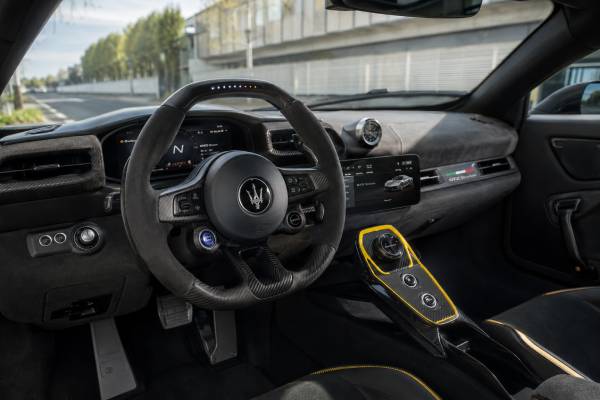
Inside, lightweight racing seats lower mass and hold occupants during lateral acceleration. Alcantara improves grip, and the steering wheel may include carbon sections and shift lights. The drive selector is anodized and repositioned on the tunnel, with yellow technical markings in some specifications.
A 10.25-inch digital cluster and central touchscreen retain navigation, connectivity, performance pages, and camera views. Climate control, wireless charging, keyless operation, and driver aids can remain available. The digital rearview mirror helps compensate for the fixed wing and reduced rear visibility.
Inspect seat shells, mounts, pads, harness provisions, road belts, airbags, steering-wheel controls, paddles, displays, cameras, audio, and climate operation. Track use can wear seat bolsters and Alcantara quickly. Improper harness installation can compromise safety.
Technical floor stickers and exposed carbon are vulnerable to abrasion. Replacement pieces should match the build. Drill holes, added cages, fire systems, data equipment, or harness bars may indicate serious circuit use and require engineering review.
Road Comfort, Corsa Evo, and Track Performance
GT2 Stradale can travel on public roads, but its steering, aero, seat support, noise, and low clearance make it more intense than MC20. The available drive modes allow a progression from wet-weather security to Corsa Evo track calibration.
In GT mode, the gearbox can shift automatically and the dampers use their least aggressive setting. Low-speed clutch engagement should be controlled. The car will still transmit more tire and road noise, and the fixed wing limits conventional rear vision.
Wet mode is valuable with cold or damp tires. The rear axle handles 640 CV, and track-oriented rubber can offer poor grip below its operating range. Electronic aids reduce risk but cannot compensate for aquaplaning or old tires.
Sport sharpens powertrain and damper response. Corsa allows faster shifts and greater slip. Corsa Evo, where fitted through a performance package, adds a more advanced circuit setting. The driver should understand each system before reducing intervention.
Acceleration is immediate once boost builds. The quoted 2.8-second sprint should be treated as a laboratory-style capability, not a routine road test. Public-road speeds arrive too quickly for repeated full-throttle operation to be useful or legal.
At circuit speed, aerodynamic load improves stability and tire use. The effect grows rapidly with speed, so setup matters more than on a low-downforce road car. Ride height, rake, wing position, tire pressure, alignment, and floor integrity should be recorded.
Carbon-ceramic brakes provide repeated stopping when warm and properly maintained. Build temperature gradually, use a cool-down lap, and inspect afterward. Gravel or tool impacts can damage discs. Fluid boiling, pad taper, or cracks demand immediate attention.
Center-lock wheels require visual checks between sessions and full torque service using factory procedure. Tire pressure should be adjusted for hot targets rather than guessed from road values. Log heat cycles and replace tires that have hardened even if tread remains.
Road comfort is acceptable for the mission, but long journeys require planning. The cabin is tight, luggage space is limited, the front splitter is vulnerable, and a loud track exhaust may be tiring or illegal. The model works best when road travel leads to a suitable driving environment.
Maintenance for a Road-Legal Track Car
GT2 Stradale maintenance combines the time-based road schedule with inspections tied to track sessions, heat cycles, and component hours. Oil, brakes, tires, center locks, aero fasteners, and diagnostic data should be documented after performance use.
Follow the VIN-specific Maserati service plan for oil, filters, spark plugs, belts, gearbox service, diagnostics, and inspections. Track use can justify earlier fluid and filter changes even when the odometer is low. Keep event and service logs together.
Check the dry-sump oil exactly as directed. Inspect for seepage at turbo lines, breathers, external tank connections, and underbody plumbing. Analyze unexplained oil use or smoke before returning to the circuit.
The dual-clutch gearbox and differential should be scanned for over-temperature events, adaptation concerns, and stored faults. Fluid procedures require correct equipment and temperatures. Do not accept repeated software resets as a repair for harsh engagement.
Brakes need frequent pad, disc, fluid, and cooling inspection. Record disc condition and pad thickness. Use protective wheel-removal methods around ceramic rotors. Replace questionable parts before a track day rather than trying to finish one more session.
Center-lock wheel service must use calibrated tools and the official direction, torque, lubrication state, and locking method. A conventional workshop may not understand the system. Preserve the correct socket and emergency instructions.
Inspect splitter, wing, diffuser, hood vents, floor panels, and mounting hardware. High downforce loads can enlarge small cracks. Replace missing fasteners with the correct specification rather than generic hardware.
Tires should be logged for date, miles, sessions, heat cycles, pressures, and repairs. Check inner shoulders after aggressive alignment. Flat spots can develop during storage, and track rubber pickup can hide cuts.
Battery voltage affects all modules. Use an approved maintainer, test capacity, and save diagnostic reports before clearing faults. Low voltage can create warnings in the transmission, differential, dampers, cameras, and engine management.
If a track exhaust is used, inspect heat shields, sensors, valves, and nearby carbon. Keep the road-homologated system and installation records. Confirm circuit noise limits before attending.
How to Buy a GT2 Stradale
A GT2 Stradale purchase should be based on factory specification, structural integrity, track documentation, consumable condition, and correct setup. A low odometer is less important than evidence of competent preparation and care. Because production spans the 2024 reveal and later customer model years, buyers should compare the VIN-specific build sheet with the actual hardware rather than relying on a registration description. Track use is acceptable when documented; unexplained setup changes, missing road parts, or erased data are not.
Request the VIN, build sheet, original invoice, service records, campaign status, track log, tire and brake data, alignment sheets, diagnostic reports, and all repair disclosures. Confirm the car is one of 914 and identify its packages, seat size, wheels, brakes, exhaust, and market status.
Inspect the carbon monocoque and aluminum subframes on an appropriate lift. Check suspension pick-up points, floor, jacking areas, splitter, diffuser, wing mounts, hood, and wheel-arch vents. Ask for photographs and measurements after any incident.
Examine center-lock wheels, nuts, sockets, and torque records. Look for bent rims, cracks, excess balancing weight, or refinishing that hides heat or impact damage. Verify tire model, date, homologation, pressure history, and heat cycles.
Have carbon-ceramic brakes assessed by a specialist. Replacement cost can dominate a purchase. Inspect pads, discs, cooling ducts, fluid, and calipers. Do not rely on an electronic percentage without physical confirmation.
Start the engine cold and scan all modules. Test gearbox engagement, steering, differential, drive modes, dampers, lift, cameras, digital mirror, climate, infotainment, seats, lights, and both keys. Repeat the scan after driving.
The road test should include slow maneuvering, smooth shifts, moderate boost, progressive braking, and several surfaces. A maximum-performance run is unnecessary. Watch for vibration, pull, warning lights, overheating, clutch shudder, or unusual aero noise.
Confirm that the wing and suspension are in an approved road setting. Ask who performed alignment and corner weighting. Undocumented setup changes can make the car difficult to drive and may accelerate tire wear.
Check exhaust legality and original parts. A non-homologated racing system may prevent registration, insurance coverage, or circuit access. Engine tunes and emissions changes require particular caution.
Inventory the numbered badge, books, keys, charger, covers, tools, original wheels or exhaust, and Fuoriserie documentation. For an Edizione Corse claim, obtain separate factory confirmation.
Finally, budget for specialist transport, insurance, annual service, tires, brakes, track preparation, and post-event inspection. The right car is one whose racing capability is supported by disciplined records rather than marketing language.
References
- Maserati GT2 Stradale. World premiere of new super sports car at Monterey Car Week 2024 | Maserati | Stellantis Media (2024, official launch)
- Maserati GT2 Stradale – Racing Is Life | Maserati (accessed 2026, official model overview)
- GT2 Stradale debuts on the road | Maserati BG (2025, official production and 914-unit limit)
- Maserati GT2: vettura da corsa omologata classe FIA GT2 | Maserati IT (accessed 2026, official competition-car background)
- Maserati Owner Documentation (accessed 2026, official manuals)
Disclaimer
This article is for general informational and educational use and is not a substitute for professional diagnosis, repair, race preparation, structural inspection, or legal advice. Specifications, torque values, service intervals, procedures, software, exhaust approval, and equipment can vary by VIN, market, production date, and installed packages. Verify all road and track work with current official Maserati documentation and qualified specialists. Share this guide with other GT2 Stradale owners and buyers who may find it useful.