
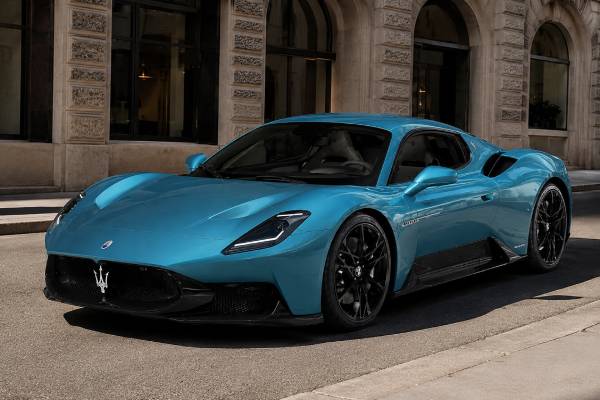
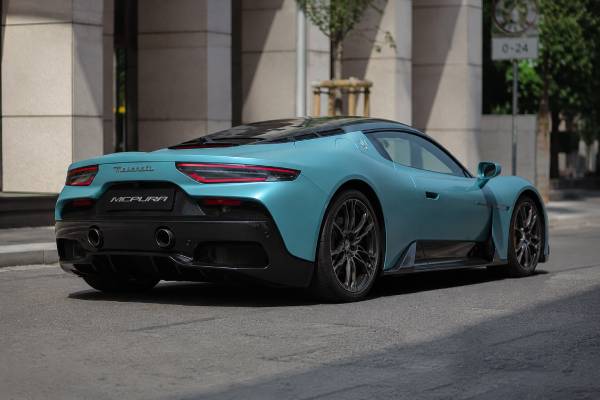
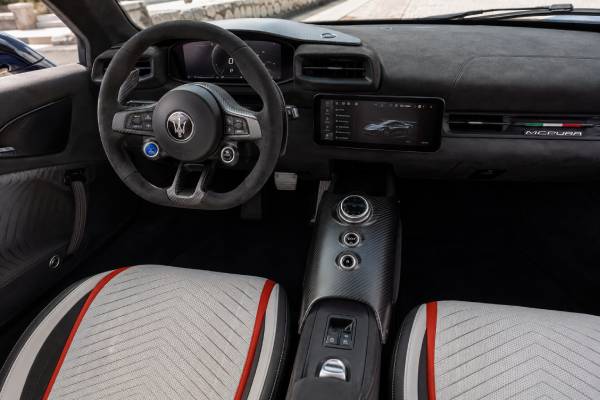
The Maserati MCPURA is the 2025 evolution of the MC20 coupe, retaining its carbon-fiber monocoque, butterfly doors, mid-mounted Nettuno V6, eight-speed dual-clutch transmission, and rear-wheel-drive layout while updating design, materials, controls, and personalization. Revealed at the 2025 Goodwood Festival of Speed, it uses a revised shark-nose front, a new lower fascia and rear treatment influenced by GT2 Stradale, an available larger spoiler, a more Alcantara-rich cabin, and a redesigned GT2-inspired steering wheel. Maserati quotes 630 CV, 720 Nm in current launch material, a weight below 1,500 kg, and a power-to-weight ratio of 2.33 kg per CV.
MCPURA should be understood as a refined continuation rather than a clean-sheet replacement. That continuity helps owners because the major structural and drivetrain principles are proven across the MC20 family, but it also carries forward the need for specialist carbon inspection, dry-sump service, dual-clutch diagnostics, battery management, and correct tire and brake care. New fascias, colors, Alcantara finishes, optional aero, and Fuoriserie content add their own repair and authentication concerns. This guide covers the model’s origin, specifications, production choices, engineering changes, performance, maintenance, and purchase checks for 2025 and 2026 cars.
Table of Contents
- How MC20 Evolved into MCPURA
- Nettuno Power, Carbon Structure, and Specs
- Model Years, Colors, Options, and Fuoriserie
- Shark Nose, Aero, and Alcantara Cockpit
- Driving Modes, Performance, and Daily Use
- Service, Reliability, and New-Model Care
- Buying and Configuring an MCPURA
How MC20 Evolved into MCPURA
MCPURA is the updated form of the MC20 halo car, introduced in July 2025 with changes concentrated on exterior design, interior materials, controls, and personalization. The carbon tub and 630-CV Nettuno concept remain central, so the model represents evolution rather than a new mechanical generation.
MC20 began Maserati’s modern supercar era in 2020. It established the mid-engine layout, clean upper body, technical underfloor, carbon-fiber monocoque, and patented pre-chamber V6. Cielo followed in 2022, while the GT2 race car and GT2 Stradale later demonstrated how far the platform could move toward circuit use.
MCPURA takes selected visual lessons from that racing development without becoming another GT2 Stradale. The front bumper is more assertive, the traditional Maserati “shark nose” is emphasized, lower surfaces are reshaped, and the rear bumper draws inspiration from the road-going GT2 derivative. An oversized spoiler is optional rather than mandatory.
The name joins “MC,” Maserati Corse, with “PURA,” Italian for pure. Maserati’s launch campaign expressed the idea as E = MC to the power of PURA. The marketing language points to a more concentrated version of the original MC20 values: speed, elegance, and direct connection.
The world premiere took place at Goodwood Festival of Speed on July 10, 2025. The coupe appeared in matte Ai Aqua Rainbow, a color that changes under sunlight through special pigments. The Cielo used the same concept in gloss. Magenta details with blue mica appeared on the Tridents and badges, and the launch seats used laser-etched Alcantara Ice.
Production continues at the historic Viale Ciro Menotti factory in Modena. Maserati builds the Nettuno engine there, assembles the car, and can complete Fuoriserie paint and personalization through the expanded Officine Maserati Fuoriserie facility. This makes factory documentation particularly important for unusual colors and one-off specifications.
The 2025 introduction leads into the 2026 model year in many markets. A car may therefore be described as a 2025 build, 2026 model, or 2026 registration. The VIN, build date, market paperwork, and warranty start should be recorded separately.
For collectors, MCPURA marks the transition from the “First of Its Kind” MC20 identity to a mature second phase. For drivers, the more useful question is whether the updates improve fit, feel, and specification without sacrificing the platform’s low mass and road usability.
Nettuno Power, Carbon Structure, and Specs
MCPURA uses a 2,992 cc, 90-degree twin-turbocharged Nettuno V6 with 630 CV at 7,500 rpm. Current launch material quotes 720 Nm from 3,000 rpm, while the engine remains paired with an eight-speed dual-clutch transaxle and rear-wheel drive.
| Specification | MCPURA Coupe |
|---|---|
| Engine | 2,992 cc, 90-degree, twin-turbo V6 |
| Bore and stroke | 88 mm × 82 mm |
| Compression ratio | 11:1 |
| Maximum power | 630 CV at 7,500 rpm |
| Maximum torque | 720 Nm from approximately 3,000 rpm in launch specification |
| Transmission | Eight-speed dual-clutch |
| Drive | Rear-wheel drive with electronic limited-slip differential |
| Structure | Carbon-fiber monocoque with composite body and aluminum subframes |
| Claimed weight | Below 1,500 kg; approximately 1,475 kg in European technical data |
| Power-to-weight ratio | Approximately 2.33 kg/CV |
| Front/rear tires | 245/35 R20 and 305/30 R20 |
Nettuno uses a small pre-chamber above each cylinder’s main combustion chamber. A dedicated spark plug ignites mixture there under suitable conditions, and flame jets pass through calibrated openings. A second spark plug supports operation when the pre-chamber is not required. Direct injection at up to 350 bar works with port injection to support power, emissions, and low-speed behavior.
Twin turbochargers use electronically controlled wastegates, and dry-sump lubrication maintains oil supply under high acceleration and cornering. The dry sump requires approved oil and the official temperature and running sequence for level measurement. Generalized advice from another Maserati V6 is not sufficient.
The eight-speed dual-clutch transmission provides automatic and manual paddle control. An electronic limited-slip differential manages rear-axle torque. Gearbox behavior, differential response, active exhaust operation, damper calibration, and stability thresholds change with the drive mode.
The carbon monocoque was developed with Dallara and produced by composite specialist TTA Adler. It forms the main safety cell and weighs roughly 100 kg in the platform’s original description. Aluminum subframes carry suspension, powertrain, and crash structures. Composite exterior panels provide shape and low mass.
The structure is strong but requires specialist repair. After a collision, inspect bonded areas, suspension mounts, windshield base, door openings, floors, jacking points, and subframes. Conventional paint measurements cannot fully assess carbon, and a smooth surface can conceal internal damage.
Double-wishbone suspension, adaptive dampers, large brakes, and staggered 20-inch tires continue. A front lift may be fitted. Brake hardware and carbon-ceramic availability depend on market and build. Use the individual configuration rather than assuming all MCPURAs share one setup.
The coupe’s luggage remains split between a small front compartment and a larger rear area, with approximately 50 and 100 liters respectively. The 60-liter fuel tank and compact cabin preserve the original MC20 packaging.
Model Years, Colors, Options, and Fuoriserie
MCPURA’s early 2025–2026 differences are likely to be driven by market launch timing, software, option packaging, colors, and Fuoriserie commissions rather than major mechanical change. Every car should be identified by its build sheet.
The standard palette starts with Grigio Incognito and expands through colors such as Blu Infinito, Winning Red, Giallo Genio, Verde Royale, Night Interaction, and Devil Orange, depending on market. Fuoriserie adds more than 30 possibilities across solid, metallic, multi-layer, and matte finishes.
Ai Aqua Rainbow is closely associated with the launch. Its blue base produces a prism-like rainbow effect in sunlight, and the coupe’s debut version used a matte finish. Magenta-with-blue-mica Tridents, wheel centers, and badges create a specific launch composition. A similar-looking custom car is not automatically the Goodwood specification.
The new Officine Maserati Fuoriserie operation in Modena allows paint and bespoke details to be integrated with production. Buyers of one-off or unusual cars should preserve the consultation record, color sample, digital render, invoice, build photographs, and factory confirmation. Those documents can matter more than a generic color name.
Lower-fascia finish can be gloss black, Hyper Dark Myron matte, or carbon fiber depending on equipment and market. The optional oversized rear spoiler changes appearance and aero. Wheel finishes, brake colors, exterior carbon, interior carbon, seat treatment, and assistance systems can further distinguish cars.
Inside, leather remains possible, but Alcantara is the main MCPURA material story. Dashboard, door panels, seats, and steering-wheel sections can use it. Laser-etched Trident graphics and contrasting seat backs appear in special configurations. Inspect the build sheet because photographs from the launch do not define every production car.
The GT2-inspired steering wheel may be ordered in different forms. A coupe-only option can add carbon upper and lower sections with LED shift indicators. Standard paddles are dark aluminum, while carbon paddles may come with an interior package.
Driver assistance, audio, cameras, lift, brakes, and comfort features vary by market. An apparently low-price car may lack expensive options, while a highly optioned car may carry greater repair exposure. The most valuable specification is coherent with intended use.
MCPURA Cielo is a separate body version with its retractable PDLC glass roof and additional weight. It should not be treated as a coupe option. GT2 Stradale remains the more track-focused 640-CV derivative rather than a performance package for MCPURA.
Shark Nose, Aero, and Alcantara Cockpit
MCPURA’s visible changes sharpen the MC20 shape without abandoning its clean-body philosophy. A more pronounced shark nose, revised lower fascia, new front and rear bumpers, reshaped side skirts, and optional larger spoiler update airflow and identity.
The front bumper takes inspiration from GT2 Stradale but reduces the race car’s aggression. Air intakes distribute flow toward radiators, floor channels, and upper surfaces. The lower fascia is completely revised and uses finish contrast to define the car’s edges.
The underbody retains the platform’s most important aerodynamic ideas. A central hump feeds vortex generators, channels behind the front wheels help create front load, side intakes support engine-bay flow, and the rear diffuser uses channels of different depths to manage pressure. Missing floor panels or incorrect fasteners can affect more than cosmetics.
An optional oversized rear spoiler brings a stronger GT2 influence. Confirm its factory origin, correct mounts, and approved configuration. An aftermarket wing may alter balance and can load composite panels incorrectly.
Butterfly doors remain the design’s most theatrical feature and also improve access over wide sills. Check hinges, struts, latches, seals, window indexing, and wiring. Doors should stay raised and close cleanly. Uneven gaps can indicate adjustment or structural work.
The cabin’s most important change is material use. Alcantara covers more of the seats, dashboard, doors, and steering wheel, giving improved grip and reduced reflections. It is lighter than leather but requires compatible cleaning. Aggressive brushing can mat the surface, and skin oils can darken high-contact areas.
The steering wheel has a flat upper section for visibility and a shape influenced by GT2 Stradale. Start and launch-control buttons sit in the central area. Fixed column paddles remain large and easy to reach. Optional LED shift lights suit track use but add electronic and carbon components to inspect.
The central tunnel remains simple, with the watch-inspired drive-mode selector as its focal point. The dashboard retains dual 10.25-inch displays. Test navigation, connectivity, cameras, performance pages, audio, climate, and all steering controls.
Paint repair can be complicated by multi-layer and matte colors. View panels under several lighting conditions, inspect film edges, and document any refinishing. Composite panels need a repairer experienced with both material and exact Fuoriserie finish.
Driving Modes, Performance, and Daily Use
MCPURA retains the MC20’s combination of extreme acceleration and a usable GT setting. Five modes—Wet, GT, Sport, Corsa, and ESC Off—change engine response, gearbox strategy, exhaust valves, dampers, and electronic control.
GT is the default at start-up. It uses normal boost response, smoother shifts, softer damping, and conservative traction control. The exhaust valves remain quieter at lower engine speed. This mode is best for evaluating a used car’s clutch take-up, ride, and low-speed behavior.
Wet limits response and keeps all stability systems active. It is appropriate for rain, cold tires, dust, or unfamiliar roads. Rear-wheel drive and more than 700 Nm still require care; electronics cannot overcome standing water or aged rubber.
Sport increases accelerator sensitivity, shift urgency, and exhaust presence. Corsa requires a deliberate longer input on the selector and prepares the car for maximum performance, including launch control. ESC Off requires an even longer command and should be used only in a controlled setting.
The engine produces strong midrange acceleration and continues to its 7,500-rpm power peak. The exact 0–100 km/h and maximum-speed claims should be checked in the market specification, but performance remains in the original MC20’s sub-three-second, above-320-km/h class.
Steering is quick and the carbon tub gives the suspension a rigid base. A healthy car should track straight and respond consistently. Vibration, pull, a crooked wheel, or nervous braking can indicate tire, wheel, alignment, suspension, or repair problems.
Iron brakes may suit ordinary road use and reduce replacement cost. Carbon-ceramic brakes resist track heat and lower unsprung mass but need specialist assessment. Ask about circuit use and inspect pads, discs, fluid, and cooling accordingly.
The front lift is valuable for ramps and speed humps. It should raise evenly and lower fully without warnings. Underbody inspection remains necessary because the splitter and floor can contact obstacles even when the car is equipped with lift.
Daily use is possible through effective climate control, cameras, infotainment, and modest luggage space. The car remains wide, low, and attention-intensive. Heat near the rear luggage area, limited rear visibility, expensive tires, and delicate paint should shape travel plans.
Service, Reliability, and New-Model Care
MCPURA service follows the MC20 platform’s core requirements, but early production cars need especially careful software, campaign, and build-quality documentation. Time-based maintenance applies even when mileage is low.
Use the VIN-specific Maserati schedule for engine oil and filter, air and cabin filters, spark plugs, belts, gearbox filters, brake fluid, inspections, and diagnostics. Market programs differ, and early manuals may be updated. Retain digital and printed service evidence.
The dry-sump engine needs the exact lubricant and measurement process. Inspect turbo connections, breathers, coolant lines, reservoirs, and underbody plumbing for residue or repeated top-up. Smoke, misfire, unusual oil use, or temperature changes should be investigated promptly.
The dual-clutch transmission should engage cleanly and shift consistently. Diagnostic data can identify adaptation, temperature, or software concerns. Reprogramming may be legitimate on a new model, but the work order should state why it was performed and what version was installed.
Battery health is essential. A weak 12-volt battery can create faults across doors, windows, cameras, infotainment, dampers, differential, transmission, and engine controls. Use an approved maintainer in storage and test actual capacity.
Check recalls and service campaigns through Maserati by VIN. As a current model, MCPURA coverage can change after publication. Public databases may lag or differ by country. Keep written proof of every completed action.
Tires should match in model, specification, and age. Inspect inner shoulders and date codes. Low-mileage cars can develop flat spots or hardening. Alignment should be measured after impact, abnormal wear, or transport damage.
Alcantara requires gentle vacuuming and compatible cleaning. Matte or multi-layer paint should not be polished conventionally. Photograph the car before paint-protection film, and use an installer familiar with sharp lower-fascia and butterfly-door edges.
Inspect the optional spoiler, floor, diffuser, splitter, and fasteners at service. Carbon and composite damage may begin as a small chip. Check door struts, seals, window indexing, lift operation, climate performance, and cameras at the same time.
Store the car dry, ventilated, and connected to a suitable maintainer. Avoid repeated short starts. A proper drive that warms oil, coolant, gearbox, and brakes is more useful when conditions allow.
Buying and Configuring an MCPURA
A new or used MCPURA should be chosen by intended use, verified build content, finish repairability, service access, and total ownership cost. Factory personalization is valuable only when it remains documented and practical to maintain.
For a new order, decide first between road touring, occasional track use, and collection. Iron brakes, comfort-oriented seats, lift, cameras, and a durable gloss color may be ideal for road mileage. Carbon-ceramics, lightweight seats, LED steering wheel, exterior carbon, and spoiler may suit a more performance-focused car.
Try the seat and steering-wheel configuration in person. Alcantara and shell seats can feel excellent during hard driving but restrictive on long trips. Confirm that available adjustment suits all intended drivers.
Choose paint with repair in mind. Ai Aqua Rainbow, matte finishes, and complex Fuoriserie colors are distinctive but require expert matching. Keep color samples and factory records. Protective film can help when installed correctly, but it should not hide delivery defects.
For an existing car, request the VIN, build sheet, original invoice, service records, campaign status, paint and film history, diagnostic reports, tire dates, and repair disclosure. Verify whether it is a 2025 build or 2026 market model and when warranty coverage began.
Inspect the carbon tub, subframes, suspension mounts, floor, jacking points, doors, splitter, lower fascia, diffuser, and spoiler. Any accident should have structural measurements and specialist repair documentation. Cosmetic panel replacement can still affect aero fit and color match.
Start cold and scan every control module. Test both keys, window indexing, lift, cameras, climate, infotainment, audio, seats, drive modes, dampers, differential, paddles, and optional shift lights. Repeat the scan after driving.
The road test should cover slow clutch engagement, automatic and manual shifts, moderate boost, steering on several surfaces, progressive braking, and full warm-up. The car should not pull, vibrate, overheat, hesitate, or display repeated warnings.
Price immediate consumables and specialist access. Tires, carbon-ceramic brakes, battery, annual service, paint correction, film, or a damaged composite panel can be expensive. Confirm that a qualified Maserati or independent specialist is available locally.
Avoid undocumented engine tunes, exhaust changes, suspension lowering, or aftermarket aero. They can affect warranty, emissions, cooling, balance, and insurance. Preserve original parts for any reversible change.
Complete the purchase with a written report and contract listing the VIN, specification, mileage, included accessories, repairs, and unresolved issues. The best MCPURA is not the most elaborate configuration; it is the one whose purpose, equipment, and maintenance plan fit the owner.
References
- Maserati MCPURA – Press Kit July 2025 | Maserati | Stellantis Media (2025, official technical and design information)
- Maserati MCPURA: the essence of performance debuts at Goodwood | Maserati | Stellantis Media (2025, official world premiere)
- Maserati MCPURA – Pure Coupé Energy | Maserati (accessed 2026, official model overview)
- Get to know your Maserati: Guides & references | Maserati UK (accessed 2026, official owner resources)
- Maserati Owner Documentation (accessed 2026, official manuals)
Disclaimer
This article is for general informational and educational use and is not a substitute for professional diagnosis, repair, structural inspection, or legal advice. Specifications, torque values, intervals, procedures, software, recalls, and equipment can vary by VIN, market, production date, and installed options. Verify all work and purchase decisions using current official Maserati service documentation and qualified specialists. Share this guide with other MCPURA owners and buyers who may find it useful.