
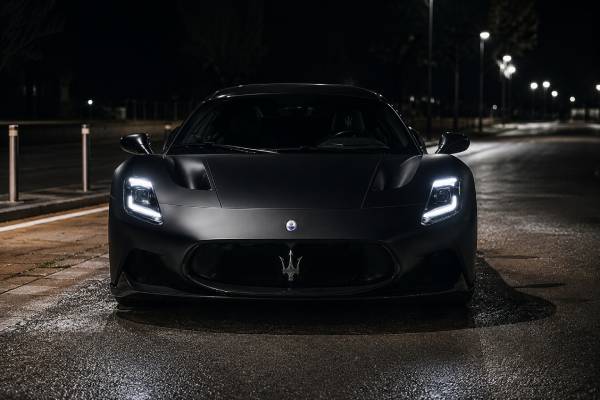
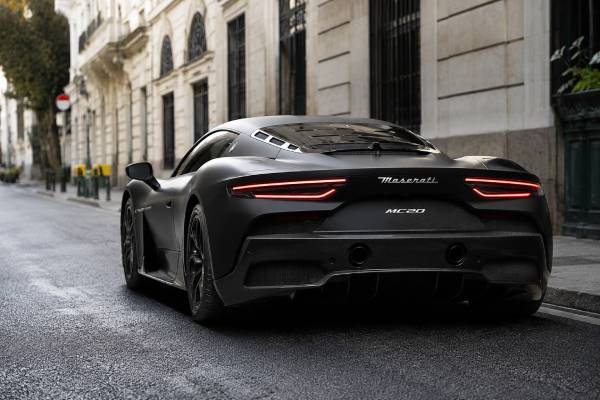
The Maserati MC20 Notte is a 50-car Fuoriserie limited edition that turns the standard coupe into a carefully coordinated study in black, carbon fiber, and Matte White Gold. Introduced in 2023, it was the first limited series based on the MC20 coupe and was created with input from Maserati test and racing driver Andrea Bertolini. Its appeal is not greater power or a different chassis tune. The Notte keeps the 630-CV Nettuno V6, carbon monocoque, eight-speed dual-clutch gearbox, and rear-wheel-drive layout of the regular MC20, then adds a factory design package that is easy to imitate superficially but difficult to reproduce correctly.
That distinction shapes the buying process. A genuine Notte should have the proper Nero Essenza Matte body, gloss-black roof, Matte White Gold identifiers, special Birdcage wheels, black brake calipers, black-and-gray Alcantara cabin, yellow stitching, and “UNA DI 50” plaque. Condition also matters more than odometer theater. Matte paint repairs, wheel refinishing, low-voltage faults, old tires, carbon-ceramic brake wear, software status, and incomplete campaign work can turn an apparently inexpensive example into an expensive project.
Table of Contents
- A Dark Milestone for the MC20
- The Performance Package Beneath the Livery
- Identifying the 50-Car Notte Series
- Fuoriserie Details With Racing Roots
- Road and Track Character After Dark
- Maintenance, Electronics, and Costly Consumables
- How to Buy the Right MC20 Notte
A Dark Milestone for the MC20
The MC20 Notte is important because it was the first numbered limited edition of the MC20 coupe, not because it changed the car’s output. Maserati produced 50 examples worldwide and used the project to show how its Fuoriserie personalization program could build a coherent collector model rather than a loose collection of options.
The underlying MC20 had already marked a major change for Maserati. Revealed in 2020, it returned the brand to a rear-mid-engine halo car and introduced the Nettuno V6, an engine designed and assembled in Modena. The carbon-fiber passenger cell, compact twin-turbo powertrain, butterfly doors, and clean bodywork gave Maserati a technical foundation that later supported the Cielo, GT2 racer, GT2 Stradale, MCXtrema, and MCPURA.
“Notte” means “night” in Italian. Maserati used the name literally and visually. The car’s body combines Nero Essenza Matte with a gloss-black roof, allowing highlights to move differently across the upper and lower surfaces. Matte White Gold replaces conventional silver on the Trident, scripts, wheel accents, and other identifiers. Black carbon-fiber aerodynamic pieces and dark exhaust outlets keep the lower body visually close to the road.
Andrea Bertolini’s involvement gives the edition a credible motorsport link. Bertolini worked as a Maserati reference driver and won at the highest level in the MC12 GT1 era. His contribution was directed at the bodywork’s visual treatment, not a secret engine calibration. The difference matters because advertisements sometimes imply that every named special edition has more power or a factory track tune. The Notte does not need that claim; its rarity and factory execution are the point.
- A confirmed production limit of 50 cars.
- Status as the first MC20 coupe limited series.
- A complete Fuoriserie exterior and interior treatment.
- A direct connection to Maserati’s modern halo-car program.
- Standard MC20 mechanicals that can be serviced through established factory procedures.
Today, the Notte occupies a useful place between a regular MC20 and more heavily altered derivatives. It is rarer and more identifiable than an individually configured car, yet it retains the standard coupe’s weight, aerodynamics, luggage layout, and road comfort. That makes it attractive to owners who want a collectible specification without the compromises of a track-focused homologation-style model.
The Performance Package Beneath the Livery
Every MC20 Notte uses the standard 630-CV MC20 powertrain and carbon chassis. There is no factory power increase, so buyers should be suspicious of listings that describe a unique Notte engine specification unless the car has documented aftermarket tuning.
Maserati MC20 Notte technical summary
| Component | Specification |
|---|---|
| Engine | 2,992 cc 90-degree twin-turbo V6 |
| Location | Rear-mid-mounted, longitudinal |
| Lubrication | Dry sump |
| Injection | Direct and port fuel injection |
| Output | 630 CV at 7,500 rpm |
| Torque | 730 Nm from 3,000 rpm |
| Transmission | Eight-speed dual-clutch |
| Driven wheels | Rear |
| Structure | Carbon-fiber monocoque, aluminum subframes |
| Suspension | Double wishbones front and rear, adaptive damping |
| Wheel size | 20 inches front and rear |
| Front tire size | 245/35 ZR20 |
| Rear tire size | 305/30 ZR20 |
| Wheelbase | 2,700 mm |
| Length | Approximately 4,669 mm |
| Width without mirrors | Approximately 1,965 mm |
| Dry weight | Less than 1,500 kg, depending on specification |
| 0–100 km/h | Less than 2.9 seconds |
| 0–200 km/h | Less than 8.8 seconds |
| Top speed | More than 325 km/h |
The Nettuno engine’s defining feature is its pre-chamber combustion system. A small chamber above each main combustion space houses a spark plug and communicates through calibrated openings. Under suitable conditions, ignition jets travel from the pre-chamber into the cylinder, promoting rapid combustion. A second conventional spark plug supports operation across the wider speed and load range required by a road car.
This system operates alongside two turbochargers, electronically controlled wastegates, a dry-sump oil circuit, and dual injection. The dry sump helps maintain oil supply during sustained cornering while allowing the engine to sit low in the chassis. Direct injection provides precise fuel delivery under high load; port injectors broaden operating flexibility and help manage emissions and deposits.
Power reaches the rear wheels through an eight-speed dual-clutch transmission. The gearbox preselects the next ratio on a second shaft, allowing rapid shifts when commanded. At parking speeds it still has to slip clutches, so a slight mechanical feel is normal. Persistent shudder, delayed engagement, overheating warnings, or harsh selection are not.
The car’s drive modes change more than throttle sensitivity:
- Wet reduces aggression and supports traction on low-grip surfaces.
- GT is the default road setting, with softer damping and calmer gearbox logic.
- Sport sharpens response and holds gears longer.
- Corsa brings the most aggressive powertrain and chassis calibration and enables launch control.
- ESC Off removes stability intervention and should be used only in controlled conditions.
The carbon monocoque weighs roughly 100 kg and provides the stiff central structure. Aluminum subframes carry suspension and powertrain loads. Double-wishbone geometry at both ends, including a virtual steering-axis concept at the front, helps the tires maintain a useful contact patch while controlling steering reactions.
Brake equipment varies. Iron discs provide strong road performance and lower replacement cost. Optional carbon-ceramic discs reduce unsprung mass and withstand repeated high heat, but they require careful measurement during purchase. The Notte’s black calipers are part of the visual specification regardless of brake material, so caliper color alone does not identify ceramic brakes.
Identifying the 50-Car Notte Series
A genuine Notte is identified by the full factory package and its build record, not by black paint and a plaque alone. The safest authentication method combines a Maserati build-sheet check with a physical inspection of every edition-specific detail.
The defining exterior specification includes Nero Essenza Matte bodywork, a gloss-black roof, exposed or dark carbon-fiber trim, Matte White Gold scripts and Trident emblems, 20-inch matte-black Birdcage wheels with Matte White Gold accents, black brake calipers, and dark exhaust outlets. The contrast between matte body and glossy roof should be deliberate and clean, not the result of a wrap applied to a normal MC20.
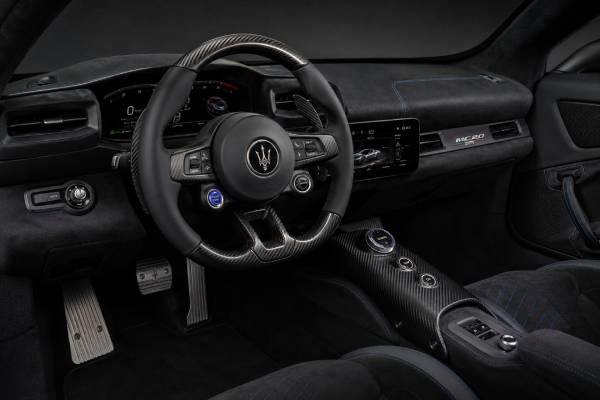
Inside, the Notte uses six-way power sport seats in black and gray Alcantara with yellow stitching. Tridents are embroidered into the head restraints. The steering wheel combines Alcantara and carbon-fiber inserts, while carbon appears on the shift paddles and other driver-facing elements. A dedicated metal plaque between the seats carries the edition identity and “UNA DI 50,” meaning “one of 50.”
A complete inspection should verify:
- Factory confirmation that the VIN was built as an MC20 Notte.
- Correct exterior paint code and finish description.
- Gloss-black roof rather than matte or body-color paint.
- Matte White Gold badges and lettering with consistent tone.
- Correct Birdcage wheel design, finish, and accent color.
- Black brake calipers without evidence of repainting.
- Black-and-gray Alcantara seat treatment.
- Yellow stitching and embroidered head-rest Tridents.
- Alcantara steering wheel with carbon details.
- Original “UNA DI 50” plaque and secure mounting.
- Books, keys, charger, tool kit, cover, and market-specific delivery items.
Matte paint is the largest cosmetic risk. Conventional polishing can create glossy patches that cannot be blended away easily. Body-shop sanding, local clearcoat repairs, aggressive cleaning chemicals, and poorly removed vinyl can change texture. Inspect the car under broad daylight and low-angle artificial light. Look for differences in sheen across panels, halos around repaired chips, hard masking lines, polish marks, and mismatched texture near edges.
Paint-protection film can be valuable on a matte car, but the film itself must match the intended sheen. Gloss film over Nero Essenza Matte changes the design; matte film with uneven edges or contamination can also look poor. Ask when it was installed, whether badges and trim were removed, what cutting method was used, and whether any paint repair occurred first.
Wheels are similarly sensitive. Matte-black surfaces and pale gold accents can be damaged by careless tire equipment or acidic cleaners. Refinishing must preserve the original color separation and surface texture. Inspect inner barrels for bends, cracks, welds, and impact marks; cosmetic perfection on the face does not prove structural condition.
Fuoriserie Details With Racing Roots
The Notte succeeds because its design details reinforce the MC20’s function instead of covering it with unrelated decoration. The dark finish emphasizes the car’s cooling openings, carbon edges, and low proportions, while the gold accents reference competition trophies and historic Maserati identifiers.
Maserati Centro Stile designed the MC20 with a relatively clean upper body. Much of the aerodynamic work occurs beneath the car through managed underfloor airflow and a rear diffuser. The front splitter, side intakes, rear vents, and engine-cover openings remain functional elements. On the Notte, carbon-fiber pieces are visually easier to read against the matte body, especially around the sills and lower surfaces.
Butterfly doors are another signature feature. They reduce the distance a long conventional door would swing outward and improve access across the wide carbon sill, but they still need clear space above and beside the car. Their glass must perform a short drop before opening and return correctly after closing. Door alignment, latch operation, gas struts, seals, and window indexing are therefore part of both design appreciation and maintenance.
The cabin avoids the dense switchgear found in some luxury cars. A 10.25-inch digital instrument display, central touchscreen, compact center console, drive-mode rotary controller, and steering-wheel controls keep the main tasks close to the driver. The Notte’s gray and black textures remain subdued, while yellow stitching gives the eye a reference point without making the cabin bright.
Carbon-fiber trim is not all equal. Factory pieces should have consistent weave orientation, clearcoat depth, edges, and attachment. Inspect the splitter, diffuser, sill areas, mirror-related trim, steering-wheel inserts, paddles, and interior panels for chips, cloudy clearcoat, lifting, or prior repair. A small impact to a lower carbon part can become expensive if the component is unique, backordered, or tied to adjacent mounting hardware.
The standard exhaust is tuned to meet road regulations and varies in character by mode. Dark outlets suit the Notte theme. Aftermarket systems are common on supercars, but a collector-quality example should retain the original components even if a reversible system is installed. ECU or transmission software changes deserve more caution because they can affect warranty, emissions compliance, thermal load, driveline behavior, and future diagnostics.
The Notte’s sensory character is strongest at night, but that does not make it a different machine. The view down the low hood, reflections moving across the gloss roof, gold wheel highlights, and instrument lighting all reinforce the edition’s concept. Its design value comes from the completeness of that experience, which is why substituted parts or incorrect finishes matter disproportionately.
Road and Track Character After Dark
The MC20 Notte feels fast without feeling heavy-handed. Its light steering, strong midrange, compact cabin, and compliant GT mode make it approachable at normal speeds, while Corsa mode reveals how much performance remains beyond public-road use.
The Nettuno is tractable in town. Below boost, the engine responds cleanly and the dual-clutch gearbox can move through traffic without constant drama. The car is wide and low, however, and rear visibility is limited. Cameras, parking sensors, mirror adjustment, and the optional front lift are practical necessities rather than luxury extras.
Once the turbochargers build pressure, acceleration becomes forceful and sustained. The engine produces its strongest character from the middle of the rev range toward 7,500 rpm. It does not imitate a naturally aspirated V8 or V12; the sound includes induction, turbo, mechanical, and exhaust layers. The coupe body keeps the experience more contained than the Cielo, with less wind noise and slightly sharper structural response.
Steering effort is modest. The front axle reacts quickly, and the car places accurately when alignment and tires are correct. Some drivers expect a modern supercar to load the steering heavily as speed rises, but the MC20 favors ease and speed of response. Feedback arrives through small changes in effort, seat movement, tire noise, and the chassis rather than through constant kickback.
Ride quality is unexpectedly usable in GT mode. Adaptive dampers allow vertical movement over normal surfaces, though the short tire sidewalls still transmit sharp edges. Sport reduces body motion and makes the gearbox more alert. Corsa is most convincing on smooth roads or a circuit, where its firmer control and reduced intervention can be used safely.
Launch control can produce the claimed sub-2.9-second sprint to 100 km/h under suitable conditions. Tire temperature, surface preparation, fuel load, weather, and measurement method influence real results. Repeated launches add clutch and thermal stress, so a seller’s willingness to demonstrate them is not evidence of care.
The rear axle has substantial grip from 305-section tires. That grip depends on heat and compound condition. Old tires may look new but provide a narrow breakaway window, especially in cool or wet weather. Mixed brands, non-matching model lines, incorrect load ratings, or large date-code differences should be corrected before high-speed use.
On a track, brake and tire management matter more than the edition name. Carbon-ceramic brakes tolerate repeated heat well when healthy, but the driver still needs to warm tires progressively and monitor pressures. Stability systems in Sport or Corsa offer a useful safety net. ESC Off should not be treated as a status setting; a 630-CV rear-drive car can exceed the available grip quickly.
Maintenance, Electronics, and Costly Consumables
The MC20 Notte should be maintained as a complex modern supercar, not stored as if zero use prevents wear. Time, battery condition, software, fluids, seals, tires, and heat cycles all matter even when annual mileage is low.
Voltage and module behavior
Stable 12-volt power is fundamental. A weak battery can cause warning messages, incomplete module wake-up, failed door-window indexing, camera faults, infotainment reboots, and spurious diagnostic codes. Use the correct maintainer during storage and test the battery under load. Replacing a battery may require proper registration or initialization through diagnostic equipment.
Scan all control units before purchase. Save a report showing current, stored, and historic faults. Do not allow a seller to erase codes immediately before inspection. Confirm software updates and campaign completion by VIN, including any applicable work involving transmission control, door operation, rearview camera behavior, labels, coolant-related inspections, or other production-specific issues.
Engine and gearbox checks
Start the engine from cold. Watch for prolonged cranking, uneven idle, smoke, warning lights, coolant smell, oil residue, or unusual mechanical noise. Verify that oil and coolant levels are checked using the correct procedure; dry-sump systems can be misread if temperature and operating conditions are ignored.
The gearbox should select drive and reverse without a hard impact. Test low-speed creeping, an incline, manual shifts, automatic operation, and every normal drive mode. A slight clutch feel is expected, but persistent shudder, hesitation, slipping, or overheating messages require diagnosis.
Brakes, tires, and suspension
The largest predictable costs often come from consumables:
- Tires age even when tread remains deep; inspect date codes, sidewalls, repairs, heat damage, and matching specification.
- Carbon-ceramic discs need measured condition, not a visual guess.
- Iron discs should be checked for cracking, lips, scoring, and vibration.
- Pads must be evaluated with the correct disc material in mind.
- Adaptive dampers should be dry and responsive in each mode.
- The front lift must rise evenly, hold pressure, and lower fully.
- Alignment should be measured after any wheel impact or tire replacement.
Brake fluid, engine oil, filters, spark plugs, gearbox filters and fluids, belts, and inspections follow market- and VIN-specific schedules. A complete history should show annual attention even if the car has covered only a few hundred kilometers.
Body and interior preservation
Use matte-safe wash products and methods. Do not polish Nero Essenza Matte. Clean Alcantara gently and avoid saturating it. Inspect yellow stitching for dye transfer and the steering wheel for flattening or contamination. Keep all removed parts, labels, fasteners, and original accessories.
How to Buy the Right MC20 Notte
The right Notte is the example with confirmed factory identity, original finishes, complete records, current campaigns, fresh consumables, and no unexplained electronic history. Paying more for those qualities is often cheaper than restoring a compromised car.
Use a staged purchase process:
- Confirm identity. Obtain the VIN, factory build record, original invoice, delivery documents, and proof that the car was built as a Notte.
- Review provenance. Check ownership, registration, import status, accident history, insurance claims, track use, transport damage, and warranty dates.
- Inspect matte paint. View every panel in different light, check film edges, and document any repair with photographs and invoices.
- Verify edition pieces. Inspect badges, roof finish, wheels, calipers, upholstery, stitching, steering wheel, and “UNA DI 50” plaque.
- Run diagnostics. Record module faults, software versions, battery state, campaign status, and operating data.
- Measure consumables. Record tire dates and tread, brake disc condition, pad thickness, alignment, suspension play, and lift operation.
- Road-test from cold. Evaluate starting, temperatures, gearbox engagement, steering, ride, brakes, cameras, air conditioning, and drive modes.
A Maserati retailer with MC20 experience or an independent specialist with factory-level tools should perform the pre-purchase inspection. A general inspection may note paint and tire condition but miss build-code authenticity, software campaigns, clutch data, door calibration, or network faults.
Ask the seller direct questions. Why is the car being sold? How was it stored? Was it connected to a maintainer? Who washed the matte paint? Has any wheel been refinished? Has the front splitter touched the ground? Were tires removed, and by whom? Has it visited a track? Are the original exhaust, ECU software, and alignment settings intact?
Modifications should be judged by reversibility and documentation. Paint-protection film, a removable exhaust, or a carefully installed dash camera may be acceptable. Engine tuning, lowering, non-original wheels, altered emissions hardware, drilled trim, or repainted edition details carry greater risk. The strongest collector car has its original parts and a clear path back to factory configuration.
Do not let low mileage dominate the decision. A car driven regularly, serviced annually, and stored correctly may be healthier than one left unused with an aging battery and flat-spotted tires. Conversely, heavy track use is not automatically disqualifying if the car has documented brake, fluid, tire, and alignment care. Condition and evidence are more useful than assumptions.
The Notte’s long-term desirability will likely follow the quality of individual examples. All 50 are rare, but not all will remain equally original. Correct matte paint, undamaged wheels, complete interior trim, factory software, full accessories, and uninterrupted history create the premium. A repaired or modified car can still be enjoyable, but it should be priced for what it is.
For an owner who intends to drive, the Notte delivers the standard MC20’s best qualities with a stronger visual identity. Keep the battery supported, exercise the car through full operating temperature, maintain it by time, protect the matte finish, and retain every original component. That approach preserves both the machine and the story that makes this 50-car series special.
References
- Maserati unveils MC20 Notte, a fierce creature of the nocturnal world | Maserati | Stellantis Media 2023
- Maserati MC20 Notte: A Custom Creation Of 50 Exemplars Only | Maserati 2023
- Maserati MC20 – Model Overview: Info, Performance, Design | Maserati 2025
- Vehicle Detail Search – 2024 MASERATI MC20 | NHTSA 2026 (Recall Database)
- MC20 Prepaid Maintenance programs | Maserati US 2025
Disclaimer
This article is for informational purposes and does not replace professional diagnosis, inspection, or repair. Specifications, torque values, service intervals, software, campaigns, and procedures can differ by VIN, market, production date, and equipment. Confirm all work with the vehicle’s official Maserati service documentation and current dealer information.
Please share this article on Facebook, X/Twitter, or your preferred automotive community to support our work.